



shopify seo
Shopify is easy to manage.
Hard to rank.
Shopify powers more than 4 million stores worldwide. For every commercial query on Google, your competitors are all there, on the same CMS, with the same templates, often with the same unresolved technical problems. The difference between those who appear on the first page and those who do not lies not in the choice of platform, but in how the platform is governed organically.
Bliss handles SEO on Shopify by working within the platform’s structural constraints, not around them. Collection architecture, crawl budget, canonicals on variants, structured data, editorial plan: all designed to make Shopify work as an organic asset that generates sales without paying for every click.
The platform's constraints
Shopify SEO: what you can control,
what is fixed, where to act
The difference between those who appear on the first page and those who do not therefore lies in how the platform is governed organically.
Shopify is a CMS with less technical flexibility than WordPress or Magento: this is a fact, not a judgement
SEO on Shopify must be governed with a precise method: first understand how the platform handles the specific domain, then intervene in the right sequence. Timing matters: SEO set up while the site is being built delivers structurally better results than SEO applied as a remedy.
Technical area
How Shopify behaves
Where Bliss steps in
Semi-fixed
URL structure
Fixed product URLs: /products/handle. Duplicated products within collections: / collections / name / products / handle. Not editable.
Canonical tag configured to consolidate authority on /products/. Product handles optimised with keywords at the point of creation.
Limited
robots.txt
Controllable
Canonical tag
Controllable
Meta titles and descriptions
Structured data
Meta titles and descriptions
Structured data
XML sitemap
The specific problems
Four SEO issues Shopify structurally creates on every store
Shopify introduces certain SEO issues that arise even in correctly built stores. These are not configuration errors but structural dynamics of the platform which, if left unmanaged, can limit organic visibility, crawl efficiency and search engines’ understanding of the catalogue.
Duplicate URLs and a proliferation of non-strategic pages
Every Shopify product can be reached both via /products/handle both via / collections / nome / products / handle. On top of this come URLs generated automatically by tags and by the page /collections/all, which multiply crawlable pages without creating real SEO value. The result is more wasted crawl budget and greater difficulty for Google in working out which URLs are genuinely priorities.
Limited handling of product variants
Shopify does not create separate URLs for variants such as colour, size or format. This avoids technical duplication, but concentrates all SEO relevance on a single product page.
If variants are not handled properly at content level, many specific queries risk going uncovered organically.
Fix → SEO architecture for product pages + variant-focused content
Incomplete schema markup in Shopify themes
Most Shopify themes include a basic Product schema, often lacking essential data such as Offer, Brand, AggregateRating or correct availability. This limits the activation of rich snippets and reduces the ability of search engines and AI systems to interpret product information accurately.
Fix → Custom JSON-LD implementation for products, collections and key pages
Conflicts caused by SEO apps
Many stores run several SEO apps at once: one for meta tags, one for schema markup, one for images or alt text. The result is often inconsistent output: duplicate canonicals, overlapping schema, meta titles rewritten several times.
In several cases, excessive automation creates more problems than it solves.
Fix → Technical audit of installed apps + definition of a coherent SEO stack
the method
How Bliss optimises SEO
on Shopify
SEO on Shopify cannot be improvised, nor delegated to apps. It is governed through a precise method: first you understand how the platform handles the specific domain, then you intervene in the right sequence. Timing matters: SEO set up while the site is being built produces structurally better results than SEO applied as a remedy.
Crawl analysis: where Google goes. Where it shouldn't.
The starting point is a complete map of the domain: a crawl of the store, cross-referenced with Google Search Console, and an analysis of crawl budget by URL type. This map reveals the tag pages that drain resources, product–collection duplicates, /collections/all URLs and other crawl waste. Only this diagnosis makes it possible to set intervention priorities and measure the impact of each change over time.
Each collection owns a semantic territory. No overlaps.
Collection structure is Shopify's equivalent of an eCommerce category architecture. Each collection must own a coherent semantic territory (a set of keywords with genuine purchase intent) without overlapping with the others. We design the collection map around the strategic keyword map.
Directing Google to the pages that matter.
Configuring the Shopify robots.txt to block non-strategic URLs, managing tags to curb the proliferation of low-value URLs, checking canonicals on product and variant pages: these three interventions, carried out in sequence, often deliver the fastest improvement in organic traffic. As a result, Google stops wasting time on the wrong URLs and crawls strategic pages more frequently.
Strategic templates for every page type.
On Shopify, meta titles and descriptions can be customised manually for each product and collection, or through Liquid templates that apply automatic rules. We define the meta title strategy by page type (product, collection, homepage) with templates that incorporate target keywords and differentiate pages from one another. Product handles, which determine the URL structure, are optimised with relevant keywords at the point of creation.
Schema markup for rich snippets and AI visibility.
Full Product schema (Offer with price and availability, AggregateRating, Brand), Organization with sameAs pointing to official social profiles, BreadcrumbList consistent with the navigation structure: we implement structured data manually or via specialist apps, checking that it validates correctly in Google's Rich Results Test. Plus the llms.txt file, for citability in AI answers from Gemini, ChatGPT and Perplexity.
Link building and GEO: one system, two effects.
The authoritative editorial publications from which Bliss secures backlinks are the same ones AI systems (ChatGPT, Gemini, Perplexity) use as sources to build their knowledge base on brands. An editorial link from a recognised publication is at once link building for SEO and GEO for visibility in generative answers.

Check your rankings
4 premium tequila brands on Shopify
SEO architecture from day one
Four premium tequila brands (Talisman, Titans, Hepic and Platinum) chose Shopify as the platform for their international stores. Bliss handled the SEO setup from the site build phase, designing its organic architecture before the site went live. The premium spirits sector has specific SEO characteristics. It is an international market that demands attention to internationalisation, with search queries spread across brand search (the brand name), category (premium tequila, tequila blanco, tequila añejo) and informational intent (how tequila is made, the history of mezcal). Building the right semantic structure from the start is far more efficient than correcting it after launch.
Talisman
Titans
Hepic
Platinum
What a Shopify SEO setup includes during site build
For all four brands, Bliss carried out a full SEO setup in parallel with site development. This means that at launch, every store already had: product URL handles optimised with category keywords, a collection structure aligned with the target semantic architecture, canonicals configured for duplicate product-collection URLs, complete Product schema with Offer and Organization, meta title and description templates for every page type, a verified sitemap, robots.txt configured to avoid wasting crawl budget, and an llms.txt file for AI citability.
The difference from a post-launch intervention is structural. URL handles are permanent on Shopify. Changing them after launch creates redirects that dilute accumulated authority. Redesigning the collection architecture requires redirects that add technical complexity. A from-scratch SEO setup is the only opportunity to do everything correctly, without compromise.
4
premium brand on Shopify with SEO setup from day zero
Day 0
6
world
Shopify SEO Consulting
Shopify SEO: when you need
specialist advisory
SEO on Shopify can be handled in-house with good results for small stores in low-competition markets. But when the catalogue grows, when target keywords are held by competitors with older domains and greater authority, and when the goal is to make the store a significant organic channel, in-house management shows its limits. Bliss is an SEO agency based in Rome with a presence in Milan, working on Shopify for brands in premium and competitive sectors. The approach is always the same: audit first, then strategy, execution in sequence, ongoing oversight. Every store has its own specific problems; the work always begins with diagnosis.
The tequila brands case shows the advantage of a preventive approach: building the SEO architecture while the site is being created, rather than remediating after launch, produces an organic foundation that does not later require costly corrections. A wrong URL handle on Shopify is permanent; changing it after launch creates redirects that dilute accumulated authority.
Building a site on Shopify?
Bliss works with brands before launch to set up the SEO architecture correctly from the start.
OUR SEO RESULTS
Success stories
These results show what happens when SEO, content and AI Search are turned into a genuine growth engine. Leads, sales, qualified traffic and revenue growth: every case study presents concrete data, verifiable results and performance built to generate real business.
Valle D'Aosta
Bliss supported the Aostæ 2025 project in building an institutional digital ecosystem designed to enhance the region, its events and public communication.
THE TEAM
Our voices
leading the way
A team experienced in organisations with complex sales cycles across tech, manufacturing and professional services: sectors where the buyer is a decision maker with structured evaluation processes and long purchasing timelines.
Andrea Maso
HEAD OF SEO
International background, a data-driven mind and no intention of slowing down.
Mario Antonini
chief design officer (cdo)
Luca Maletta
Head of Copywriting
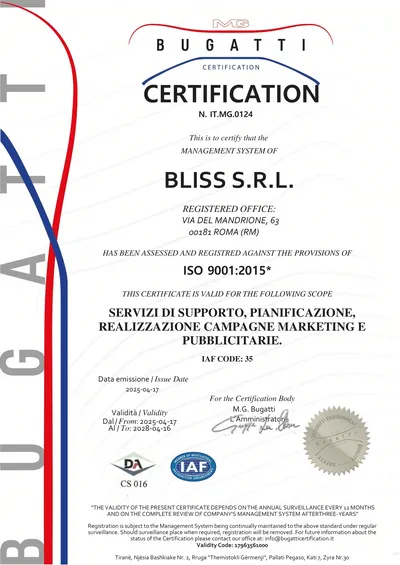
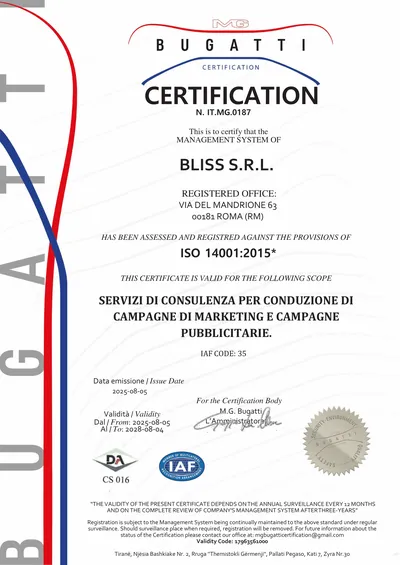
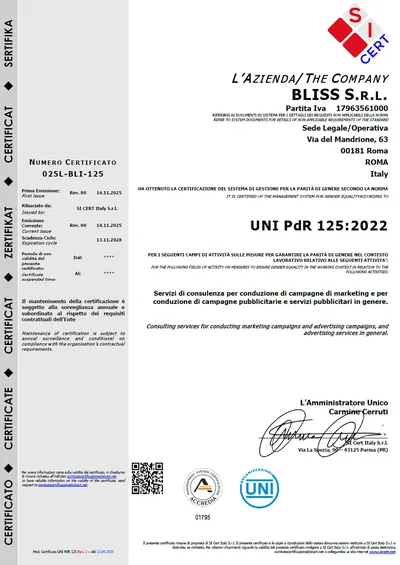
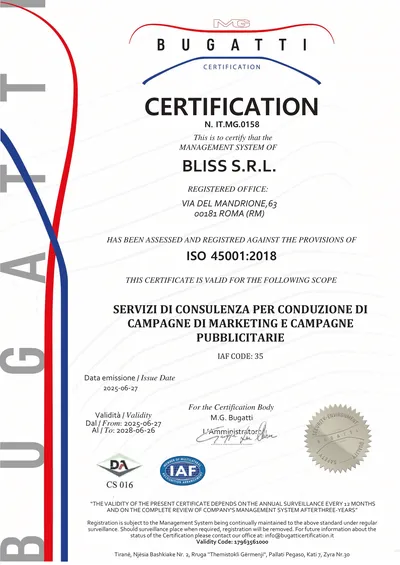
Certified Agency
Certifications
Blog & Trends 2026
SEO TRENDS & NEWS
SEO FAQ
Frequently asked questions on SEO for Shopify
How do you do SEO on Shopify?
SEO on Shopify is built by working within the platform’s structural constraints: managing canonicals on duplicate product-collection URLs, controlling crawl budget on URLs generated by tags and filters, optimising meta titles and descriptions through templates, implementing complete Product and Organization schema markup, and planning collection content editorially to give semantic coverage of target queries.
Shopify does not offer the same flexibility as WordPress or Magento, but within its constraints it is possible to build highly effective SEO — especially if the architecture is designed while the site is being built.
Is Shopify good for SEO?
Shopify is SEO-friendly on the fundamentals: it generates sitemaps automatically, supports custom meta titles and descriptions, produces clean URLs and performs well by default. Structural problems emerge with complex catalogues: duplicate URLs between /products/ and /collections/, tag pages that multiply URLs without organic value, and crawl budget wasted on filter pages.

With the right technical configuration — ideally set up while the site is being built — Shopify makes it possible to build stores with excellent organic visibility.
What is Shopify's main SEO problem?
The most common SEO problem on Shopify is URL duplication: every product can be reached at both /products/handle and /collections/name/products/handle. Shopify adds a canonical pointing to /products/ on the second version, but Google keeps crawling both and wastes crawl budget.
The second critical problem is the proliferation of tag URLs: /collections/name/tag-name for every combination of tags applied to products. A store with 10 collections and 20 tags produces 200 additional URLs to manage.
Are the SEO apps in the Shopify App Store enough?
For small stores with a simple catalogue, Shopify’s SEO apps cover the fundamentals: meta titles, meta descriptions, alt text, sitemap. For stores with large catalogues, faceted navigation and ranking goals on competitive keywords, they are not enough.
Apps do not interpret the store’s semantic architecture, do not manage crawl budget strategically and do not implement advanced structured data. A common problem: running several apps at once produces conflicting output — duplicate canonicals, overlapping schema. Bliss uses apps as an execution tool on top of a manually defined strategy.
When is the right time to optimise SEO for a Shopify site?
The optimal moment is during site development, not after launch. An SEO architecture built from the outset — collection structure, strategic URL handles, correct canonicals, schema markup implemented from day one — is far more effective than SEO applied as a fix to an existing structure.
URL handles on Shopify are permanent: changing them after launch creates redirects that dilute accumulated authority. Bliss works with brands launching on Shopify before the site even goes live, to build the organic foundation correctly.
How do you manage crawl budget on Shopify?
Crawl budget on Shopify is managed through: configuring directives in robots.txt (Shopify allows customisation via Liquid templates), managing tags to avoid the proliferation of /collections/name/tag-name URLs, configuring canonicals on pagination URLs (?page=2), and excluding internal search pages.
In large catalogues this is often the intervention with the greatest immediate impact on organic traffic: Google stops wasting resources on URLs with no value and crawls strategic pages more frequently.
Does Shopify support structured data (schema markup)?
Shopify includes basic schema markup in its standard themes (Product, Organization, BreadcrumbList), but the implementation is often incomplete: Product schema without a complete Offer field, without AggregateRating, without a correct availability field.
Bliss implements structured data manually through Liquid templates or specialised apps, checking correct validation in Google Rich Results Test. Correct structured data triggers rich snippets in the SERPs and makes the site more readable for generative AI systems.
What are the SEO differences between Shopify and WooCommerce?
Shopify imposes structural constraints that WooCommerce does not: the URL structure is fixed (/products/ and /collections/), robots.txt is only partly controllable, and variants do not have separate URLs. In return, Shopify offers better default performance, managed hosting and fewer technical risks from conflicting plugins.
WooCommerce offers more technical flexibility but more management responsibility. SEO on both platforms is possible and effective — it requires different approaches. The choice between them should be driven by operational considerations, not SEO ones.