


seo audit
Before acting,
you need to understand
what isn't working.
The Bliss SEO audit is the diagnosis that precedes any organic intervention: a structured analysis across three dimensions (technical, semantic, external authority) that produces a precise output. The priority matrix. A ready-to-use operational plan.




Definition
What is an SEO Audit?
An SEO audit is a complete analysis of a website that identifies the issues preventing its pages from appearing among Google’s top results.
When a company does not appear among the top results, the reason is almost never a single one. It may be a technical problem in the way the site is built. It may be that the pages talk about the wrong topics, or talk about the same topic in different ways, confusing search engines. It may be that other sites do not link to your domain, or that they do so in a way that harms rather than helps.
An SEO audit lets you understand exactly what is not working before touching anything. It is what a doctor would call a diagnosis: the site’s real data is gathered, how Google reads and interprets it is measured, and problems are identified in order of severity. Only then do we act.
Without this analysis, any SEO intervention risks treating the wrong symptoms. Pages that are not the decisive ones get optimised. Content gets produced on topics already poorly covered elsewhere. Money goes into activities that produce no results because the real problem lies upstream. The SEO audit removes this variable: at the end of the process, you know precisely where to act and why.
THE TEAM
Our voices
leading the way
Bliss’s SEO is managed by a team with experience of organisations with complex sales cycles in tech, manufacturing and professional services: sectors where the buyer is a decision maker with structured evaluation processes and long purchasing timelines.

Andrea Maso
HEAD OF SEO
International background, a data-driven mind and no intention of slowing down.

Mario Antonini
chief design officer (cdo)


Luca Maletta
Head of Copywriting

Sajjad Mazaherizaveh
Full stack developer
Combines front-end and back-end development with technical SEO and AI Search Optimisation.
The problem
A site you do not understand
cannot be improved
66%
of web pages with a significant organic presence have at least one critical technical issue that in-house teams have not detected.
The figure does not concern abandoned or poorly built sites. It concerns active, well-maintained sites with ongoing SEO investment. The reason is structural: technical SEO problems emerge slowly, building up in layers that no single intervention is designed to see in their entirety. Anyone optimising content on a structure with internal cannibalisation is optimising the wrong pages, and making things worse. Anyone building links to a domain with crawl budget problems accumulates external authority that does not flow to the pages that matter. Anyone writing better meta titles on pages with incorrect canonicals will not move rankings an inch.
A proper SEO analysis of the site is the condition that determines the effectiveness of everything else. It is the difference between addressing causes and addressing symptoms. The SEO audit is therefore the prerequisite for any organic work intended to produce real results.
Anyone optimising content on a structure with internal cannibalisation is optimising the wrong pages. Anyone building links to a domain with technical problems accumulates external authority that does not flow where it should.And so each intervention treats a symptom, while the cause remains untouched.
43%
of Google ranking drops have technical causes that a structured audit can identify, which do not depend on content quality or on the backlink profile.
The Process
How a Bliss SEO audit works:
the four phases
Every SEO audit is always different. The sequence and weighting of the analyses change, in fact, according to the type of domain, the platform and the objectives. What does not change is the principle: first understand the real state, then act.
Data collection and access
Before even looking at the site, you need the real data.
The audit starts with access to the domain’s real measurement tools: Google Search Console (Google’s official data on impressions, clicks, queries and index coverage), Google Analytics or GA4 (user behaviour, landing pages, organic traffic by URL) and, where relevant, server access logs to analyse Googlebot’s crawl. Without this data, the analysis relies solely on third-party signals, useful but partial. The audit begins when the real data is available.
Technical scan and crawl analysis
How Google crawls the site. Where it stops. Why.
A complete technical crawl of the domain with Screaming Frog, SEOZoom or equivalent tools produces a map of every URL: indexed pages, blocked pages, 404 errors, redirect chains, orphan pages. Cross-referenced with Google Search Console data, this map reveals the gap between what Google should find and what it actually finds. Crawl budget analysis, how much Googlebot spends on strategic pages vs. URLs with no value, is often the intervention with the greatest immediate impact on rankings.
Semantic and backlink profile analysis
How Google understands the domain. Where authority comes from.
The semantic analysis maps the content structure: which pages cover which queries, where cannibalisation occurs, and how internal link equity flows. Coverage gaps against competitors are identified, along with opportunities to strengthen the internal architecture. In parallel, the backlink profile analysis produces a map of referring domains classified by authority, toxicity and topical relevance, with a list of links to include in the disavow file.
Preparation and delivery of the matrix
Interpretation. Not just the data: the causes and the priorities.
The final phase turns the data collected into operational decisions. For each issue identified, we assess the expected impact on rankings, the technical complexity of resolving it and its dependency on other interventions. The final matrix ranks actions on three levels and includes the technical specification for each intervention. Delivery includes a presentation and walkthrough session with the client’s team to ensure the output can be put to use immediately.
The Process
How a Bliss SEO audit works:
the four phases
An SEO audit is not a standardised, one-size-fits-all process. The sequence and weighting of the analyses change according to the type of domain, the platform and the objectives. What does not change is the principle: first understand the real state of the site, then act.
Data collection and access
Before even looking at the site, you need the real data.
The audit starts with access to the domain’s real measurement tools: Google Search Console (Google’s official data on impressions, clicks, queries and index coverage), Google Analytics or GA4 (user behaviour, landing pages, organic traffic by URL) and, where relevant, server access logs to analyse Googlebot’s crawl. Without this data, the analysis relies solely on third-party signals, useful but partial. The audit begins when the real data is available.
Technical scan and crawl analysis
How Google crawls the site. Where it stops. Why.
A complete technical crawl of the domain with Screaming Frog, SEOZoom or equivalent tools produces a map of every URL: indexed pages, blocked pages, 404 errors, redirect chains, orphan pages. Cross-referenced with Google Search Console data, this map reveals the gap between what Google should find and what it actually finds. Crawl budget analysis, how much Googlebot spends on strategic pages vs. URLs with no value, is often the intervention with the greatest immediate impact on rankings.
Semantic and backlink profile analysis
How Google understands the domain. Where authority comes from.
The semantic analysis maps the content structure: which pages cover which queries, where cannibalisation occurs, and how internal link equity flows. Coverage gaps against competitors are identified, along with opportunities to strengthen the internal architecture. In parallel, the backlink profile analysis produces a map of referring domains classified by authority, toxicity and topical relevance, with a list of links to include in the disavow file.
Preparation and delivery of the matrix
Interpretation. Not just the data: the causes and the priorities.
The final phase turns the data collected into operational decisions. For each issue identified, we assess the expected impact on rankings, the technical complexity of resolving it and its dependency on other interventions. The final matrix ranks actions on three levels and includes the technical specification for each intervention. Delivery includes a presentation and walkthrough session with the client’s team to ensure the output can be put to use immediately.
Tools
SEO audit tools
An SEO audit is not done by eye. Each phase of the analysis uses specific tools that read the site the same way Google reads it, and return measurable data, not impressions. These are the tools we use.
Google Search Console
Official Google Tool
It is the official source of Google data on your site: how often it appears in search results, for which queries, how many pages are indexed and which have problems. It is the only tool that shows how Google actually sees the domain, not how we see it.
Google Analytics 4
User action tracking
Records how users actually behave on the site: where they come from, which pages they visit, where they drop off. Cross-referenced with Search Console, it shows which pages receive organic traffic and which are never found.
Screaming Frog
Crawling and Technical SEO Audit
Crawls the entire site URL by URL, exactly as Googlebot does. Produces a complete map of every technical error: missing pages, misconfigured redirects, duplicate content, indexing issues. It is the benchmark tool for technical analysis.
SEOZoom
Positioning analysis and keyword research
Enables analysis of the keywords the site ranks for, identification of cannibalising pages and comparison of performance against direct competitors. It is the main tool for semantic analysis of the domain.
Ahrefs
Backlink profile analysis
Maps the domain's backlink profile: how many external sites link to yours, with what authority and with what thematic consistency. It identifies the links that damage rankings and those that support them.
Internal Tools
Proprietary Tool Suite
A suite of in-house tools developed to understand how branding, positioning and neuroscience dynamics interact.
SEO audit dimensions
Three dimensions of analysis.
One diagnosis.
Automated tools can identify measurable technical issues, but they cannot interpret them. They do not read the domain's semantic structure, nor do they distinguish between issues that affect rankings and issues that appear in reports with no real effect. The Bliss SEO audit uses these tools as a starting point. Interpreting their output is the real work.
Technical analysis
The site’s infrastructure: every element is measured against Google’s quality signals and the specific structure of the domain under analysis.
- Crawl budget and indexing coverage
- URL structure and canonicals
- Core Web Vitals (LCP, INP, CLS)
- Schema.org structured data
- robots.txt, sitemap, redirects
- H1 tags, meta titles, ALT attributes
- External links (security and SEO)
Semantic analysis
How Google perceives the domain as a system of entities: where authority is dispersed, where strategic content is missing.
- Cannibalisation between pages
- Content architecture
- Target keyword coverage
- Internal linking and link equity
- Semantic gaps vs. competitors
- Brand entity consistency
- Citability in generative AI systems
External authority
The quality of the backlink profile: who links to the domain, with which anchor text, and with what toxicity and topical relevance.
- Referring domain mapping
- Backlink toxicity analysis
- Anchor text distribution
- Thematic consistency of sources
- Identifying links to disavow
- Authority gap vs. competitors
- Historical evolution of the profile
The output
The priority matrix.
Automated tools can identify measurable technical problems, but they cannot interpret them. They do not read the semantic structure of the domain, nor do they distinguish between problems that affect ranking and problems that appear in reports with no real effect. The Bliss SEO audit uses these tools as a starting point. Their interpretation is the real work.
Output structure
Priority matrix
Level 1
Immediate actions
Technical issues that can be resolved in hours or days and produce measurable effects on rankings within a few weeks. Correcting H1s on strategic pages, disavowing toxic links, fixing misconfigured canonicals. These interventions are carried out first because they unlock organic potential that already exists.
Level 2
Structural actions
Restructuring of the semantic architecture, review of crawl budget management, full implementation of structured data, an editorial plan to close coverage gaps. These require planning and more time, but they build the long-term organic asset.
Level 3
Monitoring and oversight
Issues with low immediate impact, which are included in the ongoing monthly monitoring plan. Newly acquired toxic links, changes in Core Web Vitals, semantic drift in content over time.
Each item in the matrix includes: a description of the issue, the expected impact on rankings, the technical complexity of implementation and an operational specification for the technical team. For clients without an in-house technical team, Bliss handles implementation directly.
The audit includes an analysis of presence in generative AI systems.
The semantic gaps that emerge from the SEO audit are almost always the same ones that limit citability in ChatGPT, Gemini and Perplexity.
Bliss Agency vs traditional SEO agencies
What distinguishes a technical SEO audit from
an assessment of organic potential
An effective SEO audit does not stop at detecting technical errors. It must show how ready the site really is to compete, which organic opportunities are being left uncovered and which actions can generate the greatest business impact.
| Criterion | Traditional SEO audit | Bliss Agency |
|---|---|---|
| Objective | Identify technical errors, slow pages, missing meta tags and basic issues. | Understand how far the site is truly able to generate authority, qualified traffic and commercial opportunities. |
| Technical analysis | Limited to crawling, status codes, performance and URL structure. | We analyse architecture, indexing, performance, UX, content, entities, internal linking and the scalability of the project. |
| Content analysis | Checks titles, H1s and the presence of the main keywords. | We assess semantic depth, editorial consistency, brand positioning and coverage of search intent. |
| Competitors | Comparison based on a handful of keywords. | Comprehensive benchmark of competitors' visibility, structure, content, authority, AI Search and organic assets. |
| Output | A technical document that is hard for management to interpret. | Priority roadmap with impact, urgency, operational effort and concrete actions to implement. |
| Value | Takes a snapshot of the site's errors. | Shows where to act to turn SEO into a growth lever. |
OUR SEO RESULTS
Success stories
These results show what happens when SEO, content and AI Search are turned into a genuine growth engine. Leads, sales, qualified traffic and revenue growth: every case study presents concrete data, verifiable results and performance built to generate real business.
Valle D'Aosta
Bliss supported the Aostæ 2025 project in building an institutional digital ecosystem designed to enhance the region, its events and public communication.
Partner




























Certified Agency
Certifications

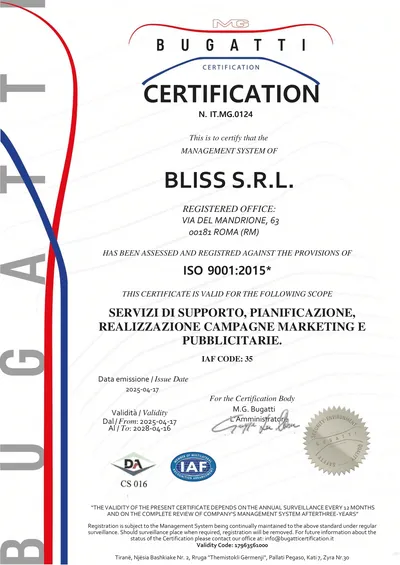
ISO 9001 – Process quality and work organisation.

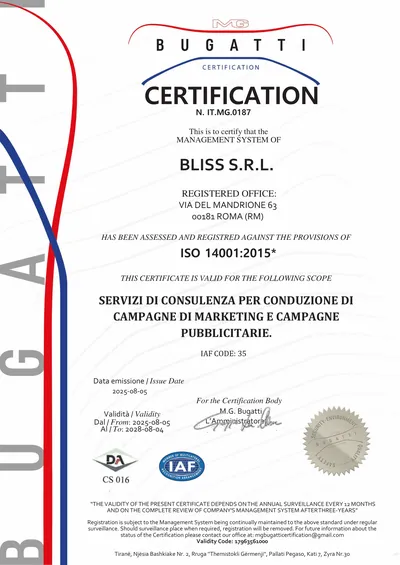
ISO 14001:2015 – Managing the environmental impact of business activities.

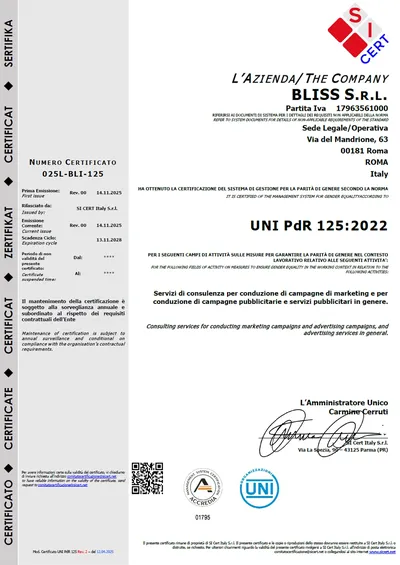
UNI PDR 125:2022 – Gender equality in processes, policies and organisation

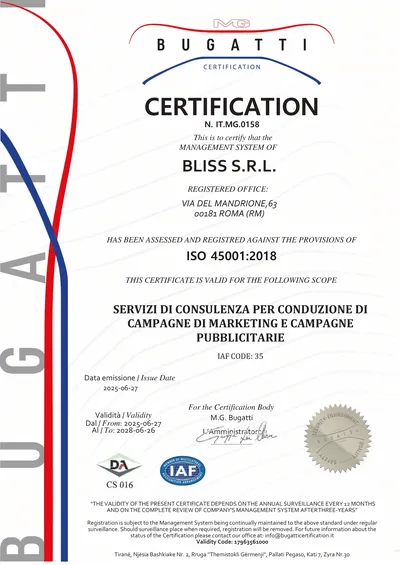
ISO 45001:2018 – Occupational health and safety.

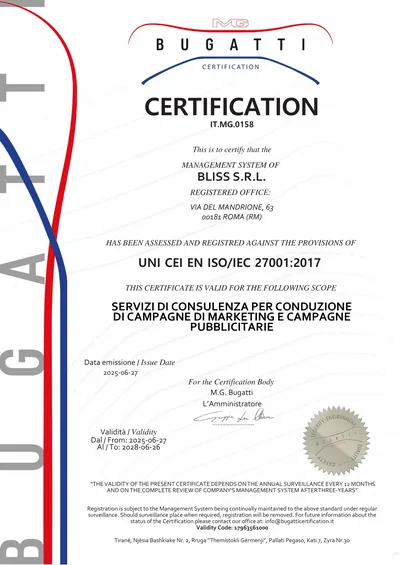
ISO/IEC 27001:2022 – Information, data and access security.
Blog & Trends 2026
SEO TRENDS & NEWS
In this space we share our know-how without filters. We explore how Cognitive Bias affects conversions, how Artificial Intelligence is rewriting the rules of SEO (AIO), and how Design manipulates value perception.


SEO FAQ
Frequently asked questions about SEO audits
What is an SEO audit?
An SEO audit is a structured analysis of a website’s organic performance across three dimensions: technical (crawl budget, canonicals, Core Web Vitals, structured data), semantic (content architecture, cannibalisation, coverage of target keywords) and external authority (backlink profile, toxic links, anchor text distribution).
The output is a priority matrix that ranks actions by expected impact on positioning — not a list of problems, but an operational plan ready for use.
How long does an SEO audit take?
Duration depends on the size of the domain. For sites of between 100 and 1,000 pages, the analysis takes two to three weeks. For e-commerce sites with thousands of SKUs or enterprise sites, the process can extend to four to six weeks.
Bliss delivers a complete operational document: for each issue identified, it specifies the priority, the expected impact and the technical implementation specification.
What is the difference between an SEO audit and analysis with automated tools?
Automated tools (Screaming Frog, Semrush, Ahrefs, SEOZoom) identify measurable technical issues. They do not interpret the semantic structure of the domain, they do not read how internal authority is distributed in relation to the content architecture, and they do not distinguish between issues that affect ranking and issues that appear in reports but have no real effect.
Bliss’s SEO audit uses the same tools as a starting point: the analysis is the next layer, the strategic interpretation of the data and the construction of the priority matrix.
Is an SEO audit necessary even for those who have already done SEO in the past?
Especially in that case. SEO work layered up over time often produces inconsistent structures: redundant content, duplicate URLs, poorly distributed link equity. An agency that optimises on top of a previous layer without diagnosing the real state of the site risks amplifying problems rather than solving them.
The audit maps the real state of the domain, regardless of how much has been invested previously and how many agencies have worked on it before.
Does an SEO audit also include analysis of presence in generative AI systems?
Yes. The Bliss SEO audit includes an analysis of the domain’s semantic structure in relation to generative AI systems (Google AI Overview, ChatGPT, Perplexity, Gemini). Gaps in the brand’s identity as an entity — missing structured data, contradictory signals across sources — affect both classic organic rankings and citability in generative answers.
The two levels are analysed together because the semantic gaps that emerge are almost always the same, expressed through different logics.
How does an SEO audit differ from ongoing SEO consultancy?
The SEO audit is a diagnostic product: a structured analysis with a defined output — the priority matrix. It is a fixed-term engagement, with a start and an end. Ongoing SEO consultancy is sustained oversight over time: executing the actions identified in the audit, monthly monitoring, adapting to the strategy.
The audit is the mandatory prerequisite for consultancy. You cannot govern what you do not know.
After the SEO audit, does Bliss also handle implementation?
Yes. Every recommendation in the priority matrix includes the technical implementation specification. For clients with an in-house technical team, the audit is a self-contained operational document. For clients without a technical team, Bliss manages implementation directly — in most cases within the ongoing SEO consultancy contract that follows the audit phase.
Is there a free or online SEO audit?
There are free online SEO check tools (SEOptimer, the Screaming Frog free tier, the free version of SEOZoom) that produce a surface-level technical analysis — useful for a first snapshot of the domain. They do not replace a structured audit because they do not interpret the data, do not analyse the semantic dimension and do not read external authority in depth.
Bliss offers a free preliminary assessment of the domain before any formal audit proposal. It is the way to understand whether the work makes sense and to estimate the complexity of the analysis.
Stop chasing. Position yourself.
Request a consultation and find out how to increase qualified traffic.