



Brand Strategy
Decide who you want to be
before others decide for you:
this is Brand Strategy
Without a clear direction, no company chooses its positioning.
At best, it has it imposed upon it, ending up following passing trends and the opinions of whoever devises the strategy of the month.
Behind every brand there are decisions. And behind every decision, a perspective.
Bliss translates the data gathered in the Audit into values, criteria and principles, to achieve every objective, and there are those who keep doing so with an indestructible brand strategy.
DISCOVER ADVISORY
Brand advisory
Brand audit
Brand strategy
Marketing advisory
Brand advisory
Brand audit
Brand strategy
Marketing advisory
Brand advisory
Brand audit
Brand strategy
Marketing advisory
Brand advisory
Brand audit
Brand strategy
Marketing advisory
Brand advisory
Brand audit
Brand strategy
Marketing advisory
Brand advisory
Brand audit
Brand strategy
Marketing advisory
Brand advisory
Brand audit
Brand strategy
Marketing advisory
Brand advisory
Brand audit
Brand strategy
Marketing advisory
Brand advisory
Brand audit
Brand strategy
Marketing advisory
Brand advisory
Brand audit
Brand strategy
Marketing advisory


TABLE OF CONTENTS
Blissionary
Brand Strategy: Meaning
/brænd ‘strætədʒi/
n. A process that defines a brand’s strategic direction, starting from the Audit data to establish positioning, non-negotiable values and decision-making criteria that hold over time.
The problem we solved
Although many companies know who they are, they do not have that identity written down anywhere.
This is why every channel speaks its own language, agencies interpret the brand in their own way and long-term goals become difficult to reach.
Where it all began
An Audit may tell you where you are losing value, but analysis alone is not enough.
We have seen it often. That is why we created a process to turn diagnosis into decision.
And in doing so, make the brand an asset that is measurable, documented and of greater value.
Our thinking
Creativity without criteria loses its way.
And since brands live in people’s minds more than in logos and individual campaigns, consistency is everything.
To grow and expand, a company must first establish who it is, how it speaks and how it will reach the goals it has set itself. Only then can there be growth and a future.
Audiences for brand reputation
It is designed for those who need to decide who to be. Before launching a campaign, entering a new market or changing agency, knowing which principles stay fixed is essential.
For those who have just completed an Audit
You have a snapshot of where you stand today. Now you need direction. Without targeted planning, the data remain a list of problems with no solution: the diagnosis is perfect. Now you need the cure.
For the brand growing faster than its own coherence
New markets, new agencies, new people: each reinterprets the brand in their own way. If you do not set the criteria now, this growth will be the reason people stop recognising you.
For those about to face a transition that leaves no room for error
Sale, acquisition, generational handover, new market. In these contexts, improvisation is costly. Brand Strategy provides direction before discontinuity creates chaos.
For those with a strategy nobody consults
A document written a year ago, locked away in a drive nobody opens, is of no use. Bliss’s Brand Strategy is designed to function as a genuine operating system.
Our Method for Brand Development
Strategy always starts from the Audit.
Without the diagnosis, direction is a hypothesis.
Audit Analysis
Weeks 1–2- In-depth reading of the diagnostic data
- Identification of strategic priorities
- Defining positioning objectives
Building the Brand Platform
Weeks 3–5- Positioning, values, brand architecture, competitive perimeter
- Working sessions with senior leadership
Criteria and Tone of Voice
Weeks 6–7- Operational decision-making criteria
- Tone of Voice with examples by channel
- Vocabulary inside and out
Roadmap and delivery
Week 8- Implementation plan with priorities, timelines and responsibilities
- Presentation of the complete system
- Handoff to Governance and Operations
Brand Platform
It sets down in writing who you are, what you will never do, and what space you occupy in people’s minds.
It includes:
- Positioning against the competition
- Non-negotiable values
- Competitive landscape
- Promise to the audience
Decision-Making Scope
It tells you, when faced with any proposal, whether it falls within your scope or should be rejected.
It includes:
- Boundaries of the strategic intervention
- Acceptance/rejection criteria
- Alignment with long-term objectives
Decision Criteria
It enables anyone on the team to decide without having to ask permission every time.
It includes:
- Everyday operating principles
- Guidelines every team member can apply
- Non-negotiable standards
Tone of Voice
It ensures whoever is writing always finds the right answer, without having to interpret.
It includes:
- Brand register and personality
- Practical examples by channel
- Internal and external vocabulary
Implementation roadmap
It turns strategy into concrete action, with clarity on who does what and when.
It includes:
- Intervention priorities
- Timelines and responsibilities
- Handoff to Governance and Operations
Update Cycles
It allows the system to evolve over time, without overturning its underlying direction.
It includes:
- Periodic review of criteria
- Adapting to new goals
- Calibration against milestones achieved
Your brand's future,
set down on paper
Brand building produces a strategic document that serves as the brand’s operating system. Designed to be used every day and updated in line with objectives.
Why build a Brand Identity
When there is no strategic perspective at all, every decision is negotiated from scratch; every campaign ends up interpreting the brand in its own way, and every change of agency brings a reinterpretation. The result is that the brand changes shape and trust declines.
| Without a corporate vision | With a corporate vision |
|---|---|
| Every decision is negotiated from scratch, with no shared reference point. | Every future decision has a reference criterion. |
| The brand depends on the presence of whoever leads it and cannot be transferred. | The brand is transferable and works without the constant presence of the founder or management. |
| Growth erodes identity: new markets, agencies and channels reinterpret it. | Growth does not erode identity: new markets, new agencies and new channels are approached with clear criteria. |
| Governance and Operations work without shared foundations. | Governance and Operations work on solid foundations: Governance knows what to oversee, Operations knows what to produce. |
| The brand is neither documented nor assessable as an asset. | The brand becomes a documented, measurable asset, and this increases its value. |
The Results Achieved for Our Clients
The brands that grasped the importance of strategy have built something more solid than a simple identity. Together with us, they have created a system.

Charles Philip Milano
Social · SEO · E-Commerce · Google Shopping
The intervention plan, tailored to Charles Philip Milano, revived a brand whose digital presence was lacking despite its prominent offline positioning. Since then, in six months, CPM has gained 4,023 followers, reached 209,400 accounts and earned a mention in L’Officiel Homme. At Pitti Uomo 106, Charles Philip could finally boast the identity a brand of its calibre deserved.


Laura Biagiotti
Further reading: Il Messaggero · Official Press Release · Wondernet Magazine · Life&People
When the pandemic called traditional fashion formats into question, we helped turn a constraint into an opportunity. At the Ara Pacis in Rome, the presentation of the AW 21/22 collection brought together fashion, art and cultural heritage, generating media attention and strengthening the bond between the Maison and the city of Rome at such a delicate moment.

Doreca
Brand Strategy · Paid Media · Content · Social · Advisory
Data verified by Reportaziende.it
Doreca was managing a dual audience: the Ho.Re.Ca. professionals it supplied as a distributor, and the end consumers it served in its own stores. The corporate strategy built a digital presence able to speak to both without inconsistency. Two different registers, one single system. The physical expansion was built on that structure, with five new centres opened in nine months.


Risivi & Co
Advisory · Governance · Operations · Content · Performance · PR
Data verified by Reportaziende.it
While the Audit of Risivi had revealed significant cultural capital, a structure capable of ensuring scalability was missing. Through a targeted operation, we therefore defined the positioning, the criteria for collaborations with artists and the brand’s identity perimeter. Those rules contributed to an increase in turnover from 206,000 to 556,850 euros in twelve months.

Profumum Roma
Performance Ads · Meta + Google · E-commerce · Branding · Governance
The Durante family’s goal was to scale digital channels across six international markets without compromising their premium positioning. To achieve this, we defined what could be adapted to local markets and what must never be touched. That distinction governed every campaign and every communication choice for the following eighteen months. And so Profumum’s positioning held firm throughout its growth.

The Bliss Case: Luck? We prefer
to call it strategy
Before building any strategic plan for our partners, we defined our own, working through every detail of positioning, criteria, scope and voice. That system, put in place a year ago, still governs every text, campaign and decision we produce.
The result is a recognisable presence that La Repubblica, Milano Finanza and Engage have chosen to cover. Because a brand with a clear direction gets followed. One without loses its way.













The team that sets the brand's direction
We work alongside national and international brands, in sectors where strategic direction is essential to creating value over time.
Every project has a dedicated senior lead, from the Audit through to delivery of the complete system.

Francesco Acri
CEO & Founder
Founded Bliss and leads its direction today.
At board level, works alongside CEOs and Boards of Directors on strategic decisions, overseeing their implementation.

Ginevra De Filippis
Chief Operating Officer (COO)
The company’s metronome: coordinates its operations, manages partner relationships and improves internal processes, ensuring continuity across projects.

Mario Antonini
Chief Design Officer (CDO)
Interprets the Bliss vision and leads its visual expression. As CDO, coordinates identity, web architecture and VFX, giving ideas concrete form.

Andrea Maso
Head of SEO
Head of SEO at Bliss, analyses the data that steers digital decisions. Supports clients from planning through to the optimisation of organic visibility.

Gianluca Sabbini
Head of Video Production
Head of Video Production at Bliss, leads the audiovisual department and directs video production for advertising campaigns.
Start here
Your brand can exist with or without a strategy. But only in one of the two cases will it go far.
Tell us about your organisation. Every fee proposal will start from a clear mandate, defined together in a working session.
The Comparison: The difference between a strategy
that gets filed away and one that gets used
The market is full of brand positioning documents. Most, however, are never opened again after the presentation. Is management to blame, or whoever wrote a marketing strategy that was never really designed to be used?
| Criterion | Standard approach | Bliss |
|---|---|---|
| Starting point | The client's brief. The strategy is built on what the company says it is, not on how the market perceives it. | The Audit data. The strategy starts from documented reality, not from the internal narrative. |
| Output | Brand positioning slides. Aesthetically polished, operationally unusable without the agency in the room. | A Brand Platform with operational decision-making criteria. The team uses it every day without waiting for Bliss. |
| Longevity of value | The document is out of date within six months. No one knows how to update it when the market changes. | The system is designed to last and to be updated. The criteria evolve with the brand. |
| Connection with execution | The strategy is delivered. Implementation is a separate problem. | Explicit handoff to Governance and Operations. The roadmap defines who does what, and in what order. |
| Who can apply it | The agency that produced it. Rarely the in-house team without them. | The internal team, external agencies, new hires. The handover is part of the process. |
4.9/5
207 verified reviews
In the words of those who chose us





Bee Lab
“Professional, dynamic team. They work around the clock and fully embrace the projects they take on, led by a highly skilled and visionary leader!”
5.0
Marco Contigiani
“A simply exceptional communications agency.
From the very first contact you sense professionalism, expertise and close attention to the client’s needs”
5.0
Nicole
“Thanks to Bliss Agency we doubled our quote requests and gained more visibility in our area. They proposed a clear editorial plan that was easy to follow and extremely effective.”
5.0
Anna Rossi
“Not just an agency, but a true partner. With Bliss Agency I felt listened to and understood from the very first meeting. They turned ideas into a concrete project”
5.0
Certified Agency
Certifications

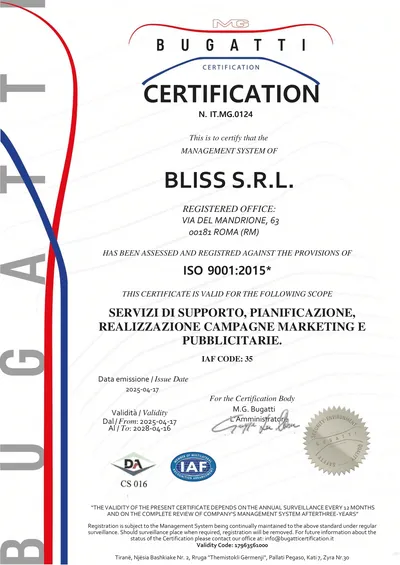
ISO 9001 – Process quality and work organisation.

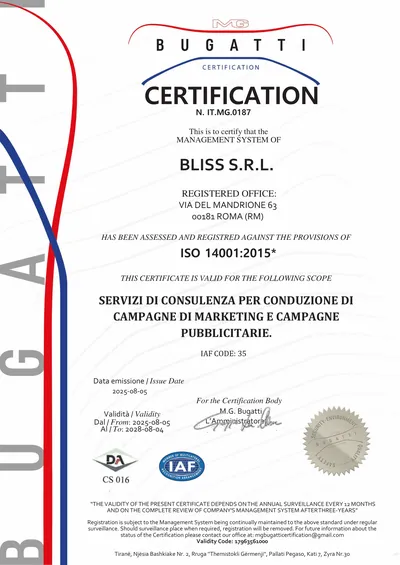
ISO 14001:2015 – Managing the environmental impact of business activities.

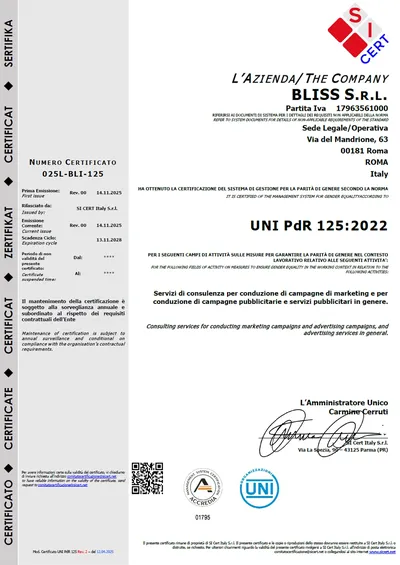
UNI PDR 125:2022 – Gender equality in processes, policies and organisation

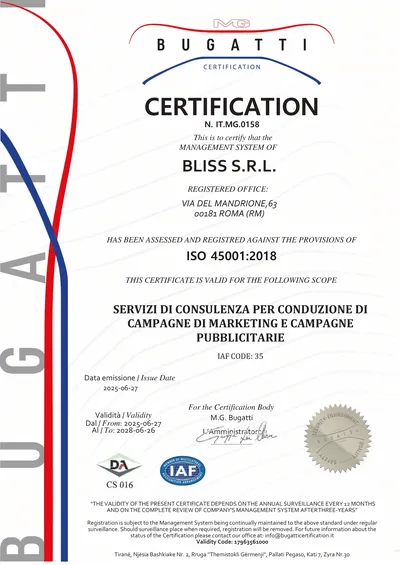
ISO 45001:2018 – Occupational health and safety.

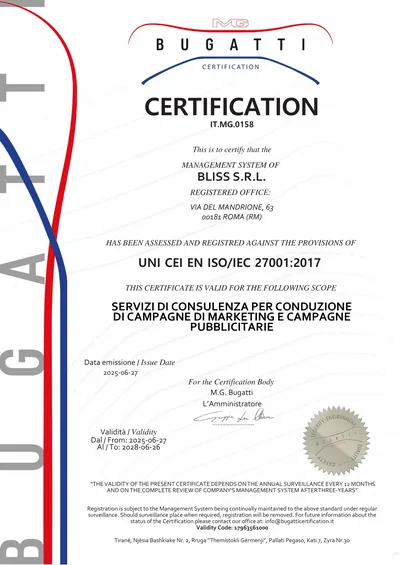
ISO/IEC 27001:2022 – Information, data and access security.
Frequently asked questions about Brand Strategy
1 - What is the difference between brand strategy and brand identity?
Brand identity is how the brand looks: logo, colours, fonts, imagery. Brand Strategy, by contrast, is the structure that governs all of these choices. Strategy comes first, then identity. An identity built without strategy is aesthetics without meaning. An identity built on strategy is a coherent system.
2 - Can we build a brand without having done the Audit?
Technically, yes. But building a direction without knowing where you are starting from means working on assumptions. The Audit replaces assumptions with data. In almost every case, the brand reality that emerges from the Audit differs from what management expected. That difference changes the strategy substantially.
3 - How long does the process take?
Around eight weeks from the start of the analysis to delivery of the complete system. Timing depends on the complexity of the brand and the number of markets. The exact scope is defined during the diagnostic phase.
4 - What happens after delivery?
Completing the audit and the Brand Strategy does not mark the end of the journey, but the move into the Governance phase.
Once positioning, architecture and strategic lines have been defined, Governance takes over coordination of the brand system, setting the scope of intervention, operational responsibilities and the criteria for applying the strategy across the company’s functions.
Through supervision, alignment and monitoring, Governance coordinates operations and checks that actions are consistent with the defined strategic objectives. The process concludes with the delivery of technical and evaluative documentation that measures the results achieved, highlights any deviations and identifies areas for improvement in subsequent cycles of brand development.
5 - Does brand positioning change over time?
The core criteria remain stable. Positioning, values, scope: these do not change with every campaign.
They change when something structural changes in the brand or the market: at that point, repositioning becomes necessary, as Abercrombie & Fitch did.
The roadmap includes explicit review points to update the system without upending its direction.
6 - We already have an agency working with us. Does Bliss's brand identity management integrate with it?
Yes, and it is also a competitive advantage, because it sits upstream of the operational agencies: it defines the criteria they work by. In many cases existing agencies benefit from a system of clear criteria, because it reduces iterations on briefs, speeds up approvals and improves the quality of outputs.
7 - We are a startup with no history. Does it make sense to develop the brand now?
It makes most sense right now. Building the direction before launch means not having to correct it while already in the market. Companies that build their strategy after they have already started communicating end up managing inconsistencies accumulated over time. The earlier the direction is set, the less it costs to maintain.
8 - How do you measure the success of a communications strategy?
Metrics operate on three levels. At decision-making level: less time spent on brand approvals, fewer iterations on briefs. At market level: perceived consistency across channels, positioning relative to competitors. At asset level: how brand value evolves in company valuations.
Metrics are defined before work begins.