
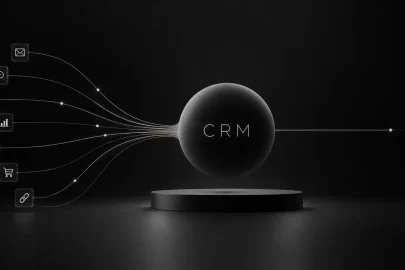
AI-powered custom CRM for businesses A company is worth as much as the relationships it can maintain

We design bespoke CRM platforms for companies that want to turn data, relationships and sales processes into a single operating system. Clearer priorities, fewer manual tasks and decisions grounded in complete information.

  • Honda logo
  • Parmigiano Reggiano logo
  • Profumum Roma logo
  • Doreca logo
  • Regione Valle d'Aosta logo
  • LEMA Mobili logo
  • Coca-Cola HBC logo
  • Paramount Pictures logo
  • Miele logo
  • Würth logo
  • Pandora logo
  • Laura Biagiotti logo
  • Courmayeur Mont Blanc logo
/ 01 The cost of absence

The value of a single system

An ineffective CRM is a silent cost, one that never appears on the balance sheet. It is spread across deals that stall without anyone noticing, information that leaves the company along with its people, and decisions made on figures that are weeks out of date. A system designed around unique requirements delivers value, and that value makes a difference.

21,7%

of Italian companies with ten or more employees use a CRM

56,5%

among large enterprises, compared with 21.1% of SMEs

41,9%

of SMEs use data analysis, compared with 83.6% of large enterprises

Source: Istat, Imprese e ICT, anno 2025, press release of 15 December 2025.

Almost four in five SMEs manage their commercial relationships without a CRM. It is a structural gap, and it is closed by designing the system around the company's processes.

/ 02 Where margin is lost

What disappears when a CRM is implemented well

Scattered data, invisible deals, broken relationships, late numbers. We find these four losses in every audit and in every sector, and they have a single cause: no one is accountable for what the company knows about its customers. A well-designed CRM assigns that responsibility.

[1]

Customer data scattered across departments

Sales in one spreadsheet, marketing in another, customer service on WhatsApp. No one sees the whole customer. Each department decides on a partial version of the same story, and the versions often contradict each other.

[2]

Sales pipeline with no visibility

"How many deals are open right now, and which ones are really worth something?" If answering takes a meeting, the problem is structural. Management is deciding on an out-of-date snapshot.

[3]

Relationships tied to individual salespeople

When a salesperson leaves the company, every relationship leaves with them. Who called, when, with what outcome. And so opportunities quietly die out.

[4]

Slow reporting and decisions on outdated data

The quarterly report arrives once the quarter has closed and can no longer be corrected. A CRM lets you read the numbers as they take shape, while there is still time to act.

/ 03 All in one

Every department. Every channel. One place

Sales, marketing, customer service and administration work on the same data. Website, email, social media, sales network and external platforms feed the same customer record. Management reads a single flow, updated in real time.

Internal departments Sales Marketing Customer service Administration Logistics and operations Management
Contact channels Website Email Social Sales network Sponsorships and events External platforms Phone and WhatsApp

Every filament is a data source. The CRM is where they converge and where management makes its decisions.

/ 04 The decision

Standard, configurable or bespoke

The right type of CRM depends on how far the process departs from the standard, how many integrations are needed, the strategic value of the data and how quickly the organisation changes. Here are the main characteristics.

Hover over a column to isolate it.

Criterion Standard Configurable Bespoke
ProcessLinear, compatible with the softwareExceptions manageable through rulesNon-standard, or a competitive advantage
IntegrationsThe native onesThree or four systemsERP, e-commerce, portals, proprietary systems
DataNon-strategicSignificantCompetitive asset, proprietary logic
LaunchWeeksWeeks or monthsMonths, with phased releases
EvolutionVendor roadmapPartialGoverned by the company
Cost over timePer-user licences that keep risingLicences plus configurationUpfront investment, low marginal cost once running

Independent CRM consultancy determines which of the three routes holds up when investment, adoption time and future autonomy are weighed against each other. The assessment comes before the choice of technology.

/ 05 Stated limits

When a bespoke CRM does not pay off

We say this before we start, even though it is often the part every supplier has an interest in keeping quiet. In three specific situations the useful work is different, and costs less.

Process still being defined

Building around an unstable process means rewriting twice. First you stabilise, then you design.

Insufficient volume

If a configured platform covers ninety per cent of the need, the remaining gap rarely justifies dedicated development.

No internal owner

Without someone accountable for data and adoption, any system decays within a year. It is the most common reason CRMs go unused.

In these cases we map the processes, put the data in order and configure an existing platform. We do it, and we say so before signing.

/ 06 Integrations

The CRM at the centre of the tools the company already uses

ERP, e-commerce, e-mail, calendars, marketing and customer service stay where they are and communicate with the CRM. Every piece of information is entered only once and is available to those entitled to it, in a single shared version.

What changes when systems talk to each other

An enquiry from the website becomes an opportunity with no manual steps. An order's status updates itself. Documents stay linked to the customer. Management reads consolidated data.

Diagram of integrations between the CRM and company systems
  • ERP and administrative management systems
  • E-commerce and sales platforms
  • Marketing automation and email
  • Customer support, ticketing and messaging
  • Business intelligence and management dashboards
/ 07 Artificial intelligence

What changes with AI built into the CRM

A traditional CRM records. An intelligent CRM reads what it records: it sets priorities, flags customers at risk of churn, qualifies incoming enquiries and answers the team's questions in natural language, with no filters or queries.

It shows which deals deserve today's attention

The likelihood of closing is estimated from behaviour, history and digital signals. The sales network stops spreading its attention evenly and concentrates it where the return is highest.

Reminders that go out on their own, at the right moment

Contact sequences follow customer behaviour. The system recognises when to persist, when to wait and when to switch channel.

The customer's entire history, retrievable with a single question

"What did we discuss with Rossi at TechCorp last time?" The system answers by citing emails, notes and documents, in a single search across every archive.

Flags the customer who is about to leave, before they say so

Real-time churn prediction, pipeline anomalies, weak signals a person would notice too late. The system protects recurring revenue.

They are built with Corallo AI and designed around the company's actual processes.

/ 08 Governance and GDPR

Governance, security and data quality

A CRM holds critical commercial and personal information. The design establishes from the outset who can view, edit, export and delete each class of data. Depending on the context, the architecture includes granular roles, strong authentication, encryption, an activity log, backups, retention policies, environment separation and recovery procedures.

Security framework
  • Granular roles
  • Strong authentication
  • Encryption
  • Activity log
  • Backups
  • Retention policies
  • Environment separation
  • Recovery procedures

For AI functions, we define the permitted data, the suppliers involved, the levels of supervision and the accuracy tests. Legal aspects are validated with the company's DPO or adviser. The framework follows the AI Governance principles we have adopted and the standards of our company certifications. The relationship between CRM and privacy obligations is covered in CRM and GDPR.

/ 09 Method

How we design and develop a CRM

The project can be stopped at the end of each phase without losing the work done, and every subsequent step is decided on the basis of a document.

Six phases, one deliverable per phase
  1. Process and data audit

    We listen to managers and users, reconstruct the request and customer journey, and catalogue tools, data, duplications, bottlenecks and manual tasks.

    Map of current processes and points of loss◆duration [Benchmark 04]

  2. Functional and technical design

    We define entities, fields, roles, permissions, pipelines, rules, integrations, indicators, security requirements and release priorities.

    Functional and technical requirements with priorities and acceptance criteria◆duration [Benchmark 05]

  3. UX design and prototype

    We design screens and flows around people's actual tasks. The prototype allows the system to be validated before any code is written.

    Clickable prototype◆duration [Benchmark 06]

  4. Development and integration

    We build the platform or configure the one chosen, develop APIs and automations, and set up the working environments.

    Platform configured or developed, tested and documented◆duration [Benchmark 07]

  5. Migration, testing and go-live

    We cleanse and map the data, run functional and integration tests, check permissions and edge cases, and plan the release.

    Migration plan and data quality control◆duration [Benchmark 08]

  6. Training, adoption and improvement

    We train each role, measure usage and data quality, and maintain an evidence-based development roadmap.

    Role-based materials, KPI dashboard, development roadmap◆duration [Benchmark 09]

/ 10 Measurement

How return is measured

Indicators are defined before development, so that the starting position can always be compared with the steady state, and the return becomes a figure both parties can verify.

Indicators defined during the audit
  • Average deal length
  • Opportunities per salesperson
  • Conversion by stage
  • Average response time
  • Average customer value
  • Renewal rate
  • Hours on manual tasks

Variances identified on completed projects are collected in the CRM benchmark, with methodology and scope stated.

/ 11 Who it is for

Who it is for

Every solution starts from understanding the organisation, even before the technology.

[1]

Companies managing customers with spreadsheets and disconnected tools

A spreadsheet holds up as long as the team is small and memory is individual. As the team grows, every handover becomes a leak of information. You need a system that can handle the increase in volume. When you need a CRM.

[2]

Companies that have a CRM but keep working outside it

The licences are active, but the real work runs through email and shared spreadsheets. The problem almost always lies in the process imposed on top of the platform. Our CRM advisory starts here.

[3]

Organisations expanding their sales network

New salespeople, new markets, a sales process to be rewritten. The CRM is the infrastructure that makes repeatable what today depends on individuals.

[4]

Groups and agent networks

Data spread across different entities, permissions to segment, consolidation to guarantee for management.

The first step

The first step: an audit

Two weeks to deliver the process map, the points where data is lost and a documented assessment of whether to configure or to develop. If the conclusion is that the current system should be optimised, the document says so.

Request a CRM audit

CRM FAQs

A custom CRM is a platform designed around a company's actual processes. It brings together contacts, enquiries, deals, sales activities, documents, communications and customer data in a single environment. Unlike standard software, it does not force the organisation to adapt to predefined functions: the CRM's structure, roles and workflows follow the way the company works. This makes it possible to eliminate manual steps, reduce errors and make information accessible to authorised people. The CRM thus becomes the shared point of reference for sales, marketing, customer service and management. To explore the meaning and functions of a CRM system in more depth, see the dedicated guide. When, instead, you need to understand which functions to develop and which processes to improve, the starting point is CRM consultancy built around the company's specific characteristics.

A standard CRM offers predefined functions and can be adequate when a company has a simple sales process, similar to that of many other organisations. Its main advantage is speed at the outset, but over time limitations may emerge in integrations, automations, permissions, reports or ways of working the platform did not anticipate. A bespoke CRM, by contrast, starts from an analysis of the company's processes. Fields, screens, roles, notifications and automations are designed to support day-to-day work, avoiding unnecessary functions and steps outside the system. The choice depends on the complexity of the process, the number of tools in use and the strategic value of the data. The dedicated guide explains what a CRM is and how it works, while Bliss's CRM consultancy helps determine whether to configure an existing platform or develop a custom solution.

A new CRM becomes necessary when customer information is scattered across spreadsheets, emails, messages, management software and separate archives. Other signs include difficulty knowing the status of deals, repetitive tasks, lost sales enquiries or the need to keep asking individuals for updates. When data is fragmented, management also has an incomplete view: it cannot understand precisely which channels generate opportunities, where sales stall and which customers need attention. CRM consultancy makes it possible to reconstruct the complete lead and customer journey before choosing the technology. If the requirement also includes automations, predictive analytics or intelligent assistance, it is worth considering a CRM integrated with artificial intelligence.

Artificial intelligence makes a CRM more useful because it helps people interpret information, not merely store it. It can summarise emails and meetings, find documents quickly, flag stalled deals, identify customers who need attention and suggest the best moment for a follow-up. The main advantage is the time it gives back to the team. People spend less energy searching for information and entering data manually, and focus instead on relationships, decisions and activities that require experience. An intelligent CRM connects these functions to the organisation's specific data and processes. Bliss also develops solutions through its own ecosystem of artificial intelligence services for businesses and through Corallo AI.

Artificial intelligence does not replace human responsibility. Its role is to reduce repetitive tasks, organise large volumes of information and suggest elements that support decision-making. The final judgement, especially in sales, financial or customer-related processes, must remain with an authorised person. A well-designed system draws a clear line between what AI can automate, what it can suggest and what always requires human validation. This makes work faster without losing control, traceability or understanding of context. The page dedicated to AI Governance covers rules, responsibilities and control criteria in depth. Practical applications, meanwhile, are illustrated in our AI for businesses services and in our intelligent CRM solutions.

Yes. A custom CRM can be connected to ERP, e-commerce, websites, marketing platforms, accounting software, customer service systems, calendars, management software and business intelligence tools. The aim is to avoid the same information having to be entered several times in different systems. Integrations make it possible, for example, to automatically turn an enquiry from the website into a sales opportunity, update the status of an order, link documents to a customer or send data to management dashboards. Before development, it is necessary to check which software has APIs, which data must be synchronised and which system should be treated as the primary source. Bliss's expertise in building websites and web platforms is combined with Operations development and with the design of the company CRM system.

Yes, but the migration must be planned carefully. Transferring data does not simply mean copying it from one system to another. Before the switch, duplicates, incomplete information, fields no longer in use and data lacking a coherent structure need to be identified. A well-managed migration establishes which information to keep, how to organise it in the new CRM and which checks to carry out before going live. It is also advisable to plan a testing period and assign clear responsibilities for validation. This analysis is addressed during the CRM consulting and design phase. Information management must also be consistent with documented procedures and appropriate standards, which can be found on the page dedicated to Bliss certifications.

Data protection must be built in from the design stage. A CRM can include differentiated roles, access permissions, activity logging, authentication, backups and criteria to restrict the visibility of the most sensitive information. Each person should be able to access only the data they need to do their job. This principle reduces the risk of errors, inappropriate sharing and unauthorised use. When the CRM includes features based on artificial intelligence, it is also necessary to establish which data may be used, which operations require approval and how to verify the responses the system produces. Bliss addresses these aspects through an artificial intelligence governance model. The standards relating to quality, processes and information security are available in the Bliss Certifications section.

Timescales depend on the number of features, users, integrations and data to be transferred. A project can be organised in progressive releases: a first version covers the essential activities, while further features are introduced on the basis of actual use and business priorities. The process normally includes process analysis, requirements definition, experience design, development, integrations, migration, testing and training. Setting a date without first analysing these elements would produce an unreliable estimate. CRM consulting also serves to build a roadmap with verifiable priorities and timescales. To present your business context and receive an initial assessment, you can use the Bliss Contacts page or explore the method further through the case studies produced by the agency.

The cost of a custom CRM depends on the complexity of the system, not just the number of screens. Integrations, access levels, automations, the volume of data to be migrated, AI features and the support required after release all play a part. To build a sustainable investment, it helps to distinguish between essential features, evolutionary features and activities that can be introduced at a later stage. This makes it possible to develop first what delivers tangible impact and to avoid an oversized project. Preliminary CRM consulting makes it possible to define requirements, priorities and roadmap before drawing up the quote. The expertise needed to design interfaces, integrations and platforms is also presented in the section dedicated to building professional web systems. To request an assessment, please use the Contacts page.

The return on a CRM is measured by comparing the starting position with the results achieved after adoption. Indicators may include average response time, number of opportunities managed, conversion rate, length of the sales cycle, average customer value, renewals, lost enquiries and hours spent on manual tasks. Metrics must be defined before development. This way, the CRM does not merely collect data, but shows whether the sales process and customer service are genuinely improving. The guide on how a CRM works examines the platform's role in relationship management. The Bliss case studies, meanwhile, show how strategy, technology and measurement can come together in real projects. When AI features are introduced, their contribution must also be assessed through an AI Governance system.

Bliss approaches CRM as an organisational project before it is a technological one. The work starts from the company's processes, responsibilities and objectives; only then are the platform, interface, integrations and automations defined. This approach brings strategy, UX design, development, data and artificial intelligence together within the same project. The aim is to build a tool that people actually use and that can evolve alongside the organisation. The team's expertise and structure are presented on the About us page, while completed projects are collected in Bliss case studies. You can also read client reviews and the standards set out in the Certifications section.

Contact