

SEO for luxury brands
A brand that doesn't appear doesn't exist.
Not even in luxury.
Premium buyers do not search Google like standard consumers. They do not compare prices, read aggregated reviews or click on the top results for generic categories. They look for confirmation, depth, stories.
SEO for luxury brands follows this logic: own the semantics of value, not volume. Build the authority a premium brand deserves in organic search and in generative AI systems.
SEO for Luxury Brands
"In luxury, SEO is not about driving traffic. It is about owning the moment the client decides. That moment happens online, before any contact with the brand. Those who are absent at that stage are not considered, not even by clients who could afford anything."
Andrea Maso | Head of SEO, Bliss
IN THE PRESS











The problem
The wrong logic,
applied to the wrong context
Most SEO agencies apply the same logic to luxury as to the consumer market: search volume, keyword density, click-through rate. Nothing could be more wrong. The queries that matter for a premium brand have low volumes and very high purchase intent. A volume-driven SEO approach systematically ignores them, focusing on keywords that attract an audience that was never the brand’s real target. The result is traffic, not clients. Sessions that inflate vanity metrics but generate no value. SEO for luxury brands requires a paradigm shift. It is not about competing for category keywords with marketplaces and price comparison sites. It is about owning the semantic territory that defines the brand: heritage, craftsmanship, exclusivity, experience. These are the queries that reach the premium client at the moment they are validating a choice that is almost made.
A luxury brand that does not control its organic narrative is delegating it to its retailers, marketplaces and bloggers. And in the premium segment, that is a strategic error even before it is a technical one.
72%
85%
3.4×
the method
The semantics of value
Rejecting category volume, Bliss holds the luxury segment with SEO built to strike with precision. We do not optimise for generic keywords that bring irrelevant traffic. We build the semantic profile that search engines and AI systems must associate with the brand.
Semantic brand mapping
The starting point is a positioning analysis that few agencies carry out: which concepts does Google associate with the brand today? Which should it associate with it? Where are the gaps between real identity and algorithmic perception? This map shapes the page architecture and the content strategy. Positioning analysis for a fashion or luxury website always starts here.
Content that builds associations
Heritage, creative process, raw materials, craftsmanship. The aim is not to attract generic traffic but to build the associations that search engines and AI systems use to define the brand's semantic profile. A luxury brand that does not appear in its sector's heritage queries is not perceived as luxury by the algorithms. Regardless of how it presents itself elsewhere.
Editorial authority in the segment
Link building in luxury follows the same logic as brand positioning in the real world: quality associations are what count. Trade publications, leading magazines, outlets that AI systems and Google recognise as authoritative sources in the premium segment. Pure quality and thematic consistency, no artificial volume.
Technical SEO for the premium experience
A luxury website must work like the brand's boutique: flawlessly. Core Web Vitals, loading speed, high-resolution image rendering, mobile architecture. In luxury, technical SEO is not just a ranking factor: it is part of the brand experience. A slow or poorly structured site sends the opposite message to the one the brand wants to convey.
Presence in generative AI systems
Premium buyers increasingly use ChatGPT and Perplexity to validate choices they have almost made. A luxury brand that does not appear, or is described inconsistently, loses credibility at the decisive moment. Bliss treats organic presence and citability in AI systems as one system integrated with traditional SEO.
Fashion SEO
Fashion, accessories
and premium lifestyle
Fashion SEO operates in a context where seasonality, the collection cycle and competition with marketplaces define positioning dynamics. A fashion brand cannot compete with Farfetch or Net-a-Porter on generic product keywords. It can, however, dominate its own semantic territory: the brand narrative, collaborations, the creative process, its stylistic identity.
Fashion SEO works on three levels. The first is ownership of brand queries: searches that include the brand name must return the official website, not a retailer. The second is building topical authority in the brand’s specific vertical: if a label is known for knitwear, it must appear as the reference for every query on high-end knitwear. The third is catalogue optimisation for the long-tail queries that capture the premium client’s real purchase intent.
A fashion SEO expert knows that value is measured not in sessions but in semantic positioning. The question is not “how many visits does this page generate” but “when someone searches for my brand, what do they find?”
SEO and branding are the same system.
Discover how Bliss integrates organic positioning and brand strategy for the premium segment.

Premium verticals
Jewellery, hospitality and other luxury segments

SEO for luxury jewellery
High-end jewellery adds its own specific features to luxury SEO: the weight of certifications and materials, the investment component, the seasonality tied to occasions and life moments. The queries that matter are not “gold ring” but “GIA-certified solitaire ring” or “high-end artisan jewellery”. SEO for luxury jewellery requires a keyword map that integrates these specific verticals with the brand narrative.
Premium hospitality and dining
A boutique hotel or a Michelin-starred restaurant competes on a different level from mass-market hospitality. SEO in the premium hospitality segment works on the experience even before the booking: the story of the place, the chef’s philosophy, the hospitality concept. The premium guest chooses first with the head and the heart, then books. SEO must capture that phase.
Design, furniture and lifestyle
Design brands, high-end furniture, premium lifestyle: sectors where the narrative and cultural component is an integral part of the product. SEO in these verticals builds the context that justifies the price positioning and sets it apart from the commodity. It is not about being found for “luxury sofa” but for “contemporary Italian design” or “high-end textile craftsmanship”.
International markets
International SEO for luxury brands
A luxury brand with international distribution cannot simply translate its SEO strategy from one market to another. The semantics of luxury change radically between cultures: what conveys heritage and exclusivity in Italy does not necessarily work in Japan, the Emirates or the United States. International luxury SEO requires market-specific keyword research, a flawless hreflang technical structure, and an editorial strategy that adapts the brand’s concepts to the cultural expectations of each audience. Made in Italy, for example, is a powerful lever in the Asian and US markets: but only if it is conveyed with the right keywords and in the right semantic context.
Bliss manages international luxury SEO market by market: each language and each territory has its own strategy, governed by an architecture that preserves brand consistency. A system that scales without fragmenting identity.
SEO + GEO
Organic visibility and artificial intelligence
Search engines are no longer just Google. ChatGPT, Perplexity, Google AI Overview, Copilot: the premium client’s informational demand is fragmenting across platforms that aggregate, synthesise and rework web content. For a luxury brand, this means SEO alone is no longer enough.
Generative Engine Optimization works on content structure to make it understandable, citable and attributable by AI systems. Schema markup, structured data, semantic consistency, editorial depth: these are the same principles as good luxury SEO, taken to a higher level of precision. A brand that invests in integrated SEO and GEO today builds a visibility asset that works on every front.
The stakes are high: when a prospective client asks ChatGPT “what is the best Italian artisan jewellery brand?”, the answer depends on the semantic structure the brand has built on the web. Brands that have not built it do not appear. Brands that have built it poorly appear with the wrong profile.
Bliss governs SEO and GEO as a single system for premium brands
Case study
PROFVMVM ROMA — Technical SEO realignment
Artistic perfumery · Rome · January 2026
PROFVMVM ROMA is an Italian house of artistic perfumery. In January 2026 Bliss began a structured technical realignment of the website: infrastructure work not immediately visible to users, but essential to improving semantic consistency, indexing quality, crawl budget management and overall technical robustness.
January was a month of technical set-up and optimisation — laying the groundwork for the strategic activities to follow. The same logic that governs every luxury SEO project: structure first, then positioning.
130
H1 pages normalised (out of 145 URLs audited)
1500
alternative text for product images
6000
external links optimised with security attributes
01.
H1 tag optimisation
Full page audit: 145 URLs had missing or incorrectly configured H1 tags. 130 strategic pages were corrected and normalised. Areas irrelevant to SEO (Privacy Policy, Terms and Conditions, Account Area) were deliberately excluded, so as not to waste crawl budget on pages with no organic value.
02.
llms.txt file implementation
Generated and published the llms.txt file to communicate the nature of the site and its strategic pages to AI models in a structured way. An intervention aligned with the evolution of the GEO ecosystem and the growing interaction between web content and generative systems.
03.
Writing ALT attributes for images
Widespread absence of alt attributes detected. Production began on around 1,500 alternative texts consistent with content and category — essential for search engines’ visual understanding, for accessibility (WCAG) and for the correct indexing of product images.
04.
International backlink profile analysis
Full mapping of the link profile. The Italian profile is solid. On the international front, we detected 25 highly toxic backlinks and 45 moderately toxic ones. Access to Google Search Console was prioritised to proceed with removal or disavowal via a disavow file — a critical task for protecting domain authority.
05.
JSON-LD schema and external link security
Implemented JSON-LD schema to give Google structured data on the brand entity: supported languages, sales areas, product types, reviews and official social profiles. In parallel, around 6,000 external links were optimised with rel=”noopener” and rel=”noreferrer” attributes to comply with SEO security best practice.
Bliss governs SEO and GEO as a single system for premium brands
OUR SEO RESULTS
Success stories
These results show what happens when SEO, content and AI Search are turned into a genuine growth engine. Leads, sales, qualified traffic and revenue growth: every case study presents concrete data, verifiable results and performance built to generate real business.
Valle D'Aosta
Bliss supported the Aostæ 2025 project in building an institutional digital ecosystem designed to enhance the region, its events and public communication.
What they say about us




Why Bliss
How we can support your luxury brand
SEO for luxury requires expertise that generalist agencies lack: the ability to work on visibility without undermining positioning. Every intervention is calibrated to the brand's identity.
Technical SEO
Information architecture, crawl budget, Core Web Vitals and schema markup. In luxury, where the quality of the digital experience is part of the product, the site's technical structure is an element of positioning — not merely an SEO prerequisite.
Keyword Architecture Luxury
Semantic mapping of the luxury buyer's search territory: heritage queries, expertise queries, comparative queries between maisons, high-intent transactional queries. Every keyword has a precise function within the content architecture.
Editorial Content
Production of content that captures the informational searches of the qualified buyer: buying guides, in-depth pieces on craftsmanship, comparisons between collections. Content that conveys authority without conveying volume.
GEO & AI Overview
Semantic optimisation to be cited by generative engines when buyers ask their AI assistant which brand to choose. In luxury, citability in AI systems is the new digital brand awareness.
Brand Protection in SERP
Control of branded queries: the maison's name, its collections, its iconic products. In luxury, the SERP is a reputational space — not merely a commercial one. It must be governed with the same care given to the brand's other touchpoints.
International SEO
Organic expansion into foreign markets with native keyword research by language, country and cultural context. Not adapted translations: independent semantic research for each market. Essential for brands with international distribution.
Certified Agency
Certifications
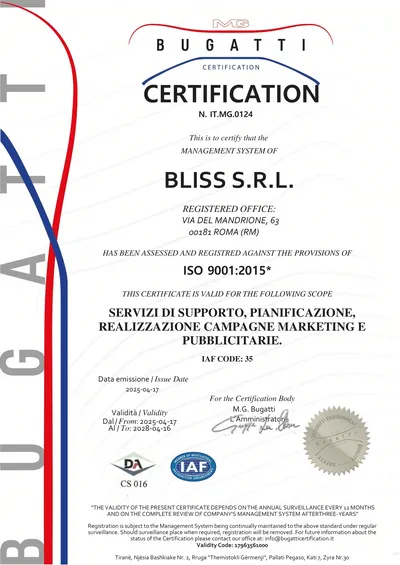
ISO 9001 – Process quality and work organisation.
ISO 14001:2015 – Managing the environmental impact of business activities.

UNI PDR 125:2022 – Gender equality in processes, policies and organisation
ISO 45001:2018 – Occupational health and safety.

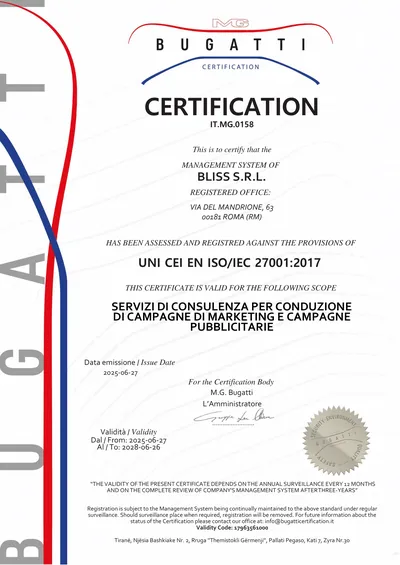
ISO/IEC 27001:2022 – Information, data and access security.
Success in luxury SEO is measured in qualified sessions, appointment requests, growing branded queries and citations in AI systems. Bliss defines these metrics before starting every project and shares them with the client monthly.


THE TEAM
Our voices
leading the way
A team experienced in organisations with complex sales cycles across tech, manufacturing and professional services: sectors where the buyer is a decision maker with structured evaluation processes and long purchasing timelines.

Andrea Maso
HEAD OF SEO
International background, a data-driven mind and no intention of slowing down.

Mario Antonini
chief design officer (cdo)


Luca Maletta
Head of Copywriting



























We build the organic presence of your luxury brand
Digital visibility is part of the product.
A luxury brand that does not own its SERPs hands its digital reputation to competitors, comparison sites and ungoverned content. Luxury SEO is not an investment in traffic; it is an investment in controlling the brand’s digital narrative.
Bliss works with structured brands that want to govern their organic presence with the same precision with which they govern their other touchpoints. The project begins with an audit. The results show in the data.
Semantic brand identity
Owning branded queries
Blog & Trends 2026
SEO TRENDS & NEWS


SEO FAQ
Frequently Asked Questions
Can a luxury brand do SEO without compromising its exclusivity?
SEO for luxury does not work on the mass market — it works on selectivity. Organic coverage focuses on high-intent, low-volume queries: specific searches for products, heritage and expertise. The point is not to become accessible to everyone, but to be found by those who have already decided to look for that brand or that level of product. Well-built luxury SEO strengthens positioning rather than diluting it.