IT

EN

Public sector SEO

Digital visibility
is part of public service.

Citizens search on Google before calling a public office. They look for opening hours, services, procedures, events, calls for tender. If the public body’s website does not appear, or appears with incorrect information, the search ends up on unofficial sources. Misinformation does not arise by chance: it fills the vacuum that institutional communication leaves open.

Bliss manages SEO and digital communication for public bodies, municipalities, regions and institutions through integrated, ongoing oversight covering organic positioning, social channels, advertising and the institutional website. All while complying with the regulatory constraints of public administration and delivering measurable results.

Certified Agency

Certifications

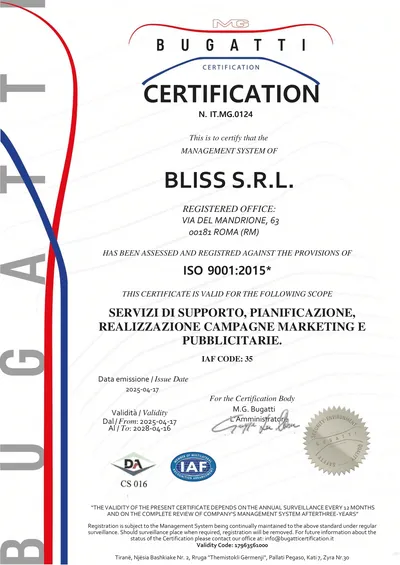
ISO 9001 – Process quality and work organisation.

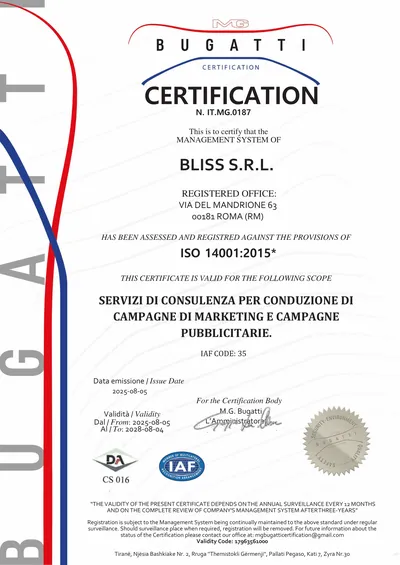
ISO 14001:2015 – Managing the environmental impact of business activities.

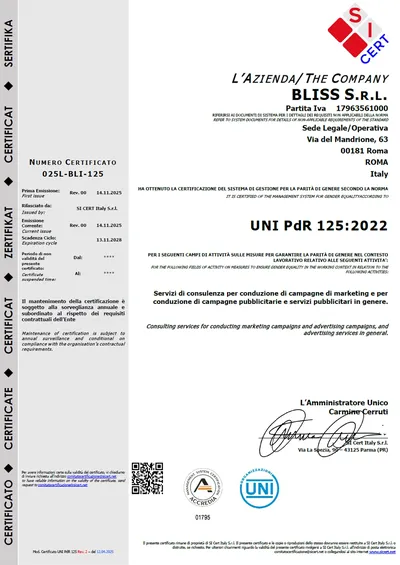
UNI PDR 125:2022 – Gender equality in processes, policies and organisation

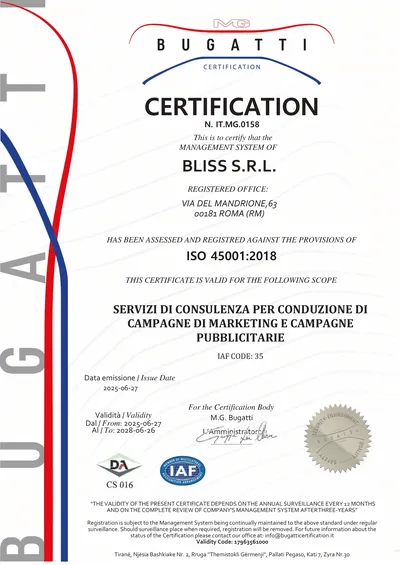
ISO 45001:2018 – Occupational health and safety.

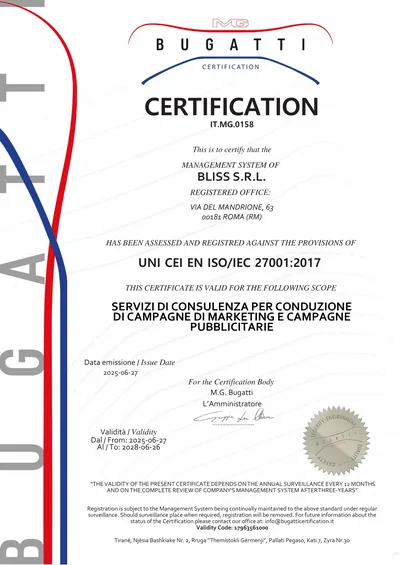
ISO/IEC 27001:2022 – Information, data and access security.

The context

Marketing in public administration:
the gap to close

Marketing in public administration remains a field largely underdeveloped relative to its potential. Most Italian public bodies have a digital presence built for compliance, with websites that meet minimum regulatory requirements but do not address citizens’ real demand on Google, social media managed inconsistently and no organic positioning plan.

The result is a visibility gap that others fill. Unofficial sources, Facebook groups, third-party websites: when a citizen searches for information on a public service and finds no answer on the institutional website, they find one elsewhere, with all the resulting risks of misinformation.

Institutional marketing and SEO for public administration are not tools of commercial persuasion: they are tools of public service. Ensuring that citizens find accurate, up-to-date and authoritative information on the body’s website is an institutional responsibility even before it is a strategic choice.

78%

of Italians search online for information on public services before contacting the authority

63%

of Italian public administration websites fail basic WCAG 2.1 accessibility tests

<1 min

average time spent on institutional websites: the sign of content not found or not understood

The institutional difference

Why SEO for public bodies is structurally different

SEO for public administration and SEO for the private sector share the same basic technical principles, but differ radically in their operational context. A communications agency working with public bodies and institutions must understand a set of constraints, priorities and dynamics that do not exist in commercial marketing.

The objectives are not commercial

A public body does not sell products. It delivers services, informs citizens, promotes the territory and guarantees administrative transparency. Institutional SEO does not optimise for conversions and revenue: it optimises for the findability of information, the quality of traffic to service pages and a lighter load on physical service desks through digital self-service information.

Procurement follows its own rules

The award of communications services by public bodies is governed by the Public Contracts Code. Direct award, negotiated procedure, public tender: each value threshold has its own procedure. An agency working with public administration must know these rules and support the communications office in drafting the technical specifications.

Multiple stakeholders complicate governance

An institutional communications project often involves several bodies with partly differing objectives: municipality, region, superintendency, local partners, sponsors. Aligning them behind a single, coherent communications vision requires institutional project management skills that go well beyond content production.

Continuity is imperative

In the private sector, a project can stop or change direction quickly. In the institutional sphere, communications discontinuity is perceived by citizens as a negative signal and sometimes has political implications. Coverage must be guaranteed for the full duration of the mandate, with operational continuity independent of variables internal to the body.

Technical compliance

Accessibility, GDPR and PA guidelines
SEO that plays by the rules

Public administration websites are subject to a specific regulatory framework that any institutional SEO work must respect. These are not constraints that work against optimisation: on the contrary, the PA’s technical requirements are often aligned with SEO best practice. An accessible, well-structured website with clear content is also a website that Google indexes better.

Regulation 01

WCAG 2.1 accessibility

Full page audit: 145 URLs had missing or incorrectly configured H1 tags. 130 strategic pages were corrected and normalised. Areas irrelevant to SEO (Privacy Policy, Terms and Conditions, Account Area) were deliberately excluded, so as not to waste crawl budget on pages with no organic value.

Regulation 02

Linee Guida Design PA

The Department for Digital Transformation has defined the Design Guidelines for the PA and the design system .italia.it. Institutional SEO is built within this framework, ensuring compliance and optimisation at the same time.

Regulation 03

GDPR and Privacy

Cookie management, privacy notices, user tracking: in public administration, GDPR implications are compounded by the principle of administrative transparency. We manage the implementation of analytics and advertising tools in line with the guidance of the Italian Data Protection Authority (Garante Privacy).

Regulation 04

Transparency and Legislative Decree 33/2013

The legislative decree on administrative transparency requires the publication of specific categories of data and documents. The information architecture of the institutional website must integrate the “Amministrazione Trasparente” section without compromising user experience or the positioning of service pages.

Regulation 05

Institutional advertising and social media

Public bodies using advertising platforms need a correctly configured Business Manager, with powers of attorney and authorisations aligned with Meta and Google requirements. Campaigns must comply with the policies on sensitive categories (political and government content) in force since 2024.

Regulation 06

Procurement and award

The Public Contracts Code (Legislative Decree 36/2023) governs the award of communications services. We support communications offices in building the technical specifications, drafting the bid and verifying PNRR compliance where applicable.

the method

How we work with
public bodies and institutions

Marketing in public administration requires a different operating model from that of the private sector. Producing content and optimising pages certainly matters, but our real objective is to coordinate institutional actors, comply with regulatory constraints, ensure continuity and deliver measurable results against metrics aligned with public objectives.

Step 01

Domain audit and semantic mapping

What citizens search for. What they find on the site. The gap to close.

The first step is an analysis of the existing institutional domain: which queries generate organic traffic, which service pages are not being found, and what information citizens search for on Google without finding an answer on the authority's website. This map forms the basis of the semantic architecture for the SEO work, prioritising the pages that reduce the load on public service counters and increase citizens' digital self-service.

Step 02

Information architecture and technical optimisation

Structure Google understands. Content citizens find.

Technical optimisation of the institutional website includes: a URL structure consistent with the service taxonomy, H1 tags and meta titles optimised for citizens' queries, schema markup for events, places and public organisations, and crawl budget management to exclude administrative sections irrelevant to organic search. All within the constraints of the .italia.it design system and the Design Guidelines for Public Administration.

Step 03

Institutional editorial plan

Content that serves citizens. And that Google rewards.

For public administration, the editorial plan is not a list of articles to publish: it is a content calendar synchronised with the public service cycle, institutional events, administrative deadlines and, where applicable, tourist seasonality. Bliss produces content in accessible language (Chiaro guidelines), optimised for citizens' real search queries and distributed across the most effective channels for each specific demographic.

Step 04

Institutional social media and digital PR

Organic presence on social media. A consistent identity on every channel.

Modern institutional marketing cannot do without social media. Instagram and TikTok reach demographic groups — under-35s, tourists, new residents — that traditional channels fail to capture. Bliss manages social media communication for public bodies with language calibrated to each channel: authoritative without being bureaucratic, accessible without being superficial. With particular attention to a consistent visual identity across every institutional touchpoint.

Step 05

Institutional advertising: low spend, high efficiency

Public budget optimised. Every euro is accountable.

Advertising for public bodies operates under spending and transparency constraints unknown to the private sector. Bliss runs Meta and Google campaigns for public bodies with maximum efficiency: precise demographic and geographic targeting, channel-specific creative, CPC monitored and fully accountable. Public budget is not wasted: every euro invested translates into measurable impact in reach, engagement and qualified traffic to the institutional website.

Step 06

Inter-institutional coordination and reporting

A steering committee across multiple bodies. A single measurement system.

Complex institutional communications projects involve multiple parties: local authorities, regions, heritage superintendencies, private partners, sponsors. Bliss acts as the operational control room, aligning objectives and messages across actors with different decision-making structures. Monthly reporting documents specific institutional KPIs — not vanity metrics — with verifiable data that can be accounted for to the communications office, the executive council and oversight bodies.

Visibility in AI systems is the next frontier of institutional marketing.

When a citizen asks ChatGPT where to renew their identity card, the answer depends on what the public body's website has built on the web.

Case study

AOSTAE 2025

Institutional communications for the 2,050th anniversary of the city of Aosta

Comune di Aosta · Regione Autonoma Valle d'Aosta · Soprintendenza Beni Culturali · 10-month mandate

AOSTAE 2025 is the institutional project marking 2,050 years since the founding of the city of Aosta, an initiative that brought the Comune di Aosta, the Regione Autonoma Valle d’Aosta and the Sovrintendenza ai Beni Culturali together in a single communications programme. On that occasion we acted as the operational control room, handling the development of the institutional website, social media management, Meta advertising, coordination of the visual identity for events, graphic materials and sponsorship activities.

The challenge was twofold: to turn 2,000 years of Roman heritage into contemporary, viral content for a young, national audience; and to do so while coordinating institutional players with different decision-making structures, in a context where public administration bureaucracy and timelines clash with the speed of social media.

+528%

Instagram community growth in 10 months

1,2M

total Instagram + TikTok views

3–4 min

average time on aostae2025.it

€0,20

Average Meta Ads CPC (min €0.16 · max €0.26)

Comune di Aosta

Promoting body

Lead commissioning body for the project, holder of the communications mandate and politically accountable for the initiative.

Regione Autonoma VDA

Institutional partner

Partner in governance and co-funding. Involved in defining the territorial and tourism objectives.

Soprintendenza BB.CC.

Scientific authority

Guarantor of the historical accuracy of content and the authority for activities relating to the Roman archaeological sites.

aostae2025.it

Central digital hub

Website developed by Bliss as the convergence point for all communication: events, booking, streaming, media.

@aostae2025

Social channels

Instagram as the community’s main hub. TikTok to reach the under-35 audience through organic algorithmic distribution.

Meta Ads

Institutional advertising

Paid campaigns calibrated to specific events with an optimised public budget. CPC kept well below the sector benchmark.

The result: from traditional institutional communication to an active digital ecosystem

Before the Bliss mandate, AostaE 2025 was an institutional project with no organised digital identity: no structured social media presence, a formal language far removed from new demographic targets, and no content engine capable of reaching under-35s and visitors from outside the region. Aosta’s Roman heritage, 2,050 years of history, was an untapped asset in terms of contemporary communication. In 10 months, Bliss built an organic community of 5,074 digital ambassadors, produced content peaking at 50,000 views on a single Reel, and generated 2,400+ clicks through Meta Ads on just €469 of spend, a CPC of €0.20 against a sector average of €0.45. An average time on site of 3-4 minutes, four times the Italian public administration benchmark, shows that citizens find the information they are looking for and read it through to the end.

Institutional communications agency

Why public bodies
choose Bliss

Few institutional communications agencies work with public bodies, and fewer still understand the operational specifics of public administration. The difference lies in knowledge of regulatory constraints, award procedures, inter-institutional dynamics and the metrics that matter for a public mandate.

Bliss gained this experience acting as the control room for a complex regional communications project, with several public bodies involved, transparent budget constraints and measurable objectives. This was not a brand consulting project for a private company: it was an institutional mandate with public reporting, real bureaucratic timelines and the obligation to deliver results despite the constraints of public administration.

The same operating architecture — initial audit, strategic plan, ongoing oversight, reporting — applies to any institutional SEO and communication project: a municipal website, a regional tourism campaign, communication for a research body, a publicly funded cultural project.

2.050

years of history turned into contemporary, viral content

3

institutional bodies coordinated within a single communications vision

Rome
Milan

operational offices · institutional mandates nationwide

THE TEAM

Our voices
leading the way

Bliss’s SEO is managed by a team with experience of organisations with complex sales cycles in tech, manufacturing and professional services: sectors where the buyer is a decision maker with structured evaluation processes and long purchasing timelines.

Andrea Maso

HEAD OF SEO

International background, a data-driven mind and no intention of slowing down.

Mario Antonini

chief design officer (cdo)
More than a designer: the true interpreter of the Bliss vision.

Ebrahim Afridi

Frontend Engineer

Designs web infrastructure with an SEO-first approach


Luca Maletta

Head of Copywriting
Copywriter, ghostwriter, author, translator and investigator of human dynamics.

Sajjad Mazaherizaveh

Full stack developer

Combines front-end and back-end development with technical SEO and AI Search Optimisation.

Partner

Logo Paramount Pictures. Montagna stilizzata con stelle. Brand consulting.
Logo Accademia Nazionale di Danza. Corsi di danza a Roma.
biagiotti
live in up logo
part.-3-_0000s_0001_AKTUALNE-LOGO-KEMON
Logo Marchesi
Logo forged irish stout beer
Logo Parmigiano Reggiano bianco per Bliss Agency, agenzia di marketing e comunicazione specializzata nel settore alimentare.
Logo shinto sushi restaurant
Logo nespresso
Logo Würth: Soluzioni di fissaggio e montaggio per Bliss Agency. Partner affidabile per marketing e comunicazione.
Logo NABLA cosmetics
Logo pandora
Logo enerfin
Logo LEMA Mobili
Adesivo moto Honda, logo alato bianco su sfondo nero. Marketing Bliss Agency per Honda, comunicazioni efficaci.
Logo Hotel Punta Tragara
Logo Miele su sfondo nero. Design minimalista per Bliss Agency, esperti in marketing e comunicazione.
Logo scarpa mondo
brondi

Blog & Trends 2026

SEO TRENDS & NEWS

In this space we share our know-how without filters. We explore how Cognitive Bias affects conversions, how Artificial Intelligence is rewriting the rules of SEO (AIO), and how Design manipulates value perception.

FAQ

Frequently asked questions on SEO for public administration

Yes. SEO for public administration governs the organic visibility of institutional websites on Google: service pages, information on administrative procedures, local events, press releases. A public body that does not hold its own semantic territory on Google cedes visibility to unofficial sources, with the risk of misinformation.

Bliss applies SEO to public bodies in line with the Design Guidelines for Public Administration issued by the Department for Digital Transformation and the WCAG 2.1 accessibility requirements.

Marketing in public administration refers to the set of digital communication strategies aimed at engaging citizens, promoting public services and strengthening institutional reputation. It is not about selling, but about being found, understood and chosen as an authoritative reference.

Covers SEO, social media, advertising on Meta and Google, institutional websites, content production and presence in AI systems. Procurement rules and regulatory constraints set it structurally apart from private-sector marketing.

Public bodies award communications services through procedures governed by the Public Contracts Code (Legislative Decree 36/2023). Different procedures apply depending on contract value: direct award below the threshold, negotiated procedure, public tender.

Bliss supports communications offices in drafting technical specifications and operates both as a direct contractor and as a partner in an ATI (temporary business association) for more complex projects.

Public administration websites are subject to: WCAG 2.1 level AA accessibility (Stanca Law), compliance with the Design Guidelines for Public Administration, cookie and privacy management under the GDPR and the guidance of the Garante, and use of the .italia.it design system where applicable.

These constraints do not work against SEO — on the contrary, an accessible, well-structured site is also a better-indexed site. Bliss integrates SEO and technical compliance as a single system, with no trade-offs.

Metrics for institutional communication differ from those of commercial marketing. The focus is not conversions and revenue, but: qualified organic traffic to service pages, positioning on strategic institutional queries, community growth, content reach and engagement, average time on site, and advertising spend efficiency (CPC).

Bliss produces monthly reports with KPIs calibrated to the specific institutional objectives of each mandate — accountable to the communications office and oversight bodies.

Yes. Bliss manages public bodies’ communication as a multichannel system: organic SEO for the institutional website, social media management on Instagram and TikTok, advertising on Meta and Google, and the website as the central hub.

Social media for public administration reaches demographic groups — under-35s, tourists, new residents — that traditional channels fail to capture. A social media presence strengthens the institutional domain’s authority on Google and drives direct searches for the website.

Yes. Bliss managed the digital communications mandate for AOSTAE 2025, the project by the Municipality of Aosta and the Autonomous Region of Valle d’Aosta marking the city’s 2,050th anniversary. The project covered website development, Instagram and TikTok management, Meta advertising and coordination between the Municipality, the Region and the Superintendency for Cultural Heritage.

In 10 months: 5,074 organic followers (+528%), 1.2 million views, average time on site of 3-4 minutes (4× the public administration benchmark), Meta Ads CPC of €0.20 against a sector average of €0.45.


An effective digital presence
makes public services more accessible.

Improves digital visibility and makes services easier to access for citizens and businesses.

Brand Advisory

Brand Positioning
Brand Architecture
Archetypal Models
Identity Systems

Audit

Consulting
Advisory
Growth
Applying strategy across markets
Brand control system
Global activation framework
Strategic validation of initiatives

Corallo.Ai

Operations

Photography
Video Production
Campaign Shooting
Cinematic Content
Visual Identity
Graphic Systems
3D Design
Motion Assets
UI/UX Design
Web Development
E-Commerce
Platform Maintenance
Google Ads
Meta Ads
SEO Optimization
AI Optimization
AI Visibility
Semantic Authority
Generative Citability
LLM Digital PR