


seo wordpress
WordPress powers
43% of the web.
SEO, far less.
WordPress is the world’s most widely used CMS and the platform with the highest concentration of undetected technical SEO issues. Not because of the software, but because its flexibility delegates critical decisions to plugins, which know nothing of the specific architecture of the site they run on.
Bliss optimises WordPress SEO as an integrated system: architecture first, plugins second. Technical configuration, correct indexing, Core Web Vitals, structured data and editorial plan, all designed for the specific platform, not for a generic site.





Specific issues
Six problems WordPress
creates on its own. Without anyone knowing.
WordPress is extraordinarily flexible, and that flexibility is the main cause of its SEO problems. The CMS automatically generates pages, URLs and structures that nobody designed and that almost nobody monitors. Every installation has its own specific issues, but six patterns recur systematically on any WordPress site that has not received dedicated technical SEO attention.
Duplicate URLs from taxonomies and archives
WordPress automatically generates archive pages for categories, tags, authors and dates. These pages duplicate the content of individual pages and consume crawl budget without contributing to ranking. They are often indexed by mistake.
Fix → Strategic canonicals + noindex by taxonomy
Crawl budget wasted on non-strategic pages
Internal search results pages (?s=), WooCommerce account pages, checkout pages, parameterised URLs generated by filters and sorting: all consume Googlebot’s attention without producing organic value. The crawler stops visiting the pages that matter.
Fix → robots.txt + noindex on non-strategic URLs
Core Web Vitals penalised by plugins
Every plugin loads scripts and stylesheets. The build-up of plugins, counters, pop-ups, chat, form builders and sliders produces render-blocking resources that push LCP and INP below Google’s thresholds. Heavy themes amplify the problem.
Fix → Script audit, lazy loading, removal of redundant plugins
Canonicals configured automatically and incorrectly
SEO plugins canonicalise automatically based on generic rules, not on the site’s specific architecture. Strategic pages end up canonicalised towards suboptimal pages. Internal authority is dispersed rather than consolidated.
Fix → Canonicals redesigned page by page
Incomplete or incorrect structured data
SEO plugins generate generic schema markup that does not reflect the site’s specific structure. Article schema without author or dateModified. Product schema without a complete Offer. FAQPage not implemented where it would be useful. JSON-LD not validated.
Fix → Manual schema implementation by page type
Ungoverned internal linking
WordPress manages internal links automatically (related posts, widgets, menus). Link equity flows towards the oldest pages or those most linked in sidebars, not towards the pages that matter most strategically for ranking.
Fix → Internal linking plan for pillar pages
WordPress site indexing
How indexing works
on WordPress. And how to optimise it.
Indexing a WordPress site is the process through which Google crawls the site's pages and decides which to include in its index. On WordPress, this process is more complex than on any other CMS, because the platform automatically generates far more URLs than the pages the user has actually created. The typical result: a site with 100 pages of real content generating 500-1,000 indexable URLs. Google spreads its crawl budget across all these URLs and often fails to reach the pages that matter as frequently as needed to keep them up to date in the index.
Correct indexing of a WordPress site is also the prerequisite for visibility in generative AI systems: a site with duplicate URLs and inconsistent semantic signals is read less accurately by Gemini, ChatGPT and Perplexity, as well as by Google.
Silent proliferation
Every WordPress installation generates URLs you did not create, but which Google finds and indexes:
- Category archives (/category/name/)
- Tag archives (/tag/name/)
- Author archives (/author/name/)
- Date archives (/2024/01/)
- Internal search results (?s=query)
- RSS feed pages (/feed/)
- URLs with pagination parameters (/page/2/)
- WooCommerce pages (cart, checkout, account)
- URLs with filter and sort parameters
Surgical crawl control
Optimising indexing is not a matter of blocking URLs: it is about directing Google towards the pages that deserve attention. Bliss works on:
- robots.txt — selective blocking of non-strategic URLs
- Meta noindex — taxonomies with no organic value
- Canonical tags — consolidating authority across variants
- XML sitemap — strategic URLs only, updated dynamically
- Permalink structure — readable, consistent URLs
- Google Search Console — coverage monitoring
- Log analysis — where Googlebot stops and why
SEO plugins for WordPress
Yoast, RankMath, All in One SEO:
what they do. What they never do.
WordPress SEO plugins are excellent tools, for what they are designed to do. The problem arises when they are used as a substitute for strategy: the plugin does not know which keywords you are trying to own, does not know the competitive structure of your sector, and does not read your site’s specific architecture. It automates generic decisions in a specific context, and this often produces the wrong results.
The SEO plugin remains in use as a useful tool. What changes is the method: Bliss sets the strategic decisions before configuring any automation. The plugin executes; it does not decide.

Yoast SEO
What it does well
Meta title and description management, basic sitemap, breadcrumbs, redirect manager, GSC integration
What it doesn't do
Does not interpret the site's architecture, does not optimise canonicals for specific contexts, does not manage CWV

RankMath
What it does well
Richer schema markup than Yoast, more detailed on-page analysis, integration with GA4 and Search Console
What it doesn't do
Schema generated automatically without page-by-page verification; crawl budget left ungoverned

All in One SEO
What it does well
Simplified interface, good tag management, broad compatibility with other plugins
What it doesn't do
Advanced configuration requires technical expertise; schema markup less flexible than the other two
Bliss + plugins
What it does well
Plugin used as an execution layer. Every technical decision (canonical, noindex, schema) made manually on the site's actual architecture
What it doesn't do
-
the method
How Bliss optimises SEO on WordPress
SEO on WordPress is a matter of architecture. Bliss always starts by analysing the specific domain: how Googlebot moves through the site, where crawl budget is wasted, which strategic pages are not reached as often as they should be. Then we intervene, in sequence.
Crawl analysis: where Google goes and where it stops.
The starting point is a complete map of the domain: a Screaming Frog crawl, cross-referenced with Google Search Console data, and a crawl budget analysis by URL type. This map reveals the strategic pages that Google does not reach often enough, the non-strategic URLs that consume crawl resources, and the plugin conflicts that send contradictory signals. Only this analysis makes it possible to set intervention priorities, since you cannot optimise what you do not know.
Canonicals and indexing: every URL has a defined destination.
Redesigning the URL architecture on WordPress includes: permalink configuration consistent with the site's semantic structure, canonical tags defined manually for each page type (categories, tags, archives, WooCommerce product variants), noindex on non-strategic pages, and pagination management. These decisions are made on the site's actual map and then implemented in the plugin as an execution layer.
LCP, INP, CLS: every plugin carries weight. Some shouldn't be there at all.
The WordPress performance audit analyses how much each plugin contributes to the load time of strategic pages. Render-blocking scripts, unused CSS, unoptimised images, poorly loaded fonts: every element is measured with PageSpeed Insights and CrUX data. The goal is to bring strategic pages within Google's quality thresholds (LCP under 2.5 seconds, INP under 200ms, CLS under 0.1), not merely to raise the overall PageSpeed score.
JSON-LD implemented where the plugin falls short.
WordPress SEO plugins generate generic schema markup. For strategic pages (service pages, product pages, authority articles) we implement JSON-LD schema manually: Organization with complete sameAs, Article with author and dateModified, FAQPage on pages that answer frequently asked questions, Service with a detailed description, BreadcrumbList consistent with the site structure. Plus the llms.txt file, for citability in generative AI systems.
Content builds authority only if the architecture supports it.
WordPress SEO optimisation does not end with the technical work. We define the editorial plan around the strategic keyword map, govern the flow of internal link equity through an internal linking plan for pillar pages, and monitor the domain's technical health every month. This way, we identify new problems before they affect rankings.
WordPress and WooCommerce SEO: even more complex territory.
An e-commerce site on WooCommerce adds a further layer of complexity: crawl budget across thousands of SKUs, variants and navigation facets, which calls for a specific approach.
Case study
blissagency.it on WordPress
an SEO asset worth €782.376 a year
blissagency.it · WordPress · CMS optimised as a reference site · 2025–2026
The Bliss website runs on WordPress. And Bliss has applied to itself the same method it offers its clients, with the stated aim of making the site public, verifiable proof that the system works. No unmeasurable claims: every figure has a primary source. The starting point was a functional but technically weak WordPress site: Zoom Authority 32, organic traffic of a few thousand visits a month, and no structured technical optimisation strategy. The SEO plugin was installed with a standard configuration, but it was running on an architecture that had never been designed for organic ranking. The work covered all five levels of the Bliss method: technical clean-up (disavowing toxic links, correcting erroneous noindex tags, redesigning canonicals), Core Web Vitals optimisation (result: PageSpeed SEO 100/100, Best Practices 100/100), full implementation of JSON-LD schema on every key page, an editorial plan for topical authority, and an editorial link acquisition strategy that took the site from 10 to 392 referring domains.
€782K
Equivalent annual value of the SEO asset built on WordPress
100/100
PageSpeed Insights SEO score · desktop
23.623
Monthly organic visitors on WordPress
392
Active referring domains
WordPress SEO Agency
WordPress SEO consultant
or generalist agency?
The difference between specialist WordPress SEO consultancy and a generalist SEO agency lies in the depth of platform knowledge. Knowing how to manage WordPress taxonomies, how to configure canonicals on a WooCommerce site, how to identify the plugins that penalise Core Web Vitals, and how to structure data for different page types are skills acquired by working on WordPress, not on SEO in the abstract.
Bliss is an SEO agency based in Rome with a presence in Milan, working mainly on WordPress and WooCommerce. The agency’s own site runs on WordPress, optimised with the same method Bliss offers its clients. Before any commercial proposal, Bliss carries out a free preliminary audit of the domain to assess the real state of its WordPress SEO and identify intervention priorities.
Before SEO optimisation comes diagnosis.
Bliss always starts from a technical audit of the WordPress site — not from a standardised plan.
OUR SEO RESULTS
Success stories
These results show what happens when SEO, content and AI Search are turned into a genuine growth engine. Leads, sales, qualified traffic and revenue growth: every case study presents concrete data, verifiable results and performance built to generate real business.
Valle D'Aosta
Bliss supported the Aostæ 2025 project in building an institutional digital ecosystem designed to enhance the region, its events and public communication.
THE TEAM
Our voices
leading the way
Bliss’s SEO is managed by a team with experience of organisations with complex sales cycles in tech, manufacturing and professional services: sectors where the buyer is a decision maker with structured evaluation processes and long purchasing timelines.

Andrea Maso
HEAD OF SEO
International background, a data-driven mind and no intention of slowing down.

Mario Antonini
chief design officer (cdo)


Luca Maletta
Head of Copywriting

Sajjad Mazaherizaveh
Full stack developer
Combines front-end and back-end development with technical SEO and AI Search Optimisation.
Certified Agency
Certifications

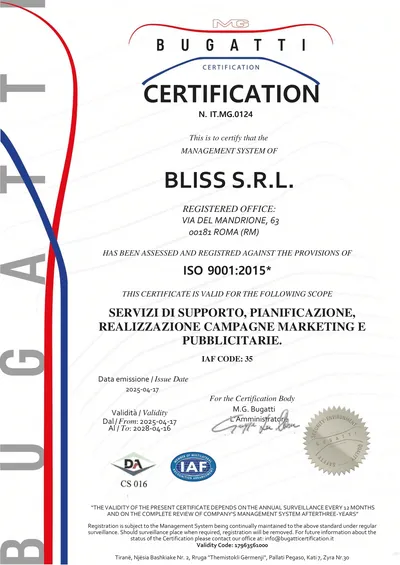
ISO 9001 – Process quality and work organisation.

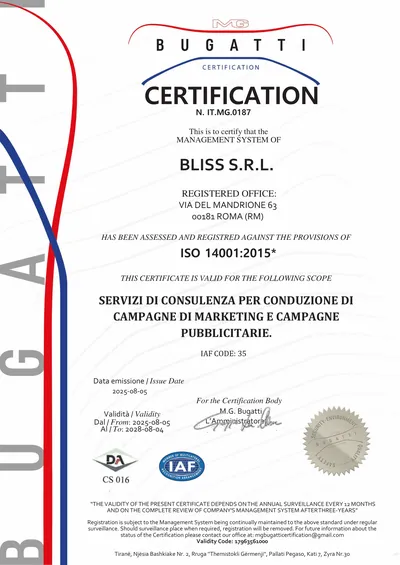
ISO 14001:2015 – Managing the environmental impact of business activities.

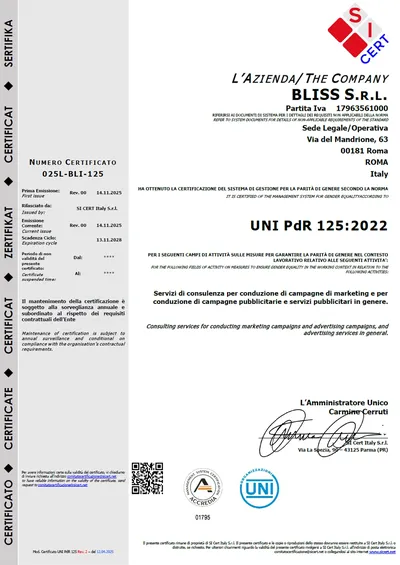
UNI PDR 125:2022 – Gender equality in processes, policies and organisation

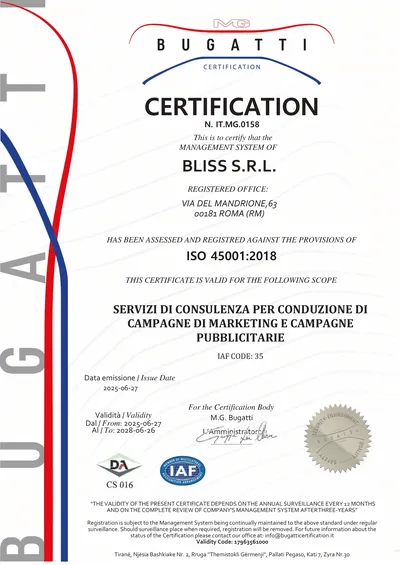
ISO 45001:2018 – Occupational health and safety.

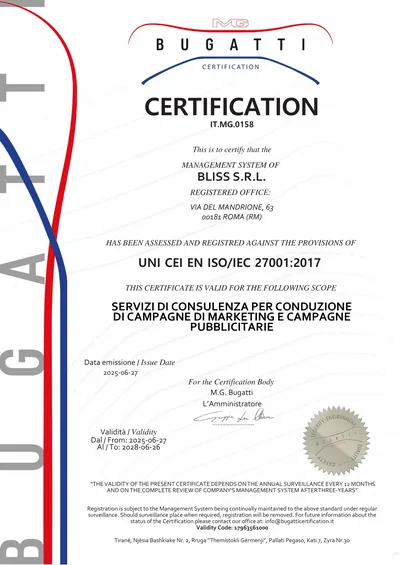
ISO/IEC 27001:2022 – Information, data and access security.
Blog & Trends 2026
SEO TRENDS & NEWS


Partner






























SEO FAQ
Frequently asked questions on
WordPress SEO
How is SEO done on WordPress?
SEO on WordPress is built on three levels: technical (crawl budget, canonicals, permalinks, Core Web Vitals, structured data), semantic (content architecture, keyword map, internal linking) and external authority (editorial backlinks). SEO plugins handle some basic technical aspects but do not interpret the site’s specific architecture.
Bliss works on the architecture before configuring any plugin: the strategic decisions (which pages to index, how to canonicalise, which schema to implement) are made manually, and the plugin is used as an execution layer.
How do you optimise the indexing of a WordPress site?
WordPress indexing is optimised through: correct configuration of the robots.txt file, an XML sitemap kept up to date with the strategic pages, canonical tag management to avoid duplicates (archive pages, taxonomies, parameterised URLs), and exclusion of non-strategic pages from the index (search results, tag pages, the WooCommerce account area).
WordPress automatically generates far more URLs than the pages users actually create — and Google spreads its crawl budget across all of them. Indexing optimisation focuses Googlebot’s resources on the pages that matter.
Which SEO plugin works best on WordPress?
The choice of SEO plugin has a marginal impact compared with the quality of the configuration. Yoast SEO, RankMath and All in One SEO produce comparable results if configured correctly for the site’s specific architecture.
The common problem is never the tool: it is that the plugin is used as a strategic decision-maker rather than an execution tool. Bliss configures plugins as an operational layer on top of a manually defined strategy — the choice of which pages to index or how to structure canonicals is never delegated to the plugin.
Is WordPress good for SEO?
WordPress is one of the most SEO-friendly CMSs available, but only if configured correctly. The platform’s flexibility is also the main cause of its SEO problems: it automatically generates duplicate URLs from taxonomies and archives, delegates critical technical decisions to plugins, and accumulates redundant scripts that penalise Core Web Vitals.
With the right technical configuration, WordPress makes it possible to build very powerful organic assets. The Bliss website runs on WordPress with an SEO score of 100/100 and an organic asset worth €782,376 a year.
How do you improve the SEO of an existing WordPress website?
The mandatory starting point is a technical audit that maps the real state of the domain: indexing coverage in Google Search Console, crawl analysis (which pages Googlebot reaches and how often), Core Web Vitals performance, canonical configuration, backlink profile.
This audit produces the priority matrix for interventions, starting with those that are high-impact and low in technical complexity. Bliss conducts this audit before any operational proposal.
Does technical SEO on WordPress need updating after every CMS update?
Not necessarily after every minor update. Major updates — especially those that change the Gutenberg block system, the APIs or the theme architecture — can alter how SEO plugins behave and change the site’s technical structure.
Bliss monitors technical health monthly through Google Search Console and automated crawls. Every significant change is analysed and addressed before it has a measurable effect on ranking.
How does WordPress SEO integrate with generative AI systems?
Structured data implemented on WordPress — Article, Service, FAQPage, Organization and BreadcrumbList schema — is among the primary signals that generative AI systems (Gemini, ChatGPT, Perplexity) use to read and classify content. A WordPress site without correct schema markup is a site that AI models read less precisely.
The llms.txt file, an emerging standard for visibility in AI systems, communicates the site’s structure and strategic pages directly to language models. Bliss implements it as part of its WordPress SEO strategy, not as an optional extra.
What is a WordPress-specialist SEO agency?
An SEO agency specialising in WordPress knows the platform’s specific technical issues — taxonomy management, duplicate URLs, plugin conflicts, Gutenberg’s impact on HTML structure, crawl budget management on WooCommerce — and knows how to resolve them without overturning the existing architecture.
The difference from a generalist SEO agency lies in in-depth knowledge of the CMS and the ability to work directly on the code when plugins are not enough. Bliss works mainly on WordPress, and its own site is the proof.