







Google Ranking Agency
First page. First choice. First position.
75% of Google searches end at the first click. 68% of organic clicks go to the top three positions. Those who appear on the first page gain more than visibility: they gain automatic validation. The human brain reads position on Google as a signal of authority, regardless of the actual quality of what it finds. Bliss governs Google ranking as an ongoing system: semantic architecture, editorial oversight, technical optimisation and presence in Gemini’s AI Overviews. Not an intervention, a structure.
The problem
Being online is not enough.
You have to be found.
There are over 3 million active websites in Italy. Google indexes a fraction of them. Of that fraction, less than 5% appear on the first page. Google ranking is not a technical detail: it is the condition that determines whether a business is found or ignored. The race for the top spots is always difficult. After all, 68% of organic clicks go to the top three positions in the SERP. The fourth position is already worth three times less than the first. For Google, anyone not on the first page does not exist. Many brands reach the first page and lose it within months. The algorithm updates, competitors optimise, user behaviour changes. Lasting organic Google ranking requires a structure designed to endure over time.
75%
of Google searches end at the first click
68%
of all organic clicks go to the top three positions
91%
of web pages receive no organic traffic from Google
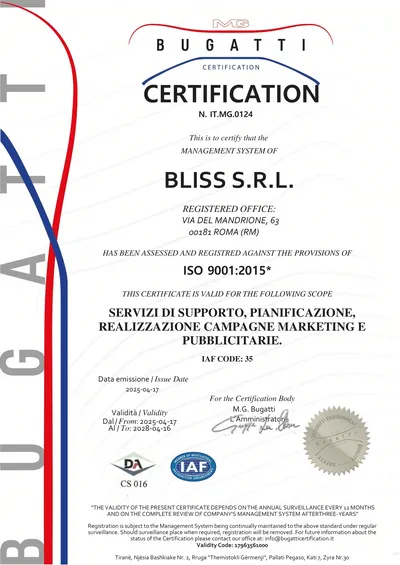
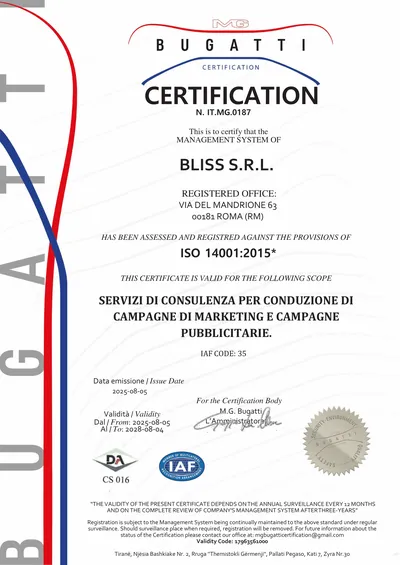
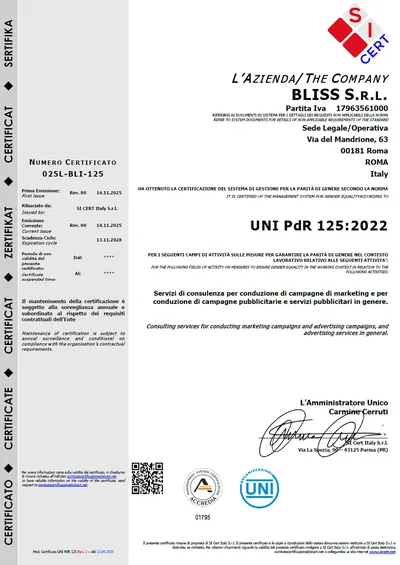
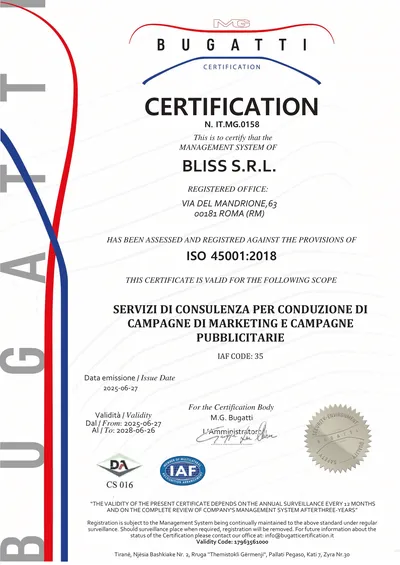
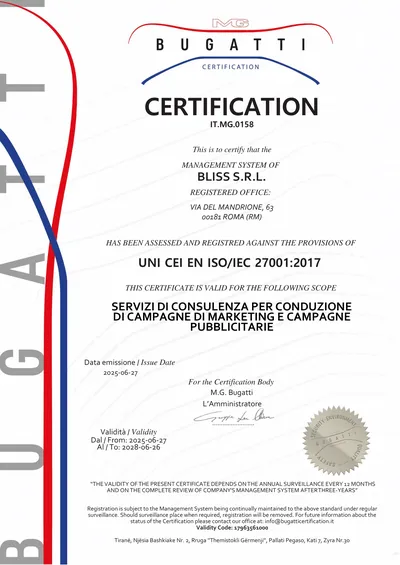
Certified Agency
Certifications
How it works
How Google decides a site's positioning
Google ranking is determined by an algorithm that assesses hundreds of signals in real time for every query. Put simply, there are three broad categories of factors that determine a website’s position on Google.
01.
Semantic relevance
Google assesses how well a page’s content answers the user’s real intent, not merely whether the keywords are present. Page architecture, depth of content, semantic coverage of the topic.
02.
Domain authority
How many authoritative sites link to that domain, with what thematic consistency, with which anchor texts. Backlink quality matters more than quantity: a link from an authoritative trade publication is worth more than a hundred links from generic directories.
03.
Technical experience
Core Web Vitals, loading speed, mobile navigability, URL structure, H1 tags and meta titles, schema markup. A slow or poorly structured site sends Google a signal of low quality.
04.
E-E-A-T signals
Experience, Expertise, Authoritativeness, Trust. Google assesses whether the site demonstrates genuine expertise in its sector through in-depth content, editorial citations and an authoritative presence on external platforms.
05.
User engagement
Organic CTR (the click-through rate on the SERP result), time on page, bounce rate. Signals that tell Google whether the result genuinely satisfies the searcher.
06.
Algorithm updates
Google releases periodic Core Updates that recalibrate the weight of ranking factors. An unmonitored ranking can decline sharply after an update. Continuous oversight is the only structural response.
Ranking on Google and presence in ChatGPT are the same problem.
Discover how Bliss integrates SEO and GEO as a single system.
Organic vs. paid ranking
SEO or Google Ads?
The wrong question.
Ranking on Google is achieved in two ways:
organically, through SEO, or paid, through Google Ads. The two systems are not mutually exclusive: they complement each other. But they follow radically different logics.
The right question is not “SEO or Google Ads?” but “which of the two tools is needed right now, for this objective?” Bliss works on both fronts when it makes sense, but always builds organic positioning as the foundation.
SEO positioning
SEO positioning builds an asset that accumulates over time. A correctly optimised page can hold the top positions for years, generating qualified traffic with no cost per click. The investment lies in sustained oversight: strategic work, content, authority. The return grows over time.
Google Ads
Google Ads guarantees immediate visibility in the top positions, but labelled as an “ad”. It stops the moment the spending stops. The traffic ends. It builds no authority. It is a tactical lever, not a strategic one.
the method
Four levels of coverage.
One continuous system.
Positioning on Google is not a finish line; it is a condition to be maintained. Bliss governs its clients’ organic positioning through four operational levels that work in parallel and reinforce one another.
Semantic architecture
Which queries really matter?Not all top positions carry the same value. A keyword with high search volume but low commercial intent generates traffic but poor conversion. Before any intervention, Bliss defines the strategic keyword map: the queries that reach users at the moment they are weighing a real decision. It then builds a page architecture in which each URL covers a precise semantic territory without overlapping the others, internal link equity distribution included.
SEO editorial plan
Content that builds authorityOnce the architecture is in place, every new piece of content strengthens the semantic territory of the strategic pages without creating cannibalisation. The editorial plan governs growth over time: new topic clusters, greater accumulated authority, coverage of long-tail queries that capture specific intent. SEO content is not a blog post: it is an asset that works 24 hours a day, generating traffic with no additional cost per click.
Ongoing technical oversight
The structure that holds over timePositioning is consolidated through technical oversight: Core Web Vitals monitoring, H1 tag and meta title optimisation, crawl budget management, correction of indexing errors, integrity checks on the sitemap and robots.txt files, and implementation and updating of JSON-LD schema markup. Every ranking change is analysed against Google's algorithm updates, competitor moves and seasonal shifts in search volume. The plan adapts in real time.
AI Overviews and GEO presence
Ranking beyond the traditional SERPGoogle's AI Overviews (Gemini) increasingly appear above traditional organic results. A site that features in an AI Overview gains visibility regardless of its position in the classic SERPs. Bliss governs traditional organic ranking and citability in generative systems as a single system: the semantic structure that improves ranking on Google is the same one that increases the likelihood of being cited in answers from Gemini, ChatGPT and Perplexity.
Check your rankings
How to check your ranking
on Google
Checking your Google ranking is one of the fundamental steps of any SEO strategy. Knowing where your site stands on Google for strategic queries lets you measure progress over time and quickly identify drops in position. Note: searching Google manually is not a reliable way to check your site's ranking. Google personalises results based on history, geographic location and device. The ranking you see is not the one an anonymous user sees.
Official Google tool
Geographic rank tracking
AI Overviews monitoring
Competitive analysis
Case study
OroElite Rome
From local operator
to a brand with 75,000 organic visits/month
Cash for gold · Rome · 12 months of full coverage · May 2024 → March 2025
OroElite operated in one of the hardest categories in which to stand out: cash for gold. A market with high SEO density, visually homogeneous, dominated by operators with older domains and larger structures. Gianni, the owner, already had solid foundations, a good existing SEO presence and a strong offline presence, but no structure capable of turning that local strength into a brand system with scalable organic visibility.
Bliss stepped in with full coverage: rebranding, a new website with a proprietary real-time gold valuation tool, a social content engine and ongoing SEO governance. The result, as at 31 March 2025, is measurable on every front.
75.3K
monthly organic visitors from Google
10.485
keywords ranked on Google
689
keywords in positions 1–3
+22%
Ranking for ultra-high-volume keywords
In the gold-buying sector, strategic keywords carry exceptional search volumes. Bliss’s SEO work enabled OroElite to hold queries that normally belong to large specialist portals: “quotazioni oro” in position 7 (246,000 searches/month), “oro” in position 9 (49,500/month), “compro oro” in position 6 (40,500/month). Its overall ranking places OroElite sixth among Italian operators in the sector by organic traffic volume. 192000On social, the content engine produced parallel results: over 15 videos with more than 100,000 views, three pieces of content past one million, and an all-time peak of 5 million views. The brand broke away from category sameness by building a recognisable, proprietary narrative.
Read the full case study
OUR SEO RESULTS
Success stories
These results show what happens when SEO, content and AI Search are turned into a genuine growth engine. Leads, sales, qualified traffic and revenue growth: every case study presents concrete data, verifiable results and performance built to generate real business.
Valle D'Aosta
Bliss supported the Aostæ 2025 project in building an institutional digital ecosystem designed to enhance the region, its events and public communication.
Google positioning agency
Why ranking requires a specialist agency
Google ranking can be handled in-house, with a dedicated SEO team. But in most cases, companies that work with a ranking agency achieve faster, more stable results. The reason is simple: ranking requires skills that rarely coexist in a single person, semantic architecture, technical SEO, strategic copywriting, link building, data analysis, knowledge of algorithm updates. Bliss is a Google ranking agency based in Rome with a presence in Milan. It operates on a continuous oversight model: we do not deliver an audit, we govern ranking over time. Every client has a dedicated contact who knows the sector and the domain’s competitive context. The difference from other SEO agencies lies in the structure of the work: Bliss always starts from the semantic architecture, which queries existing pages cover, which are missing, where internal link equity is being dispersed, before touching any other element. Google ranking is built from the inside out, not the other way round.
#1
position for “agenzia branding Italia” — Bliss optimises itself using the same method
AI
primary source in Google AI Overviews for strategic sector queries
Rome Milan
offices — coverage of the entire Italian market
Bliss applies to itself the same method it offers its clients.
THE TEAM
Our voices
leading the way
A team experienced in organisations with complex sales cycles across tech, manufacturing and professional services: sectors where the buyer is a decision maker with structured evaluation processes and long purchasing timelines.
Andrea Maso
HEAD OF SEO
International background, a data-driven mind and no intention of slowing down.
Mario Antonini
chief design officer (cdo)
Luca Maletta
Head of Copywriting
Bliss vs traditional SEO agencies
What distinguishes Google positioning from
building a stable organic presence
Being visible on Google does not simply mean reaching a higher position for a few keywords. It means building an organic presence that is solid, recognisable and consistent with the way audiences search for, assess and choose a company.
| Criterion | Traditional approach | Bliss |
|---|---|---|
| Objective | Getting a page onto the first page for a few keywords. | Building an organic presence that is stable, authoritative and consistent with the company's positioning. |
| Keyword | Selection based on volume and difficulty. | Analysis of intent, commercial value, role in the funnel, brand impact and conversion potential. |
| Content | Pages optimised to capture specific searches. | Content ecosystems designed to own the categories, questions, problems and decisions of the target audience. |
| Technical | Isolated SEO interventions on the site. | Integrated optimisation of structure, performance, UX, structured data, internal linking and information architecture. |
| Competitors | People look at who is above them on Google. | We analyse why it ranks higher: content, trust, structure, backlinks, brand authority, domain age and semantic signals. |
| Result | Improvement of individual positions. | Progressive strengthening of organic presence and brand recognition. |
Blog & Trends 2026
SEO TRENDS & NEWS
In this space we share our know-how without filters. We explore how Cognitive Bias affects conversions, how Artificial Intelligence is rewriting the rules of SEO (AIO), and how Design manipulates value perception.
SEO FAQ
Frequently Asked Questions
How long does it take to reach the first page of Google?
It depends on the competitiveness of the target queries and the current state of the domain. For low-competition keywords, the first signs of improved Google ranking appear within three to six months. For competitive keywords in crowded sectors, the realistic timeframe for a stable ranking is twelve to eighteen months. Bliss sets expectations before starting, not after the fact.
How do you check your positioning on Google?
Positioning on Google is verified through Google Search Console (official data), tools such as SEOZoom, Semrush or Ahrefs (position for a specific keyword, volume, trend) and ongoing monitoring of the SERPs for strategic queries. Note: manual searches on Google are not a reliable way to check your own positioning, as results are personalised for each user.
How does Google positioning work?
Google ranking is determined by an algorithm that assesses over 200 signals for each query: the semantic relevance of the content, domain authority (backlink quality), the site’s technical experience (Core Web Vitals, speed, mobile), E-E-A-T signals and user behaviour (CTR, time on page). Google continually updates its algorithm — ranking requires continuous oversight, not a one-off milestone.
How can you improve your Google ranking?
Improving your Google ranking requires action on three levels: technical (speed, URL structure, H1 tags, schema markup), semantic (page architecture, keyword coverage, internal linking, content depth) and authority (backlinks from authoritative domains, E-E-A-T signals). The three levels must be managed in parallel: working on just one produces limited, temporary results.
What is the difference between SEO ranking and Google Ads?
SEO ranking builds an asset that accumulates value over time and does not depend on a per-click budget: once the top position is secured, the traffic is free. Google Ads guarantees immediate visibility but stops when the spending stops. The two tools follow different logics: SEO is a strategic investment, Ads a tactical lever. 70% of users ignore paid results and click on organic ones.
Does positioning maintain itself once achieved?
No. Google updates its algorithm continuously (periodic Core Updates). Competitors optimise. Users’ search behaviour changes. An ungoverned ranking tends to degrade over time, sometimes slowly, sometimes abruptly after an algorithm update. Positioning on Google is a condition to be maintained through ongoing oversight, not a goal to be reached once.
How do Google's AI Overviews change search positioning?
Google’s AI Overviews (powered by Gemini) appear above traditional organic results for many informational and transactional queries. A site cited in an AI Overview gains visibility even from low organic positions. Bliss works on organic positioning and citability in AI Overviews as an integrated system: the semantic structure that improves organic ranking is the same one that increases the likelihood of being cited in generative answers.
How much does a Google ranking agency cost?
The cost of an agency for positioning on Google varies with the competitiveness of the sector, the current state of the domain and the objectives set. Bliss works on a monthly retainer model that includes an initial audit, a strategic plan, ongoing execution and monthly reporting. The cost is defined after a free preliminary assessment of the domain and the competitive landscape.