


Founder-independent branding
What your brand is worth
Without you?
A brand and the person who created it are two different things.
Of course, the founder can often act as strategist, public face and ambassador, but if this stops them growing into new markets, selling or delegating, then something is wrong. And action is needed.
We offer a Brand Governance service to founders who want to separate their own identity from that of the company, and so give the brand a structure. Criteria. But above all, a future.
DISCOVER GOVERNANCE
Brand governance
Political brand governance
Generational continuity
Brand recovery
Founder-independent branding
Brand governance
Political brand governance
Generational continuity
Brand recovery
Founder-independent branding
Brand governance
Political brand governance
Generational continuity
Brand recovery
Founder-independent branding
Brand governance
Political brand governance
Generational continuity
Brand recovery
Founder-independent branding
Brand governance
Political brand governance
Generational continuity
Brand recovery
Founder-independent branding
Brand governance
Political brand governance
Generational continuity
Brand recovery
Founder-independent branding
Brand governance
Political brand governance
Generational continuity
Brand recovery
Founder-independent branding
Brand governance
Political brand governance
Generational continuity
Brand recovery
Founder-independent branding


TABLE OF CONTENTS
Blissionary
Founder-independent branding: Meaning
/diˌfaʊndəraɪˈzeɪʃən/
n. A structured process that separates the brand’s identity from that of its founder, turning personal dependency into an autonomous, transferable operating system. It maps the dependency nodes, quantifies them in terms of their impact on company valuation, and builds the rules that allow the brand to exist, grow and be sold independently of the presence of its principal face.
The problem we solved
When the brand is only worth something if you're there
Every great company is born of a great person. The problem arises when it cannot exist without them.
If the public face also serves as the sole point of reference, the contact with the market and the voice, the company runs up against its limits. And so, you cannot open a new office without them. You cannot delegate without losing consistency. You cannot sell without the buyer starting to ask questions.
Rarely does anyone deal with it. Yet a great many businesses fail to grow because of it.
Where it all began
The solution that was missing
Key person risk is an item that appears in almost every due diligence report on family businesses or personal brands. Without the key figure, the brand is perceived as less secure, and therefore of lower value.
Solving the problem would require separating the brand’s identity from its creator’s in a structured way. Yet no one had ever thought of it.
Founder-Independent Branding was born of this gap.
Our thinking
A brand is not a person, but what that person has built
Separating the founder from the brand is not an act of distance, but of respect for what they have created.
A company that survives only thanks to its founder’s presence is not free, nor does it allow that person to live freely. It cannot scale, cannot sell, cannot delegate without losing everything. Building the system that allows the brand to exist even when the founder is not there means working towards everyone’s freedom.
The numbers
The cost of dependency
A brand tied to its founder is worth less. The numbers say so.
For a €10 million company whose brand is still tied to its founder, the valuation can drop by as much as €2.5 million. And none of this is due to accounts that don’t add up or reputational crises. Quite simply, without the person who created it, the brand is worth less.
€2.5 million left on the table for a €10 million company whose brand has not been separated. The difference is measured in percentage points on the valuation multiple.
Who it is for
Who needs
Founder-Independent Branding?
Founder-independent branding is designed for those who have built a strong brand, but have realised that the brand exists only because of their presence. Before this becomes a limitation, the system that makes it independent needs to be built. That is why it proves particularly useful:
For those who want to scale, but face a bottleneck.
You have built revenue through your presence: your videos, your relationships, your name. It works, but it won’t let you open ten shops, because there aren’t ten of you. Founder-Independent Branding puts in writing everything that can be replicated without you having to be physically present every time.
For those who want to sell, sooner or later.
Without you, what you have built is worth less. Founder-Independent Branding builds the system that eliminates, or drastically reduces, that valuation discount before the negotiation begins.
For those who want to delegate without losing consistency.
You are bringing in new managers, new roles, new structures. But every brand decision still goes through you. Founder-independent branding builds the rules that allow anyone to act consistently with the brand, without asking your permission every time.
How the service works
Founder-independent branding
what it is
It is the structured process that separates a company’s identity from the person of its founder, without destroying the trust capital built up over time. Not rebranding. Not communications. Brand Governance.
The question that drives the process
If the founder were no longer there, why would a client still choose this company?
01 Brand Audit
Mapping of dependency points, their intensity and impact
02 Autonomous corporate identity
Positioning, narrative and value system separate from the person
03 Brand Governance System
Operational Decision Framework the team can use autonomously
04 Transition Management
Narrative transition plan towards the market
Our method
The 4 phases
Founder / company brand audit
A diagnostic map of everything in the corporate brand that is currently tied to the founder as a person. A document showing precisely where the dependency nodes lie, how intense they are and their potential impact on valuation, scalability and handover.
Exemplary case
Ruzza Orologi: the audit would reveal that almost all brand awareness is tied to visual recognition of Lorenzo Ruzza. Practically no element of the corporate brand would exist independently.
Building an autonomous corporate identity
Defining the positioning, narrative and value system that belong to the company — not to the founder. Not as a denial of its history: as its deliberate evolution. If the founder were no longer there, why would a client still choose this company? If there is no answer, the brand does not yet exist as an autonomous entity.
Brand Governance System
Development of Bliss’s proprietary Decision Framework: non-negotiable elements, elements adaptable within rules, free elements. Once these rules exist, the team no longer waits for the founder on every decision. It acts within clear boundaries, with speed and consistency. The company scales because the brand scales.
Transition Management
Management of the transition phase in communications to the market. How to communicate the brand’s evolution without losing the trust capital built up. How to retain existing customers while attracting an audience not tied exclusively to the founder as a person. The brand outlives the person. It is an asset — not a dependency.
Real Cases
The numbers no one calculates
until it is too late
Three Italian stories of founder-brand fusion in its most extreme form.

Founder-independent branding.
The guide for SMEs and personal brands built around their founder
THE TEAM
The team that leads the process
The Founder-Independent Branding service is run by a team with experience of family-owned SMEs, growing personal brands and companies preparing for a sale or a leadership handover. Every project has one or more dedicated points of contact for the entire duration of the programme.
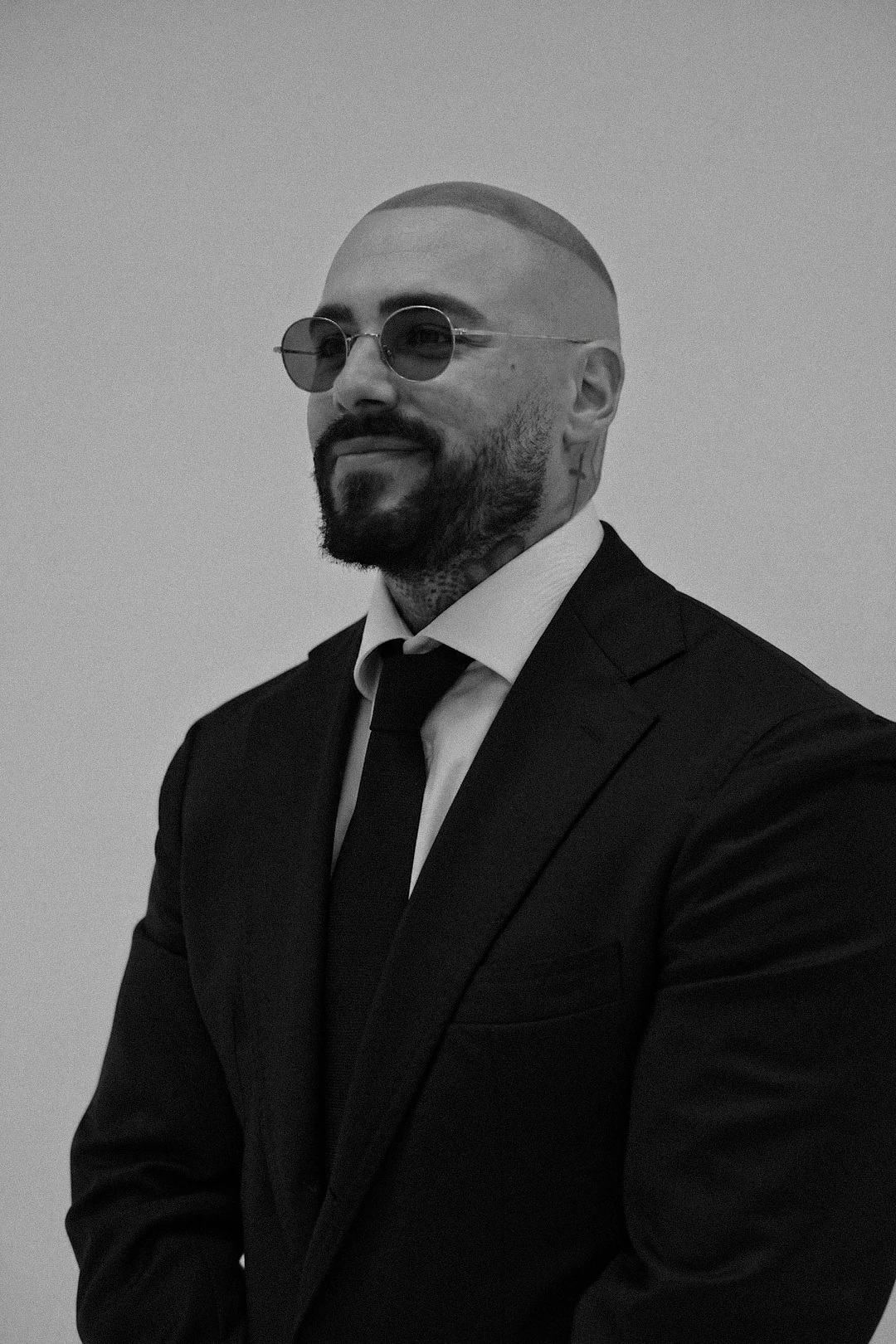
Francesco Acri
CEO & Founder
Founded Bliss and leads its direction today.
At board level, works alongside CEOs and Boards of Directors on strategic decisions, overseeing their implementation.

Ginevra De Filippis
Chief Operating Officer (COO)
The company’s metronome: coordinates its operations, manages partner relationships and improves internal processes, ensuring continuity across projects.

Mario Antonini
Chief Design Officer (CDO)
Interprets the Bliss vision and leads its visual expression. As CDO, coordinates identity, web architecture and VFX, giving ideas concrete form.

Andrea Maso
Head of SEO
Head of SEO at Bliss, analyses the data that steers digital decisions. Supports clients from planning through to the optimisation of organic visibility.

Gianluca Sabbini
Head of Video Production
Head of Video Production at Bliss, leads the audiovisual department and directs video production for advertising campaigns.
Start here
Think your brand depends too much on you? First answer this question: without you, is what you have built worth the same?
Tell us about your business. Every fee proposal will start from a clear mandate, defined together in a working session
The comparison
Where the standard approach stops
Few treat the brand as an asset to be made autonomous and transferable. And so they produce brand guidelines or editorial plans, trying to solve something they have not yet recognised. They ignore the problem. We don’t.
| Criterion | Standard approach | Bliss |
|---|---|---|
| Starting point | They start with communications: new graphics, a new website, a new tone of voice. The dependence on the founder remains intact. | We start with the diagnosis: where the real points of dependency lie, how much they weigh, and what would happen if the founder left tomorrow. |
| What we deliver | A document with visual and verbal guidelines. Static, destined to become obsolete within six months. | A living operating system: positioning, company story, rules for every brand decision. Updatable over time. |
| The team at work | Often creative figures from outside the brand, with no continuity on the project. | A dedicated senior point of contact for the entire programme, from diagnosis to management of the transition. |
| After delivery | No oversight. The system is applied, or not, without control. | Ongoing monitoring of brand consistency during and after the transition. |
| Presence in AI systems | Not considered. AI models continue to describe the brand as dependent on its founder. | Governance includes overseeing the brand's presence on ChatGPT, Perplexity and Google AI: the brand is described on its own terms, regardless of who leads it. |
4.9/5
207 verified reviews
Verified reviews
In the words of those who chose us





Bee Lab
“Professional, dynamic team. They work around the clock and fully embrace the projects they take on, led by a highly skilled and visionary leader!”
5.0
Marco Contigiani
“A simply exceptional communications agency.
From the very first contact you sense professionalism, expertise and close attention to the client’s needs”
5.0
Nicole
“Thanks to Bliss Agency we doubled our quote requests and gained more visibility in our area. They proposed a clear editorial plan that was easy to follow and extremely effective.”
5.0
Anna Rossi
“Not just an agency, but a true partner. With Bliss Agency I felt listened to and understood from the very first meeting. They turned ideas into a concrete project”
5.0
Certified Agency
Certifications

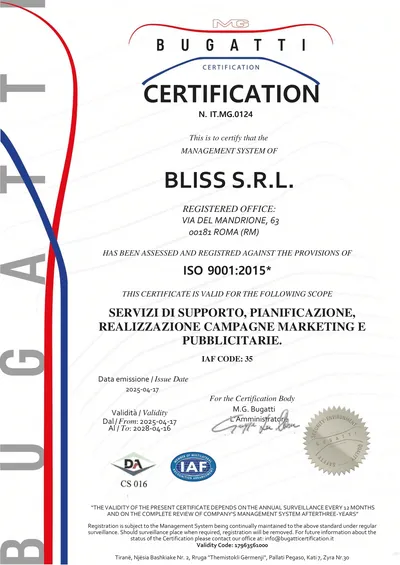
ISO 9001 – Process quality and work organisation.

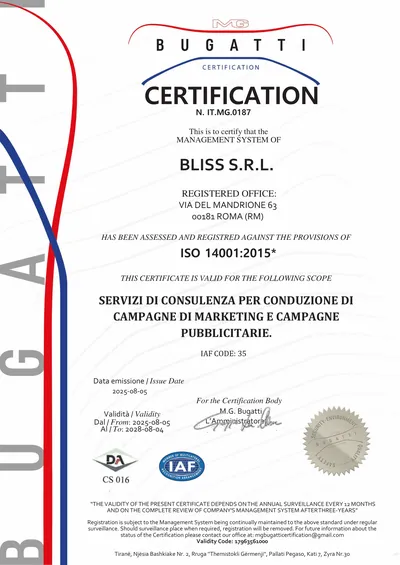
ISO 14001:2015 – Managing the environmental impact of business activities.

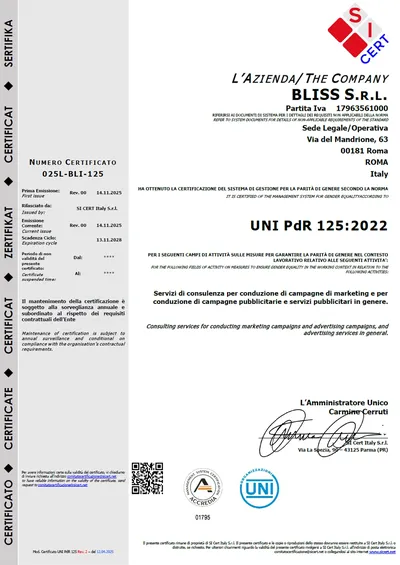
UNI PDR 125:2022 – Gender equality in processes, policies and organisation

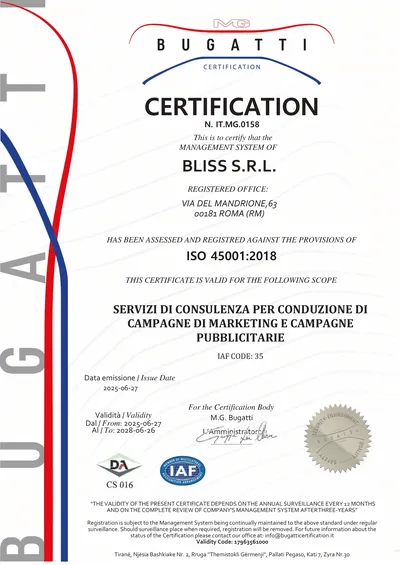
ISO 45001:2018 – Occupational health and safety.

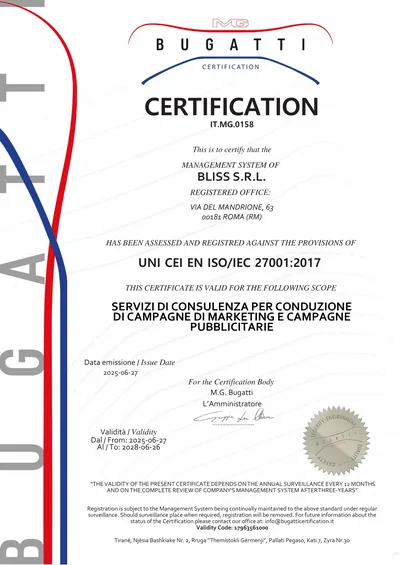
ISO/IEC 27001:2022 – Information, data and access security.
Frequently Asked Questions
Frequently asked questions about founder-independent branding
1 - How do I make my company independent of me?
To achieve this, you have to start from what currently exists only in the founder’s head: the positioning, the decision criteria, the way of speaking, the values. At that point it can be turned into a written, applicable system. Once these things are documented and made available to the team, anyone can make consistent decisions without waiting for the founder. The founder stops being a bottleneck and becomes a strategic, not operational, point of reference.
2 - What is my company worth if it depends on me?
Anyone who buys or invests in a company weighs the risk of losing the founder. If the brand depends on their presence, that person is a risk. The discount applied to the company’s value ranges from 10 to 25%. For a 10-million company, that means losing up to 2.5 million: not because the accounts are wrong, but because nobody has built a brand that works on its own.
3 - Do I have to disappear from my brand's communications?
There is no need to erase the founder for the brand to emerge. What matters is repositioning them. The founder’s personal brand can continue to exist, create value and open doors. The aim is to build something that exists in parallel: a corporate brand with its own identity, which works even when the founder is not present. The two can coexist. What matters is that neither depends on the other.
4 - How long does it take to make my brand independent of me?
The standard programme runs over six to twelve months. Timing depends on how deeply rooted the dependence on the founder is and how much time remains before the event that makes change necessary. Those who start earlier achieve more solid results.
5 - What is the difference between founder-independent branding and generational handover?
Generational succession transfers the leadership of the company. Founder-Independent Branding transfers the brand. They are two different operations, but they often overlap: for generational succession to succeed, the brand must already be autonomous. Otherwise the successor inherits the company but not the market’s trust.
6 - When should I start stepping back from my brand?
Sooner than seems necessary. The worst moment is when the dependency has already become a visible problem: during a sale negotiation, during a leadership handover already under way, during a crisis. The best moment is when the company is performing well and there is room to work calmly. Those who wait for urgency pay more for worse results.
7 - My brand is so closely tied to me that separating the two seems impossible. Can it be done?
Yes. Even in the most extreme cases, such as the three Italian examples described on this page, there are elements that can be built alongside the person: a recognisable method, a corporate promise, a documented quality system. The further the fusion has gone, the longer the work. But it is never impossible.
8 - If a reputational crisis is under way, is this the right service?
No. When there is an active crisis, the right service is the Brand Recovery Program. Founder-independent branding is preventive, structural work: it works best without an emergency under way. The two programmes fit together in sequence: first the crisis is managed, then the system that prevents drift is built.