Link Building
Every link is a vote
of trust.
Worth as much as whoever casts it.
Google reads the web as a network of academic citations. Every inbound link is a signal: someone, somewhere, has decided that your site is reliable enough to deserve a reference. The standing of whoever makes that judgement determines the weight Google gives it.

A link from La Repubblica is worth as much as thousands of links from aggregator sites. An editorial backlink from a recognised trade publication transfers authority that builds up over time and does not stop when the budget runs out. Bliss builds genuine editorial backlink profiles. And we do it for ourselves first, and for our partners second.
Definition
What link building is
and why Google cares so much about it
Link building (or SEO link acquisition, in its modern sense) is the set of activities aimed at acquiring backlinks (inbound links) from other websites to your own domain. For Google, every backlink is a signal of authority: someone has decided that the domain deserves a citation. The algorithm assesses the quality, quantity, thematic consistency and naturalness of the profile to determine a domain’s authority. One of the main organic ranking factors.
The concept goes back to the heart of the PageRank algorithm, patented by Larry Page and Sergey Brin in 1998: links as votes of trust between web documents. Almost thirty years on, the principle holds. Google has changed the relative weight of ranking factors dozens of times, but has always considered quality backlinks among the most important signals in determining where a page deserves to appear in the SERP.
The difference from 1998 lies in the sophistication of the assessment. Google now distinguishes between earned editorial links, paid links, artificial links and links in thematically inconsistent contexts. It can read patterns, acquisition velocity and anchor text distribution. Manipulating the algorithm is impossible. Link building in 2026 therefore means building genuine editorial authority.


96%
of pages in position 1 on Google have at least one backlink from an external domain
2.2×
the average organic traffic of pages with backlinks compared with those without
66%
of web pages have not a single backlink and receive close to zero organic traffic
Why invest in link building
When a company does not appear among Google's top results, the problem is not always in the site's content. Often it lies in how Google perceives that company relative to others: how often it is cited, by whom, and in what contexts. Link building is the activity that builds that perception over time.
Increase domain authority
Google also assesses every site on how many other authoritative sites cite it. A company cited by recognised trade publications is considered more trustworthy than one that is not, all content being equal. This authority accumulates over time and continues to produce effects even when acquisition activity slows down.
Improve positioning for strategic keywords
Pages ranking first on Google almost always have more high-quality backlinks than those below them. Link building does not replace content, it amplifies it: with equal editorial quality, the site with greater external authority wins.
Capturing qualified traffic from other channels
A link in a trade publication does not just bring SEO authority: it also brings real readers who click through to the company’s website. These visitors are already interested in the subject, and therefore closer to a decision to buy or get in touch.
Closing the gap with competitors
In almost every sector, the competitors best positioned on Google have a stronger backlink profile. Analysing where their external authority comes from shows exactly where to act to close the gap and, over time, overtake them.
Preventing penalties
Not every link pointing to a site is useful. Backlinks from unreliable or thematically inconsistent sources can damage positioning. Ongoing management of the backlink profile makes it possible to identify and neutralise them before they have a negative effect.
Building lasting editorial relationships
The publications and portals that cite a company become, over time, channels of recurring visibility. An editorial relationship built with a trade publication does not produce a single link: it produces an ongoing presence in a context where the right audience is already present.
OUR SEO RESULTS
Success stories
These results show what happens when SEO, content and AI Search are turned into a genuine growth engine. Leads, sales, qualified traffic and revenue growth: every case study presents concrete data, verifiable results and performance built to generate real business.
Valle D'Aosta
Bliss supported the Aostæ 2025 project in building an institutional digital ecosystem designed to enhance the region, its events and public communication.
Backlink quality spectrum: from toxicity to editorial authority
Link building for SEO is measured on the basis of the quality of the sources, their thematic consistency, the diversification of referring domains and the naturalness of the profile over time. A single editorial link from an authoritative publication can have more impact than a thousand links from artificial sites; indeed, those thousand artificial links may penalise the domain rather than help it.
Spam links, PBNs, artificial directories
Sites built to sell links, private blog networks, link farms or generic directories with no real traffic. They pass negative signals. They must be identified in the audit and disavowed via Google Search Console. They can lead to algorithmic or manual penalties
Thematic directories, forums, low-quality guest posts
Links with little impact on authority. Not necessarily harmful, but they do not produce meaningful ranking. They saturate the profile without building genuine authority. Their weight in Google’s assessment is marginal or nil.
Industry blogs, niche digital publications
Links with a measurable impact on authority when they come from sources thematically consistent with the linked domain. Useful for building the profile in the early phase or in low-competition sectors. They do not replace high-authority editorial links.
National and trade publications, authoritative portals
Links from publications with high Domain Authority, real organic traffic and established editorial standing. Each link of this kind transfers significant authority, strengthens the domain’s E-E-A-T and contributes to citability in generative AI systems. These are the links Bliss works to secure.
Link building vs link buying
Buying links is the most expensive shortcut there is.
The link buying market (undisclosed paid links) is enormously widespread. Many SEO agencies practise it quietly. Prices range from a few tens of euros per link on low-quality sites to a few thousand per link on major publications. The problem, however, is the risk they accumulate
Buying links: the hidden risk
The signals Google uses to detect paid links include: unnatural anchor text patterns, anomalous acquisition velocity, an inconsistent source profile, and correlation between links and payments. Penalties range from loss of rankings to removal from the index. Links acquired on a monthly budget disappear when the contract ends, and with them the authority they had temporarily generated.
Earning links: the permanent asset
An editorial link earned through valuable content does not disappear when a contract ends. It stays in the domain’s profile and keeps transferring authority over time, like an investment paying compound interest. The key is to offer publications something with value in its own right. Bliss has built 392 referring domains for itself using this approach.
the method
How to build an editorial network,
in five stages
A valuable backlink profile must be governed over time. To achieve this, Bliss safeguards the editorial authority of its partners through an acquisition system that works on sources, relationships and content in parallel. One that grows stronger with every cycle.
Audit of the existing backlink profile
The mandatory starting point is a complete mapping of the existing backlink profile: active referring domains, anchor text distribution, per-link toxicity, topical consistency of sources. This audit produces two lists: links to disavow (toxic or artificial links that risk penalties) and links to replicate (the sources that transfer real authority and indicate the editorial territory where the brand already has a presence). Disavowing toxic links is often the first step, and produces results within a few weeks
Mapping authoritative sources
Every sector has a hierarchy of publications that Google and AI systems regard as authoritative. National titles, sector verticals, specialist portals. We build a map of the relevant sources for each partner, based on sector, geographic market and the type of query on which rankings need to improve. This map guides all subsequent work.
Editorial strategy for acquisition
The key question is: what can we offer these publications that is genuinely relevant to their readers? Proprietary industry data, original research, expert opinion, verifiable case studies, authoritative commentary on emerging trends. We build the editorial plan for link acquisition starting from this question. The result is content that publications choose to publish because it has value in its own right, and that generates natural editorial backlinks.
Editor relations and outreach
Authoritative outlets do not publish every press release they receive. Building relationships with editors (understanding what they are looking for, pitching it at the right moment, offering angles their peers are not covering) is the part of link building that cannot be automated. We nurture these relationships over time: not with mass emails, but with personalised approaches tailored to each publication and each journalist.
Profile monitoring and ongoing oversight
A domain's backlink profile evolves constantly: new links acquired, links lost (the linking site changes or closes), new toxic links appearing spontaneously. We monitor the profile monthly, presenting a monthly report with changes against the previous period and the expected impact on rankings.
Link building and GEO: one system, two effects.
The authoritative editorial publications from which Bliss secures backlinks are the same ones AI systems (ChatGPT, Gemini, Perplexity) use as sources to build their knowledge base on brands. An editorial link from a recognised publication is at once link building for SEO and GEO for visibility in generative answers.
Bliss vs traditional SEO agencies
What sets link building apart from
building digital authority
Link building should not be measured solely by the number of backlinks obtained. Its real value lies in the ability to build digital authority, secure consistent citations and strengthen the brand’s reputation in the right contexts.
| Criterion | Traditional link building | Bliss |
|---|---|---|
| Approach | Buying links on general-interest sites, often with no real editorial value. | We build authority through digital PR, strategic content, qualified citations and reputational consistency. |
| Link quality | Assessment based mainly on metrics such as DR, DA or estimated traffic. | We assess relevance, editorial context, source credibility, semantic consistency and impact on the brand. |
| Strategy | Links distributed across anchor texts and target pages. | An architecture of authority built around pillar pages, strategic content, entities and corporate positioning. |
| Risk | Repetitive activities that can create artificial or low-credibility profiles. | A controlled, gradual process consistent with the brand's sector, tone and positioning. |
| AI Search | No attention to the brand's citability in generative engines. | We also use digital authority to strengthen the signals that matter to Google AI Overviews, ChatGPT, Perplexity and entity recognition systems. |
| Result | Numerical increase in backlinks. | Greater perceived authority, greater trust and a stronger capacity for the brand to be recognised as a source. |
THE TEAM
Our voices
leading the way
Bliss’s SEO is managed by a team with experience of organisations with complex sales cycles in tech, manufacturing and professional services: sectors where the buyer is a decision maker with structured evaluation processes and long purchasing timelines.
Andrea Maso
HEAD OF SEO
International background, a data-driven mind and no intention of slowing down.
Mario Antonini
chief design officer (cdo)
Luca Maletta
Head of Copywriting
Sajjad Mazaherizaveh
Full stack developer
Combines front-end and back-end development with technical SEO and AI Search Optimisation.
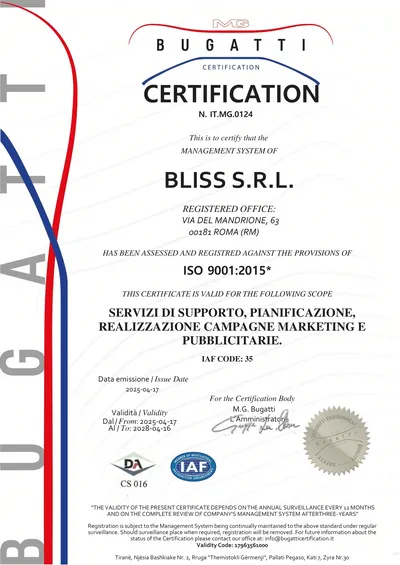
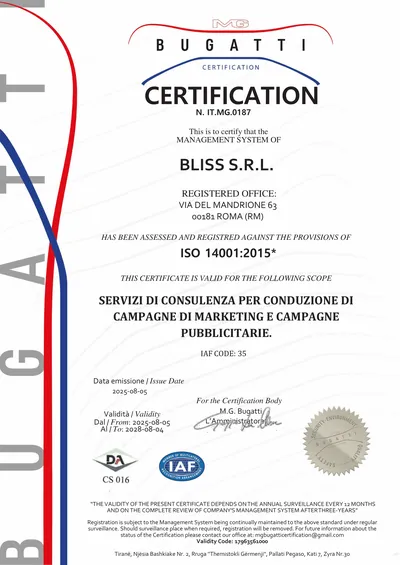
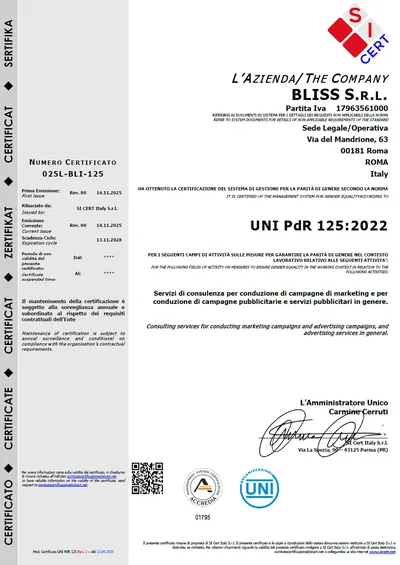
Certified Agency
Certifications
Partner
Blog & Trends 2026
The publications that have covered Bliss
The 392 referring domains linking to Bliss belong to publications, magazines and portals that have mentioned us in their own editorial content, helping over time to build the authoritative profile of blissagency.it. Here are some of the publications that have featured Bliss in their articles and in-depth pieces.
SEO FAQ
Frequently asked questions about link building
What is link building in SEO?
Link building is the set of activities aimed at acquiring backlinks from other websites to your own domain. For Google, every backlink is a signal of authority. The algorithm assesses the quality, quantity, thematic relevance and naturalness of the profile to determine a domain’s authority, one of the main organic ranking factors.
A solid backlink profile is an asset that builds up over time: acquired links continue to transfer authority for as long as they remain in the profile, regardless of ongoing activity.
What is the difference between link building and link buying?
Link buying (purchasing undisclosed links) violates Google’s guidelines and can lead to algorithmic or manual penalties that wipe out organic positioning. Google detects artificial links through anchor text patterns, abnormal acquisition speed and an inconsistent source profile.
Editorial link building relies on genuinely valuable content that publications choose to cite. Bliss does not buy links. It builds real editorial authority, as it has done for itself, growing from 10 to 392 referring domains.
How many backlinks does it take to improve rankings?
There is no minimum number. A single editorial link from an authoritative, thematically relevant publication can have more impact than a hundred links from low-authority sites. What matters is the quality of the sources, the diversity of referring domains and how natural the profile remains over time.
Bliss works on impact, not volume. The right question is not “how many links” but “from which sources”.
What is link acquisition and how does it differ from traditional link building?
Link acquisition is the modern technical term for acquiring editorial backlinks, as opposed to traditional link building, which historically included practices Google now considers spam (directory submission, link farms, reciprocal linking).
Modern link acquisition is built on valuable content, digital PR and relationships with authoritative publishers. Bliss takes an editorial link acquisition approach integrated with its Digital PR activities.
How long does link building take to affect rankings?
The first effects on domain authority are seen three to six months after acquiring quality backlinks. The effects on ranking depend on the competitiveness of the target queries and on the overall structure of the domain.
Link building produces lasting results because it builds real authority: acquired links remain in the profile and continue to pass link equity over time, unlike paid advertising, whose effects stop the moment it is switched off.
Does link building also work for visibility in generative AI systems?
Yes, directly. Language models (ChatGPT, Gemini, Perplexity) use as primary sources the same authoritative editorial publications that Google considers trustworthy. A brand regularly cited in La Repubblica, Il Sole 24 Ore, Startup Italia or trade publications is included more frequently in AI answers.
Editorial link acquisition is at once link building for SEO and GEO for AI visibility: the same backlink produces effects on both fronts.
What is a toxic backlink profile and how is it managed?
A toxic backlink profile is made up of links from spam sites, PBNs, artificial directories or penalised sites. These links pass negative signals to the domain and increase the risk of algorithmic penalties.
Management includes: a full audit with tools such as Semrush, Ahrefs or SEOZoom; identification of toxic links; disavow via Google Search Console. Bliss carries out this audit as the first step in any SEO project, and did so on itself as the starting point of its own journey.
What is the difference between link building and Digital PR?
Digital PR builds reputation: mentions, interviews, quotes, with or without an editorial link. Link building builds SEO authority: backlinks that pass link equity to the domain and improve organic ranking.
Bliss integrates the two activities into a single system: every Digital PR action is also designed to generate high-quality backlinks. Publications that cite the brand with an editorial link simultaneously contribute to its reputation, its SEO authority and its citability in AI systems.