



Generational Continuity
Every company has a founder.
Not every brand has a
futuro
In Italy around 70% of family businesses do not survive the first generational transition. The stated causes are often financial. But there is often another: the brand lived in the founder’s head. And it stayed with them.
Generational Continuity is a Governance service created for exactly this: putting on paper what exists only in the head of whoever has run the brand for so many years, and turning it into a transferable, governable system, ready for whoever comes next.
DISCOVER GOVERNANCE
Brand governance
Political brand governance
Generational continuity
Brand recovery
Founder-independent branding
Brand governance
Political brand governance
Generational continuity
Brand recovery
Founder-independent branding
Brand governance
Political brand governance
Generational continuity
Brand recovery
Founder-independent branding
Brand governance
Political brand governance
Generational continuity
Brand recovery
Founder-independent branding
Brand governance
Political brand governance
Generational continuity
Brand recovery
Founder-independent branding
Brand governance
Political brand governance
Generational continuity
Brand recovery
Founder-independent branding
Brand governance
Political brand governance
Generational continuity
Brand recovery
Founder-independent branding
Brand governance
Political brand governance
Generational continuity
Brand recovery
Founder-independent branding


TABLE OF CONTENTS
Blissionary
Generational Continuity: Meaning
/ˌkontinuiˈta dʒeneratsjoˈnale/
n. Brand Governance service designed in particular for founders preparing for an exit and for organisations facing a generational transition. It works by mapping brand assets, formalising them into operating rules and building a transferable system. It turns principles into governable processes that can be defended in due diligence and are ready for whoever comes next.
The problem we solved
Thirty years of work. Zero guidance
Whatever the reason, the passing of the torch is always an emotional moment. The company that for years was built in the image and likeness of its founder is taken over by someone else. Accountants, notaries and advisors get to work straight away on figures, shares and taxes.
Yet nobody thinks about the brand.
How should suppliers be handled? How do you communicate consistently? How do you tell the story of the transition? Often it is not written down anywhere, because there is no dedicated counterpart for a phase as delicate as this.
At least, until now.
Where it all began
Preserving our legacy
Only 30% of Italian family businesses reach the second generation.
13% reach the third.
4% the fourth.
With these numbers, years of sacrifice by Italian entrepreneurs risk disappearing: and certainly not for lack of heirs.
We have seen it happen too often, and in these figures we recognised a Governance problem. That is why we built a system to prevent it.
Our thinking
A company is sold.
A brand is passed on.
Years upon years of decisions, relationships and knowledge do not deserve to be forgotten. We believe the true legacy of someone who builds a business is not their company, but their way of working.
That way of working is the brand. And for a brand to survive, it needs to be written down somewhere, so that someone, sooner or later, can consult it. Because a legacy without instructions is not a gift.
It is a burden.
The numbers
35,000 Italian companies
begin a succession every year
Yet few prepare the brand for the transition.
For years the focus is on the financial, legal and tax side, while the brand remains undocumented.
The numbers show it.
The right counterparts
Why accountants, advisors and standard agencies are not enough
Every generational transition brings in sector specialists. Each one takes care of their own area. Rarely does anyone think about the brand.
| Counterpart | What it does, and what it doesn't |
|---|---|
| Accountant | They see the numbers. Documenting a positioning or structuring a Brand Asset Book is not part of their mandate. |
| M&A Advisor | They identify the problem in the report and flag it as “high key person risk”. Solving it is not part of their mandate. |
| Communications agency | It produces content, without building transferable governance systems or valuation-ready documentation. |
| Bliss | It oversees the brand perimeter, as a complement to the other advisers involved. |
Who it is for
Who needs
Generational Continuity?
Generational Continuity is designed for those who have built something worth passing on, and want that transfer to happen with method. That is why it proves particularly useful to:
Those approaching the sale of their business.
Whether the handover is to a child, to an external manager, or through a sale in the next five years, makes no difference. What you have built over thirty years deserves to be documented. The time to do it is now, before urgency forces it.
For those who have inherited a brand but do not know where to begin.
You have inherited a company built by someone else. You know the numbers and the products, yet you don’t know how to negotiate, how to approach clients, how to make decisions. At such an intense moment, Generational Continuity helps you reconstruct, working backwards, the system no one had ever written down.
For those who have already been through one transition and know there is another ahead.
The second generation took over the company. It learned, adapted and grew the business. But the brand is still tied to the story of the original founder, and the third generation is approaching.
Building the system now means not having to start from scratch at the next handover, which is often the hardest.
For those who want to step away from day-to-day operations without losing control of the brand.
Perhaps you are not planning a sale. You are not thinking about an heir. You simply want to stop being present at every decision: to delegate, to grow, to step back from your role. Generational Continuity builds the system that makes that freedom possible, without the brand losing coherence in the process.
Our method
From generation to generation,
one brand
Every brand is unique, as is the story of its founders. Bringing past and future together in a single narrative, the method works on three dimensions:
| Size | Without governance | With Bliss governance |
|---|---|---|
| Business valuation | Key person discount of 10-25% on valuation. The brand does not withstand due diligence without the founder. | A documented, defensible brand. The Brand Asset Book eliminates or reduces the key person discount in negotiations. |
| Speed of transition | The successor learns by watching the founder. The process takes years and is never complete. | The Brand Governance System transfers operating rules to the successor systematically and measurably. |
| Post-handover consistency | The brand fragments in the months following the transition. The market perceives the change before the company is aware of it. | The governance system maintains coherence regardless of who makes the day-to-day decisions. |
4.9/5
207 verified reviews
Verified reviews
In the words of those who chose us





Bee Lab
“Professional, dynamic team. They work around the clock and fully embrace the projects they take on, led by a highly skilled and visionary leader!”
5.0
Marco Contigiani
“A simply exceptional communications agency.
From the very first contact you sense professionalism, expertise and close attention to the client’s needs”
5.0
Nicole
“Thanks to Bliss Agency we doubled our quote requests and gained more visibility in our area. They proposed a clear editorial plan that was easy to follow and extremely effective.”
5.0
Anna Rossi
“Not just an agency, but a true partner. With Bliss Agency I felt listened to and understood from the very first meeting. They turned ideas into a concrete project”
5.0
Certified Agency
Certifications

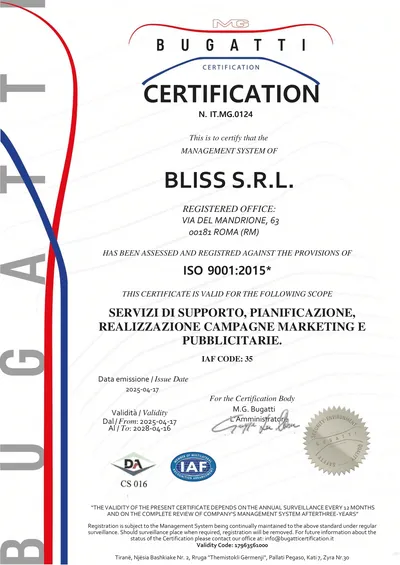
ISO 9001 – Process quality and work organisation.

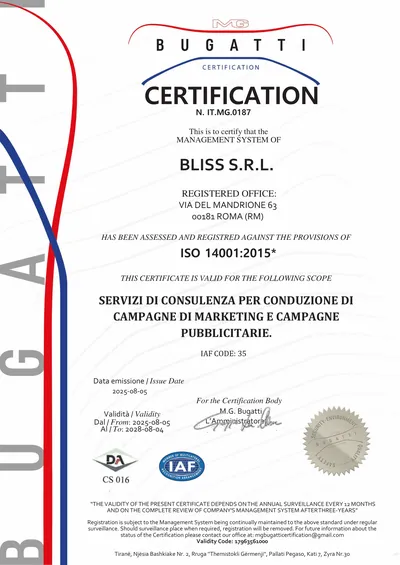
ISO 14001:2015 – Managing the environmental impact of business activities.

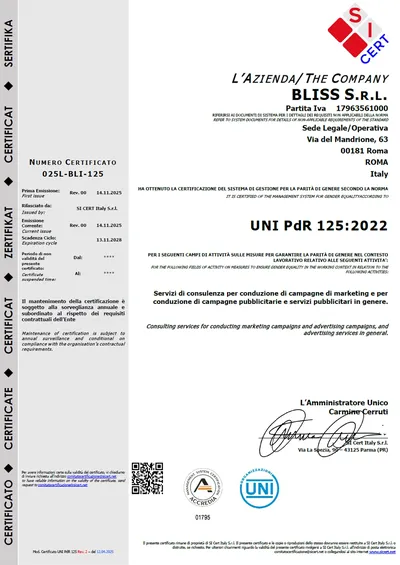
UNI PDR 125:2022 – Gender equality in processes, policies and organisation

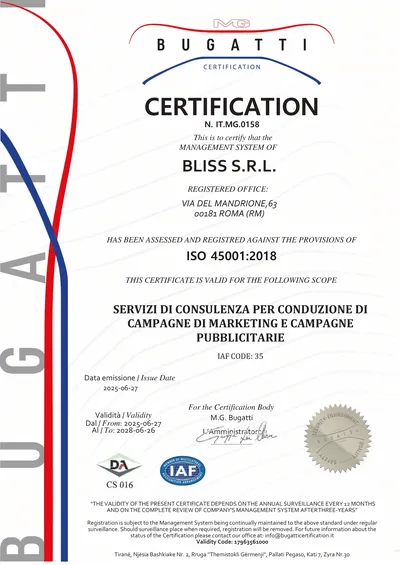
ISO 45001:2018 – Occupational health and safety.

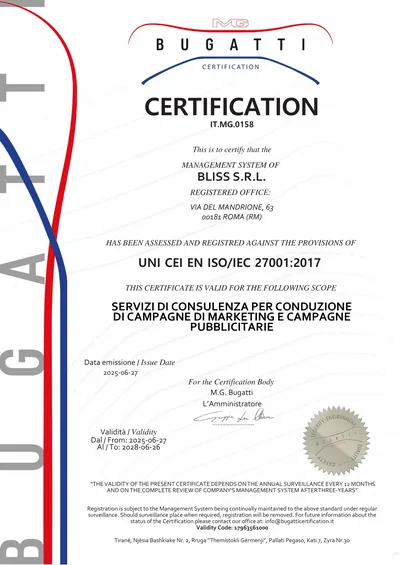
ISO/IEC 27001:2022 – Information, data and access security.
FAQ
Frequently asked questions about Generational Continuity
1 - How is ownership of a brand transferred?
Ownership of the trademark passes through corporate and notarial deeds. For the brand to pass as well, a structured process is needed, Generational Continuity, which transforms it It is a structured process that transforms the brand from a personal dependence on the founder into a documented, transferable asset. It is organised in three phases: Brand Governance Audit, Brand Asset Book and De-personalisation Plan. The starting point is always the diagnosis: without knowing how far the brand depends on the person, neither the risk nor the intervention required can be estimated.
2 - How do I know what my brand is worth before sale negotiations?
In M&A transactions and IPOs, the brand is often the asset that justifies the gap between book value and market price. When the brand depends on the founder, advisors may apply a key person discount that reduces the valuation by 10-25%. The Brand Asset Book is produced precisely to reduce this discount in negotiation.
3 - How long does the process take?
The standard programme (Audit, Brand Asset Book, De-personalisation Plan) runs over six to twelve months, depending on the complexity of the brand and the timing of the handover. Ongoing oversight has no fixed duration: it is structured in six-monthly review cycles. It is not artificially accelerated: de-personalisation is a process, not a restyling.
4 - When is the right time to prepare to transfer my brand?
The ideal moment is twenty-four to thirty-six months before the planned transition. Those who start early have time to produce documented, credible evidence. Those who start thirty days before signing have little to bring to the table. In practice, we also work under urgent conditions, but the result is proportional to the time available.
5 - I have no intention of retiring. Should I still prepare for an exit?
Yes. Generational Continuity also serves those who want to scale into new markets, bring in new managers and expand into new structures. If every brand decision still goes through the founder, the brand is not scalable. The system set out by the process reduces this dependence, even with no liquidity event on the horizon.
6 - Can the advisers I already work with handle brand continuity?
Each party oversees its own perimeter. Generational Continuity covers the brand’s: positioning, system governance, Brand Asset Book. We work alongside M&A advisers, accountants and law firms, without entering their areas of expertise and without requiring operational exclusivity. The Brand Asset Book is produced in a format that advisers and buyers recognise and know how to read.
7 - I have a personal brand. How do I prepare to transfer it?
The work goes deeper, but it is not impossible. There are brand elements that can be built alongside the founder: a recognisable method, a corporate promise, a documented quality system, a narrative that includes the founder without depending on them. The time required depends on how far the fusion has gone. The degree of dependence is assessed in the audit phase, before anything else.
8 - Is this the right service if I am going through a reputational crisis?
No. For active reputational crises the dedicated service is the Brand Recovery Program. Generational Continuity is preventive, structural work: it works best when there is no emergency under way. The two services fit together in sequence: first the crisis is managed, then the system that prevents drift is built.