


Brand Audit
Understand before acting: this is Bliss Audit
Imitating competitors leads, at best, to following them.
Many agencies offer new clients what worked elsewhere. The Audit is the line that separates those who hope a campaign will work from those who want to know where to invest.
That is why we analyse the ground you operate on, and find the open space for you to occupy.


DISCOVER ADVISORY
Brand advisory
Brand audit
Brand strategy
Marketing advisory
Brand advisory
Brand audit
Brand strategy
Marketing advisory
Brand advisory
Brand audit
Brand strategy
Marketing advisory
Brand advisory
Brand audit
Brand strategy
Marketing advisory
Brand advisory
Brand audit
Brand strategy
Marketing advisory
Brand advisory
Brand audit
Brand strategy
Marketing advisory
Brand advisory
Brand audit
Brand strategy
Marketing advisory
Brand advisory
Brand audit
Brand strategy
Marketing advisory
Brand advisory
Brand audit
Brand strategy
Marketing advisory
Brand advisory
Brand audit
Brand strategy
Marketing advisory
TABLE OF CONTENTS
Blissionary
Audit: Definition
/’ɔːdɪt/
n. (pl. audits) A service that analyses the data, flows and structures of a brand or company to assess its points of contact with the market, its alignment with objectives and the latent risks before they turn into financial damage. It produces an objective X-ray that certifies what works, what is burning budget and where the greatest opportunities lie hidden. It is the diagnosis that comes before any strategy.
The problem we solved
Treating the symptoms while ignoring the disease
Many marketing agencies sell services before understanding the context. So they propose a new website, paid campaigns, the latest trends. All cures that ignore the disease.
The result? Companies wasting budget without reaching their objectives, diluting the meaning of the word marketing to the point of devaluing it.
Where it all began
From finance to marketing
In healthy markets, nobody wakes up in the morning deciding to invest a million on gut feeling, copying someone else’s strategy.
First the numbers, the risks and the weak points are analysed.
If the numbers add up, you invest. If they don’t, you stop. Full stop.
The marketing world, however, has always worked the other way round. Then we came along.
Our thinking
Direction before action
Before any work, we analyse the entire ecosystem.
How the company makes decisions. What assets it owns. Where it loses value.
Together, this data provides a real map of the brand, which is all you need to know to get started.
That is what the Audit is.
Who it is for
Who is an Audit for?
The Audit is designed for those who must make important decisions about their brand. Before investing, growing or changing strategy, it is essential to understand the starting point, the strengths, and the problems holding back results.
For those about to launch a brand strategy
Before building, you need to know where you are starting from. Any initiative launched without an initial diagnosis risks optimising the wrong things. The Audit sets the baseline against which everything else is measured.
For those investing in marketing without seeing results
When campaigns spend but do not convert; when traffic grows but sales do not; when you change agency and the problem remains, there is almost always an issue no one has identified. The Audit’s job is to find it.
For those opening up to new markets
Before investing in communications in a new market, it is worth knowing how the brand is perceived there: what do people find when they search for you on Google? What does ChatGPT say? What authority do you have? The Audit answers these questions.
Those preparing for a sale, an acquisition or a fundraising round
During due diligence, the brand is analysed by those who are buying or investing. Arriving with an Audit already in hand means controlling the narrative rather than being subjected to it. The Bliss report is produced in a format that financial advisers and prospective buyers can read equally well.
Our method
How the Audit is structured
over eight weeks
Over its eight weeks, the Audit follows a four-phase process. Each phase produces data that feeds into the next.
Weeks 1–2
Data collection
Access to analytics tools. Collection of historical data on every touchpoint. Sector benchmarks and competitor analysis.
Weeks 3-5
In-depth analysis of each of the five touchpoints. Website, generative AI systems, social, SEO, paid. Numerical scoring on a proprietary Bliss scale.
Weeks 6-7
Week 8
Report and presentation
Drafting of the full diagnostic report. Presentation to senior leadership with an in-depth session on priorities.
Our output
The end result
The outcome of the Audit is a complete diagnostic document.
The Audit analyses the brand and its ecosystem. You can use it internally to identify intervention priorities, share it with the board as a basis for strategic decisions, or present it in a due diligence process as a documented, verifiable snapshot.
01.
Brand Equity
Every brand accumulates economic value over time. This module measures how much of that value reaches digital intact and how much instead leaks away.
What we analyse
– Brand value
– Ability to sustain premium positioning
– Dispersion of brand value
– Competitive strength in the digital market
– Ability to generate direct demand

02.
Brand Governance
A group with multiple brands, multiple sites and many internal stakeholders risks communicating in different ways. This module looks at how the brand voice is managed: who decides what, on what criteria, and whether the end result is a coherent system or a series of separate initiatives.
What we analyse
– How many versions of the brand exist
– How many entities communicate in different ways
– Differences in tone of voice
– Narrative consistency
– Omnichannel visual consistency

03.
Share of Voice
How much space the brand occupies relative to competitors: who talks the most, where, and whether that presence generates real positioning. The analysis extends across two fronts: visibility in traditional search engines and presence in the new generative engines.
What we analyse
– Share of attention in the market
– Visibility relative to competitors
– Media coverage and PR
– Relevance in sector communities

04.
Distinctive Elements
What makes the brand instantly recognisable and what instead blends in with the market. This module identifies the distinctive elements the brand already owns: visual, narrative, values-based. Those to amplify and those that are not yet perceived today.
What we analyse
– Editorial content and owned media
– Visual and photographic assets
– Updating of proprietary assets
– Video library and branded content

05.
Psychographic Insights
Numbers tell you how many people there are. This module tells you who they are, what they want and why they choose. A qualitative analysis of the real drivers that move the target audience, so you speak to people, not to the market.
What we analyse
– Audience interests
– Implicit expectations
– Purchase drivers
– Emotional drivers of choice
– Breakdown by interests, age and household

06.
Online Customer Journey
From first contact to purchase decision, every step leaves a trace. This module reconstructs the user’s actual journey to understand where the system works, where it loses people and where it leaves opportunities open.
What we analyse
– Information architecture and hierarchy
– Clarity of navigation paths
– Friction in the conversion path
– Drop-off at critical points in the journey
– Interaction with forms and key components

07.
Conversion Capability
Generating traffic and attention is only the first step. This module assesses the real capacity to convert: structure, clarity and quality of the journey at the moment the customer is ready to act.
What we analyse
– Pre-contact experience
– Friction in the decision funnel
– Speed of response to leads
– Perceived quality of the contact process
– Lead generation paths

THE TEAM
The team behind the Audit
The Audit is carried out by a team with integrated expertise in technical SEO, data analysis, brand strategy and GEO optimisation. Each area is analysed by a specialist in the relevant discipline. The final report is written and presented by a senior lead who brings the analyses of the individual areas together into a single, unified reading.

Francesco Acri
CEO & Founder
Founded Bliss and sets its direction today.
At board level, works alongside CEOs and Boards of Directors on strategic decisions, overseeing their implementation.

Ginevra De Filippis
Chief Operating Officer (COO)
The company’s metronome: coordinates its operations, manages partner relationships and improves internal processes, ensuring continuity across projects.

Mario Antonini
Chief Design Officer (CDO)
Interprets the Bliss vision and leads its visual expression. As CDO, coordinates identity, web architecture and VFX, giving ideas concrete form.

Andrea Maso
Head of SEO
Head of SEO at Bliss, analyses the data that steers digital decisions. Supports clients from planning through to the optimisation of organic visibility.

Gianluca Sabbini
Head of Video Production
Head of Video Production at Bliss, leads the audiovisual department and directs video production for advertising campaigns.
Start here
What does the market find when it searches for your brand? And what does AI say about it?
In eight weeks, the Audit will put it in black and white.
Tell us about your organisation. Every fee proposal will start from a clear mandate, defined together in a working session.
The Comparison
The difference between knowing and understanding
Many agencies offer an Audit as an entry-level service.
The difference, however, lies in the depth of the analysis and the coverage of touchpoints.
An Audit is only useful when it is complete. Here is why:
4.9/5
207 verified reviews
Verified reviews
In the words of those who chose us





Bee Lab
“Professional, dynamic team. They work around the clock and fully embrace the projects they take on, led by a highly skilled and visionary leader!”
5.0
Marco Contigiani
“A simply exceptional communications agency.
From the very first contact you sense professionalism, expertise and close attention to the client’s needs”
5.0
Nicole
“Thanks to Bliss Agency we doubled our quote requests and gained more visibility in our area. They proposed a clear editorial plan that was easy to follow and extremely effective.”
5.0
Anna Rossi
“Not just an agency, but a true partner. With Bliss Agency I felt listened to and understood from the very first meeting. They turned ideas into a concrete project”
5.0
Certified Agency
Certifications

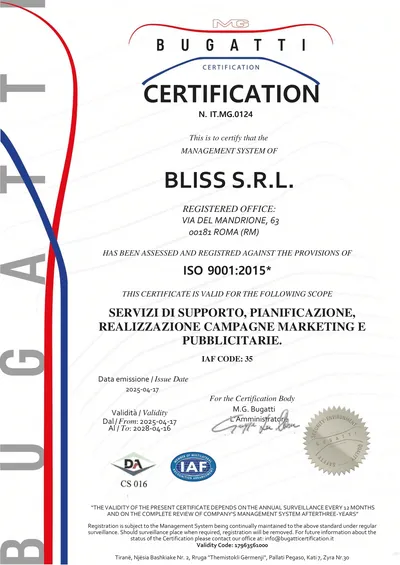
ISO 9001 – Process quality and work organisation.

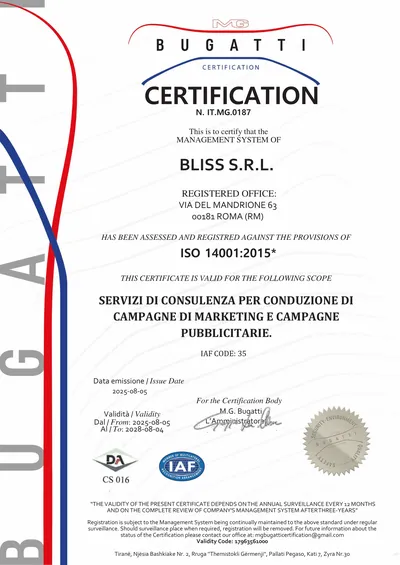
ISO 14001:2015 – Managing the environmental impact of business activities.

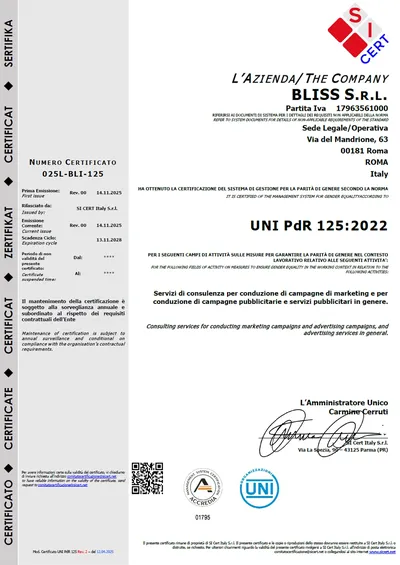
UNI PDR 125:2022 – Gender equality in processes, policies and organisation

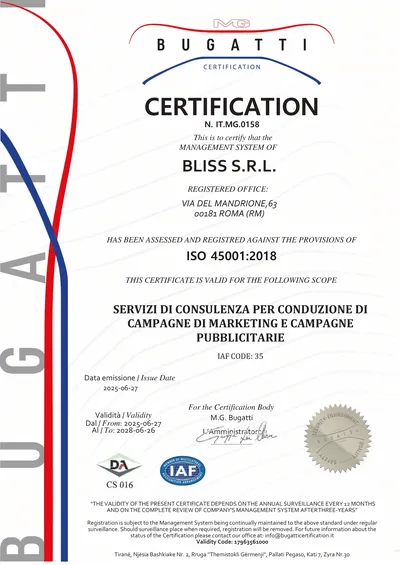
ISO 45001:2018 – Occupational health and safety.

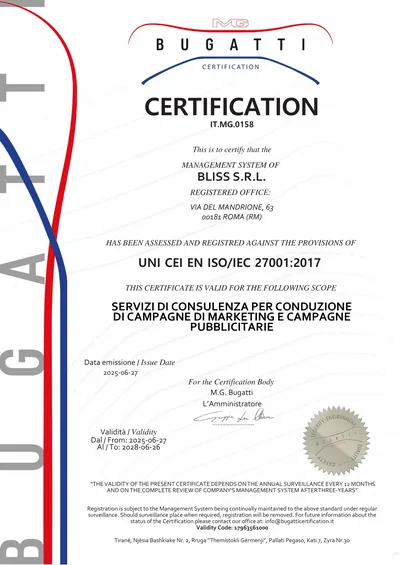
ISO/IEC 27001:2022 – Information, data and access security.
faq
Audit FAQs
1 - What does an Audit usually include?
The most frequent findings are the “symptoms” of a brand disconnected from reality: crawl budget wasted on non-strategic pages, semantic authority squandered on keywords with no commercial value, and a marked inconsistency between how the brand describes itself and how AI systems interpret it. Often we also uncover paid campaigns funding off-target queries and social assets speaking to an audience demographically distant from the real one.
2 - Is the Audit a mandatory first step before any project?
Not mandatory, but almost always advisable. In rare cases a brand already has a crystal-clear diagnosis and can move straight to strategy. In most cases, however, the diagnosis management has in mind does not match what the data says. The Audit defuses this ambiguity before it turns into a very costly strategic mistake.
3 - Do we need to give you the keys to all our platforms? What access is required?
We only need the access required to read the reality of the data, strictly read-only. Specifically: Google Search Console, Google Analytics 4, Google Ads, the analytics panels of your social channels and access to the website CMS. For the analysis of your presence in AI systems, however, no access is needed: we query the generative models directly from the outside, exactly as the market would.
4 - And once the Audit is finished? What happens next?
The Audit is not the destination but the starting point. Once it is complete, we have a clear picture of the brand, the issues to resolve and the opportunities to seize. From there, subsequent decisions (whether a Brand Strategy, a repositioning or operational interventions) rest on solid ground rather than assumptions.
5 - But we know our brand inside out. Do we really need an Audit?
You know your intention; the Audit measures the result. A company often sees its brand as it is described in internal meetings. The Audit shows how the market actually perceives it.
6 - Isn't looking at Analytics and the agency's monthly reports enough to understand how we're doing?
Traditional reports show vanity metrics or isolated data. The Bliss Audit is a systematic study that cross-references different channels: it relates real traffic to domain authority, digital sentiment and, above all, your presence in Artificial Intelligence systems. It does not just tell you “how many” users arrive, but “what” the market finds when it searches for you.
7 - If we do the Audit, does it mean we then have to rebuild the whole strategy from scratch?
No, it means no longer proceeding by trial and error. The Audit does not judge; it maps. At the end of the eight weeks you will know with surgical precision which assets are already working (and worth continued investment) and where value is being lost. It is a diagnosis: it serves to treat only what is ailing, optimising the budget.
8 - Isn't eight weeks too long for an analysis?
Moving fast in the wrong direction is the surest way to waste budget. Eight weeks is the time needed to gather clean historical data, analyse positioning on strategic keywords, map the competition and check visual and narrative consistency without cutting corners. It is not a wait; it is an investment in precision.
9 - We are an SME: is the Audit a tool suited only to large companies with large budgets?
On the contrary: it is SMEs that need it most. A large company can afford to get a fifty-thousand-euro campaign wrong; an SME cannot. The Audit exists to give certainty to those with focused resources, showing clearly which interventions will deliver the highest return (ROI) and the right order of priority for tackling them.
10 - Does the Audit then commit us to signing a long-term contract with you?
Absolutely not. The Audit is the natural starting point of an Advisory engagement, but it is designed as a fully standalone tool. It gives you a detailed map and a clear diagnosis: you are then free to decide whether to implement the solutions with us, with your in-house team or with other partners.