SEO for ecommerce
Google is your first customer.
Google visits your store every day. It studies the catalogue, analyses the categories, reads the product pages. Then it decides which stores deserve to be found and which do not, regardless of how much you are spending on advertising.
By handling eCommerce SEO, Bliss makes sure Google never leaves empty-handed, carefully studying the semantic architecture of the catalogue, the technical management of the platform and continuous coverage of transactional queries.
Only in this way can you build an organic infrastructure that accumulates value and generates orders with no cost per click.



The organic channel
The channel with the lowest
acquisition cost
An eCommerce business has two types of traffic. Traffic you buy, Google Ads, Meta Ads, price comparison sites, and traffic you build. Organic positioning belongs to the second category: it is the channel with the lowest acquisition cost over the long term, because it does not depend on a monthly advertising budget and does not stop when spending stops. A well-optimised eCommerce site accumulates authority over time. Every category that reaches the first page generates orders at zero marginal cost. Every optimised product page captures high commercial-intent demand without paying for the click. Over the long term, the difference between an eCommerce site with structured SEO and one without is structural: it cannot be recovered through campaigns. And yet most online stores have no real SEO strategy. They have surface optimisations, a few rewritten meta titles, a few added keywords, with no architecture. This is the gap where the opportunity opens up.
43%
2.4×
68%
What they say about us





Case study
PROFVMVM ROMA — +21% orders
year on year from the organic channel
PROFVMVM ROMA is an Italian house of artistic perfumery. Its online store runs on WooCommerce in a competitive segment, niche perfumery, where marketplaces such as Sephora and major retailers hold the category keywords with superior domain authority. The challenge was not to compete on generic volumes: it was to capture qualified, high purchase-intent demand, the kind that converts at an AOV significantly above the sector average. Bliss’s work redefined the semantic architecture of the domain, optimised the WooCommerce technical structure (crawl budget management, canonicals on variants, Product and Offer schema), and established continuous oversight of the strategic categories. The year-on-year comparison over the first four months is the most honest measure of organic impact: same time window, same catalogue, organic channel isolated.
+21,3%
+18,9%
€89,2K
record gross revenue: April 2026
€146
The context: 36.811 organic clicks, 4,5% CTR, €512K annual revenue
Google Search Console data confirm the organic structure: 36,811 organic clicks in Q1 2026, with an average CTR of 4.5%, almost double the industry benchmark for eCommerce (2.4%). An above-average CTR shows that optimised title tags and meta descriptions capture the right queries with the right copy. The annual result: €512K in revenue from the organic channel, with 2,862 transactions and an AOV of €179. Growth accelerated in the second half of the period: February and April 2026 recorded +27% and +41.8% respectively in gross revenue compared with the same months of 2025. The organic channel did not spread growth evenly; it concentrated it in the months when the semantic architecture was already consolidated and seasonal categories had been optimised in advance.
Read the full case study
OUR SEO RESULTS
Success stories
These results show what happens when SEO, content and AI Search are turned into a genuine growth engine. Leads, sales, qualified traffic and revenue growth: every case study presents concrete data, verifiable results and performance built to generate real business.
Valle D'Aosta
Bliss supported the Aostæ 2025 project in building an institutional digital ecosystem designed to enhance the region, its events and public communication.
What sets eCommerce SEO apart
Why eCommerce SEO is structurally different
eCommerce SEO and traditional SEO share the same core principles (semantic relevance, domain authority, technical experience) but diverge radically in operational complexity. A blog or corporate website manages dozens of pages. An eCommerce store manages thousands, with dynamics that standard SEO never has to address.
The catalogue generates internal cannibalisation
The platform wastes crawl budget
Seasonality demands a dynamic editorial plan
Product pages require structured data
eCommerce platforms
WooCommerce, Shopify, Magento:
each platform has its own rules
There is no such thing as generic eCommerce SEO. Each platform produces different technical structures that require different approaches. An architecture that works on WooCommerce does not transfer directly to Shopify. eCommerce SEO consultancy always starts with an analysis of the platform.
Bliss manages eCommerce SEO across all three main platforms. The initial technical diagnosis identifies the domain’s specific issues before any intervention.

WooCommerce
The greatest technical flexibility on the market, and the greatest risk of semantic disorder. WordPress lets you configure any URL structure, but without governance it produces duplication, canonical conflicts and incoherent category architectures.

Shopify
By design, it produces duplicate URLs (/products/ and /collections/), facet structures that are hard to control and variant handling that generates organic cannibalisation without specific technical intervention.

Magento / Adobe Commerce
The platform with the greatest technical control and the greatest complexity to govern. Layered view, attribute filters and multi-store management demand rigorous SEO governance so that flexibility does not turn into disorder.
the method
An approach to purchasing
To reach the buyer at the moment they are ready to purchase, Bliss works on category architecture. This way every page covers a precise semantic territory, and every transactional query has a page that governs it. All of this follows five phases.
Semantic category architecture
Every URL covers a territory. No overlaps.The first step is a semantic mapping of the catalogue: which pages cover which queries, where cannibalisation occurs, how internal link equity flows. From this map, the category structure is redesigned so that every URL has a precise semantic territory and every product page strengthens the authority of its parent category through internal links with thematic anchor text. eCommerce SEO optimisation always starts here.
Crawl budget management
Google must find the pages that matter.On any eCommerce site with a catalogue of over 500 SKUs, crawl budget management is a priority intervention. We identify which URLs generate real organic value and which consume crawl resources without contributing to positioning. Canonicals, robots.txt and sitemap structure are redesigned to direct Googlebot to the strategic pages. On WooCommerce, Shopify and Magento, this intervention often delivers the fastest organic traffic gains, within four to eight weeks.
Category editorial plan
Seasonality is anticipated. Not chased.Categories that own seasonal keywords are optimised ahead of search peaks (at least six weeks before: ideally, twelve). Evergreen categories are consolidated over time through content updates, semantic expansion and progressive internal linking. The editorial plan for an eCommerce site is a calendar of technical and content interventions synchronised with the seasonality of the catalogue and user behaviour.
Structured data and AI visibility
Schema markup for rich snippets and visibility in generative systems.Product, Offer and AggregateRating schema implemented on product pages to maximise presence in Google Shopping rich snippets and in the answers of generative AI systems that aggregate product information. A product without correct structured markup is a product invisible to Gemini, ChatGPT and Perplexity, regardless of the quality of the copy describing it. We manage this integration as part of the overall eCommerce SEO strategy.
Ongoing oversight and reporting
Positioning is maintained. It is not reached.Every ranking change is analysed against Google's algorithm updates, competitor moves and seasonal shifts in search volume. The plan adapts in real time. A monthly report documents positions for each strategic keyword, organic traffic by category, CTR by page, the organic conversion rate and competitor movements. These are the numbers that count. Not vanity metrics.
eCommerce SEO Consultancy
Why eCommerce SEO consulting
requires a specialist
eCommerce SEO and traditional SEO are two separate disciplines.
A generalist SEO consultant who optimises corporate websites does not necessarily have the skills to govern the technical complexity of a WooCommerce catalogue, duplicate URL management on Shopify or Magento’s layered navigation.
Bliss is an eCommerce SEO agency based in Rome with a presence in Milan. Our working model is continuous oversight: we govern SEO over time, updating our interventions and assigning each partner a dedicated point of contact who knows the platform, the sector and the competitive landscape of the domain.
What sets Bliss apart from other eCommerce SEO agencies is the sequence of the work: Bliss always starts with the semantic architecture of the catalogue before touching any other variable. Optimising product pages without structure is the most common waste in the sector. We do not repeat it.
#1
position for “agenzia branding Italia”: Bliss optimises itself with the same method
AI
primary source in Google AI Overviews for strategic industry queries
Rome Milan
operating offices, covering the entire Italian market
THE TEAM
Our voices
leading the way
A team experienced in organisations with complex sales cycles across tech, manufacturing and professional services: sectors where the buyer is a decision maker with structured evaluation processes and long purchasing timelines.

Andrea Maso
HEAD OF SEO
International background, a data-driven mind and no intention of slowing down.

Mario Antonini
chief design officer (cdo)


Luca Maletta
Head of Copywriting
Certified Agency
Certifications

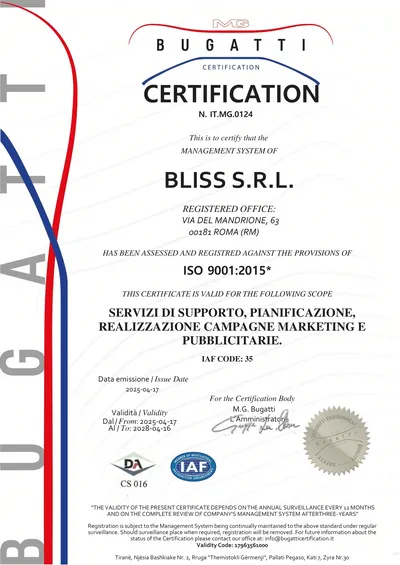
ISO 9001 – Process quality and work organisation.

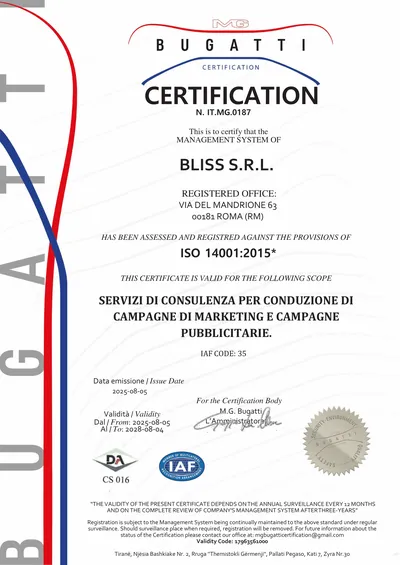
ISO 14001:2015 – Managing the environmental impact of business activities.

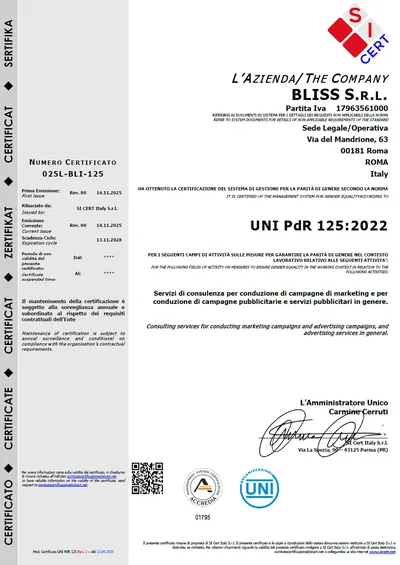
UNI PDR 125:2022 – Gender equality in processes, policies and organisation

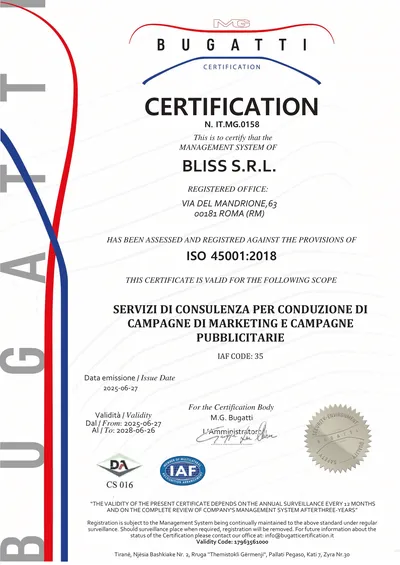
ISO 45001:2018 – Occupational health and safety.

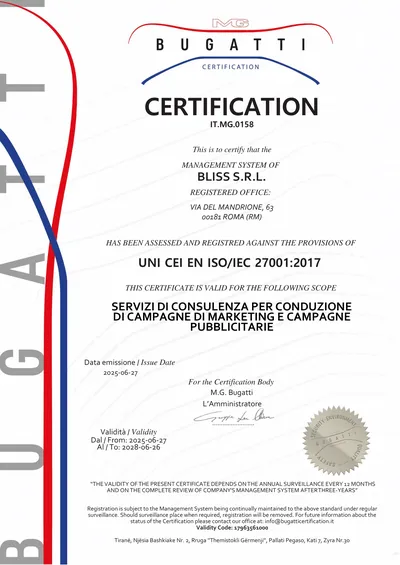
ISO/IEC 27001:2022 – Information, data and access security.
Blog & Trends 2026
SEO TRENDS & NEWS
In this space we share our know-how without filters. We explore how Cognitive Bias affects conversions, how Artificial Intelligence is rewriting the rules of SEO (AIO), and how Design manipulates value perception.


SEO FAQ
Frequently Asked Questions
What is eCommerce SEO and how does it differ from traditional SEO?
eCommerce SEO is the organic optimisation strategy specific to online stores. It differs from traditional SEO for three structural reasons: the volume of pages to manage (thousands of product pages at risk of cannibalisation), the technical complexity of the platforms (duplicate URLs, faceted navigation, dispersed crawl budget) and the seasonality of the catalogue, which demands a dynamic editorial plan.
A well-optimised eCommerce site generates qualified traffic and transactions with no cost per click — the channel with the lowest acquisition cost over the long term.
What is the best SEO strategy for an eCommerce store?
The SEO strategy for e-commerce is built on four levels: category architecture (each URL owns a precise semantic territory with no overlap), crawl budget management (optimised canonicals, robots.txt and sitemaps), category editorial plan (updates ahead of seasonal peaks) and structured data (Product, Offer, AggregateRating schema).
Order matters: without the right architecture, any surface optimisation produces only temporary effects.
How do you optimise an eCommerce store with thousands of products without wasting resources?
Optimising everything means optimising nothing. The most common mistake in large catalogues is dispersion: resources spread evenly across thousands of product pages with radically different organic potential.
Bliss segments the catalogue by SEO potential and focuses resources on high-impact pages — those covering established demand with high commercial intent. The rest are governed through structured templates, canonicalisation and crawl budget management. Budget is not spread. It is directed.
Does eCommerce SEO work on Shopify? And on WooCommerce?
Shopify produces duplicate URLs by design (/products/ and /collections/), facet structures that are hard to control and variant handling that, without technical intervention, generates organic cannibalisation. With the correct configuration of canonicals and metadata templates, Shopify supports a solid SEO architecture.
WooCommerce offers the greatest technical flexibility on the market — and the greatest risk of semantic disorder without governance. Magento requires rigorous management of layered navigation and attribute filters. Bliss knows the room for manoeuvre on all three platforms.
How long does it take to see SEO results on an eCommerce store?
Technical interventions (crawl budget, canonicals, fixing indexing errors) take effect within four to eight weeks. Organic positioning on competitive category keywords takes six to twelve months.
On stores with large catalogues and a domain with established authority, the first meaningful signals arrive sooner. Bliss sets timing expectations after analysing the domain, not before looking at it.
How do I get my products to appear in Google's AI Overviews and in ChatGPT's answers?
AI systems do not read a store the way a human does: they read structured signals. A product without correct schema markup (Product, Offer, AggregateRating) is invisible to AI models, regardless of the quality of the copy describing it.
Visibility in generative systems (Google AI Overview, ChatGPT, Perplexity) is built through structured data, the semantic authority of the category page and consistent product information across every touchpoint. Bliss manages this integration as part of the overall organic strategy.
I have an eCommerce store and a corporate website: does SEO work the same way for both?
No. A corporate website and an eCommerce site do not share the same organic logic. An eCommerce site carries thousands of product pages, variants, navigation facets and a seasonality that reshapes the editorial plan every quarter.
Bliss distinguishes between the two contexts before defining any organic architecture. An eCommerce SEO strategy starts from the structure of the catalogue, not from content production.
How much does eCommerce SEO consultancy cost?
The cost depends on the size of the catalogue, the platform and the competitiveness of the sector. Bliss works on a monthly retainer model that includes an initial audit, strategic architecture, ongoing execution and monthly reporting.
Before any commercial proposal, we carry out a free preliminary analysis of the domain to assess its real organic potential and set intervention priorities. We do not offer standard packages: every project has its own architecture.