


The crisis ends.
The work to be done doesn't
Brand Recovery
A media scandal. A legal dispute. A social media controversy. The crises a company can face come in many forms. The consequences do not: they are always the same.
The Bliss Brand Recovery Program is a structured programme to rebuild a brand’s value after a crisis in 90, 180 or 365 days. Because every crisis is an event. Rebuilding is a choice.
DISCOVER GOVERNANCE
Brand governance
Political brand governance
Generational continuity
Brand recovery
Founder-independent branding
Brand governance
Political brand governance
Generational continuity
Brand recovery
Founder-independent branding
Brand governance
Political brand governance
Generational continuity
Brand recovery
Founder-independent branding
Brand governance
Political brand governance
Generational continuity
Brand recovery
Founder-independent branding
Brand governance
Political brand governance
Generational continuity
Brand recovery
Founder-independent branding
Brand governance
Political brand governance
Generational continuity
Brand recovery
Founder-independent branding
Brand governance
Political brand governance
Generational continuity
Brand recovery
Founder-independent branding
Brand governance
Political brand governance
Generational continuity
Brand recovery
Founder-independent branding
TABLE OF CONTENTS
The problem we solved
Before it is too late
A reputation that crumbles, a narrative that cracks. AI systems that keep telling the wrong story even after the press has stopped covering it.
Once the damage is done, every day without an active rebuilding system is a day in which someone, somewhere, is forming the wrong opinion of you. Many organisations think about it too late. The Brand Recovery Program exists to prevent that.
Where it all began
The brand before the crisis
When a crisis breaks, the professionals arrive quickly. The legal team assesses the legal risk. PR puts out the media fire. The creative agency produces new content.
Everyone manages the damaging event. Yet no one takes care of the brand.
The Brand Recovery Program exists to remedy this mistake.
Our thinking
The beginning of a new story
When a company is hit by a crisis, a new story inevitably begins for it. How people will tell that story, however, is entirely a matter of Governance.
And so, those who don’t take control of change end up subject to it. Those who govern it decide what to tell. And how to turn the crisis into a new chapter in the brand’s story.
Who it is for
Who is the Brand Recovery Program for?
The programme is activated at three different moments in a brand’s life. The approach changes according to urgency.
The method, however, stays the same. That is precisely why it proves particularly useful for:
For those who know they are exposed and want to prepare in advance
Your sector has high media exposure. Your brand depends on a key figure. There is no crisis under way, but you know the risk exists. The best time to build a response system is when you don’t yet need one, and can take your time.
For those under attack right now
The brand is under pressure. The narrative is crumbling in real time. You need someone to make an immediate diagnosis and build a plan that goes beyond managing the media in the moment. The programme is activated within 48-72 hours of the start of the mandate.
moment. Bliss mobilises within 48-72 hours of the start of the mandate.
For those whose crisis has passed, but whose damage remains
The emergency is over. Yet the brand has emerged weaker, its positioning is undefined and the narrative no longer knows where to go. What is needed is a structured programme that rebuilds value over time. How long it takes depends on the case, and on you.
Every crisis costs
Reputational damage can be measured. The problem is that many companies only discover it when it is too late.
Many crises. One
single programme.
Although the crises a brand can face come in many forms, our programme adapts to any need. Here's how.
Programme milestones
A three-step process to diagnose the damage, rebuild the narrative and turn brand oversight into an operating system.
THE TEAM
The team leading the rebuild
The Brand Recovery Program is entrusted to a team with experience in reputational crises in sectors with high media exposure and in post-crisis repositioning. Every mandate has a dedicated senior lead, from activation to the close of the programme.

Francesco Acri
ceo & founder
Founded Bliss and leads its direction today.
At board level, works alongside CEOs and Boards of Directors on strategic decisions, overseeing their implementation.

Ginevra De Filippis
Chief Operating Officer (COO)
The company’s metronome: coordinates its operations, manages partner relationships and improves internal processes, ensuring continuity across projects.

Mario Antonini
chief design officer (cdo)
Interprets the Bliss vision and leads its visual expression. As CDO, coordinates identity, web architecture and VFX, giving ideas concrete form.

Andrea Maso
HEAD OF SEO
Head of SEO at Bliss, analyses the data that steers digital decisions. Supports clients from planning through to the optimisation of organic visibility.

Gianluca Sabbini
HEAD OF video production
Head of Video Production at Bliss, leads the audiovisual department and directs video production for advertising campaigns.
Start here
Are you in the middle of a crisis, or do you still bear its scars? In urgent cases the programme is activated within 48-72 hours.
Tell us about your organisation. Every fee proposal will start from a clear mandate, defined together in a working session.
The comparison
The difference between managing a crisis and rebuilding a brand
A crisis management programme and Brand Recovery are not the same thing. The first deals with the emergency of the moment; the second takes care of everything else. The difference shows.
| Size | Without Recovery / Standard crisis management | With the Bliss Brand Recovery Program |
|---|---|---|
| Objective | Stop the immediate damage. Manage media coverage in the first hours. | Rebuilding brand value over time. The immediate damage is only the starting point. |
| Duration | A few days, usually. Then the mandate closes. | 90, 180 or 365 days, with objectives measured at every stage. |
| Output | Press release, CEO statement, interview management. | Post-crisis Brand Platform, Narrative Framework, governance system, active digital oversight. |
| Digital presence and AI | Search results show the crisis. ChatGPT, Perplexity and Google AI keep describing the brand through the narrative of the emergency. The damage feeds itself. | Active monitoring across Google, ChatGPT, Perplexity and Google AI. Negative content is progressively counterbalanced by new, authoritative content that AI systems can use to describe the brand through the new narrative. |
| Positioning | The brand emerges from the crisis with an undefined identity: it is no longer clear what it stands for. The market fills the void with its own interpretations. | A new Brand Platform built on the post-crisis reality. The brand finds defensible ground that integrates the crisis into its story. |
| Stakeholder trust | Customers, partners and employees don't receive consistent messages. Each interprets the crisis in their own way. | Stakeholder message map: tailored messages for each audience. Everyone receives the same story, in the right register for each. |
| After closure | The mandate ends. The brand stays exactly where it was when the emergency passed. | An active, self-sufficient reputational governance system. The brand knows how to respond to the next crisis before it arrives. |
4.9/5
207 verified reviews
Verified reviews
In the words of those who chose us





Bee Lab
“Professional, dynamic team. They work around the clock and fully embrace the projects they take on, led by a highly skilled and visionary leader!”
5.0
Marco Contigiani
“A simply exceptional communications agency.
From the very first contact you sense professionalism, expertise and close attention to the client’s needs”
5.0
Nicole
“Thanks to Bliss Agency we doubled our quote requests and gained more visibility in our area. They proposed a clear editorial plan that was easy to follow and extremely effective.”
5.0
Anna Rossi
“Not just an agency, but a true partner. With Bliss Agency I felt listened to and understood from the very first meeting. They turned ideas into a concrete project”
5.0
Certified Agency
Certifications
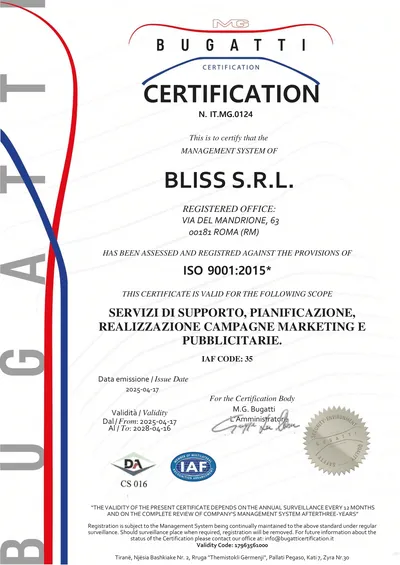
ISO 9001 – Process quality and work organisation.
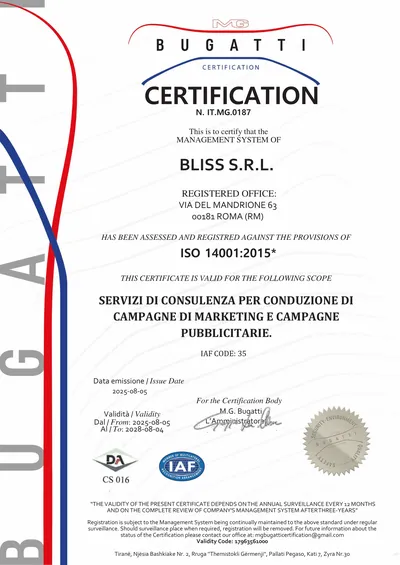
ISO 14001:2015 – Managing the environmental impact of business activities.

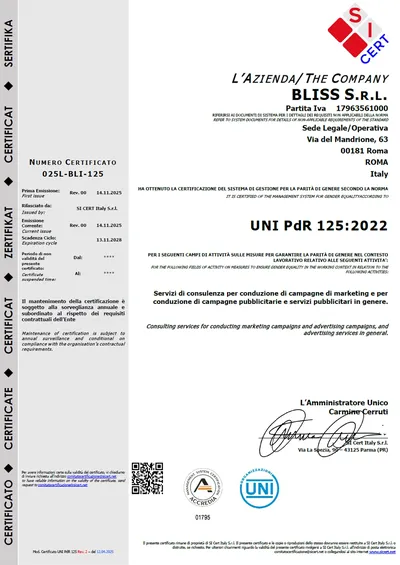
UNI PDR 125:2022 – Gender equality in processes, policies and organisation
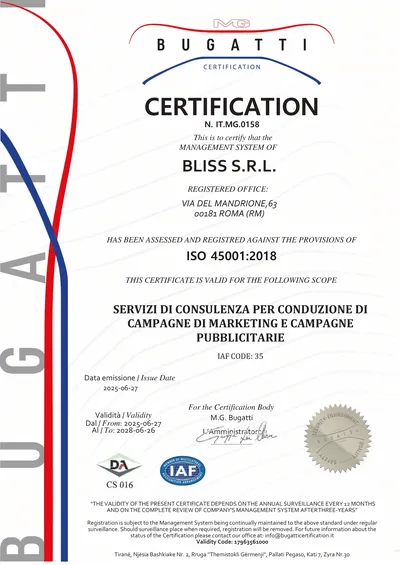
ISO 45001:2018 – Occupational health and safety.

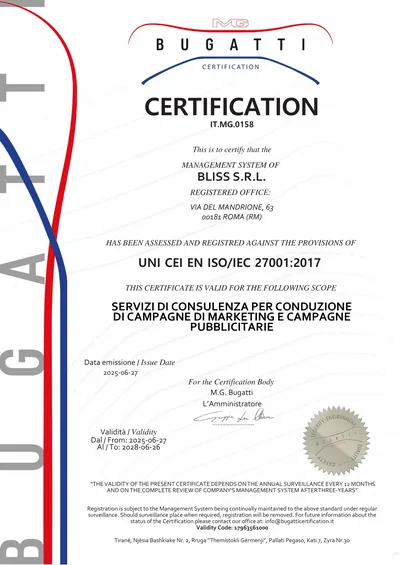
ISO/IEC 27001:2022 – Information, data and access security.
FAQ
Frequently asked questions about the Brand Recovery Program
1 - Why has my brand lost customers even though the product hasn't changed?
The product has not changed. The market, however, has. The brand filters how the product is perceived: a brand seen as unreliable acts as a cognitive barrier before the product is even evaluated. In a context where ChatGPT and Perplexity synthesise online reputation, a damaged brand simply stops being recommended. Recovery always starts from a precise diagnosis: what has changed in perception and where the positioning broke down.
2 - How do I relaunch my brand in crisis without cutting prices?
Cutting prices is the fastest response, and often the one that does the most lasting damage. Those who compete on price often lose on perceived value. The way forward is to rebuild that value before touching any commercial lever: find what the brand can still say credibly, and say it in a way that makes price comparison irrelevant to the right customer.
3 - Can I change my company's positioning without losing the customers I already have?
Yes, if the transition is governed. A repositioning is a narrative evolution that keeps the touchpoints with loyal customers while opening up to new ones. The difference between a repositioning that works and one that alienates lies in the quality of the governance of the transition.
4 - How can I tell whether a fall in revenue is a brand problem or a marketing problem?
If there is traffic or presence but conversions do not close, the problem is often the brand: trust or perceived value has eroded. If, on the other hand, nobody searches for or finds the brand, the problem is visibility. Brand Recovery addresses the first case, when the marketing machine is running but the message no longer convinces.
5 - Does a programme like this make sense if my company is in financial difficulty?
That may well be when it is needed most. A renewed brand tells customers, suppliers and stakeholders that the company has a clear direction. An economic crisis is rarely just financial: underneath there is often a positioning crisis. Acting on the brand at that stage can be the way to break the cycle.
6 - What is the difference between the Brand Recovery Program and Executive Advisory?
Brand Recovery is a fixed-term programme (90, 180 or 365 days) activated in response to a crisis or a loss of relevance that has already occurred. Executive Advisory is an ongoing relationship that oversees the brand over the long term. The two can work in sequence: once the rebuild is complete, oversight can continue through Executive Advisory.
7 - How long does it take to see measurable results?
The first signs are measurable within 90 days of activation: improving digital sentiment, the new narrative live on the main channels, key stakeholders reached. Structural recovery of brand equity takes 180-365 days, depending on the depth of the damage and the competitiveness of the sector.
8 - Does the Brand Recovery Program also work for unlisted SMEs or local brands?
Yes. Reputational damage has no minimum revenue threshold: a social media controversy or a worn-out image can undermine an SME’s relevance as quickly as it hits a major brand. The programme is calibrated to the size and specific context of each business.
9 - Can science help me relaunch my brand?
Neuroscience makes it possible to understand which visual and verbal stimuli trigger interest and trust in a specific target audience today. A brand in crisis often sends signals that trigger indifference or distrust: its communication codes have fallen out of sync with the way the market processes information. Neuroscience helps identify where that code broke down.