


Magento SEO
The more complex the platform,
the more urgent the SEO.
Magento, now Adobe Commerce, is the choice for those managing enterprise catalogues: thousands of SKUs, multi-store, multi-language, faceted navigation. This complexity is the platform’s strength. It is also the source of the hardest SEO problems to manage in e-commerce.
A Magento site without dedicated SEO advisory can generate millions of URLs from layered navigation, incorrect canonicals between store views and crawl budget wiped out on filter and sorting pages. Bliss governs SEO on Magento as a system: from the technical architecture to the editorial plan for categories, through to managing the international backlink profile.





The main problem
Layered navigation:
how Magento generates millions of URLs
Faceted navigation (layer navigation) is one of Magento’s strengths for user experience. Every combination of filters applied generates a new URL. On a catalogue with 1.000 products, 5 filterable attributes and a few values per attribute, the theoretical number of URLs that can be generated runs into the hundreds of thousands. None has any real organic value. All of them are crawled by Google.
The result: Google wastes crawl budget on an ocean of variants and never reaches the strategic pages. Category pages that target high-volume queries are therefore indexed very infrequently, and rankings collapse without warning.
Example URLs generated by layered navigation: what to keep and what to block
Strategic
To be assessed
Block
Block
Block
Block
On a real catalogue, the URLs with a red badge number in the tens of thousands. Managing layered navigation through robots.txt, canonical tags and Magento’s SEO configuration options is the first step on any Magento site with ranking problems.
Bliss Agency vs traditional SEO agencies
What separates Magento SEO from a truly scalable
e-commerce strategy
Magento requires SEO designed for complex structures, extensive catalogues and advanced e-commerce dynamics. The aim is not only to optimise categories and products, but to build an organic infrastructure that is scalable, orderly and sales-oriented.
| Criterion | Traditional Magento SEO | Bliss Agency |
|---|---|---|
| Approach | Technical work on categories, products, canonicals and sitemaps. | E-commerce SEO strategy integrating architecture, content, performance, UX and commercial positioning. |
| Catalogue structure | Basic optimisation of categories and products. | We build a scalable structure for categories, subcategories, filters, search intents and commercial clusters. |
| Technical issues | Managing duplication, URL parameters and indexing. | We work on crawl budget, faceted navigation, pagination, canonical strategy, performance and structured data. |
| Content | Generic product descriptions and category copy. | Strategic copy designed to sell, position and strengthen brand perception. |
| Conversion | SEO is kept separate from CRO. | SEO, UX and CRO are read together to improve qualified traffic, the purchasing experience and conversions. |
| Output | Technical optimisation of the platform. | An organic e-commerce system designed to grow with the catalogue. |
Specific issues
Six SEO problems Magento
creates on complex catalogues
Layer navigation is the main problem, but not the only one. Magento produces a set of structural SEO issues that compound in enterprise catalogues. Each requires a specific intervention, but the real problem arises when they all appear together, with no plan to address them in sequence.
Layered navigation and parameterised URLs
Products in multiple categories
Multi-store without hreflang
Critical Core Web Vitals
Disorganised URL rewrite table
Non-strategic XML sitemap
Magento 1 vs Magento 2
Magento 1 and Adobe Commerce:
the SEO differences that matter
Magento 1 reached End of Life in June 2020: no security updates, no support. Migrating to Adobe Commerce (Magento 2) is a priority, but it requires careful SEO planning to preserve the organic rankings built up over time. Magento 2 solves some problems but does not remove the structural SEO complexity: layered navigation, products in multiple categories and a non-strategic sitemap remain critical issues that require dedicated manual configuration regardless of version.
SEO status
- Complex URL rewrites that are hard to govern
- No security updates (risk of penalties)
- Poorer performance by default (LCP often critical)
- Layer navigation harder to configure for SEO
- Multi-store hreflang, complex to implement
- Schema markup often missing or incomplete in themes
- No support for technical SEO developments
SEO improvements
- Cleaner, more controllable URL structure
- Natively improved canonical management
- Improved performance with PWA and built-in optimisation
- Layered navigation SEO options more accessible in the admin panel
- Hreflang manageable per store view with dedicated configuration
- More complete schema markup in official themes
- Ongoing updates (support for SEO developments)
the method
How Bliss optimises
SEO on Magento
Magento SEO requires expertise not found in generalist SEO: in-depth knowledge of the platform, the ability to work at CMS configuration level, and experience managing enterprise catalogues. The work always begins with diagnosis.
Crawl analysis on an enterprise catalogue: where Google goes, and where it shouldn't.
We run a full crawl of the domain and analyse crawl budget by URL type: category pages (strategic), products (strategic), layered navigation URLs (to block), sorting parameter URLs (to block), URLs of products in multiple categories (to canonicalise) and deprecated URLs in the URL rewrite table (to clean up). On enterprise Magento with a large catalogue, this mapping produces the prioritised list of actions that guides all subsequent work.
Blocking the ocean of URLs to focus Google on the strategic pages.
Layered navigation generates URLs in the tens of thousands. Google crawls them all, and in doing so the strategic pages fall behind. We identify which URLs have real organic value and govern crawl budget accordingly. As a result, category pages hold the queries that matter, while the rest does not consume crawl resources.
Every URL has a precise place in the authority structure. In every language and market.
Products in multiple categories: each URL has a canonical indicating the primary version of the product to Google. Multi-store: hreflang implemented for every store view, with the correct relationships between language versions. The sitemap is redesigned to include only URLs with real organic value. The URL rewrite table is audited and cleared of redirects accumulated over time.
A fast Magento is a correctly configured Magento.
Unoptimised Magento is slow by default. On unconfigured installations, LCP often exceeds 6 seconds. We work on the platform's technical architecture to bring strategic pages below Google's quality thresholds. The result is better performance and better rankings.
Schema markup for every page type. A content plan for strategic categories.
Complete Product schema (Offer, AggregateRating, Brand, availability), Organization with sameAs, BreadcrumbList consistent with the navigation structure: we implement structured data on Magento through dedicated extensions or custom code, verifying correct validation in Google's Rich Results Test. The category editorial plan identifies the pages with the greatest organic potential and defines the supporting content that strengthens the semantic relevance of each category.
SEO on enterprise Magento includes the GEO foundation: correct structured data and an llms.txt file increase citability in AI answers from Google Gemini, ChatGPT and Perplexity, which matters above all for brands with international distribution across multiple store views.
Magento SEO migration
From Magento 1 to Adobe Commerce
without losing search positioning
Migrating from Magento 1 to Adobe Commerce (Magento 2) is a high-risk SEO operation. Any migration that changes the URL structure without planned 301 redirects can wipe out years of organic positioning. It is not unusual to see stores lose 60-80% of their organic traffic after an unplanned migration.
Bliss manages migration SEO planning as a separate, priority phase. Every URL whose structure changes is mapped. Every redirect is verified. Index coverage is monitored before and after through Google Search Console. The technical and SEO migrations run in parallel. Neither can precede the other.
Planning a migration from Magento 1 to Magento 2?
SEO planning must begin before the technical migration
OUR SEO RESULTS
Success stories
These results show what happens when SEO, content and AI Search are turned into a genuine growth engine. Leads, sales, qualified traffic and revenue growth: every case study presents concrete data, verifiable results and performance built to generate real business.
Valle D'Aosta
Bliss supported the Aostæ 2025 project in building an institutional digital ecosystem designed to enhance the region, its events and public communication.
THE TEAM
Our voices
leading the way
Bliss’s SEO is managed by a team with experience of organisations with complex sales cycles in tech, manufacturing and professional services: sectors where the buyer is a decision maker with structured evaluation processes and long purchasing timelines.

Andrea Maso
HEAD OF SEO
International background, a data-driven mind and no intention of slowing down.

Mario Antonini
chief design officer (cdo)


Luca Maletta
Head of Copywriting

Sajjad Mazaherizaveh
Full stack developer
Combines front-end and back-end development with technical SEO and AI Search Optimisation.
Certified Agency
Certifications

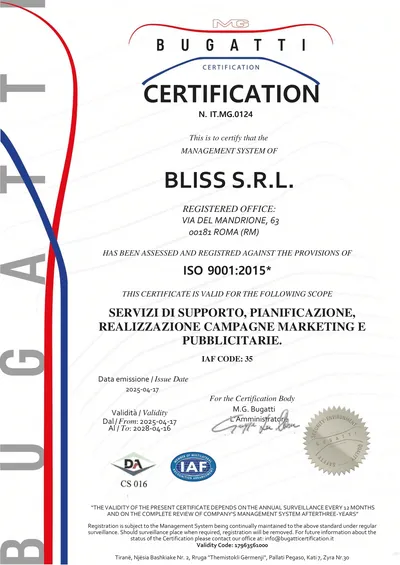
ISO 9001 – Process quality and work organisation.

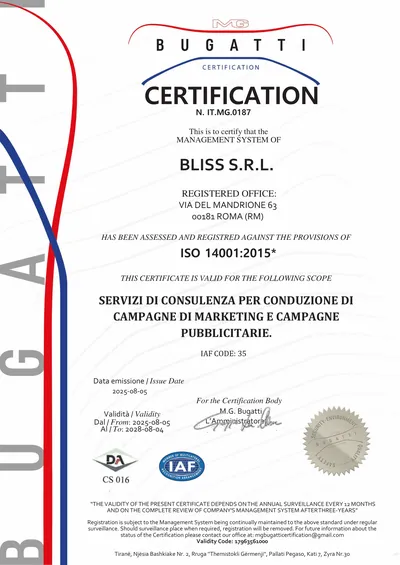
ISO 14001:2015 – Managing the environmental impact of business activities.

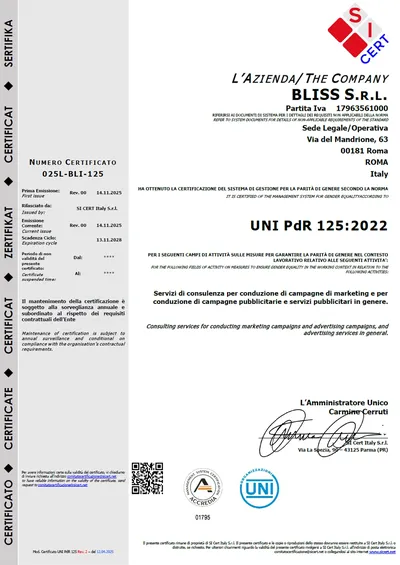
UNI PDR 125:2022 – Gender equality in processes, policies and organisation

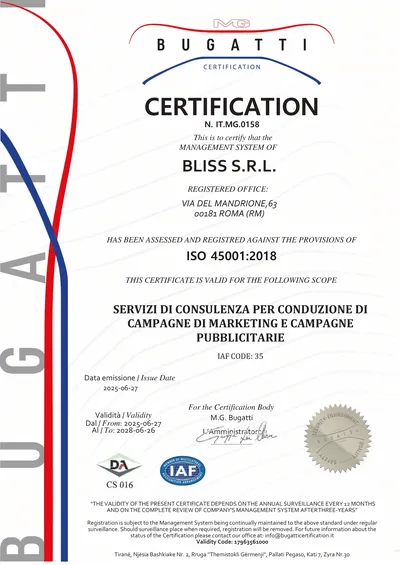
ISO 45001:2018 – Occupational health and safety.

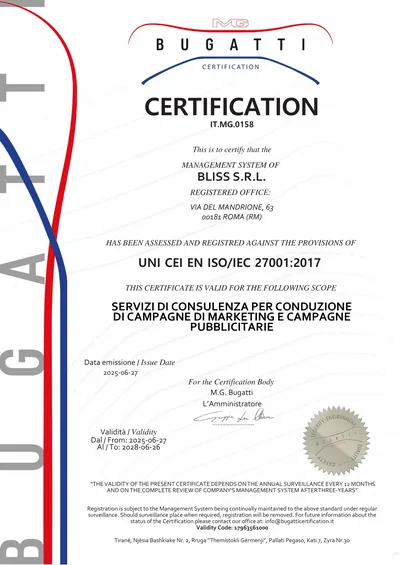
ISO/IEC 27001:2022 – Information, data and access security.
Blog & Trends 2026
SEO TRENDS & NEWS


Partner






























SEO FAQ
Frequently asked questions about Magento SEO
What is Magento SEO?
SEO for Magento (Adobe Commerce) governs organic visibility on Google for enterprise stores: thousands of SKUs, multi-store, multi-language, faceted navigation. This complexity creates SEO problems that are hard to manage without platform-specific expertise: millions of layer navigation URLs, canonicals to manage across store views, crawl budget wasted on filter pages. It requires both advanced SEO skills and in-depth technical knowledge of Magento.
What is Magento's main SEO problem?
The proliferation of URLs from layered navigation: every combination of filters generates a new URL. On a catalogue with 1,000 products and 10 filterable attributes, the potential URLs run into the hundreds of thousands. Google spreads its crawl budget across these URLs and does not reach the strategic pages as often as it should.
Managing crawl budget through robots.txt, canonicals and Magento’s SEO settings is the first intervention on any Magento site with search positioning problems.
SEO differences between Magento 1 and Magento 2 (Adobe Commerce)?
Magento 1 reached EOL in June 2020. Adobe Commerce (Magento 2) brought improvements: cleaner URL structure, better canonical management, more accessible layered navigation SEO options, better default performance.
It does, however, retain the structural problems: layered navigation, products in multiple categories, a non-strategic sitemap. Migration requires careful SEO planning to preserve the organic positioning already achieved.
How do you optimise crawl budget on Magento?
Configuring robots.txt to block layer navigation URLs, handling sort parameters (?order=price&dir=asc) through canonicals or blocking, configuring the XML sitemap with strategic URLs only, and analysing Googlebot logs to identify where the crawler spends its time.
On an enterprise Magento site with a large catalogue, this work can reduce crawled URLs by 70-90%, concentrating resources on the pages that matter.
How is multi-store SEO managed on Magento?
Magento natively supports multi-store: a single installation manages multiple store views for different markets and languages. From an SEO standpoint: hreflang implementation for each store view, canonical management across store views, separate sitemap configuration.
Without correct hreflang, Google treats the different store views as international duplicate content, dispersing domain authority across versions that should reinforce one another.
What does a Magento SEO consultant do?
A Magento SEO consultant analyses and optimises the organic visibility of an Adobe Commerce site: audit of layered navigation and problematic URLs, crawl budget configuration, canonical management, hreflang implementation, Core Web Vitals optimisation (Varnish, full-page cache), schema markup, category editorial plan.
This advisory work requires skills not found in generalist SEO: technical knowledge of the platform, the ability to work on the CMS configuration and experience with enterprise catalogues.
Is Magento good for SEO?
Magento (Adobe Commerce) offers the greatest technical flexibility for SEO among enterprise e-commerce CMSs: full control over URLs, robots.txt, canonicals, sitemaps, hreflang and structured data. It has none of Shopify’s structural constraints.
The problem is not the platform: it is the complexity that an unoptimised configuration creates. With the right configuration, Magento lets you build stores with enterprise-grade organic visibility. Specialist SEO advisory is the requirement that does not change.
How is SEO migration from Magento 1 to Magento 2 managed?
Migration is a high-risk SEO operation. Critical points: mapping URLs whose structure changes, corresponding 301 redirects, checking indexing coverage before and after in Google Search Console, preserving metadata, handling structured data, configuring the new sitemap.
SEO planning must begin before the technical migration. It is not unusual to see stores lose 60-80% of their organic traffic after an unplanned migration.