
The value proposition canvas is a tool devised by Alexander Osterwalder that sets out on a single page what a customer segment is trying to achieve (jobs, pains, gains) alongside what an offer proposes in response, to check whether the two sides match. It was introduced in 2014 in the book Value Proposition Design and is used by start-ups and large companies to design products and services.
The canvas is not for writing a persuasive sentence but for discovering what customers truly regard as a problem.
We have already covered the value proposition in a dedicated article. In this in-depth piece we explain what the canvas is, how it is structured, how to fill it in, where to find a template and how to validate it with real customers.
In brief
The value proposition canvas in 4 key points:
- 1
The canvas sets out on a single page what the customer is looking for and what the offer proposes, to check whether they match.
- 2
It is divided into six areas: three in the customer profile, three in the value map.
- 3
It is completed in six steps, one customer segment at a time.
- 4
It is only valid if validated with customers: interviews, observation, price tests, negotiations.
What is the value proposition canvas?
The value proposition canvas is a framework that describes a customer segment, with the jobs it is trying to get done, the obstacles it encounters and the outcomes it wants, and sets it alongside a map of the offer designed to respond (Strategyzer, The Value Proposition Canvas). The aim is to design an offer that matches real needs, not the ones the company imagines.
The tool originates in the book Value Proposition Design by Alexander Osterwalder, Yves Pigneur, Greg Bernarda and Alan Smith, published by Wiley in 2014. It is the follow-up to Business Model Generation, the book behind the business model canvas.
The relationship between the two tools is direct: the value proposition canvas zooms in on two of the nine blocks of the business model canvas, customer segments and the value proposition (SuperSummary, Value Proposition Design). The business model canvas describes the whole company on one page; the other magnifies the point where the company meets the customer. We will devote a separate guide to the business model canvas.
How is the value proposition canvas structured?
The diagram is divided into two parts: on the right the customer profile, drawn as a circle, on the left the value map, drawn as a square. Each has three areas, and the areas correspond in pairs (Strategyzer).
The six areas of the value proposition canvas
Three areas describe the customer and three describe the offer: each answers a specific question.
| Part | English name | Italian name | Question it answers |
|---|---|---|---|
| Customer profile | Customer jobs | Customer jobs | What is the customer trying to do? |
| Customer profile | Pains | Pains | What hinders them, worries them or costs them too much? |
| Customer profile | Gains | Gains | What outcomes does the customer want to achieve? |
| Value map | Products & services | Products and services | What do we offer? |
| Value map | Pain relievers | Pain relievers | Which pains do we relieve or eliminate? |
| Value map | Gain creators | Gain creators | What gains do we create? |
Customer jobs can also be functional, such as delivering work on time; social, such as looking good in front of one’s boss; or emotional, such as feeling at ease after a decision. The most important problems often lie in the last two categories.

How do you complete the value proposition canvas?
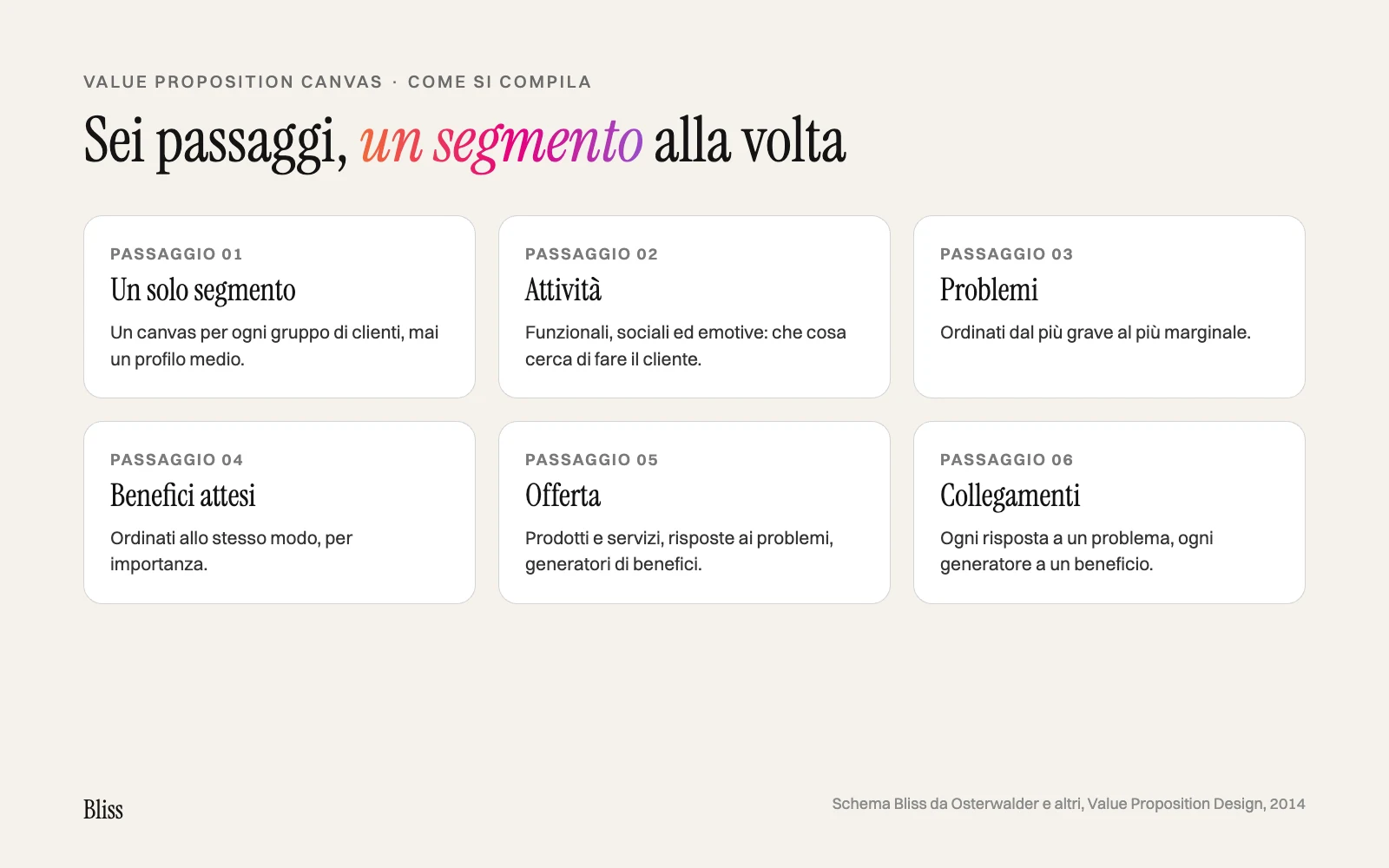
The value proposition canvas is filled in in six steps.
- Choose a single customer segment. One canvas per segment: if different customers are mixed, pains and gains cancel each other out. Buyer personas help to define it.
- List the customer’s jobs: functional, social and emotional.
- List the pains and rank them by importance, from the most severe to the most marginal.
- List the expected gains and rank them in the same way.
- Describe products and services, then the pain relievers and gain creators.
- Connect the two sides: every pain reliever must match a problem in the profile, every gain creator a benefit. Anything left unconnected needs to be revisited.
Ranking by importance is the step most often skipped, and the most useful: an offer that solves ten marginal problems is worth less than one that solves a serious one well.
What does fit mean in the value proposition canvas?
Fit is the match between what the customer is looking for and what the offer proposes, and the authors distinguish three successive levels of it (Andrew Clark, summary of Value Proposition Design).
- Problem-solution fit: there is evidence that customers really have those pains and want those gains, and the offer is designed to respond. It is fit on paper.
- Product-market fit: once on the market, the offer creates value for customers and is bought.
- Business model fit: the offer fits into a business model that generates profit sustainably.

SuperSummary sums up the difference this way: the first level exists on paper, the second exists in the market (SuperSummary). Many canvases stop at the first without realising it.
Value proposition canvas example
Let us start with Doreca, a Rome-based beverage distributor we have worked with since 2023, with €214.9 million in revenue in 2023 according to its filed accounts. On this basis we reconstructed a value proposition canvas.
What sets Doreca apart is that it sells to two different audiences: trade professionals, such as restaurateurs, bartenders and venue managers, and end consumers, who can buy in its stores even without a VAT number. As the canvas rule requires, below we will fill in just one, for a single segment: the professionals.
Value proposition canvas example: Doreca
The canvas reconstructed for a single segment: Ho.Re.Ca. professionals.
| Area | Content |
|---|---|
| Customer jobs | Stocking the venue with drinks without interrupting service; finding the full catalogue needed from a single supplier; reordering quickly when a product runs out |
| Pains | Unreliable suppliers; deliveries too slow for the pace of the venue; having to split orders across several suppliers |
| Gains | A supplier you can count on; fast deliveries; a broad catalogue in one place |
| Products and services | Beverage distribution for Ho.Re.Ca.; network of local outlets; on-demand delivery |
| Pain relievers | Fast turnaround, with on-demand delivery; outlets close to venues, for immediate restocking |
| Gain creators | Wide catalogue; tastings and in-store events, which build a relationship beyond the order |
What does the Doreca example teach us?
The Doreca canvas shows that a company can already have the answer to its customer’s most serious problem without telling anyone. For the trade customer, the decisive problem is speed, because a venue without drinks loses takings. Doreca was developing precisely an on-demand delivery service, yet the communication around its openings still relied mainly on the logo and promotions (Bliss, Doreca case).
The canvas brings the answer that matters to the centre. The message chosen for the new openings, “Bet we deliver in under three hours?”, mentions neither prices nor brands: it speaks directly to the customer’s problem.

The example also shows why each segment needs its own canvas. End consumers look for something else: they form an opinion of the brand through social media and advertising, and a single canvas would have blurred the two profiles. During the engagement, in-store conversion rose by 8% and the average transaction value by 12% (Doreca internal data, 2023). The canvas alone does not explain those results, but it does show the logic behind the choice.

Our case study
A promise that speaks about the customer
For Doreca’s new store openings, the message started from the professionals’ most severe problem, speed of restocking: “Bet we deliver in under three hours?”. During the engagement, in-store conversion rose by 8% and the average receipt by 12%.
Read the case studyA second example: the customer profile in luxury
In our work for Charles Philip Milano, a Made in Italy luxury footwear brand, the right-hand side of the canvas was built on data before intuition: the strategic audit produced buyer personas, customer archetypes and an analysis of the competition in the premium segment. Only then did we decide what the brand could promise, and at which touchpoints.

In luxury, the customer profile carries even more weight, because the expected gains are largely social and emotional: recognising oneself in an aesthetic, being seen with a product, feeling part of a story. These are precisely the categories that a canvas filled in around a boardroom table tends to forget. The detail is in the Charles Philip Milano case study.
Where can you find a value proposition canvas template?
The original template can be downloaded free of charge from the website of Strategyzer, the company founded by Osterwalder, and shared with your team; Strategyzer separately sells a subscription with further materials (Strategyzer). Editable versions also exist in tools such as Notion, Creately and Piktochart, and as templates for PowerPoint and Google Slides.
Whichever template you choose, check that it contains the six areas in their original form, with the customer circle on the right and the value square on the left. Some simplified templates merge pains and gains into a single box, losing the ability to rank and compare them.
Can you create the value proposition canvas in Canva?
Yes, you can complete the canvas in Canva, starting from a value proposition template or a blank page. Canva has a guide to value propositions that cites Osterwalder’s canvas and offers templates to start from (Canva, Creating a value proposition, November 2025).
The only risk is that a polished look makes a canvas seem finished when it is not. Before using one, it is therefore worth checking two things: that all six areas are there, and that there is room to note, next to each pain and gain, which interview or data point it comes from. A Canva canvas without sources is just a well-laid-out hypothesis.
How do you test the value proposition canvas with customers?
The canvas is tested by checking each element of the customer profile against evidence gathered in the market: interviews, observation, price tests, analysis of deals won and lost. The match between needs and offer remains an assertion until customers confirm it (Strategyzer).
Four methods also work for an SME:
- Interviews: conversations with current and lost customers, focused on how they made their decision rather than on what they think of the product.
- Observation: watching how the customer carries out the job today, with which tools and which shortcuts.
- Price tests: offering different terms to different groups and measuring the response.
- Deal analysis: review the bids won and lost over the past year and note the stated reason.

In our experience, interviews almost always surface a problem the company considered secondary and the customer considers decisive.
Why does a canvas filled in in the boardroom not work?
A canvas completed in the boardroom does not work because it describes the company, not the market: the customer profile becomes a list of what the offer already does. It is the shortcoming we find in many strategic tools used as fill-in exercises, which we wrote about in the academic con nobody names.
The canvas is only useful if it starts from what customers say, not from what the company thinks of them. That is why we treat it as a listening tool before a design tool.
Bliss’s point of view
“If the customer profile is filled in in the boardroom, without speaking to a single customer, the canvas just tells the company its own story.” Francesco Acri, founder and CEO of Bliss
A canvas completed after the interviews is almost always different from the first draft, and it is precisely that difference that shows where to act.
The clearest warning sign is perfect symmetry: if every customer problem already has an answer in the offer, the profile was probably written by looking at the offer. A genuine canvas always has some unanswered problems, and that is where the opportunities lie.
Who works on your project
The people of Bliss across Rome and Milan





From canvas to value proposition: how do you write the final statement?
The value proposition statement is written by taking from the canvas the most serious pain and the most important gain that the offer addresses best, and stating in one sentence who it is for, what it solves and how it is different. The canvas provides the material; the statement is the synthesis.
The next step is positioning: the same choice, seen from the competitors’ side. If a competitor could sign your value proposition statement, the difference is missing. How to define the place the brand wants to occupy is the subject of the guide to positioning.
Finally, the difference must be made recognisable in a short, repeatable formula, which is the job of the unique selling proposition.
When this work concerns the brand as a whole, rather than a single product, it is the work we do through brand advisory alongside company leadership.
Frequently asked questions about the value proposition canvas
What is the difference between the value proposition canvas and the business model canvas?
The business model canvas describes the whole company in nine blocks, from customers to costs. The value proposition canvas zooms in on two of those blocks, customer segments and the value proposition, to check that the offer responds to real problems and wants.
How many canvases do I need if I have several customer segments?
You need one for each segment. Different customers have different jobs, problems and expected benefits, and putting them in the same canvas produces an average profile that describes no one. It is best to start from the most important segment by revenue or potential.
Who should take part in completing it?
The people who talk to customers, such as sales, customer service and product managers, together with those who make decisions on the offer. The most important contribution, however, remains that of the customers themselves, gathered through interviews and observation before and after filling it in.
Does the canvas also work for B2B services?
Yes. In B2B the customer profile often needs to be completed for several people in the same company, for example the person who uses the service, the person who approves it and the person who pays for it, because each has different pains and gains.
How long does it take to fill it in properly?
A first draft can be filled in within a few hours. Validating it, however, takes weeks, because it requires interviews, observation and data from sales negotiations. The most time-consuming part is the one that makes the canvas reliable.
Is the value proposition canvas free?
Yes. The original template can be downloaded free of charge from the Strategyzer website and shared with your team. The book Value Proposition Design and the in-depth materials Strategyzer offers by subscription are paid for.
Sources
- Alexander Osterwalder, Yves Pigneur, Greg Bernarda, Alan Smith, “Value Proposition Design”, Wiley, 2014
- Strategyzer, “The Value Proposition Canvas”, accessed November 2026
- SuperSummary, summary of “Value Proposition Design”
- Andrew Clark, summary of “Value Proposition Design”
- Canva, “Creating a value proposition: how-tos, templates, and tips”, November 2025
- Bliss, Doreca case study; revenue from filed accounts, 2023
- Bliss, Charles Philip Milano case study, 2024
- Images: Bliss diagrams; photographs from the Doreca and Charles Philip Milano case studies; cover generated with Magnific
Bliss · Rome and Milan
Let’s put your value proposition to the test
A new product, a new segment or an offer that no longer convinces: we start from the customer profile and establish what the customer truly considers a problem.
Tell us about your offer
Two minutes on the contact form: product, customers, objectives.
We get back to you
A consultant reads your request and arranges an initial call with you.
You receive a proposal
Scope, priorities and costs, starting from the diagnosis.