


The value proposition, in Italian proposta di valore, is the statement that explains to a specific customer which problem an offering solves, what benefit it brings and why it is worth choosing over the alternatives. The term originated in 1988 in an internal McKinsey document and today refers both to the written promise and to the value the company is genuinely able to deliver.
The value proposition is the sentence on which pricing, communication and sales depend: if it is vague, every department rewrites it in its own way.
The purpose of this article, then, is to explain in detail what a value proposition is, what it is for, what elements it is made of and how to write one, with real examples, the value proposition canvas and how it differs from a USP and positioning.

What is a value proposition?
The value proposition is the answer, in a few lines, to the question every customer asks before buying: why this particular offer. In the most widely used definition, it is the economic value that a company or product offers a customer segment, expressed as a statement explaining why that customer should choose it (Wikipedia, Value proposition).
The most common translation of value proposition in Italian is “proposta di valore”. You will also find the acronym CVP, or customer value proposition, which means the same thing with the emphasis on the customer. In practice the term refers to two different things that are worth distinguishing: the real value the offer produces for the customer, and the sentence used to communicate it. The second without the first is a slogan.
Where does the term value proposition come from?
The term is credited to Michael Lanning and Edward Michaels, McKinsey consultants, who used it in 1988 in an internal paper entitled “A business is a value delivery system” (Wikipedia, Value proposition). The idea was that a business should be conceived starting from the value it delivers to the customer, not from the products it makes.
Mass adoption came later, however, with the tools of Alexander Osterwalder and Yves Pigneur: first the Business Model Canvas, then the book Value Proposition Design, published by Wiley in 2014 with Greg Bernarda and Alan Smith (Wiley, Value Proposition Design).
What is a value proposition for?
A value proposition makes clear within seconds why a customer should choose an offer, and gives the company a single criterion for deciding what to say and what to do. The first use is external, and it is the value proposition in marketing: website, sales presentations, campaigns. The second is internal, and is often the more important.
When the value proposition is written down and shared, marketing knows which benefit to put first, sales knows which argument to use, product knows which features really matter and whoever sets prices knows what they are charging for. When it is missing, every department invents its own, and the customer receives different messages from the same company.
There is also a strategic use. Writing the value proposition forces you to choose a specific customer and give up the others, which is why it is a brand strategy decision before it is a writing exercise.
What are the elements of a value proposition?
A complete value proposition contains five elements: the customer it addresses, that customer’s problem or goal, the benefit the offering brings, the alternative it is measured against and the proof that makes it credible.
| Element | Question it answers | Typical mistake |
|---|---|---|
| Client | Who it is for | ‘For everyone’ |
| Problem or goal | What the customer needs to achieve | Starting from the product rather than the need |
| Benefit | What changes for them | Listing technical features |
| Alternative | Better than what | Ignoring competitors and DIY solutions |
| Proof | Why they should believe it | Promises without figures, case studies or guarantees |
The benefit is not always functional. A Bain & Company study published in Harvard Business Review identified 30 “elements of value”, arranged in a four-level pyramid: functional, emotional, life-changing and social impact (Harvard Business Review, 2016). According to the authors, well-combined elements sustain customer loyalty and revenue growth. The model is useful as a checklist: it helps reveal benefits that those writing the proposition tend to take for granted, such as time saved or reduced risk.
How do you write a value proposition?
It is written starting from the customer, not the product, in seven steps. Those below follow the method proposed by Harvard Business School Online, which draws on Clayton Christensen’s “jobs to be done” theory (Harvard Business School Online).
- Describe what the brand offers.
- Identify the “job” the customer chooses it for, that is, the outcome they want to achieve.
- List the companies and solutions competing for the same job.
- Clarify what sets the offer apart from the alternatives.
- Condense everything into a short statement.
- Test it with people who do not know the company and correct whatever they do not understand.
- Use it on the website, in materials and in presentations.
The second step is the one that changes the outcome most, because it shifts the focus from what the company sells to what the customer wants to achieve. Buyer personas exist precisely to describe this job, in the customer’s own words.
A structure for writing the statement
For
It is not a formula to publish as it stands: it is there to check that no piece is missing. Once checked, the sentence is rewritten in the brand’s own language: the substance stays, the vocabulary and rhythm change.
Moving from structure to text is a copywriting job. A good final test is to read it to a customer: if they repeat it in their own words without changing the meaning, it works.
Value proposition examples
Three real examples show the same logic in different contexts. The first is a well-known e-commerce case; the other two come from our own work.
Warby Parker: designer glasses at an affordable price
Warby Parker, a US eyewear brand, builds its value proposition on designer glasses and contact lenses at affordable prices, combined with a social commitment. Its homepage presents the purchase as an experience that leaves the customer satisfied and with money saved (Harvard Business School Online).
All the elements are there. The customer is someone who wants quality glasses without spending what a branded shop would charge. The alternative is traditional channels. The benefit is twofold, aesthetic and financial, and the social commitment adds an element of emotional value.
Oro Elite: trust as a value proposition
In the gold-buying sector, where shopfronts look alike, Oro Elite did not stand out from its competitors. The work began with a choice: stop communicating like a gold buyer and start communicating like a brand (Bliss, Oro Elite case). The value proposition became trust, understood as something to demonstrate rather than to ask for.
The proof was built into the offer: a real-time gold price tool on the website, allowing anyone to find out the value of what they own, and educational content on the precious metals market. Over the same period the case reports revenue rising from €29.9 million in 2023 to €36.7 million in 2024 (Bliss, Oro Elite case). It shows how proof, more than the sentence, makes a proposition credible in a category where customers start out sceptical.

Our case study
Trust as a value proposition
In a category where shopfronts all look alike, Oro Elite stopped communicating like a cash-for-gold shop and started communicating like a brand. Its value proposition became trust, built into the offer: real-time gold prices on the website and content on the precious metals market. Over the same period revenue rose from €29.9 million to €36.7 million.
Read the case studyBliss: the value proposition as a choice of audience
Our own value proposition is also an example of the rule that choosing a customer means giving up the others. In our case, we decided to reserve Brand Advisory for CEOs and boards of directors, using a decision-based rather than size-based criterion: what matters is who has the mandate to decide, not how large the company is.
The benefit of this choice is consistent brand decisions over time, and the alternative we are measured against is the execution-only supplier. We have explained the reasons for this choice in an editorial on Brand Advisory reserved for leadership.
What is the value proposition canvas?
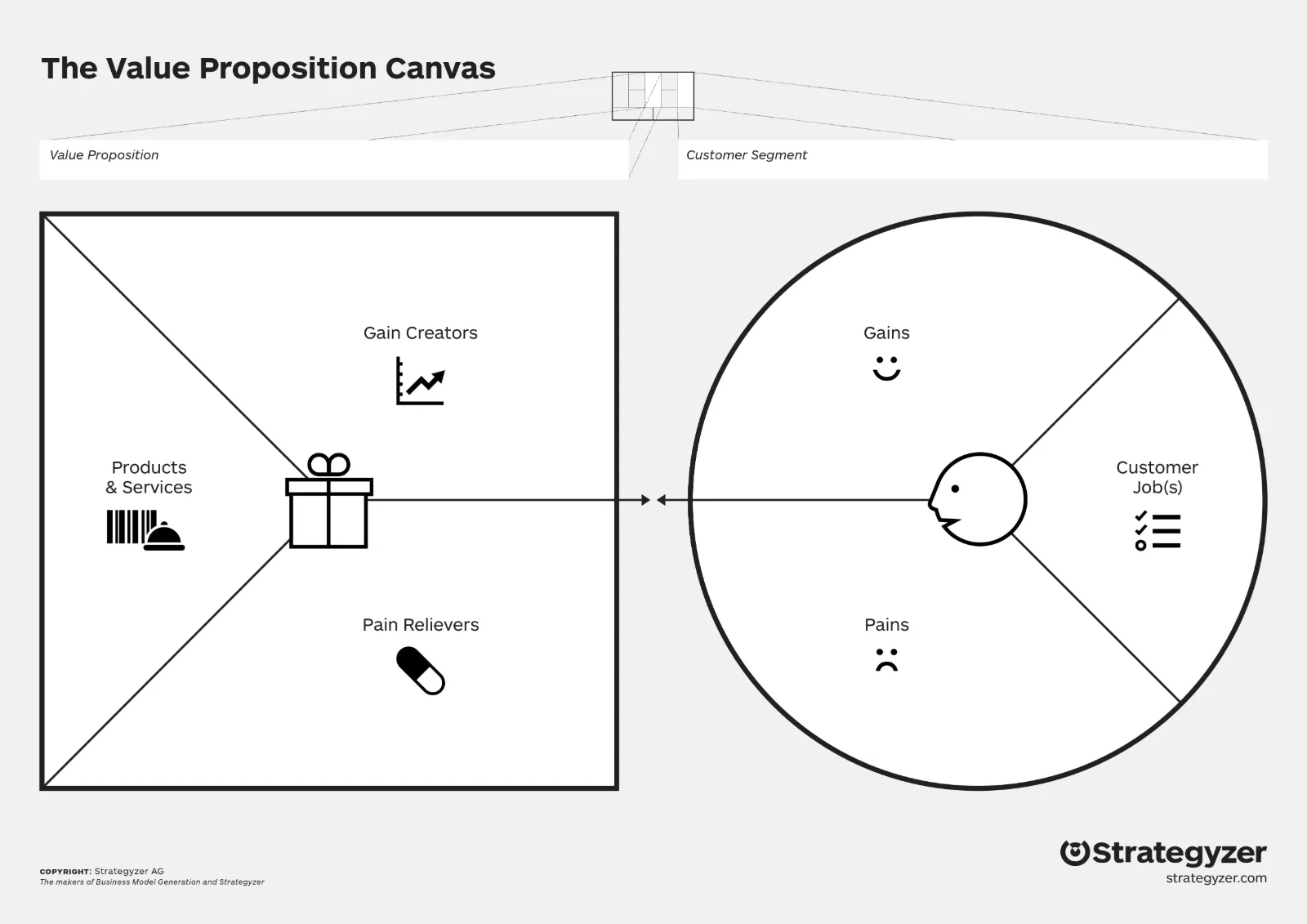
The value proposition canvas is a one-page framework that compares what the customer wants with what the offer gives them, to check that the two sides match. Strategyzer, the company founded by Osterwalder, presents it as a tool that plugs into the Business Model Canvas and expands on two of its blocks (Strategyzer).
The canvas has two sides. The customer profile describes the jobs customers want to get done, the pains they encounter and the gains they want. The value map describes products and services, how they relieve pains and how they create gains (Strategyzer). The aim is “fit”, that is, the match between the two sides: every significant pain has an answer, and every feature of the offer serves something the customer wants.
The canvas is useful before writing the statement, because it forces you to fill the customer side with facts rather than assumptions. Its limitation is the same as any framework: filled in during a meeting without having spoken to customers, it confirms what the company already thought.
Value proposition, USP and positioning: what is the difference?
Value proposition, USP and positioning are three different levels of the same choice. The value proposition describes the overall value an offering creates for a customer segment. The USP, unique selling proposition, isolates the distinctive element that makes the offering preferable to the alternatives. Positioning is the place the brand wants to occupy in the customer’s mind relative to competitors.
A company can have several value propositions, one per segment, and a single brand position. The USP is often the sharpest part of the value proposition, the part that goes into a headline or a campaign. The differences between USP, value proposition and slogan are compared, with examples and selection criteria, in our guide to the unique selling proposition.
Positioning comes before both. A value proposition written without deciding where to stand relative to competitors risks promising what others already promise: the positioning map is the tool for checking this.
Positioning, value proposition and USP
Three levels of the same choice, from the broadest to the sharpest.
Positioning comes first
The place the brand wants to occupy in the customer’s mind relative to competitors. One per brand.
Value proposition one per segment
The overall value an offer creates for a customer segment. A company can have more than one.
USP the spearhead
The distinctive element that makes the offer preferable to the alternatives: the sharpest part of the proposition, the part that ends up in a headline or a campaign.
A value proposition written without first deciding where to stand in relation to competitors risks promising what others already promise.
The most common mistakes
Five mistakes recur in most value propositions that do not work.
- Speaking to everyone. A proposition for every customer convinces no one in particular.
- Listing features instead of benefits: customers do not buy the features, they buy what those features change for them.
- Using words everyone uses, such as quality, innovation and passion, which do not set you apart from any competitor.
- Promising what the company does not deliver. A value proposition contradicted by customer service or logistics damages trust more than a modest one.
- Writing it once and forgetting it. Markets and competitors change, and the proposition should be reviewed at least whenever the offer, prices or customers change.
The fourth mistake is the most expensive, because the customer discovers it after buying. That is why the value proposition concerns those who govern the brand, not only those who communicate it.
Who decides the value proposition in a company?
The value proposition is decided by senior leadership, because choosing which customers to address and which to forgo is a strategic choice, not a communications one. Marketing and sales translate and use it, but they should not be the ones to set it.
In our experience the most frequent problem is not a wrong proposition, but three different ones: the website’s, the sales presentations’ and the one the founder tells key clients. Once decided, the proposition must be written down, approved and made mandatory for anyone producing materials, and that is the task of brand governance.
The same reasoning applies to those who work in the company: the employer value proposition applies the same logic to candidates and employees.
Domande frequenti
What does value proposition mean?
It means proposition of value. It is the statement that explains to a specific customer which problem an offer solves, what benefit it brings and why it is worth choosing over the alternatives. It also refers to the real value the company is able to deliver, not only the sentence used to communicate it.
What is a good example of a value proposition?
Warby Parker, an eyewear brand, promises designer glasses at affordable prices with a social commitment: customer, benefit and alternative are clear. In our work, Oro Elite built its value proposition on trust, made credible by a real-time gold pricing tool and educational content.
Are a value proposition and a USP the same thing?
No. The value proposition describes the overall value an offer creates for a customer segment. The USP isolates the distinctive element that makes it preferable to the alternatives, and is often the sharpest part of the value proposition, the one used in a headline or a campaign.
How long should a value proposition be?
The core statement fits in one or two sentences, which a customer must grasp in a few seconds. Behind the sentence, however, you need a longer document covering customer, problem, benefits, alternatives and proof, to guide those who write the copy and those who sell.
What does CVP mean?
CVP stands for customer value proposition. It is a synonym of value proposition that stresses the customer’s point of view: value counts for how the customer perceives it, not for how the company describes it.
How often should the value proposition be updated?
It should be reviewed whenever the offering, prices, customers or competitors change, and in any case at least once a year. The signal that it needs revisiting is simple: customers choose for reasons other than those written down, or competitors have started promising the same thing.
Fonti e riferimenti
- Wikipedia, Value proposition
- A. Osterwalder, Y. Pigneur, G. Bernarda, A. Smith, Value Proposition Design (Wiley, 2014), scheda bibliografica
- Strategyzer, The Value Proposition Canvas
- E. Almquist, J. Senior, N. Bloch, The Elements of Value, Harvard Business Review (settembre 2016)
- Harvard Business School Online, C. Cote, How to Create a Value Proposition (aggiornato il 15 agosto 2025)