



Buyer personas are semi-fictional profiles of a company’s buyers, built from interviews and real data: they describe who decides, in which situations, with which criteria and with which doubts.
Many companies have a target written in a document and a profile pinned to a wall, yet neither actually guides a decision. For Bliss, buyer personas are a brand decision-making tool before they are a marketing one: they establish who the positioning is built for and verify that messages and offers respond to that audience.
In this guide we explain how to create buyer personas in six steps, how they differ from target, ICP and brand persona, and how to fill in a profile, with an example. We also cover the differences between B2B and B2C, the privacy question and the cases in which we have worked on audiences and customer selection criteria.
Buyer personas in 3 key points
Not who buys, but the situation in which they choose
- 1
A buyer persona describes a buying situation, not the buyer’s age.
- 2
It is built from interviews and first-party data; a hypothesis workshop only produces a proto-persona.
- 3
It holds value if it changes a decision on message, offer or channel, and if it has an owner and a review date.
Buyer personas: meaning and definition
Buyer personas are representations of typical buyers, drawn from research and data, that summarise goals, trigger situation, selection criteria, barriers and the people who influence the purchase. The term buyer refers to the person who purchases; personas is the plural used in the industry for the profiles. In Italian texts both buyer persona and buyer personas circulate, and it is best to use a single form across all company material.
The method originated in software design. Alan Cooper introduced it in his book The Inmates Are Running the Asylum, in 1999, to design interfaces around archetypal users (Interaction Design Foundation); marketing then extended it to the moment of purchase (Wikipedia).
Buyer personas inform four decisions: whom to convince first, with which promise, through which channels and with which offer. In a company with several departments they also help choose between two conflicting messages, because the persona serves as a common yardstick. A profile that changes none of these decisions is a portrait, not a tool.
Buyer persona, target, ICP and brand persona: the differences
Target persona and buyer persona are often used as synonyms, but they answer different questions. Ideal customer is the most ambiguous term: it sometimes means a segment, sometimes a person, sometimes a company. In this table we separate the concepts by what they describe and the decision they support.
| Term | What it describes | Where it comes from | Decision it supports |
|---|---|---|---|
| Target | A segment defined by demographic and geographic characteristics | Market data and customer records | Audience size, media planning |
| Buyer persona | A typical buyer with goals, criteria and doubts | Interviews and behavioural data | Message, offer, channel |
| ICP (ideal customer profile, B2B) | The company worth serving | Sales data and CRM | Which accounts to contact |
| User persona and customer persona | Who uses the product and who has already bought it | Usage research and post-sale data | Product and support |
| Brand persona | The personality with which the brand presents itself | Positioning and identity | Voice and tone |
The most common confusion is between buyer persona and brand persona: the first describes who buys, the second how the brand speaks. Positioning holds them together, and it reads clearly on a brand positioning map built on the same choice criteria that emerge from the interviews.
How to create buyer personas, in six steps
Creating buyer personas starts from a decision to support, and only then from the data. The six-step process moves from explicit hypotheses to validated personas.
- Define the decision to support, for example which message to use with people who do not know the brand.
- Write down the hypotheses in a 2-4 hour workshop with sales, support and marketing: this is a proto-persona and must be labelled as such (Nielsen Norman Group).
- Gather the data already available: CRM, analytics, on-site searches, support requests, reviews.
- Interview customers, prospects and lost customers.
- Group by choice situation rather than demographics, writing each persona with quotes taken from the interviews.
- Validate, assign a named owner and set a review date.
The first step is the most underestimated. In our work for Risivi & Co, defining the real audience came before editorial plans, e-commerce and artist activations, and guided the activities that followed (Bliss, Risivi & Co case study).

What data to collect
Demographic data only matter if they change a decision. More useful are the situation that triggers the search, the alternatives considered, the criteria used to choose, the barriers to purchase, the people who influence the decision and the words customers use to describe the problem.
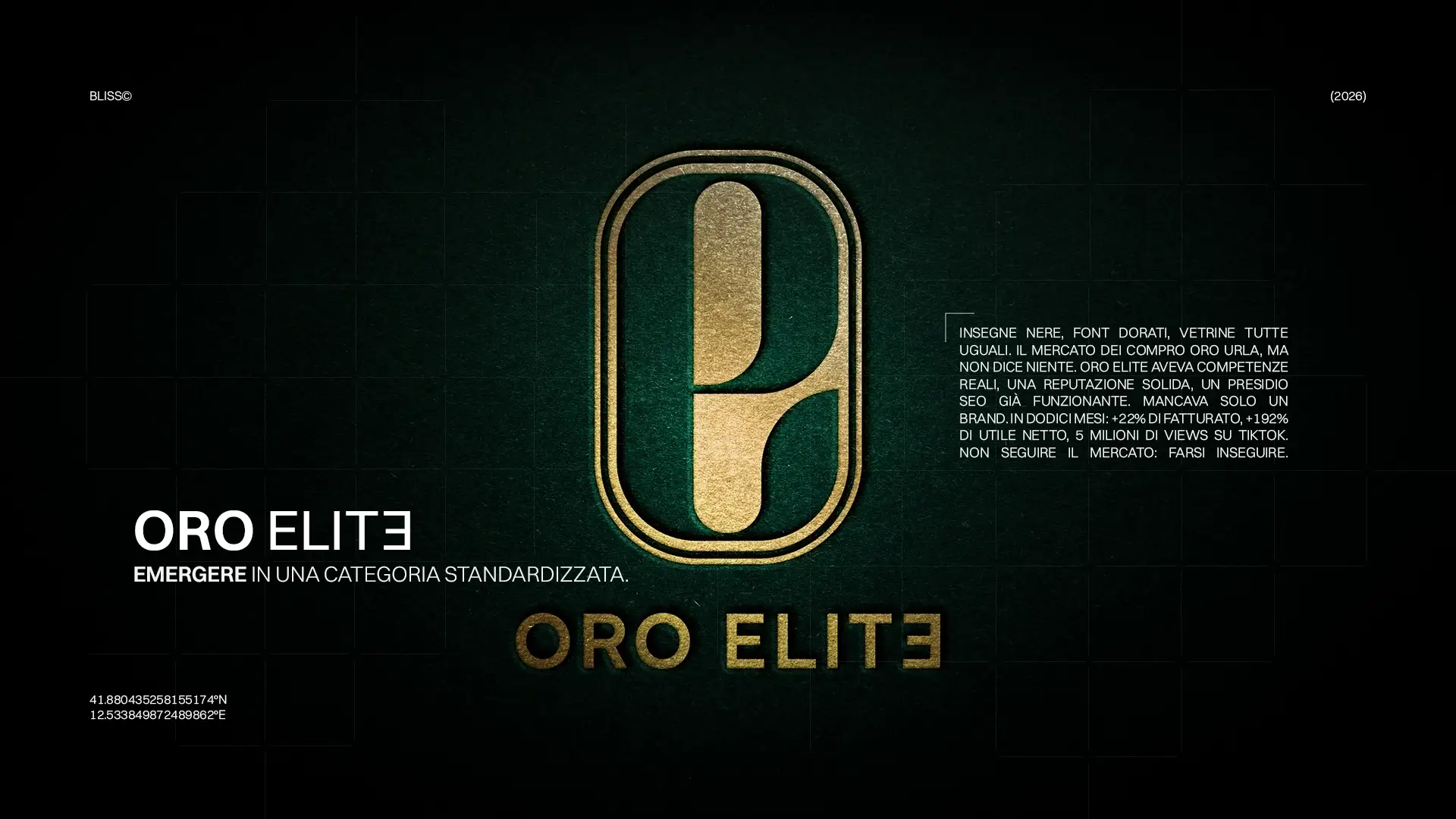
A concrete example is the work carried out for Oro Elite on the brand’s buyer personas. People who turn to a gold buyer want to sell an asset, usually out of necessity, and the queries covered (quotazioni oro, compro oro, valori oro) show the question they arrive with. The real-time pricing tool and content on the precious metals market answered that question before any commercial promise. Between 2023 and 2024, the first year of full governance, revenue rose from €29.9 million to €36.7 million and net profit from €94,000 to €274,500: these are figures stated in the case study, and the comparison is over time, not controlled (Bliss, Oro Elite case study).
Our case studies
Websites, e-commerce and campaigns for brands we have worked with









How to conduct the interviews
Qualitative personas are based on interviews, testing or field observation: Nielsen Norman Group suggests 5-30 users, interviewed in groups of about five until new conversations add almost nothing. Statistical personas start from a survey with at least 100 respondents, ideally 500 or more, and require analytical skills (Nielsen Norman Group).
The questions that work start from facts:
- what happened before I started looking for a solution;
- which alternatives you considered and why you rejected them;
- who else took part in the decision and in what role;
- what almost made you give up;
- how you described the problem when you searched online.
Interviews with lost customers correct assumptions more than any others, because they explain what a satisfied customer does not remember.
Who works on your project
The experts at work across Rome and Milan





First-party data and consent
Data collected directly from customers is the most solid foundation and the simplest to manage. One example is gathering contacts before each sales opening, which gave Collectors Italia an audience that was already activated, made up of people who had chosen to be notified of the drop. This is because the first purchase very often stems from trust in the community, while the second seeks out the brand (Bliss, Collectors Italia case study).
How many buyer personas you need, and the negative persona
The number depends on the decisions. An extra persona is justified only if it changes the message, the offer or the channel; our rule is one primary persona and at most two secondary ones, and Nielsen Norman Group suggests merging profiles that are too similar and removing those of little relevance (Nielsen Norman Group).
A negative persona describes who is not worth serving: those who constantly ask for discounts, those who return products, those who absorb support without renewing. It is built from data, starting with lost customers, returns and support tickets, and is used to exclude audiences from campaigns and the CRM.
Buyer persona examples: a template to complete
The best buyer persona examples have seven or eight fields, each linked to a decision. The name and photograph help people remember it; what makes it useful is the trigger situation, the criteria and the translation into actions.
Buyer personas canvas, illustrative B2B example:
Role and context
Procurement manager of a restaurant group with four locations
Triggering situation
A supplier missed two deliveries in the same month
Objective
Reducing off-menu dishes without increasing stock
Choice criteria
Delivery reliability, catalogue breadth, payment terms
Who influences
Chef (quality), owner (costs), accounts (invoicing)
Main doubt
Changing supplier disrupts the team’s routines
Where they search
Industry peers, sales rep, online search by product code
What changes for us
Pages with stated delivery times and references from similar venues; a trial in a single department
B2B and B2C buyer personas: what changes
Buyer personas in B2B must represent a decision-making group: this is the biggest difference. An average buying group includes 11 active members and up to seven occasional participants (Gartner, 2020; the press release does not report the sample).
| Aspect | B2B | B2C |
|---|---|---|
| Who decides | A group with different roles: decision-maker, influencer, user, whoever can block | An individual or a household |
| What the persona describes | Their role in the purchase and their criteria | The buying situation |
| Search | Interviews by role, lost customers, CRM data | Interviews, analytics, reviews, on-site searches |
| Useful content | References, lead times, risk of disruption | Trials, discovery formats, reviews |
In Bliss Studio’s work on Doreca, two audiences coexisted within the same company. Listening, through direct observation of the stores and the team and analysis of the market and competitors, identified the professionals (restaurateurs, baristas, venue managers), end consumers and a strategic target of people aged 25 to 35. The informal tone, billboards in Roman dialect in the areas of new openings and the launch of TikTok from scratch spoke to all three. Over the same period the TikTok profile reached 2.5 million views in three weeks and 30,129 organic followers between March and May 2023, while in stores conversion rose by 8% and the average transaction value by 12% in 2023. Presenting data and method before requesting approval addressed the initial resistance of a board accustomed to a different kind of communication (Bliss, Doreca case study).
The Bliss angle: a persona is a buying situation
In supporting chief executives and boards of directors, we always point out that building real buyer personas starts with lost customers, the searches through which customers arrive and the CRM: they show choices already made. The approach changes with volume: with few customers, qualitative interviews are enough; with plenty of clean data, you can move to statistical personas; in B2B, you map the buying group first.
Ownership matters as much as research. A profile with no owner and no review date becomes a dated portrait; assigned to whoever approves messages and offers, it becomes a brand governance rule.
How to use buyer personas in decision-making
In the sales funnel, the persona determines which contacts to qualify and which content to support them with. A CRM holding the persona fields (role, trigger situation, stage) makes it possible to check whether the assumptions hold up against the data.
| Decision | Related question |
|---|---|
| Positioning | Which choice criterion weighs most, and where we are credible |
| Message | The words the persona uses to describe the problem |
| Offer | Which doubt the proof, format or guarantee removes |
| Channels | Where they search and whom they consult before deciding |
| Funnel | At which stage they drop out, and why |
| Approvals | Whether the material addresses the primary persona |
Buyer personas and privacy
Personal data is any information relating to an identified or identifiable person; profiling is the automated processing of personal data to evaluate aspects such as preferences, interests or behaviour (GDPR, Art. 4). A persona built from interviews and aggregated data is not profiling in itself. It becomes profiling when the persona’s fields are linked to individual CRM contacts for automated decisions. Interviews require a privacy notice and consent to recording, and the scope must be checked with the data protection officer before linking personas to customer records.
Common mistakes with buyer personas
- Personas built on assumptions: messages are written for a customer who does not exist, and no metric flags it until conversions fall.
- Too many irrelevant details: the team remembers the hobby and forgets the selection criterion, and Nielsen Norman Group lists irrelevant details among the method’s limitations (Nielsen Norman Group).
- Too many personas: none is a priority and every campaign speaks to all of them.
- Only satisfied customers: the reasons why others do not buy are missing.
- No owner: the profile stands still while the offer changes.
- Automated tools without data: a profile generated without research is a proto-persona, and an expert review is no substitute for user testing (Nielsen Norman Group).
Costs and updates
The cost depends on the number of interviews, participant incentives, internal time, data analysis and tools. There is no verifiable market price, and it is advisable to request a quote that specifies sample, deliverables and rights to the materials.
Buyer personas should be updated whenever an event changes the buying decision: a new product or market, a rebrand, a drop in conversion, a change of channel. Nielsen Norman Group treats them as living documents, to be validated over time and checked against analytics segments (Nielsen Norman Group). Without such events, an annual review is a reasonable minimum.
Domande frequenti
What are buyer personas and what are they for?
They are semi-fictional profiles of typical buyers, built from interviews and real data. They help choose message, offer and channels based on customers' selection criteria, and give departments a common reference for assessing materials and campaigns, avoiding decisions based on management's impressions.
Is it buyer persona or buyer personas?
Both forms appear in Italian texts: buyer persona is the single profile, buyer personas the set. It is best to choose one form and keep it across all material. Buyer refers to the purchaser; it is also the job title of the procurement professional, who in a B2B project is one of the people to interview.
What is the difference between a target and a buyer persona?
The target is a segment defined by shared characteristics, such as age, geographical area or sector. The buyer persona is a typical buyer with goals, selection criteria and doubts. The target is used to size and plan the audience; the buyer persona to decide the content of the message and the offer.
Who invented buyer personas?
The method originated in software design with Alan Cooper, who described it in his book The Inmates Are Running the Asylum (1999). Marketing then extended it to purchasing. Sources do not agree on every date, and 1999 is the year most often cited for the book's publication.
How many interviews does it take to create a buyer persona?
For qualitative personas, Nielsen Norman Group recommends 5–30 users, in groups of around five, until new interviews stop adding information. Statistical personas require at least 100 survey respondents, ideally 500 or more (Nielsen Norman Group).
How many buyer personas do you need?
As many as you need to make different decisions. One primary and at most two secondary personas are a starting point; if two personas lead to the same choice of message, offer and channel, they are merged into one. More personas than the company can serve dilute priorities.
Can buyer personas be created with artificial intelligence?
Tools can summarise transcripts and data already collected. A persona generated without research remains a proto-persona and must be declared as a hypothesis to be validated with interviews and analytics. Validation with real people cannot be delegated: it prevents profiles that are plausible but disconnected from customers.
Do you need personal data to create a buyer persona?
Not for the persona itself, which is built from interviews and aggregated data. GDPR comes into play when persona fields are linked to individual contacts to assess their preferences or behaviour: in that case, it is advisable to involve the data protection officer before proceeding. How much does it cost to create a buyer persona? It depends on the sample, internal hours, incentives and analysis. There is no verifiable market price: the quote should state the number of interviews, the deliverables and the rights to the materials, so that you can compare offers covering the same work and see how much of the time remains the company’s responsibility.
Fonti e riferimenti
- Interaction Design Foundation, Personas
- Wikipedia, Buyer persona
- Nielsen Norman Group (Page Laubheimer), 3 Persona Types: Lightweight, Qualitative, and Statistical
- Nielsen Norman Group (Taylor Dykes), Personas Make Users Memorable for Product Team Members
- Gartner, Gartner Says B2B CMOs Should Employ Three Strategies to Reduce Buyers’ Uncertainty and Unlock Purchase Decisions during the COVID-19 Pandemic
- GDPR, Art. 4 Definitions
- Bliss, Come si vende un profumo online: il caso Profumum Roma
- Bliss, Oro Elite
- Bliss, Collectors Italia
- Bliss, Doreca: allineare la percezione digitale alla potenza operativa
- Bliss, Risivi & Co: scalare senza perdere identità