



Personal branding is the work through which a person decides how they want to be recognised for their work and makes that consistent in what they say, write and do. In Italian it is rendered by the little-used term marchio personale.
The term spread in 1997 with an article by Tom Peters, and today it concerns professionals, managers and founders.
In this guide we will look at what personal branding is, how it differs from the corporate brand, what it is for and how to build a personal brand (complete with tools, channels, examples and the most common mistakes). We focus in particular on CEOs and founders, because that is where personal branding stops being a career matter and becomes a business matter: an audience that follows a person does not belong to the company.

What is personal branding?
Personal branding is the process through which a person becomes aware of their strengths, such as skills, style and character, and communicates them in a way that sets them apart from others. The result is a personal brand: the idea others have of that person when they think of their work.
The most common Italian translation is marchio personale, though marca personale is also found. The synonym self-branding refers to the same activity, with the emphasis on doing it yourself. Conversely, personal branding is also used when the image is built by a consultant or an agency.
Note this, though: a personal brand exists regardless. After all, anyone who works leaves an impression. That is why personal branding does not create something out of nothing: rather, it decides whether that impression is left to chance or built with judgement. It is also why the activity is not reserved for famous people: it concerns the professional looking for clients, the manager changing companies, the founder who wants to grow their business.

The personal brand of Bliss’s leadership
Francesco Acri writes on LinkedIn about brand, governance and business decisions: the same themes Bliss works on. This is the condition that makes a founder’s personal brand work, namely pointing back to the company rather than replacing it.
The personal profile belongs to the person, the page belongs to the company: keeping them consistent is a governance decision, not a communications one.
Follow Francesco on LinkedInWhere does personal branding come from?
The concept spread with “The Brand Called You”, an article by Tom Peters published in Fast Company magazine in August 1997. Peters urged everyone to think of themselves as the chief executive of their own company, “Me Inc.”, and to take charge of marketing the brand called “You” (Fast Company, 1997). Wikipedia notes that the idea of self-branding already appears in a 1980 book (Wikipedia, Personal branding).
In Italy the subject gained ground from 2010, with the book by Luigi Centenaro and Tommaso Sorchiotti published by Hoepli, the first volume on the topic to come out in the country (Hoepli).
Personal brand and corporate brand: what is the difference?
A personal brand belongs to a person and follows them wherever they work; a corporate brand belongs to the company and remains when people change. This is the most important distinction to grasp before investing in the personal branding of a company’s leader.
| Personal brand | Corporate brand | |
|---|---|---|
| Who it belongs to | To the person | To the company |
| What it promises | Expertise, point of view, individual reliability | Products, services, the organisation’s values |
| Who governs it | The person | Senior leadership, with shared rules |
| If the person leaves | The audience follows it | The brand remains, but loses a voice |
| Typical channel | Personal profile | Company page, website, retail outlets |
The two brands are not in competition. They work well when they reinforce each other, and badly when the company depends on a single person to be heard. That risk has a name, key person risk: a significant share of the company’s value concentrated in one person, which becomes a vulnerability, including in due diligence.
What is personal branding for?
Personal branding exists to get a person chosen for what they can do, even before they introduce themselves. For a professional it means receiving work requests instead of looking for them. For a manager it means being recognised as competent in a specific area. For a founder it means giving the company a credible face.
It works because of trust, which today is concentrated in people close to us more than in institutions. In the 2026 edition of the Edelman Trust Barometer, “my CEO” is trusted by 66% of employees, among the highest figures in the survey (Edelman, 2026). In B2B the same mechanism applies to buyers: research by Edelman and LinkedIn cited in our article on the most-followed CEOs shows that 67% of decision-makers prefer content signed by an identifiable author (Bliss, most-followed CEOs on LinkedIn).
How do you build a personal brand?
How it is built
Six steps, from objective to review
- 1
Define the objective
Clients, career, authority in a sector, support for the company.
- 2
Choose your audience
Who needs to recognise us, and for what.
- 3
Identify your theme
A specific area of expertise, not a list of interests.
- 4
Gathering the evidence
Projects, results, testimonials, publications.
- 5
Choose one or two channels
And a sustainable cadence.
- 6
Measure and adjust
Who is looking for us, for what, and with which words.
The third step is the hardest and the most important. A personal brand that talks about everything is remembered for nothing. The same logic applies to companies: it is positioning, the choice of the place to occupy in the minds of those who have to choose us.
The fourth step separates personal branding from self-promotion. A claim without proof is a slogan, whereas a project presented with its results is proof that others can verify. We will devote a dedicated article to the step-by-step guide on how to create a personal brand.
The personal branding canvas
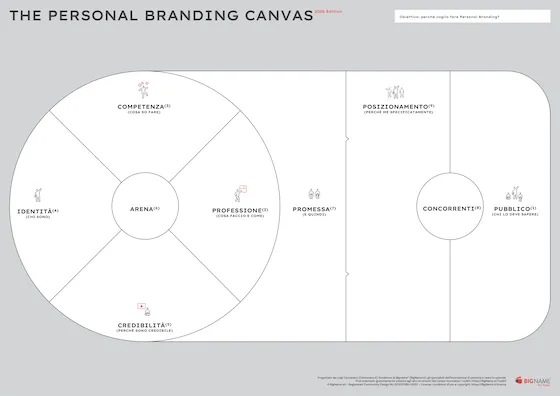
The personal branding canvas is a one-page framework for designing a personal brand strategy: audience, value offered, channels, resources, activities. It was devised by Luigi Centenaro, adapting the visual tool proposed by Tim Clark in the book Business Model You (Ninja Marketing, 2015).
It is useful for those starting from scratch, because it forces you to put into a few lines what often remains vague, such as the concrete benefit you bring to a client. Like any framework, it works if you fill it in with real data, for example the reasons why current clients chose us, and not with intentions.
Personal branding on social media: which channels should you choose?
No channel is indispensable for everyone: you choose those where the audience you want to reach is found, and it is better to do one well than four badly. For professionals, managers and founders in B2B, the main channel is almost always LinkedIn. For those who work with consumers, Instagram, TikTok or YouTube matter more.
LinkedIn rewards consistency and expertise that is backed up with examples. Our guide on how to create a personal LinkedIn profile explains how to go from an empty account to a recognisable presence, while the article on visibility and recognisability explains why being seen often is not enough to be remembered.
Beyond social media, there are channels that build authority more slowly but more durably: bylined articles, speaking at events, books, podcasts, newsletters. Search results are also part of a personal brand, including the way artificial intelligence systems describe a person, a topic we cover in our article on reputation in AI.
Personal branding for CEOs and founders
For a CEO or a founder, personal branding is a business decision, because the audience that follows the person does not coincide with the company’s. A company page belongs to the company, a personal profile belongs to the person, and the company’s ability to be heard should not depend on a single profile (Bliss, most-followed CEOs on LinkedIn).
The risk is real in small and medium-sized businesses, where the brand often coincides with whoever founded it. When that happens, the company is hard to grow and to sell, because its value depends on one person. The solution is not to remove the founder from communications, but to build a system in which person and company reinforce each other: this is the path we describe in our guide to founder-independent branding.
In practice, a leader’s personal brand works when it points back to the company rather than replacing it: themes consistent with the company’s positioning, team members appearing alongside the founder, content that also lives on the company page. We will devote a separate in-depth piece to personal branding for managers, with its rules and responsibilities.
Personal branding examples
The most useful examples show two different ways of building a personal brand: around a person who leads a company, or around an experience rather than a face.
Italian CEOs on LinkedIn
Some Italian chief executives have built a LinkedIn audience comparable to that of a mid-sized company. In our article on the most-followed CEOs on LinkedIn, Stephan Winkelmann, Chairman and CEO of Lamborghini, exceeds 534,000 followers, Cristina Scocchia, CEO of illycaffè, 211,000, and Nerio Alessandri, Chairman and CEO of Technogym, is approaching 200,000 (Bliss, most-followed CEOs on LinkedIn). The numbers change over time and should be read as a snapshot.
Italian CEOs with a mid-sized company’s audience
Followers on the personal LinkedIn profile.
Stephan Winkelmann Lamborghini
534,000Cristina Scocchia illycaffè
211,000Nerio Alessandri Technogym
200k
The numbers change over time and should be read as a snapshot. The point is not the number of followers: it is that these profiles talk about themes consistent with the companies they lead.
The point is not the number of followers. It is that these profiles address themes consistent with the companies they lead, and that the audience follows them to gain access to a perspective on a sector. That is the condition for a leader’s personal brand to support the corporate brand rather than overshadow it.
Amici & Buon Vino: a personal brand without a face at the centre
Amici & Buon Vino is a project that started on social media around wine, music, food and conviviality, with the claim “Situazione Giusta”. In our editorial reading, it shows that a personal brand can emerge without putting a person at the centre: the identity rests on a way of being together, recognisable through places, music and a repeated claim (Bliss, Amici & Buon Vino).
The limit here is the opposite of the one CEOs face: growing without losing the atmosphere that made the project recognisable. A selection of the most interesting Italian personal brands, with stated criteria, will be the subject of a dedicated article.
What are the most common personal branding mistakes?
The most common mistakes come from confusing personal branding with visibility.
- Talking about everything. Without a specific theme, the audience does not know what to remember us for.
- Promising without proof. Claims about your own expertise are worth only as much as the results that support them.
- Imitating another profile. A copied style is recognisable, and invites comparison with the original.
- Neglecting consistency across channels. One tone on LinkedIn and the opposite elsewhere confuses those who follow us.
- Making the company coincide with the person. If the founder stops posting and the company disappears, the personal brand has replaced the corporate one.
- Ignoring reputation. A misjudged post or a controversy stays in search results for a long time, and it pays to know in advance how to respond.
The fifth mistake is the one that weighs most heavily on a company’s value. We analysed it in the article on the brand that becomes a person.

How much does personal branding cost?
There is no verifiable market price: the cost depends on how much of the work you do yourself and how much you entrust to professionals. Those who start on their own spend mainly time, that is, a few hours a week writing, posting and replying.
When professionals are brought in, the typical cost items are strategy definition, professional photography, writing or editing content and, for managers, alignment with company communications. To compare quotes, it is worth asking what will be delivered, who actually writes the content and how results are measured.
How do you measure a personal brand?
It is measured by whether the right people recognise and seek out the person for the chosen theme, not just by how many follow them. There are four useful indicators: unsolicited requests received, invitations to speak or write, Google searches for the name, and the type of audience engaging with the content.
Followers also grow with content that has nothing to do with the objective, so on their own they say little. A useful periodic check is to search for your own name and read the top results as a client or a recruiter would: if they tell what you want people to know, the personal brand is working.
Domande frequenti
How is personal branding translated into Italian?
The most common Italian translation is marchio personale; marca personale is also found. The English synonym self-branding refers to the same activity, with the emphasis on the person doing it themselves. In everyday use, even in Italian, the English expression is almost always used.
Who created the concept of personal branding?
The term spread with the article “The Brand Called You” by Tom Peters, published in Fast Company in August 1997, in which the author urged everyone to think of themselves as the CEO of “Me Inc.”. The idea of self-branding, however, already appears in earlier texts, starting with a book from 1980.
Is personal branding only for famous people?
No. It concerns anyone who needs to be chosen for their work: freelancers, consultants, managers, founders, people looking for a new role. For those who are not famous, personal branding matters even more, because the people who have to choose them do not know them yet.
What is the difference between a brand and a personal brand?
The corporate brand belongs to the company and remains when people change. The personal brand belongs to the person and follows them wherever they work. They work well together when they reinforce each other, and they create a risk when the company depends on a single personal profile to make itself heard.
Which social channels are needed for personal branding?
The ones where your target audience is. For B2B professionals and managers the main channel is almost always LinkedIn; for those working with consumers, Instagram, TikTok or YouTube matter more. One channel maintained consistently is better than four opened and abandoned.
What is corporate personal branding?
It is work on the personal brand of those who represent a company, such as CEOs, founders and managers, coordinated with the company’s communications. The aim is for people’s reputations to strengthen that of the brand, without the company depending on a single profile to be recognised.
Fonti e riferimenti
- Wikipedia, Personal branding
- T. Peters, The Brand Called You, Fast Company (agosto 1997), testo riprodotto
- Hoepli, scheda autore di Luigi Centenaro (Digital You)
- Ninja Marketing, intervista a Luigi Centenaro sul Personal Branding Canvas (14 luglio 2015)
- Edelman, 2026 Edelman Trust Barometer: Society Slides into Insularity