
Corporate identity, in Italian identità aziendale, is the set of values, behaviours, ways of communicating and visual signs through which a company presents itself, recognisably and consistently, to customers, employees, investors and institutions. It concerns the company as a whole, not a single product or brand.
The logo is only its most visible part. Corporate identity is the way the company decides, behaves and communicates; design comes last and makes visible something that must already exist. When behaviour contradicts design, the market believes the behaviour.
In this guide we explain what corporate identity means, what its elements are according to the reference models, how it differs from brand identity and coordinated image, how it is built, what the manual contains and how to check whether it is consistent, with the examples of Olivetti, IBM and Brunello Cucinelli.
In brief
Corporate identity in 4 key points:
- 1
Corporate identity is the identity of the company as a whole, addressed to customers, employees, investors and institutions.
- 2
It is expressed through behaviour, communication and design, with corporate culture as its foundation.
- 3
It is built in five steps, starting from strategy and values, not from the logo.
- 4
It is credible when behaviour confirms the design: otherwise the market believes the behaviour.
What is corporate identity and what does it mean?
Corporate identity is what a company is and chooses to declare about itself: its personality, expressed through what it does, what it says and how it looks. Wally Olins, in Corporate Identity (Thames & Hudson, 1989), describes it as the way an organisation makes its strategy visible to all the audiences it deals with.
The distinction to keep in mind is between identity and image. Identity is built by the company; image is the perception that customers, employees and the market form of it. The first is governed, the second is received, and the gap between the two is the first sign that something is not working.
In the projects we work on, this gap often shows up in concrete terms: companies with a carefully crafted visual identity and a customer service, recruitment process or pricing policy that contradicts it. In these cases, redoing the logo does not help; what is needed is to align behaviour.
How is corporate identity translated into Italian?
Corporate identity translates into Italian as “identità aziendale” or “identità d’impresa”. The English term is the most widely used in management literature and project documents, while in Italian “identità aziendale” is preferred in institutional and academic contexts. Both terms mean the same thing: the identity of the company as an organisation, distinct from that of its products.
What are the elements of corporate identity?
The elements of corporate identity are behaviour, communication and design, to which many authors add corporate culture. The reference model is that of Klaus Birkigt and Marinus Stadler (Corporate Identity: Grundlagen, Funktionen, Fallbeispiele, 1980): a company’s personality is expressed through these three channels, and the identity is credible only if all three say the same thing.
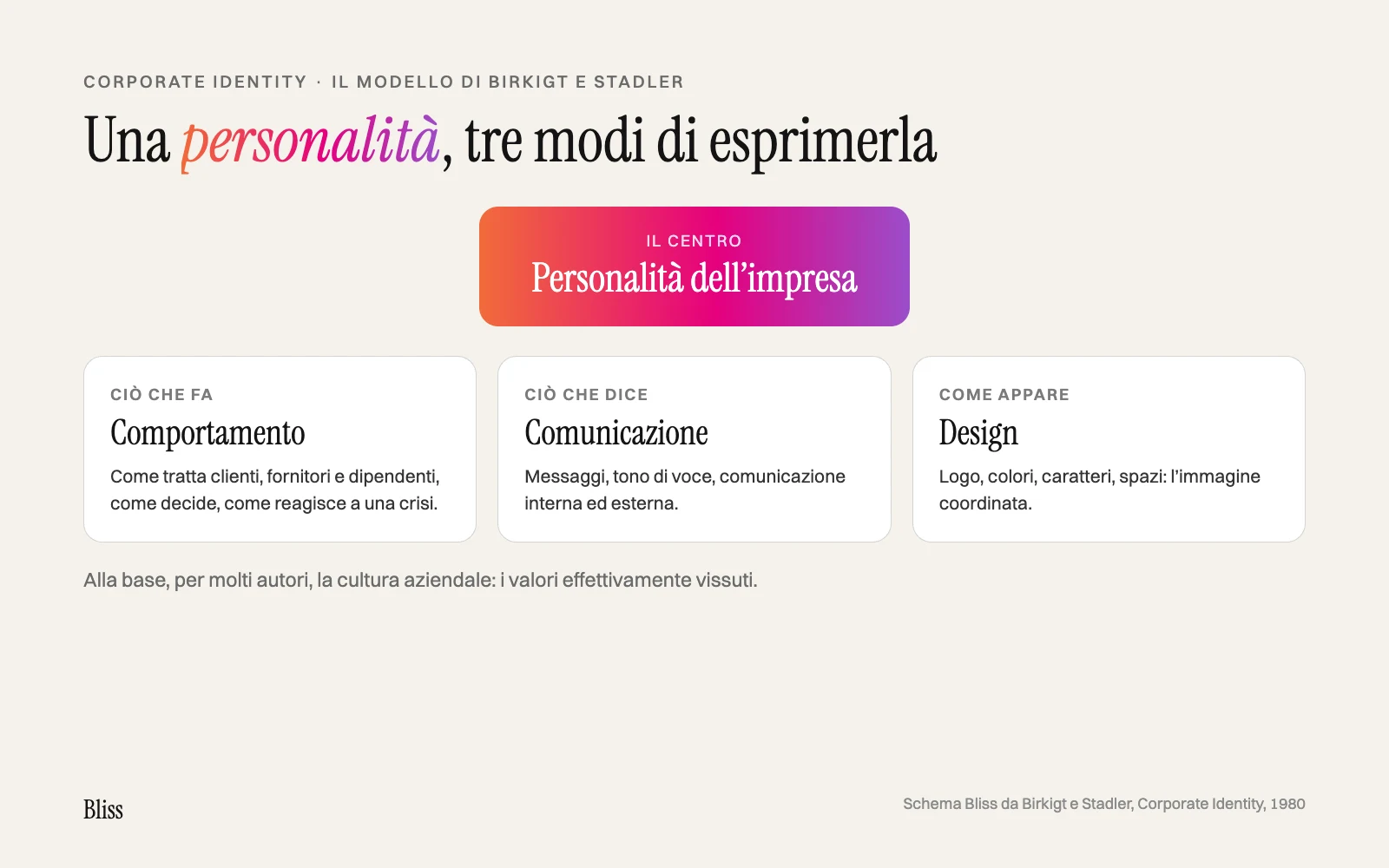
A study by T.C. Melewar and Elif Karaosmanoglu (European Journal of Marketing, 2006), based on interviews with industry practitioners, extended the model to seven dimensions, including corporate culture, structure and strategy. The point remains the same: design is one of the components, not the whole identity.
What is corporate design?
Corporate design is the visual part of corporate identity: logo, corporate colours, typefaces, photographic style, the architecture of spaces. Gathered into a system of rules applied to all materials, it becomes the house style. Corporate identity design does not create the identity: it translates it into recognisable signs, and it works only if what it translates is already clear.
What is corporate communication?
Corporate communication is the way a company speaks to its audiences: press releases, annual reports, corporate website, internal communication, press and institutional relations. It includes the tone of voice and the key messages the company repeats. It differs from product communication because it speaks about the company as an organisation, and because it also addresses people who will never buy anything: investors, candidates, public authorities.
What is corporate behaviour?
Corporate behaviour is the way a company conducts itself: how it treats customers, suppliers and employees, how it makes decisions, how it reacts to a mistake or a crisis. It is the component that weighs most on reputation, because it is the one people experience directly. A promise of customer care contradicted by a badly handled complaint wipes out years of communication in a single day.
What role does corporate culture play?
Corporate culture is the set of values actually lived within the company, not the declared ones. It is the foundation of the other components: it determines how people behave when no one is watching. A well-written corporate vision shapes the culture only if senior management applies it first; externally, culture becomes visible above all through employer branding.
What is the difference between corporate identity, brand identity and house style?
Corporate identity concerns the company as a whole, brand identity a single brand or product, and house style the graphic layer applied to materials. John M.T. Balmer, in a 2001 article in the European Journal of Marketing tellingly titled “seeing through the fog”, showed how often these concepts are confused even in the specialist literature.
Corporate identity, brand identity and coordinated visual identity
Three different levels of the same company.
| Corporate identity | Brand identity | Corporate identity | |
|---|---|---|---|
| Concerns | The company as a whole | A brand or a product | The graphic element applied to materials |
| Aimed at | All stakeholders: customers, employees, investors, institutions | Mainly customers and prospective customers | Anyone who sees material from the company |
| Includes | Behaviour, communication, design, culture | Values, personality, verbal and visual identity | Logo, colours, typefaces, layouts |
| Who is accountable | Senior leadership | Who leads the brand | Those who manage communication and design |
When a company and its main brand coincide, as is often the case with SMEs, we speak of corporate brand identity: the brand’s identity is also the company’s. In groups with several brands the two remain distinct, and corporate identity provides the common framework. For more on the brand side, we have devoted a guide to brand identity.
What is the difference between corporate identity and corporate image?
Corporate identity is built, corporate image is received: the former is what the company decides to be, the latter is what the public thinks it is. The gap between the two is the first indicator of a problem. When this gap widens and becomes entrenched over time, the issue becomes brand reputation, that is, the settled judgement the market forms of the company.
Examples of corporate identity
The cases that defined the discipline share one trait: design came after a choice about what the company wanted to be, and that choice also concerned how it treated people.
Olivetti: identity as a way of doing business
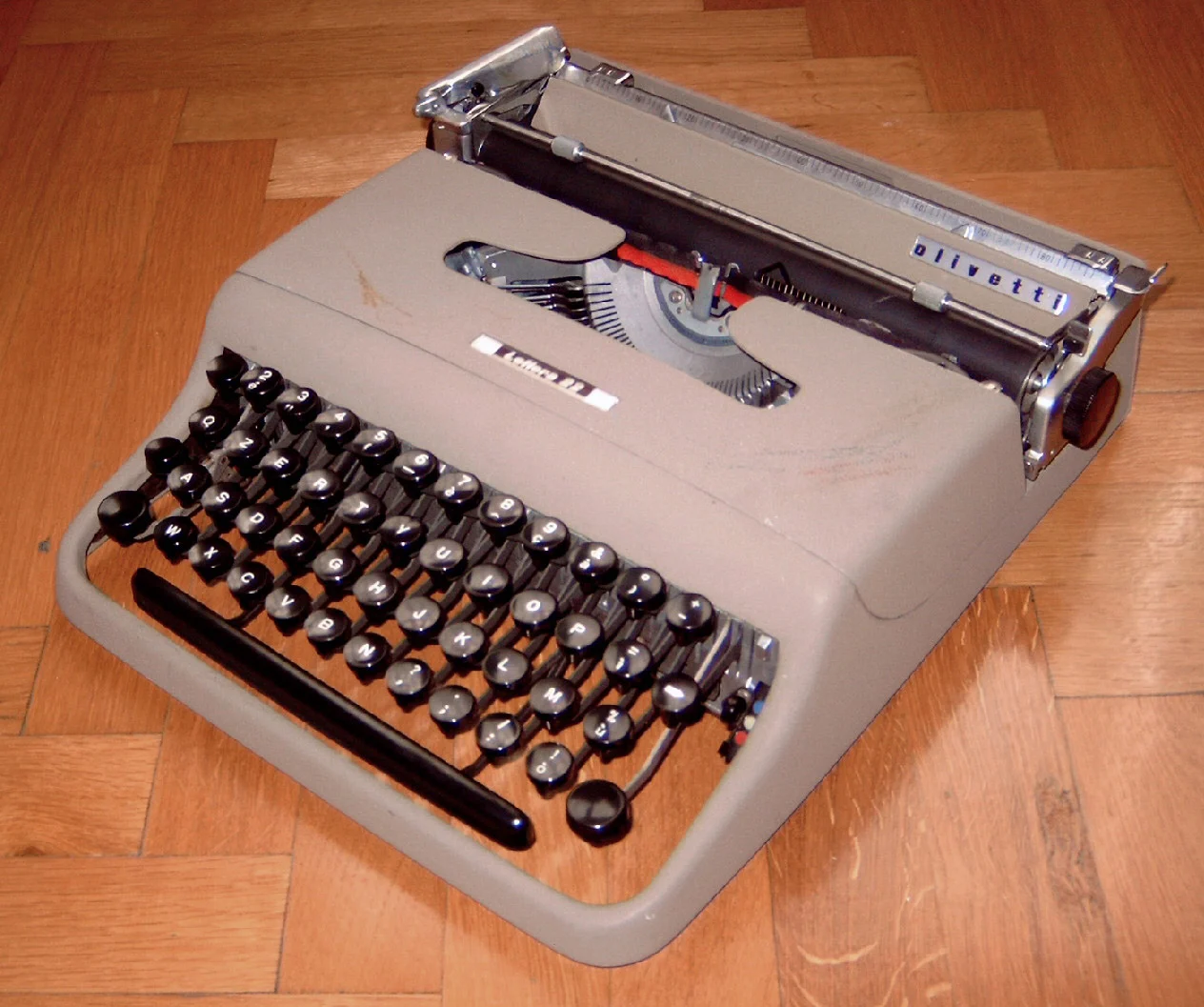
Under Adriano Olivetti, general manager from 1932 and chairman from 1938, the Ivrea company built an identity that held together products, factories, graphics and employee policies. Designers such as Marcello Nizzoli and Giovanni Pintori and architects such as Figini and Pollini worked for Olivetti; alongside the factories came nurseries, canteens, libraries and social services for workers.
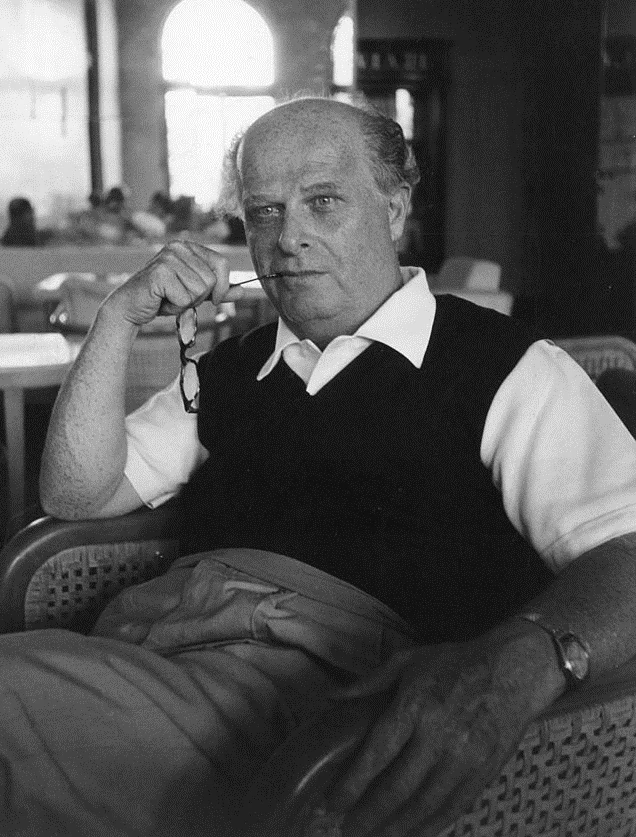
According to the Associazione Archivio Storico Olivetti, the logo itself, redesigned by Pintori, was the visual synthesis of a way of being a company. In 2018 UNESCO inscribed “Ivrea, industrial city of the 20th century” on the World Heritage List, recognising the value of the relationship between production, architecture and community that the company had built.
IBM: the first corporate design programme
In 1956 Thomas J. Watson Jr., recently appointed president of IBM, commissioned the architect and designer Eliot Noyes to create the first design programme extending across the entire company, from architecture to graphics to products. Noyes brought in Paul Rand for the logo and graphics, Charles and Ray Eames for exhibitions and films, and Eero Saarinen for the buildings (IBM, history of the design programme).
According to several accounts, Watson Jr. was struck by the Olivetti showroom on Fifth Avenue in New York. Watson set out the principle that guided the programme, “good design is good business”, in a lecture at the University of Pennsylvania in 1973: design as a management choice, not as decoration.
Brunello Cucinelli: an identity founded on behaviour
Brunello Cucinelli, founded in 1978, has built its identity on what it calls “humanistic capitalism”. The rules are concrete: the working day ends at 17:30, work emails after that time are banned, the lunch break lasts an hour and a half, and salaries are around 20% above the industry average (The Wall Street Journal, August 2026, in the press review published by the company). The company has also invested in restoring the village of Solomeo, in Umbria, where it is headquartered.

The case shows the hardest part to imitate: an identity visible above all in behaviour. The brand’s understated design is consistent with what happens on the factory floor, and that is why it is credible.
How do you build a corporate identity?
A corporate identity is built in five steps. It starts from strategy and values, that is, from what the company wants to be and for whom, as described in the guide to brand strategy. The real identity is then tested with a brand audit: what customers, employees and suppliers say, and where perception drifts away from intent.
The third step is defining the messages: what the company says about itself, in what words, to which audiences. The fourth is designing the visual system that makes those messages recognisable. The last is writing the rules and deciding who enforces them, because an identity with no one accountable for it wears out within a few years.
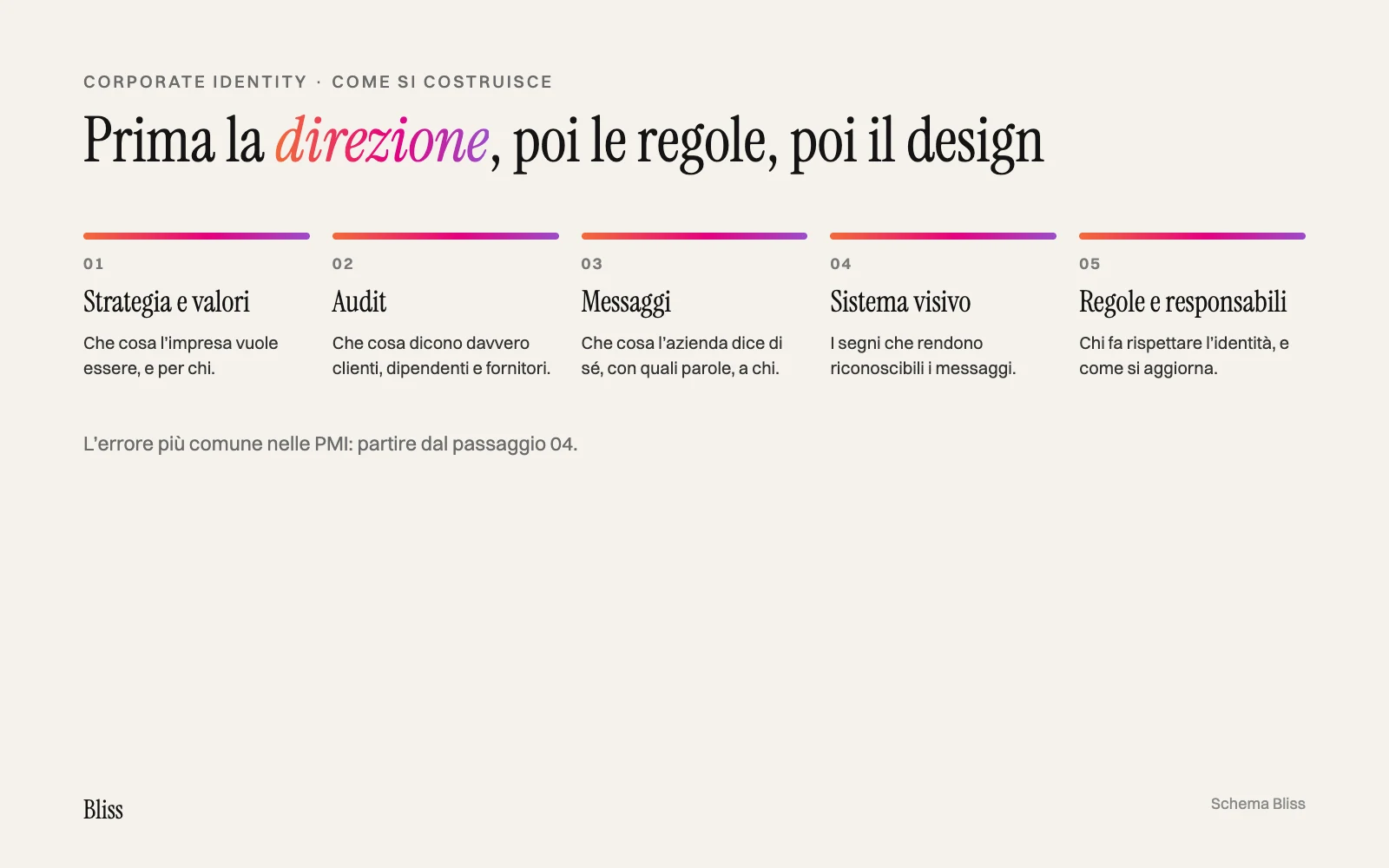
The most common mistake we see in SMEs is starting from the fourth step, the logo, and skipping the first three. The result is a new graphic system resting on behaviour and messages that remain exactly as they were.
For Tecnoelios, a solar energy company born from the meeting of technical and commercial expertise, we started with an analysis of the market and the competition before designing any mark. The visual system and house style came after positioning, to make the company recognisable without losing the rigour the sector demands (Tecnoelios case).

What is a corporate identity manual?
The corporate identity manual is the document that sets out the rules of the corporate identity: values and messages, tone of voice, logo and its variants, colours, typefaces, layouts, and examples of application on every medium. It is used by internal departments, suppliers and anyone producing materials on the company’s behalf. On its own it is not enough: a manual that no one consults and no one enforces remains an archive document. We covered this in our guide to the brandbook.
For Collectors Italia, a community dedicated to the world of collectible cards, the manual brings together logo, palette, typefaces and usage rules for every medium, from custom envelopes to e-commerce, alongside the business logic built with the brand (Collectors Italia case).

What are corporate identity mockups for?
Corporate identity mockups show the visual system applied to real materials, such as letterheads, signage, vehicles and the website, before they are produced. They make it possible to check whether the rules hold across very different media and to correct them before printing. In visual identity design we use them as a decision-making tool, not as presentation images.
How can you tell whether a corporate identity is consistent?
A corporate identity is coherent when it passes four tests:
- What the company declares matches what customers and employees say. If the words used externally and internally diverge, the identity exists only on paper.
- Materials are recognisable even without the logo. Colours, tone and layout are enough to tell who a document comes from.
- Difficult decisions respect the stated values. Pricing, crisis management, recruitment: that is where identity is put to the test.
- Someone is accountable for it. A person or body with the mandate to enforce the rules and to update them.

The last check is the one most often missing, and it concerns brand governance: who decides, who monitors, with which indicators. In an international group the issue multiplies with every country, as we saw in the Würth case.
How do we work on corporate identity in brand governance projects?
In brand advisory and governance projects we treat corporate identity as a board-level responsibility: first the direction, then the rules that protect it, then execution. Every aesthetic choice comes after the strategic ones.

Our case study
Direction first, then the rules
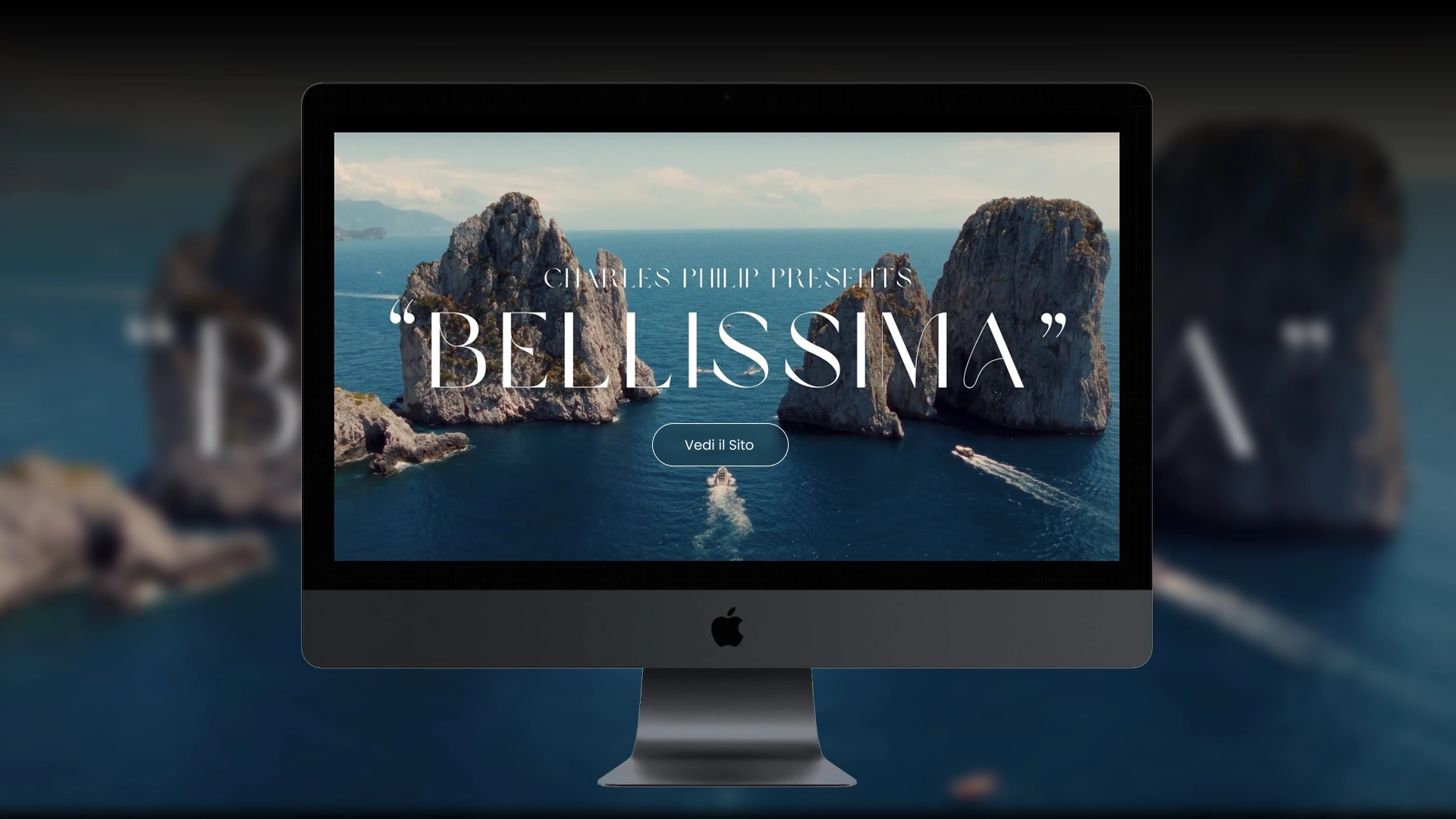
For Charles Philip Milano we started with a strategic audit and positioning in the premium segment, then defined the identity rules, the KPIs and reporting to the board. The visual system came later. Between March and September 2024 Instagram followers rose from around 400 to 4,023 and email CTR from 1.8% to 6.8% (Instagram Insights and newsletter platform).
Read the case studyIn the projects we work on, the opening question is not how the company should look, but how it should behave when no one is watching. If the answer is clear, messages and design are chosen against precise criteria; if it is not, design remains a promise that behaviour contradicts.
Bliss’s point of view
‘A logo can be changed in a few months, a company’s behaviour in a few years. Corporate identity is the second thing, and the logo only has to make it visible.’ Francesco Acri, founder and CEO of Bliss
This is why the corporate identity projects we handle close with a governance system: who decides, who monitors and with which indicators.
Who works on your project
The people of Bliss across Rome and Milan





Frequently asked questions about corporate identity
Is corporate identity the same thing as the logo?
No. The logo is an element of corporate design, which is one of the components of corporate identity alongside behaviour, communication and culture. A company can change its logo without changing its identity, whereas a change of identity also requires action on behaviour and messages.
Who is responsible for corporate identity within a company?
Responsibility lies with top management, because identity concerns decisions that involve the whole company. Day to day, it is usually handled by the communications or marketing department, supported by HR on culture and behaviour and by external consultants on strategy and design.
How much does it cost to design a corporate identity?
It depends on the scope: a graphic system for a small business and a project covering audit, values platform, communication and governance rules for a group have very different costs. The investment is best assessed against the number of audiences, countries and media on which the identity will have to work.
How often should corporate identity be reviewed?
Values and behaviours should be reviewed every year and changed only when the strategy changes: a merger, a new market, a generational handover. The visual side is updated more often in its details, but without losing the elements that make it recognisable.
Does an SME need a corporate identity?
Yes, because every company already has one, even if it has never defined it. In SMEs, corporate identity and brand identity often coincide, and defining them calls above all for clarity on what the company promises and how it behaves, more than for major investment in design.
What is the difference between corporate identity and corporate culture?
Corporate culture is the set of values and habits actually lived within the company; corporate identity is the way the company presents itself externally and internally. Culture is the foundation of identity: if the two diverge, the declared identity does not hold.
Sources
- Klaus Birkigt, Marinus M. Stadler, “Corporate Identity: Grundlagen, Funktionen, Fallbeispiele”, 1980
- Wally Olins, “Corporate Identity: Making Business Strategy Visible Through Design”, Thames & Hudson, 1989
- John M.T. Balmer, “Corporate identity, corporate branding and corporate marketing: seeing through the fog”, European Journal of Marketing, 2001
- T.C. Melewar, Elif Karaosmanoglu, “Seven dimensions of corporate identity: a categorisation from the practitioners’ perspectives”, European Journal of Marketing, 2006
- Associazione Archivio Storico Olivetti; UNESCO, “Ivrea, Industrial City of the 20th Century”, 2018
- IBM, “IBM design” and “Art and architecture”, ibm.com/history
- Brunello Cucinelli, investor relations press review (The Wall Street Journal, August 2026)
- Bliss, Charles Philip Milano case study, March-September 2024
- Images: Bliss diagrams; photographs from the Charles Philip Milano, Tecnoelios and Collectors Italia case studies; Adriano Olivetti and Olivetti Lettera 22 from Wikimedia Commons (public domain); Solomeo, photo by trolvag, Wikimedia Commons, CC BY-SA 3.0; cover generated with Magnific
Bliss · Rome and Milan
We make your company’s identity consistent
Rebranding, a merger, generational succession or an identity that no longer holds: we start from values and behaviours and build a system that senior management can govern.
You tell us about the company
Two minutes on the contact form: company, markets, objectives.
We get back to you
A consultant reads your request and arranges an initial call with you.
You receive a proposal
Scope, priorities and costs, starting from the diagnosis.