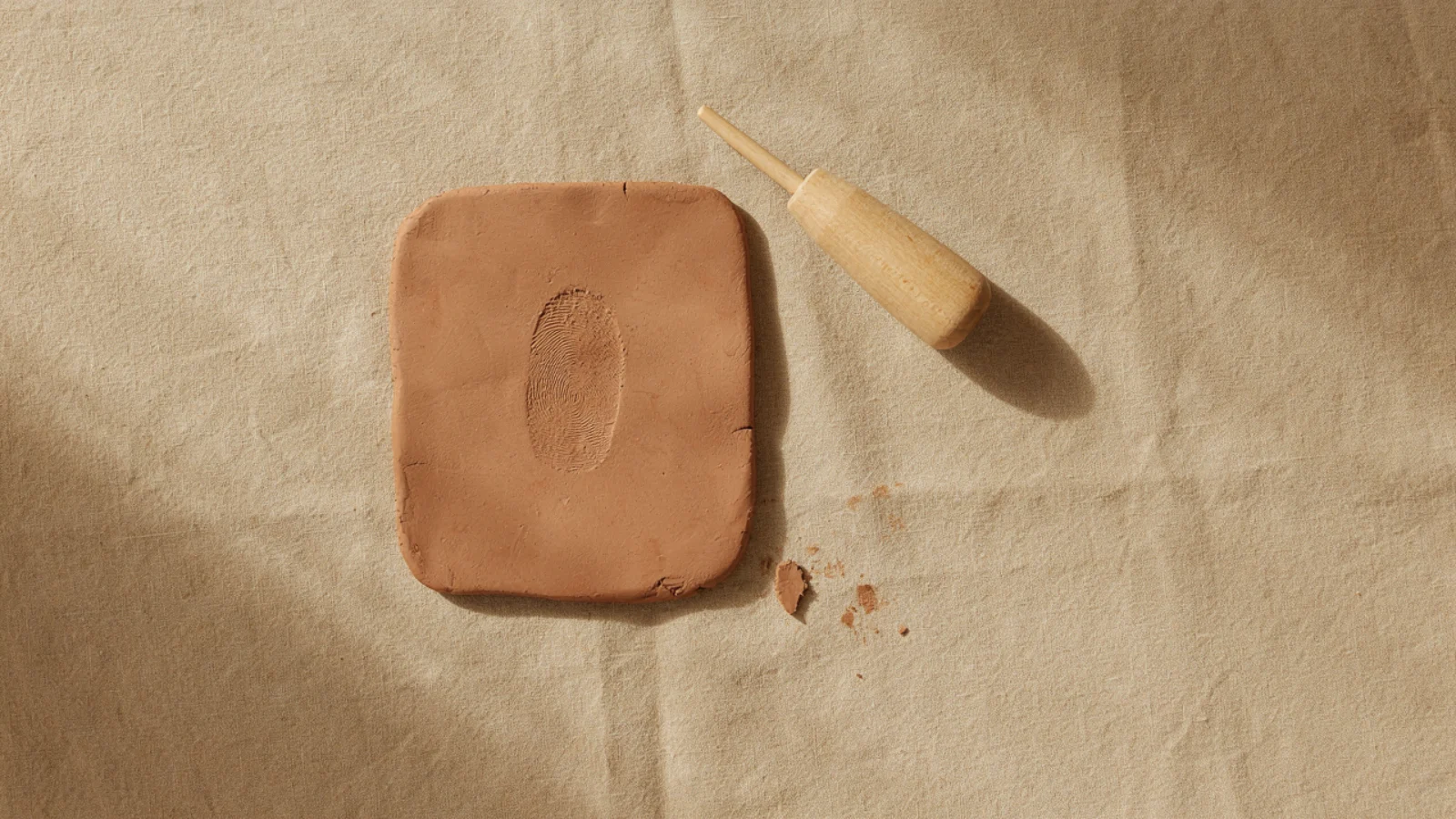
Brand identity is the set of values, personality, language and visual signs by which a brand chooses to be recognised, and which it repeats consistently at every point of contact with its audience. It is an intention of the company: it describes how the company wants to be perceived, before how it is actually perceived.
The logo is its signature, not its content. The content is the choices the brand repeats every day, what it promises, how it speaks, what it refuses to do, and which the market learns to recognise over time. This is why an identity is designed once, but governed always.
In this guide we explain what brand identity means, with examples of Italian and international brands, which elements it comprises, how it differs from branding, brand image and corporate identity, how it is created and how to check whether it works.
In brief
Brand identity in 4 key points:
- 1
Brand identity is how the brand chooses to be recognised: values, personality, language and signs.
- 2
The logo is its signature, not its content: the substance lies in the choices repeated every day.
- 3
It is created in five steps, starting from strategy, not from design.
- 4
It is tested with four checks: recognisability, shared words, price, consistency.
What is brand identity and what does it mean?
Brand identity means the identity of a brand: the way a company decides to be recognised, through what it says, what it shows and what it does. David A. Aaker, in Building Strong Brands (Free Press, 1996), defines it as the unique set of associations that those who lead the brand want to create or maintain in people’s minds.
The key word is “wants”. Identity is the part of the brand the company controls: it is decided, written and designed. The perception the public forms of it is something else, the brand image, and it depends on everything the brand actually does, not only on what it claims. When the two coincide, the brand is credible; when they diverge, the market believes the experience, not the claim.
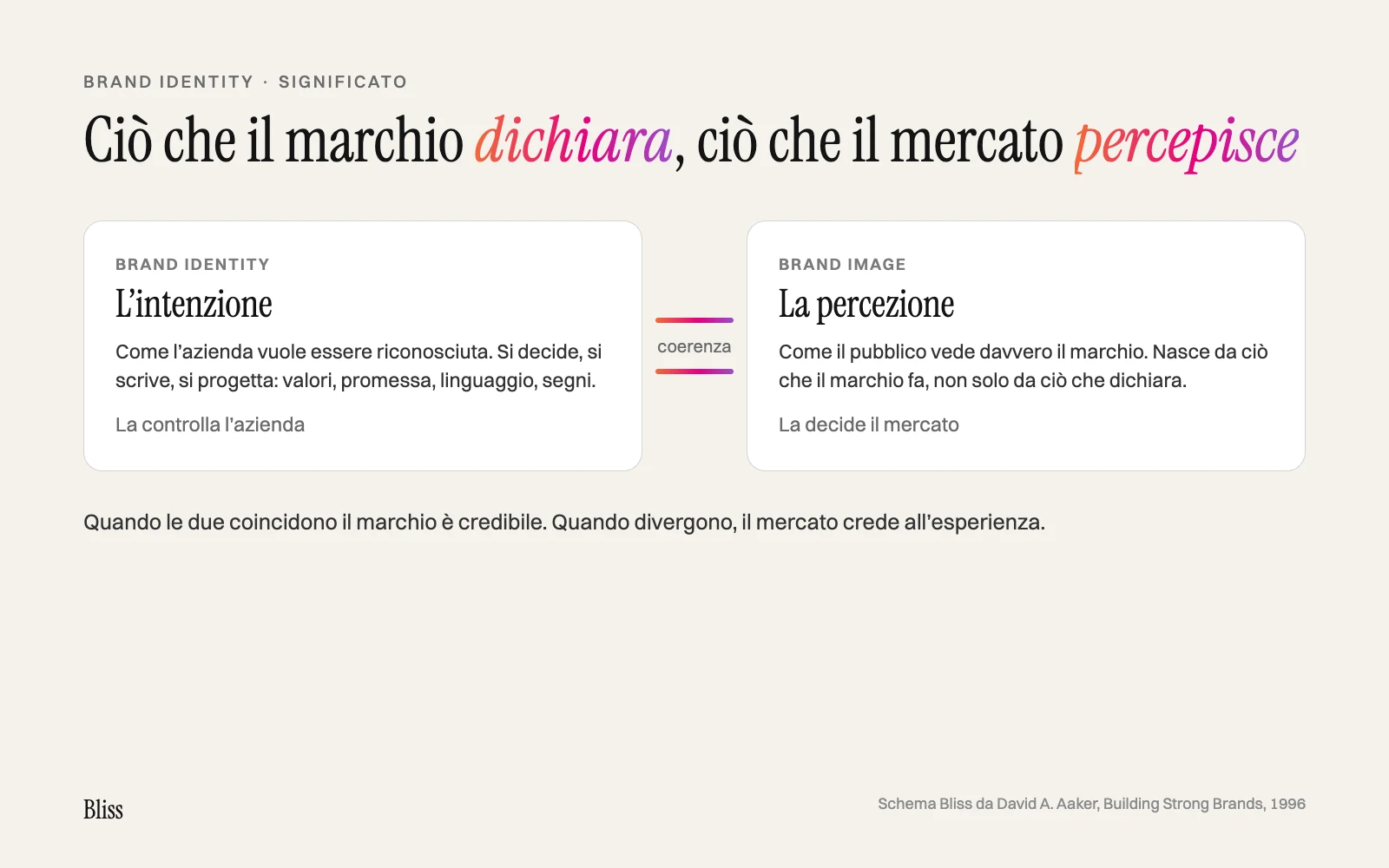
In the projects we work on, this distinction is the first point to clarify, because many companies arrive convinced they have an identity problem when they actually have a coherence problem: the stated identity exists, but day-to-day behaviour contradicts it.
What is the difference between branding and brand identity?
Branding is the process; brand identity is what that process defines and makes recognisable. Branding encompasses research, positioning, choices of name, language and design, and their application over time; brand identity is the stable outcome of those choices, what stays the same while campaigns and channels change.
Upstream of both lies the brand strategy, which establishes where the brand intends to go. Identity translates that direction into recognisable signs and behaviours.
Brand identity examples
The most useful examples are not those with the most attractive logo, but those in which an identity choice has remained consistent for decades, until it became part of the brand’s value. We look at three, two Italian and one international, all documented by official sources.
Ferrari: a symbol inherited and never changed
Ferrari’s prancing horse was not born in an agency. It was the emblem the aviator Francesco Baracca painted on the fuselage of his aircraft during the First World War. In 1923 Baracca’s mother, Countess Paolina, suggested Enzo Ferrari use it on his cars; Ferrari kept the black horse and added the yellow background, the colour of Modena, his home town. The shield made its debut on Scuderia Ferrari cars in 1932 (Sky Sport, 2022).
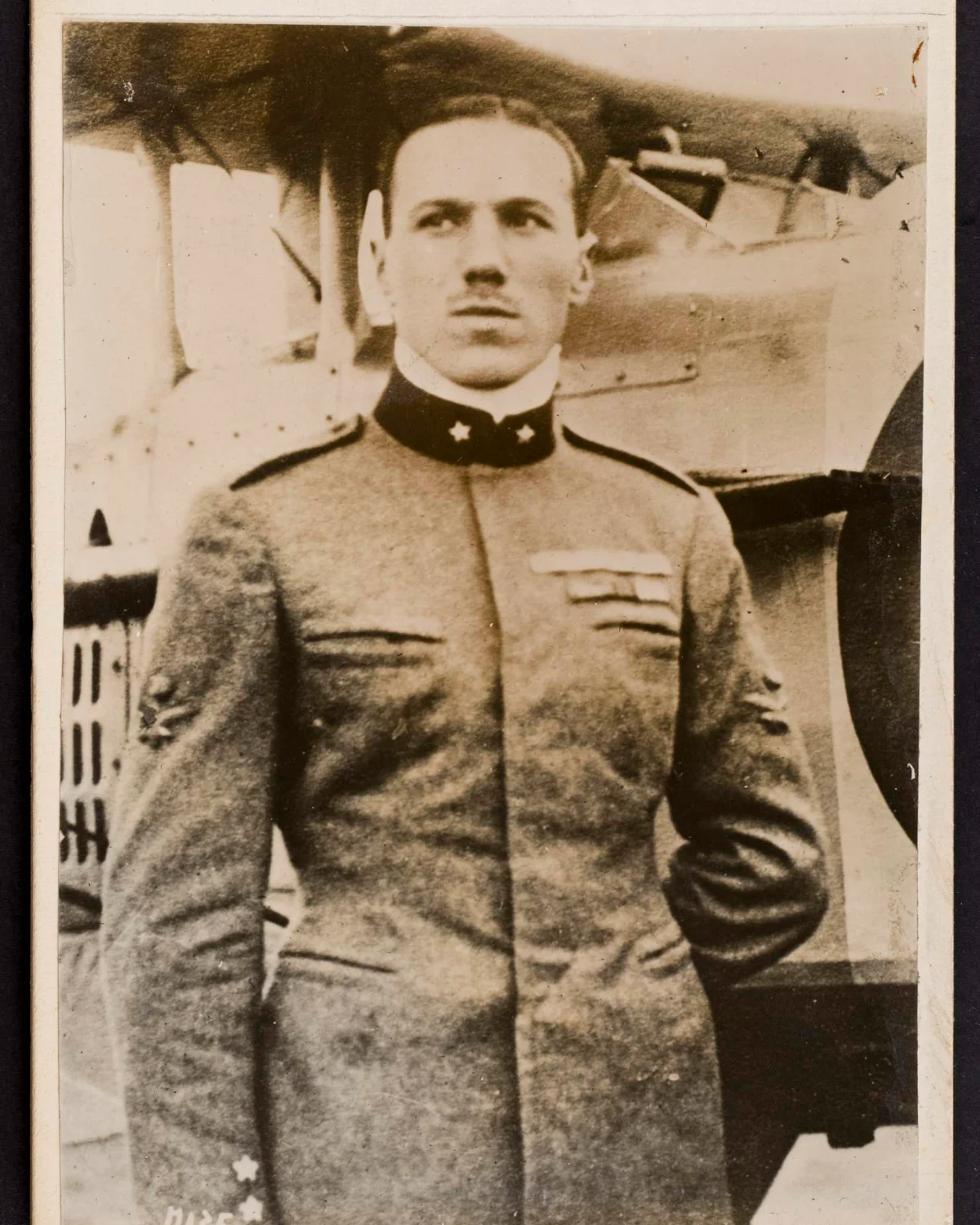
The lesson for a company is that a mark is worth the story it carries and the discipline with which it is repeated. The prancing horse has been redrawn several times in its details, but its substance, a black horse on a yellow background, has never changed.
illy: art as part of the identity
illycaffè chose to express its identity through contemporary art. Since 1992 it has commissioned artists and designers to decorate the cups of the illy Art Collection, with names such as Robert Rauschenberg, Jeff Koons, Marina Abramović and Michelangelo Pistoletto; in 1996 it adopted its current logo, designed by the pop artist James Rosenquist (illy, company history).
The point is not the artists’ fame but the consistency of the choice: a coffee that presents itself as an aesthetic experience, and proves it through an everyday object such as the cup, makes its promise recognisable without having to explain it.
Patagonia: an identity that also states what it rejects
On 25 November 2011, Black Friday, Patagonia ran a full page in the New York Times headlined “Don’t Buy This Jacket”, urging people not to buy what they do not need and to repair and reuse their garments (Patagonia, 2011). It was the direct consequence of an identity built by founder Yvon Chouinard on care for the environment.

The example shows something the textbooks overlook: a strong identity can also be recognised by what the brand refuses to do. On our site we have covered two other cases of identity applied to everyday objects: the popcorn bucket case and merchandising as an extension of the brand.
Which brand identity projects have we delivered?
Since 2024 we have built the identity of several Italian companies from scratch, in sectors far removed from one another: technical services, solar energy, gold buying, collectible cards. The starting point was almost always the same: a business that worked, but that the market could not yet recognise.
Our brand identity projects
Identities built from scratch for Italian businesses, from positioning to visual system.


Oro Elite: how does a brand stand out in a category where everyone looks the same?
Oro Elite operates in the cash-for-gold sector, a category in which almost everyone communicates the same way: black, gold and promises to buy and sell. Between May 2024 and March 2025 we supported the company with advisory, governance and operational services, building a brand system that holds together identity, content, website and proprietary tools.

During the engagement, revenue rose from €29.9 million in 2023 to €36.7 million in 2024, growth of 22% (registroaziende.it). The result depends on many factors, but it shows that a clear identity holds up even in a market where price seems the only lever. The details are in the Oro Elite case study.
What are the elements of brand identity?
The elements of brand identity are the brand’s values and promise, its personality, its verbal identity (name, tone of voice, messages) and its visual identity (logo, colours, typefaces, imagery). The most widely used model to describe them is Jean-Noël Kapferer’s brand identity prism, presented in The New Strategic Brand Management (Kogan Page).
The prism describes identity through six facets. Physique concerns the concrete characteristics and visible signs; personality, the character through which the brand expresses itself; culture, the values from which it springs; relationship, the kind of bond it establishes with the customer; reflection, the image of the typical customer that the brand projects back; self-image, the way customers see themselves when they choose it.
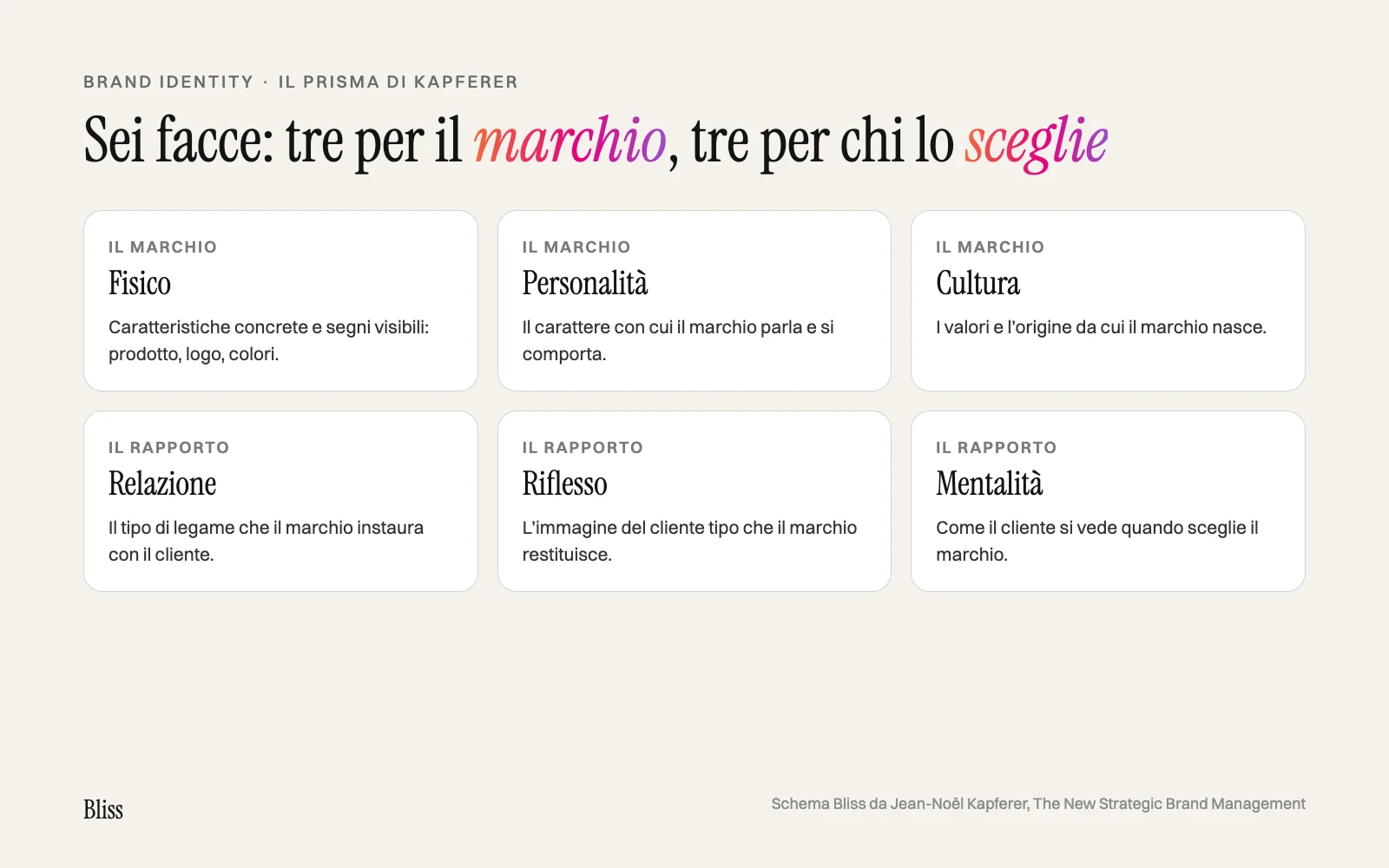
The first three facets describe the brand, the last three its relationship with those who choose it. It is a useful distinction for spotting a common mistake: working only on the physique, that is, the logo, and leaving everything else undefined.
What is a brand’s visual identity?
Visual identity, or brand visual identity, is the visible part of brand identity: logo, colour palette, typefaces, photographic and illustration style, layout rules. Gathered into a system of rules it becomes the coordinated identity, which ensures the same look across every medium.
In our work for Profumum Roma, a maison of artistic perfumery, the visual identity lives above all in its images: still lifes and raw materials treated with the same light and the same restraint as the bottle, on the website as in the campaigns.

Good brand identity design is judged by the coherence of the system rather than by any single element. An effective logo within a disorderly system remains an isolated mark.
For EGA Group, a technical company in a consolidation phase, the visual identity had to work first and foremost in the field: logo and pictogram, corporate stationery, workwear and operational materials, then the website. In thirty days of work the company moved from word of mouth to a system recognisable at every touchpoint (EGA Group case).

What is a brand’s verbal identity?
Verbal identity is the way the brand speaks: naming, tone of voice, key messages, the words it uses and those it avoids. It is often the most neglected part, because it does not show up in a graphic manual, yet it is the part customers encounter most often: in an email, on the phone, on the website.
For the new openings of Doreca, a Rome-based drinks distributor, we chose an ironic tone in Roman dialect, consistent with a brand born and raised in Rome and with an audience that sees it as one of their own. The same voice signs the billboards for the Ostia openings (the Doreca new openings case).

What is the difference between brand identity, brand image and corporate identity?
Brand identity is how the brand wants to be recognised, brand image is how it is actually perceived, corporate identity is the identity of the company as an institution. The three overlap, but they answer different questions and are measured in different ways.
Brand identity, brand image and corporate identity
Three related concepts that answer different questions.
| Brand identity | Brand image | Corporate identity | |
|---|---|---|---|
| What it is | How the brand wants to be recognised | How the brand is actually perceived | The company’s identity as an institution |
| Who defines it | The company, with those who lead the brand | The audience, through experience | Senior leadership |
| Intended for | Clients and prospective clients | Everyone who comes into contact with the brand | Investors, institutions, employees, partners, suppliers |
| How it is measured | Consistency between rules and applications | Perception research, reviews, awareness | Corporate reputation, ratings, employer attractiveness |
We have devoted our corporate identity guide to corporate identity, which concerns the company as a whole. The gap between identity and image is one of the most useful indicators for a company: it measures how far the declared promise actually reaches the audience. When perception deteriorates over time, the issue becomes brand reputation.
How is a brand identity created?
A brand identity is created in five steps, in this order:
- Strategy and positioning: who the brand is for, who it competes with, why it should be chosen.
- Audit: how the brand is perceived today by customers, employees and the market.
- Brand platform: promise, values, personality and boundaries, set down in a shared document.
- Verbal and visual system: name, tone of voice, messages, logo, colours, typefaces, imagery.
- Rules and governance: a manual and someone accountable for it, so that the identity stays coherent over time.
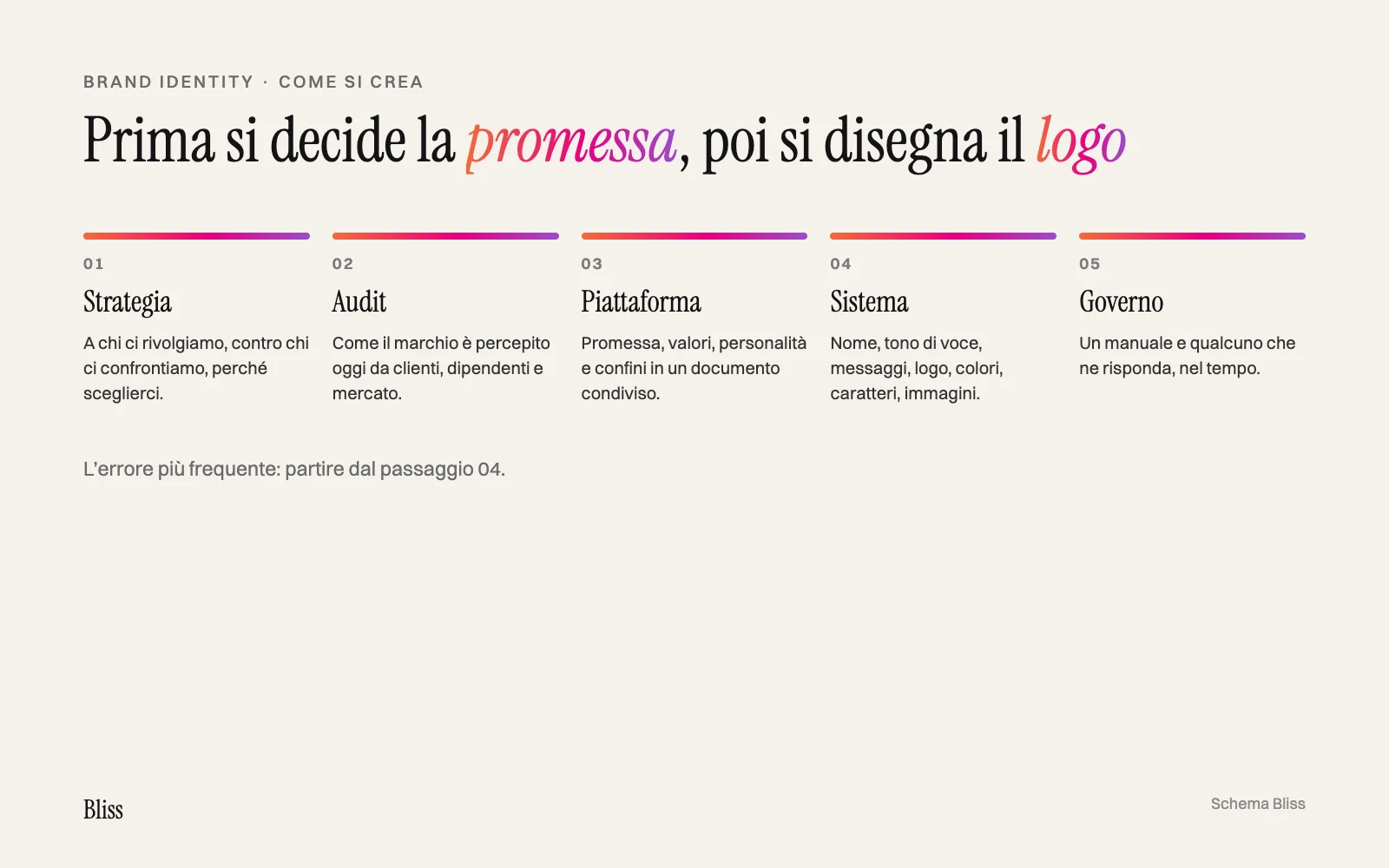
The most common mistake we see is starting from the fourth step: redoing the logo before deciding what the brand promises. The result is a new mark that tells the same confused story as before. The full process, step by step, is set out in our guide on how a brand identity is created.
What are brand identity mockups for?
Brand identity mock-ups show the identity applied to real materials, such as packaging, signage, uniforms and web pages, before they are produced. They are there to support decisions, not to decorate a presentation: an identity that works on a business card may not hold up on a van or in an app. In visual identity design we use them to test the system on the media the client will actually use.

How can you tell whether a brand identity works?
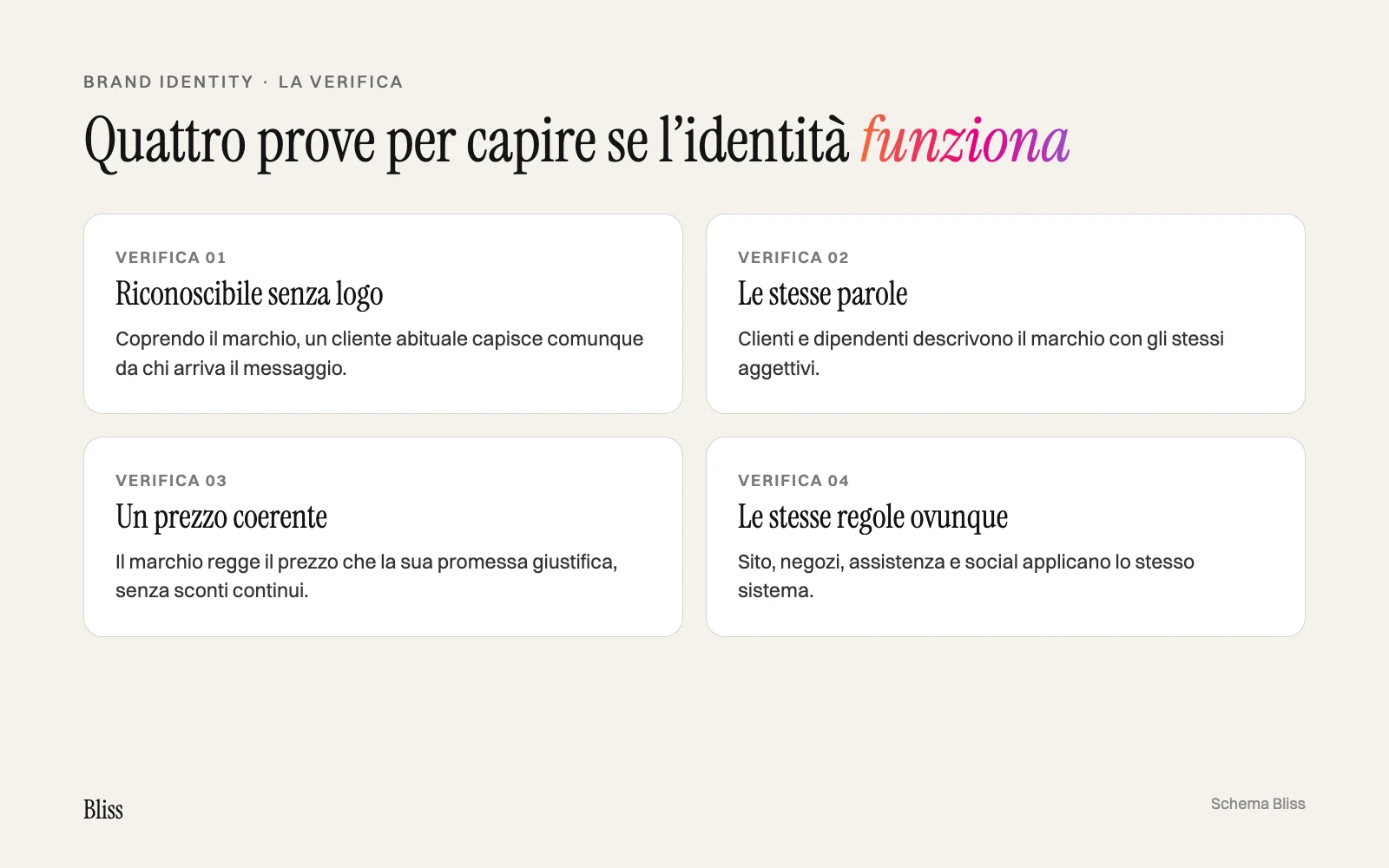
A brand identity works when it passes four tests, which are worth repeating at least once a year:
- It is recognisable even without the logo. With the logo covered, a regular customer still recognises who a page, a post or a pack comes from.
- Customers and employees describe it in the same words. If those who work in the company and those who buy from it use different adjectives, the identity exists only on paper.
- It sustains a price consistent with what it promises. A premium identity that needs constant discounts to sell is not believed.
- All touchpoints follow the same rules. Website, shops, customer service, invoices, social media: every inconsistency wears away part of the identity.
The first two checks require listening to the market, which is the job of the brand audit. The third links identity to the brand’s economic value, a topic we explored in depth when discussing a brand identity worth millions.
How do we work on brand identity in brand advisory projects?
In brand advisory projects, brand identity is not a graphic chapter but a decision taken at the top: what the brand promises, who is accountable for it and the rules by which it is applied in every department. Design comes afterwards, and governance never ends.

Our case study
A heritage identity governed every day
Together with the owning family we govern the maison’s visual and verbal identity across the entire catalogue, from the corporate identity system with 3D modelling to the website rebuilt from scratch. Over the period of our engagement, gross e-commerce revenue grew by 23.9% in 2025 compared with 2024 (Profumum Roma internal data).
Read the case studyIn identity projects the first question is not how the brand should look, but what it promises and what it refuses to do. When the answer is clear, logo, colours and tone of voice are chosen against precise criteria; when it is not, every design choice remains a matter of taste.
Bliss’s point of view
“The logo is the signature of the brand identity, not its content. The content is the choices the brand repeats every day, even when no one is watching.” Francesco Acri, founder and CEO of Bliss
That is why every identity project we lead closes with the governance rules: who decides, who checks and how the system is updated.
The issue becomes decisive in family businesses, when the identity must survive a change of leadership. We have written about it in brand identity in generational succession.
Who works on your project
The people of Bliss across Rome and Milan





Frequently asked questions about brand identity
Is brand identity the same thing as the logo?
No. The logo is one element of the visual identity, which in turn is one part of the brand identity. Identity also includes values, personality, tone of voice and behaviour: a brand can change its logo without changing its identity, and change its identity without touching the logo.
How much does it cost to create a brand identity?
It depends on the scope. A basic visual identity for a small business costs something very different from a project that starts with strategy and an audit and ends with a complete system, with governance rules for several markets. It makes sense to weigh the cost against how often, and on how many media, the identity will be used.
How long does it take to build a brand identity?
The project usually takes a few months, from strategy to visual system. Recognition by the market, on the other hand, takes years of consistent application: it is repetition over time that turns a set of choices into a recognisable identity.
When does a brand identity need to be redone?
When the strategy changes: a new positioning, a new market, a merger, a generational handover that brings a different vision. If the strategy stays the same, an update to the visual identity is usually enough, without calling into question what the brand promises.
What is a brand book?
The brand book is the document that sets out the brand identity and the rules for applying it: promise, values, tone of voice, logo, colours, typefaces and examples of use. It is for everyone who works on the brand, inside and outside the company. We covered it in our guide to the brandbook.
Does an SME need a brand identity?
Yes, because every business already has one, whether chosen or imposed. An SME that does not define it lets the market decide it on its behalf, usually on the basis of price. Defining it does not require a multinational’s budget: it requires choosing what to promise and keeping that promise.
Sources
- David A. Aaker, “Building Strong Brands”, Free Press, 1996
- Jean-Noël Kapferer, “The New Strategic Brand Management”, Kogan Page (brand identity prism)
- Kevin Lane Keller, “Strategic Brand Management”, Pearson
- illycaffè, company history and illy Art Collection, illy.com
- Sky Sport, “Ferrari, 90 years since the debut of the shield with the Prancing Horse”, July 2022
- Patagonia, “Don’t Buy This Jacket, Black Friday and the New York Times”, 25 November 2011
- Bliss, Profumum Roma case study; Profumum Roma internal data, 2025 vs 2024
- Bliss, Doreca new openings case
- Bliss, Oro Elite case study; revenue from registroaziende.it, 2024 vs 2023
- Images: Bliss diagrams; photographs from the Profumum Roma, Doreca, EGA Group, Tecnoelios, Vantagio, Collectors Italia and Oro Elite case studies; Francesco Baracca (Université de Caen, Fonds Lafond) and Yvon Chouinard (public domain) from Wikimedia Commons; cover generated with Magnific
Bliss · Rome and Milan
We give shape to your brand’s identity
A new brand, a relaunch or an identity that needs putting in order: we start from what the brand promises and build a system that holds up over time.
You tell us about the brand
Two minutes in the contact form: company, market, objectives.
We get back to you
A consultant reads your request and arranges an initial call with you.
You receive a proposal
Scope, priorities and costs, starting from the diagnosis.