



The brandbook, sometimes also written as brand book, is the document that sets out the rules by which a company presents and uses its brand: strategy, voice, visual identity and how they are applied. It is for anyone who needs to decide whether a piece of material is consistent with the brand without asking the founder or the agency every time. That is why it is a governance tool before it is a design tool: it establishes what can be done, who decides and who is accountable.
When materials come from several departments, agencies or branches, the logo stays the same and everything else changes: tone, layouts, promises. This guide sets out how the brandbook differs from brand guidelines and a brand manual, which sections to include, a method for checking that the brandbook works, and a useful table of roles specifying who owns it, who approves exceptions and who holds the files. Let’s begin.
What is a brandbook and what is it for?
If brand identity is what the company decides to be, the brandbook is the document that allows those who took no part in that decision to respect it. It presupposes an identity that is already defined, so it is best to start with how a brand identity is built and return here once positioning and brand platform are clear.
A brandbook serves four purposes. It aligns departments and suppliers on what is correct, without going through the founder. It shortens onboarding for newcomers, who find the rules instead of asking for them. It makes approval verifiable: a piece of material either complies or it does not, with a written reason. It protects continuity when the brand changes hands, in a rebrand, an acquisition or a generational handover. This is why we call it a tool of brand governance: the brandbook sets the rules; governance lies in deciding who applies them and who changes them.

Brandbook, brand guidelines and brand manual: what’s the difference?
Brand guidelines, brand manual and logo manual are often used as synonyms. Some authoritative sources even treat the brand book and brand guidelines as equivalent terms, distinguished at most by form, since the brand book is usually the printed version (Canva). Look more closely, however, and a real difference emerges: the brand book explains the why and the what, while the style guide sets out the how (Fabrik Brands).
In short, the sources disagree. The table below summarises our view.
| Term | What it answers | Typical content | Who it is for |
|---|---|---|---|
| Brandbook | Why and how brand decisions are made | Strategy, voice, visual identity, applications, operating rules | Management, marketing, suppliers |
| Brand guidelines, brand manual, logo manual | How the brand elements are used | Logo, colours, fonts, imagery, examples | Designers and those producing materials |
| Editorial style guide | How to write and lay out | Vocabulary, grammar, tone by channel | Copywriters, social media, customer service |
| Brand kit | Where the files are | Logos, palettes, fonts, ready-made templates | Anyone who has to produce a file |
| Design system | How the interface is built | Components, style rules, code | Product designers and developers |
| Corporate identity | How company materials look | Letterhead, business cards, e-mail signature | Administration and sales |
When do you need a brandbook?
A basic brand book of a few pages is enough as long as one person approves everything. The full document becomes necessary when brand decisions pass to others, in these cases:
- an agency or several suppliers come in, and without written rules each interprets the brand in their own way;
- branches, offices or markets open, and local communications drift away from head office without anyone noticing;
- a strategic rebrand gets under way, and old and new materials coexist for months;
- an acquisition or merger takes place, bringing together two identities with different rules;
- the founder steps down or generational succession begins, and brand decisions can no longer depend on one person;
- teams start using content generation tools, which produce materials without going through marketing.
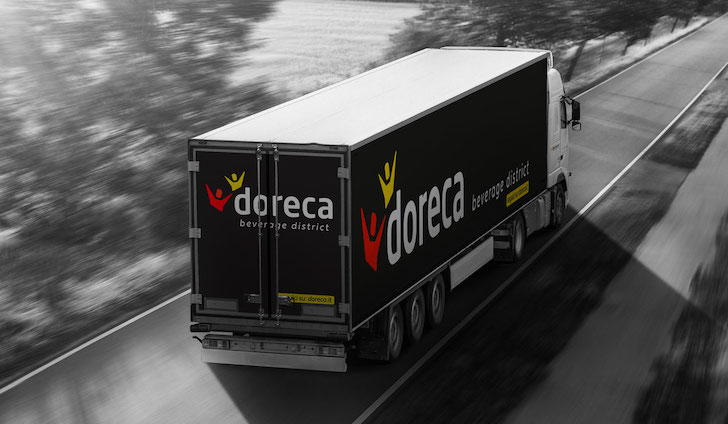
In the work Bliss Studio carried out for Doreca, for example, the brandbook was fundamental. Every new store was treated as a brand moment, with dedicated kits, content produced on site and local campaigns, and billboards in Roman dialect around Ostia and Fiumicino carried the same voice beyond digital channels.
Our case studies
Brand identity and brandbooks by Bliss Studio







What should a brandbook contain?
A complete brandbook is organised into five levels. The table shows what each one sets and what happens when it is missing.
| Section | What it sets | If it is missing |
|---|---|---|
| Brand strategy | Mission, positioning, audiences, values translated into decision criteria | Visual and verbal choices have no rationale and everyone interprets them |
| Voice and tone | Consistent personality, variations by channel and situation, vocabulary | Copy from different departments does not read as the same brand |
| Visual identity | Logo (versions, clear space, minimum size, prohibited uses), colours with HEX, RGB and CMYK codes, typography, imagery | Suppliers improvise |
| Applications | Real examples on website, social media, presentations, packaging, sales materials | The rules remain abstract |
| Operating rules | Where the files are, licences, who approves, how to request an exception | The document is not enforced |
Strategy comes before visual rules. In the work for Risivi & Co, defining the positioning, the real audience and a visual and narrative language consistent with the existing identity came before editorial plans, photo and video production, e-commerce, artist activations, events and SEO, all steered by a single direction.
Tone of voice: a constant voice, a tone that adapts
Tone of voice is the section that most often stays generic, with formulas such as ‘friendly but professional’. The voice, however, is the brand’s constant personality, while the tone changes with the situation and the reader’s state of mind (Mailchimp, Voice and Tone). The brandbook works when it sets out pairs of sentences for the main channels.
We have covered the method for setting the voice in a full article on tone of voice.
Visual identity and accessibility
The visual identity section should record the measured contrast ratio for each text–background pair. WCAG 2.2 requires at least 4.5:1 for normal text and 3:1 for large text, i.e. 18 point, or 14 point bold (W3C, WCAG 2.2, criterion 1.4.3), and 3:1 for user interface components and graphics (W3C, WCAG 2.2, criterion 1.4.11). In Italy, accessibility has been mandatory since 28 June 2025 for services falling within Legislative Decree 82/2022, e-commerce included, with size thresholds to be verified case by case (Agenda Digitale). A brandbook that bans colour pairs below the threshold moves the check upstream, before anything reaches the website.
Applications, files, licences and artificial intelligence
Brandbook applications are the rules shown on materials the company actually produces. In a B2C business, that means packaging, the point of sale, social media and customer service. In a B2B business, it means sales presentations, proposals, tender documents and co-branding with partners: a B2B brandbook that only shows business cards leaves uncovered the very materials on which sales are decided.
The operational section states where the source files are kept, which font and image licences have been purchased and for which uses. A font’s licence can differ between print, website and app, and images carry limits on use and duration: these are checked against the contract, not assumed. If teams use generative tools, the brandbook states for which uses they are permitted and who reviews the output.
Who works on your project
The experts at work across Rome and Milan





How do you create a brandbook in six steps?
Guidelines written by one person alone are the ones nobody then uses, so the process involves those who will apply them from the outset. To do this, we recommend following these six steps:
- Gather what already exists (logo, templates, presentations, suppliers’ materials) and flag the genuine inconsistencies.
- Set out the strategy in a few lines: positioning, audiences and three criteria for making decisions.
- Write every rule with its rationale, one right example and one wrong one.
- Apply the rules to the company’s real materials, not to generic templates.
- Test the document with people who were not involved in drafting it.
- Publish it, name an owner and set when it will be reviewed.
How do you test a brandbook?
At this point, though, how do you test a brandbook?
The first step is to hand it to someone who was not involved in writing it and give them three real tasks: a slide, a post, a brief for a supplier. You then measure the time taken, the questions put to the team and the deviations spotted by whoever approves. A question that comes up twice points to a missing rule. Pass criteria are set in advance, for example no deviations on logo and colours and no more than two questions left open; these values should be adapted.
Which format to choose: PDF, web portal or design system
A digital brand book is not a single format. The choice depends on how many people use it and how often it changes.
Suitable when
Users are few, updates rare and suppliers occasional.
LimitationOld versions stay in circulation.
Web page or portal
Suitable when
Users are many, updates frequent and downloadable files are needed.
LimitationRequires someone to maintain it and manage access.
Design system
Suitable when
There is a digital product with interfaces and a development team.
LimitIt does not replace strategy and voice.
Suitable when
Useful for formal occasions and for onboarding on site.
LimitationDifficult to update.
For many SMEs, a short PDF brandbook for occasional suppliers and a shared folder of official files, under a single owner, is enough.
The Bliss Corner: a brandbook without an owner becomes an archive
In the day-to-day operations of Bliss Studio (the operational unit of Bliss that acts as an in-house marketing agency), before a single page is written, the person who owns the document and the person who approves exceptions are named: this is what decides whether it will still be in use a year from now.
Who is accountable for the brandbook
| Role | What it does | If it is missing |
|---|---|---|
| Brandbook owner | Decides on changes and is accountable for consistency | No one can say no |
| Exceptions approver | Assesses out-of-policy requests within a set timeframe | Users work around the document |
| File custodian | Keeps assets up to date and retires old versions | Outdated logos circulate |
| Users and suppliers | Apply the rules and flag gaps | Gaps become habits |
At that point, all that remains is to check how many people and suppliers produce materials, how many times a month someone requests an approval, and where the exceptions already granted end up.
To return to the Doreca case: there, the board struggled to recognise a positioning built without the brand mark in the foreground, and the answer was to bring data and build trust over time. A written rule with its rationale moves the discussion from taste to criteria.
If producers are few and in-house, we change approach: a short document with an annual review is sufficient. If channels are many and branches autonomous, you need a portal, a procedure for exceptions and a maximum response time.
How much does a brandbook cost?
Cost depends on scope: whether strategy is included, the number of applications, channels, languages, format, training and maintenance. A brandbook rarely has a price of its own, because it is usually one line item in an identity project; our analysis of brand design project costs sets out market price bands by package. When requesting a quote, ask in writing whether source files, font licences, an editable version, training and updates for the following twelve months are included: anything not named is paid for after delivery.
Public brandbook examples and what they teach
Among the publicly available brand book examples, two show complementary criteria.
Mailchimp’s Content Style Guide is public and organised by writing situation: voice and tone, newsletters, social media, accessibility, legal content, copyright and trademarks. It is released under a Creative Commons Attribution-NonCommercial 4.0 licence, so it can be adapted for non-commercial purposes with attribution (Mailchimp, Content Style Guide). It shows how to organise the document around the situations writers actually find themselves in.

The NASA Graphics Standards Manual, designed by Danne & Blackburn in 1975, defined the logo, typography, colour, letterhead, publications, signage and the agency’s vehicles (Standards Manual). NASA withdrew it in 1992 and it was reissued in 2015 (Design Milk). We looked at it earlier in this article, and it shows that rules hold when they cover real-world media, and that a manual stays alive only as long as someone in the organisation champions it.
Why many brandbooks go unused and how they are updated
A brandbook falls into disuse for four reasons: one person writes it, it contains prohibitions without reasons, it has no examples drawn from real materials, and the files exist in three versions. It is updated with every change of offer, channel, market or corporate structure and, if nothing happens, at least once a year. Each revision records the version, date and change log, and withdraws the previous files.
Domande frequenti
What is a brand book and what is it for?
It is the document that sets out the rules by which a company presents and uses its brand: strategy, voice, visual identity, applications and approval procedures. It enables people who did not design the brand to apply it consistently, and it protects its continuity when people or the company’s structure change.
Are brandbook and brand book the same thing?
Yes, they are two spellings of the same term. Brand manual and brand guidelines often refer to the same document or to its operational section, depending on who is writing. It is best to choose one for internal documents and stick with it.
What is the difference between a brandbook and brand identity?
Brand identity is the set of choices about how the brand wants to be recognised: positioning, values, voice, visual signs. The brandbook puts them in writing and turns them into rules of use. Without it, consistency depends on the memory of a few people.
What should a brandbook contain?
Brand strategy, voice and tone, visual identity, applications on real materials and operational rules: files, licences, roles, procedure for exceptions. A section that changes no decision can be left out.
How long should it be?
As long as its users need: a start-up can stop at four pages, while a group with subsidiaries needs dozens. Every rule must have a reason and an example, and anyone looking for an answer must be able to find it within minutes.
Does a start-up or SME need a brandbook?
An essential version is worth producing early. The full version becomes necessary when suppliers, collaborators or branches come in; with a single decision-maker it can wait.
Can you create a brandbook if the logo already exists?
Yes. You start with an audit of existing materials, document the rules that work and fill the gaps in voice, applications and procedures. It is also the moment to retire old versions of the logo.
How much does a brandbook cost?
It depends on scope, and it rarely has a price of its own, because it is usually part of an identity project. When requesting a quote, check source files, font licences, an editable version and updates.
Fonti e riferimenti
- W3C, Understanding Success Criterion 1.4.3: Contrast (Minimum)
- W3C, Web Content Accessibility Guidelines (WCAG) 2.2, criterio 1.4.11 Non-text Contrast
- Agenda Digitale, Siti eCommerce accessibili: guida in 5 step per evitare sanzioni
- Mailchimp, Content Style Guide
- Mailchimp, Voice and Tone
- Canva, Brand guidelines
- Fabrik Brands, Brand books vs style guides: What’s the difference (and which do you need?)
- Standards Manual, NASA Graphics Standards Manual
- Design Milk, NASA’s 1975 Graphics Standards Manual to be Reissued
- Bliss, Doreca: allineare la percezione digitale alla potenza operativa
- Bliss, Oro Elite
- Bliss, Risivi & Co: scalare senza perdere identità