Strategic marketing is the part of marketing that analyses the market and decides in which segments to compete, with what positioning and with what offering, before any promotional and sales activity. It answers the question “where and for whom to compete”, while operational marketing answers “how to get chosen”.
Strategic marketing is not a higher level of operational marketing: it is a different question. When it is missing, operational marketing spends the wrong money well, with polished campaigns aimed at clients not worth serving or with a message that does not set the company apart from its competitors.
In this guide we explain what strategic marketing is, how it differs from operational marketing, what its phases are, how to tell when it is missing, who should be responsible for it and how it relates to the brand.
In brief
Strategic marketing in 4 key points:
- 1
It decides where and for whom to compete, before how to communicate.
- 2
Operational marketing turns choices into actions on product, price, channels and communication.
- 3
It unfolds in five phases, from analysis to objectives.
- 4
Its visible outcome is brand positioning.
What is strategic marketing?
Strategic marketing is the analysis-driven process through which a company studies customer needs and market developments to identify the most promising opportunities and build on them an advantage over competitors. This is the definition found in the standard reference text in Italy, Market-driven management. Marketing strategico e operativo by Jean-Jacques Lambin, published by McGraw-Hill and in its eighth edition as of 2021.
Lambin, a Belgian economist and professor at the University of Louvain, popularised the distinction between strategic and operational marketing in Europe from the 1980s onwards. Strategic marketing works over a medium- to long-term horizon and produces choices: which markets to cover, which customers to serve, what promise to make. These choices then become the basis of the marketing strategy and of the plan through which it is put into practice.

Philip Kotler, in the textbook Marketing Management, written with Kevin Lane Keller and published by Pearson, describes the same work with the acronym STP: segmentation, targeting and positioning. The name changes, the substance does not: before deciding how to communicate and sell, you have to decide to whom, and with what difference.
What is the difference between strategic marketing and operational marketing?
Strategic marketing decides where and for whom to compete; operational marketing decides how to get chosen by those customers. The first is geared towards analysis and the medium to long term, the second towards action and the short to medium term: product, price, distribution and communication, in other words the marketing mix.
Strategic marketing and operational marketing
Two different questions, following Jean-Jacques Lambin’s distinction
| Aspect | Strategic marketing | Operational marketing |
|---|---|---|
| Question | Where, and for whom, to compete? | How to get chosen? |
| Orientation | Analysis | Action |
| Horizon | Medium to long term | Short to medium term |
| Tools | Market analysis, segmentation, positioning | Product, price, distribution, communication |
| Who decides | Senior management with marketing | Marketing and sales |
| Outcome | Segments, promise, objectives | Campaigns, price lists, channels, sales |
An example helps. An office furniture manufacturer decides, through strategic marketing, to focus on professional firms with fewer than fifty people, with a promise of rapid delivery and assembly. Operational marketing turns this choice into a reduced catalogue, dedicated price lists, a dealer network in the right cities and campaigns aimed at the firms’ owners. Without that initial choice, operational marketing ends up addressing everyone, with a message that convinces no one in particular.
Can you do operational marketing without strategic marketing?
You can, and it is the most common situation in companies that have never formalised their choices. Campaigns are launched, the website is rebuilt, trade fairs are attended, and some actions deliver results. The limitation shows over time: without a reference segment and a defined positioning, every action starts from scratch, messages change with every agency or manager, and results do not add up. Operational marketing on its own produces activity; with strategic choices behind it, it produces a trajectory.
What is analytical marketing?
Analytical marketing is the phase of gathering and interpreting data on the market, customers and competitors that precedes strategic choices. Some authors treat it as a third level: analytical, strategic, operational. In practice the first two phases overlap, because analysis only makes sense if it serves a decision, and a decision only holds if it rests on analysis.
What are the stages of strategic marketing?
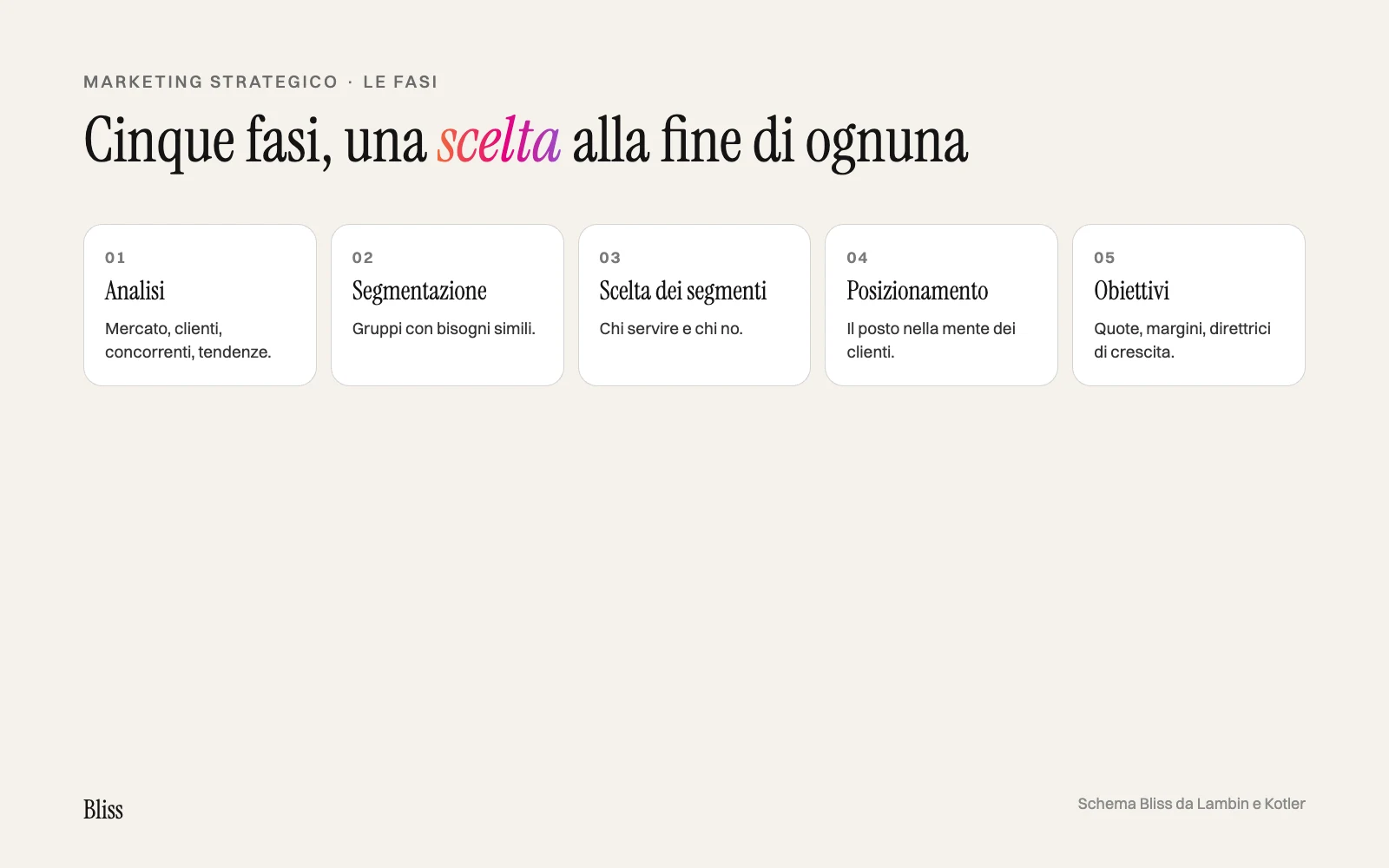
Strategic marketing has five phases:
- Market analysis: size, growth, customer needs, competitors, trends. It draws on industry data, research, interviews and the company’s internal data.
- Segmentation: dividing the market into groups of customers with similar needs and behaviours. To describe them properly, buyer personas are built on real data.
- Choice of segments: which groups to serve, based on their attractiveness and the company’s ability to satisfy them better than competitors. It also means deciding which clients not to serve.
- Positioning: the place the company wants to occupy in the minds of its chosen customers, relative to the alternatives. This is the subject of positioning.
- Objectives and growth paths: market share, expected revenue and margins by segment, and the choice between growing in current markets, with new products or in new markets.
How do you choose a segment to compete in?
A segment is chosen by combining two assessments: how attractive it is, and how well the company can serve it compared with others. Attractiveness depends on size, growth, achievable margins and intensity of competition. Capability depends on the products, skills, channels and reputation the company already has or can build. A large, growing segment in which the company has no advantage is often a trap; a smaller segment in which the company is already recognised can be the base from which to grow.
For the final phase, Igor Ansoff’s matrix is often used, published in 1957 in the Harvard Business Review in the article “Strategies for Diversification”. It crosses current and new products with current and new markets, and identifies four growth paths: market penetration, product development, market development and diversification, each with an increasing level of risk.
How can you tell if a company is not doing strategic marketing?
You can tell from a few signs that are visible without any complex analysis:
- Campaigns without a target segment: communication addresses “everyone” or changes audience with every campaign.
- Prices set on cost alone: a fixed mark-up is applied, without asking what the offering is worth to the chosen customers and what competitors charge.
- An offer identical to competitors’: same products, same arguments, same promotions; price is the only differentiator.
- Clients acquired by chance: the portfolio is the result of opportunity rather than choice, and includes low-margin clients that absorb a great deal of resources.
- Revenue-only targets: the company measures how much it sells, not to whom, at what margin and with what share in the segments that matter.
In the companies we work with, the most frequent signal is a well-crafted communications plan in a business that has never decided which clients not to serve. The plan works on campaign metrics, but revenue barely grows, because every euro invested is spread across different clients with different needs.
Why is strategic marketing so often missing in SMEs?
It is often missing because in SMEs marketing decisions are driven by urgency: a trade fair to prepare for, a competitor cutting prices, a website to rebuild. Operational marketing has deadlines, strategic marketing does not, and so it ends up being postponed. Another reason is organisational: whoever handles marketing in the company often has an executive role and takes no part in decisions on prices, products and customers, which remain with the owner or the sales management.
Who is responsible for strategic marketing in a company?
Strategic marketing belongs to the company’s senior management, because it involves choices that affect prices, products, channels and investment. In more structured companies the marketing director prepares the analyses and proposals and decides on them with the CEO and the sales leadership: this is the work described in the guide to marketing management. In SMEs the same decisions often rest with the owner, who rarely has the time to do the analysis.
This is why many companies entrust part of the work to an external adviser: to analyse the market and competitors, to lead the choices on segments and positioning with senior management, and to translate them into measurable objectives. This is the strategic marketing advisory service we offer: the decisions remain with the company, while the adviser brings method, data and an outside perspective.

How does strategic marketing relate to the brand?
The brand is the visible outcome of strategic marketing. Choices about clients and positioning become a brand promise, which operational marketing communicates and which products, prices and service must keep. The work that links the two is brand strategy: deciding what the brand promises, to whom and with what proof.
For Doreca Italia, a Rome-based chain of drinks shops, the work began with an in-store audit and a reorganisation of the range and the space around the customers to be served, before any campaigns. In 2023 the conversion rate, measured as transactions per store visit, rose by 8% and the average transaction value by 12%; Bliss supported 7 of the 14 new openings that year (Doreca internal data).

Doreca’s communication, with billboards in Roman dialect and local references, was the most visible part of the work. It worked because it rested on an earlier choice: whom to speak to and with what promise. Without that choice, the same campaign would merely have been likeable.
How is strategic marketing measured?
Strategic marketing is measured by different indicators from those used for campaigns. What matters is market share in the chosen segments, the average price customers accept relative to competitors, margin by segment, the share of customers who buy again and brand awareness among the target audience. These figures change slowly: reading them requires comparisons over at least twelve months and a baseline measured before starting.

Our case study
Decisions on the offer before campaigns
In-store audit and reorganisation of the range around the customers to be served. In 2023 the conversion rate rose by 8% and the average transaction value by 12% (Doreca internal data).
Read the case studyWhen a company asks us for a communications plan, our first question is not about channels, but which customers it has decided not to serve. If there is no answer, the plan risks being well made and of little use.
Bliss’s point of view
«Operational marketing answers how to get chosen. Strategic marketing first decides by whom, and the second answer cannot correct the first.» Francesco Acri, founder and CEO of Bliss
That is why every marketing engagement we set up starts from segments and positioning, and only then moves on to campaigns and channels.
Who works on your project
The people of Bliss across Rome and Milan





Frequently asked questions about strategic marketing
Do small businesses need strategic marketing too?
Yes, perhaps even more than to large ones: a small business has limited resources and cannot afford to waste them on the wrong customers and markets. An SME’s strategic marketing can fit into a few pages, but it must answer three questions clearly: which customers to serve, how it differs from competitors and with what objectives.
What tools does strategic marketing use?
The most common are SWOT analysis, competitor analysis, market segmentation, buyer personas, the positioning map, the Ansoff matrix and the BCG matrix for the product portfolio. What matters more than the tools are the questions they answer and the data they rest on.
What is the Ansoff matrix?
It is a framework proposed by Igor Ansoff in 1957 that crosses existing and new products with existing and new markets. It yields four growth directions: market penetration, product development, market development and diversification, with risk increasing the further a company moves from the products and markets it knows.
What is the difference between strategic marketing and a marketing plan?
Strategic marketing produces the choices on markets, segments, positioning and objectives. The marketing plan turns them into actions, budgets, timelines and responsibilities for a defined period, usually a year. Without the strategic choices, the plan becomes a list of activities.
How often should strategic marketing be reviewed?
The fundamental choices, such as segments and positioning, usually hold for a few years. It is worth reviewing them every year, alongside the budget, and whenever something significant changes: a new competitor, a technology, a shift in client behaviour or in margins.
Who invented strategic marketing?
There is no single inventor. The distinction between strategic and operational marketing was popularised in Europe by Jean-Jacques Lambin from the 1980s onwards; tools such as segmentation and positioning are owed to scholars such as Wendell Smith, Al Ries and Jack Trout, and their organisation into the STP process to Philip Kotler.
Sources
- Jean-Jacques Lambin, Market-driven management. Marketing strategico e operativo, 8th edition, McGraw-Hill Education, 2021
- Philip Kotler, Kevin Lane Keller, Marketing Management, Pearson
- H. Igor Ansoff, “Strategies for Diversification”, Harvard Business Review, 1957
- Bliss, Doreca case study; Doreca internal data, 2023
- Images: Philip Kotler in Prague by ZSsen (CC BY-SA 4.0) and Igor Ansoff in 1971 by Rob Mieremet / Anefo (CC BY-SA 3.0), Wikimedia Commons; Bliss diagrams; photographs from the Doreca case study
Bliss · Rome and Milan
Let’s decide together where to compete
Market analysis, segments, positioning and objectives: we work with senior management to set the choices that make every euro of operational marketing count.
Tell us about your company
Two minutes on the contact form: sector, customers, objectives.
We get back to you
A consultant reads your request and arranges an initial call with you.
You receive a proposal
Scope, priorities and costs, starting from the diagnosis.