
When a business needs to cover a capability it lacks, such as marketing, brand or management control, it usually chooses between hiring and turning to an external party by looking only at the monthly cost. It is an incomplete comparison: an employee costs around 35-40% more than their gross salary, and time, independence of judgement and what happens if the person leaves also matter. Choosing requires shared criteria: Bliss works as an external consultant on brand and marketing, alongside companies’ in-house teams.
The external consultant is a professional or a firm that works for the business under a service contract, with no employment relationship. The internal consultant is an employee who performs an advisory role for the company’s other functions. The operational employee carries out the work under the company’s direction. We have written a dedicated guide on the professional profile of the business consultant.
In brief
External consultant, internal consultant or employee in 4 points:
- 1
The external consultant works independently, under a service contract.
- 2
An employee costs the business around 35-40% more than their gross salary.
- 3
The external consultant brings a comparison with other sectors, the internal one knowledge of the company.
- 4
The best choice is often a mixed model, not one of the three.
What is the difference between an external consultant, an internal consultant and an employee?
The main difference is the relationship with the company: the external consultant provides a service independently, under the rules on self-employment (Art. 2222 of the Italian Civil Code), whereas the internal consultant and the employee work as subordinate staff (Art. 2094 of the Italian Civil Code). Between these last two, the role differs: the internal consultant guides the decisions of other functions, while the operational employee carries out the work of their own.
External consultant, internal consultant and employee compared
Selection criteria for the company
| Criterion | External consultant | Internal consultant | Employee |
|---|---|---|---|
| Relationship | Self-employed, service contract | Employee | Employee |
| Cost to the company | Fee by scope and period | Gross salary plus 35-40% | Gross salary plus 35-40% |
| Knowledge of the company | To be built | High | High |
| Market knowledge | Broad, across sectors | Limited to the company | Limited to the role |
| Independent judgement | High | Medium | Low |
| Time to become operational | Short | Already in place | Recruitment and onboarding |
| Continuity if the person leaves | Guaranteed by a firm | At risk | At risk |
| Flexibility | High | Low | Low |
In the table we compare the three roles against the same criteria; in the sections that follow we examine each one in turn.
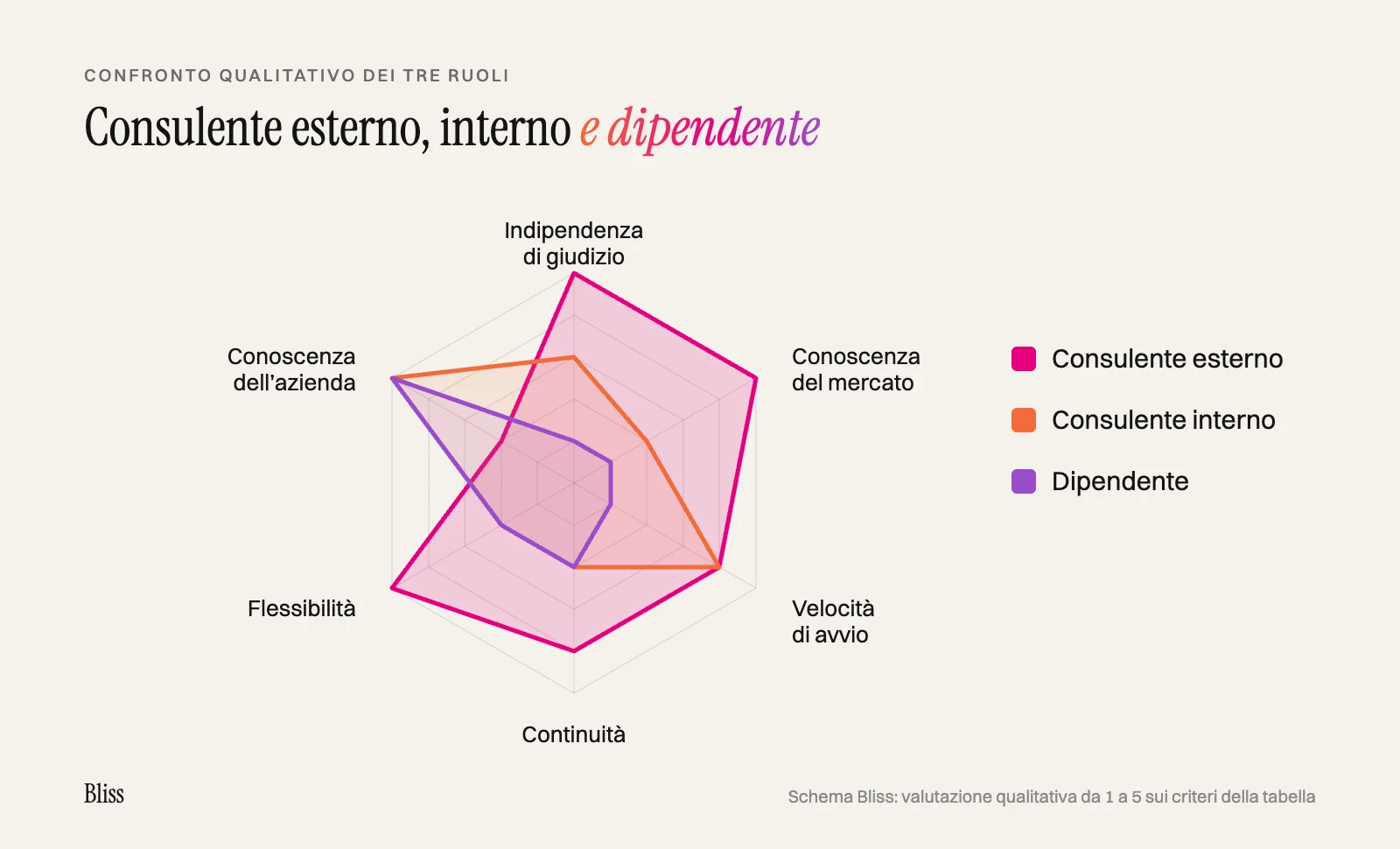
The chart translates the table onto a scale of 1 to 5: it is our qualitative reading, not a measurement. It shows that none of the three roles covers every criterion, and that the external consultant and the employee are almost complementary.
How much does an employee cost compared with an external consultant?
For a company, an employee costs on average 35-40% more than gross annual salary, because employer contributions, TFR (severance accrual) and the INAIL premium are added to it. An external consultant costs the agreed fee, paid only for the scope and period of the engagement.
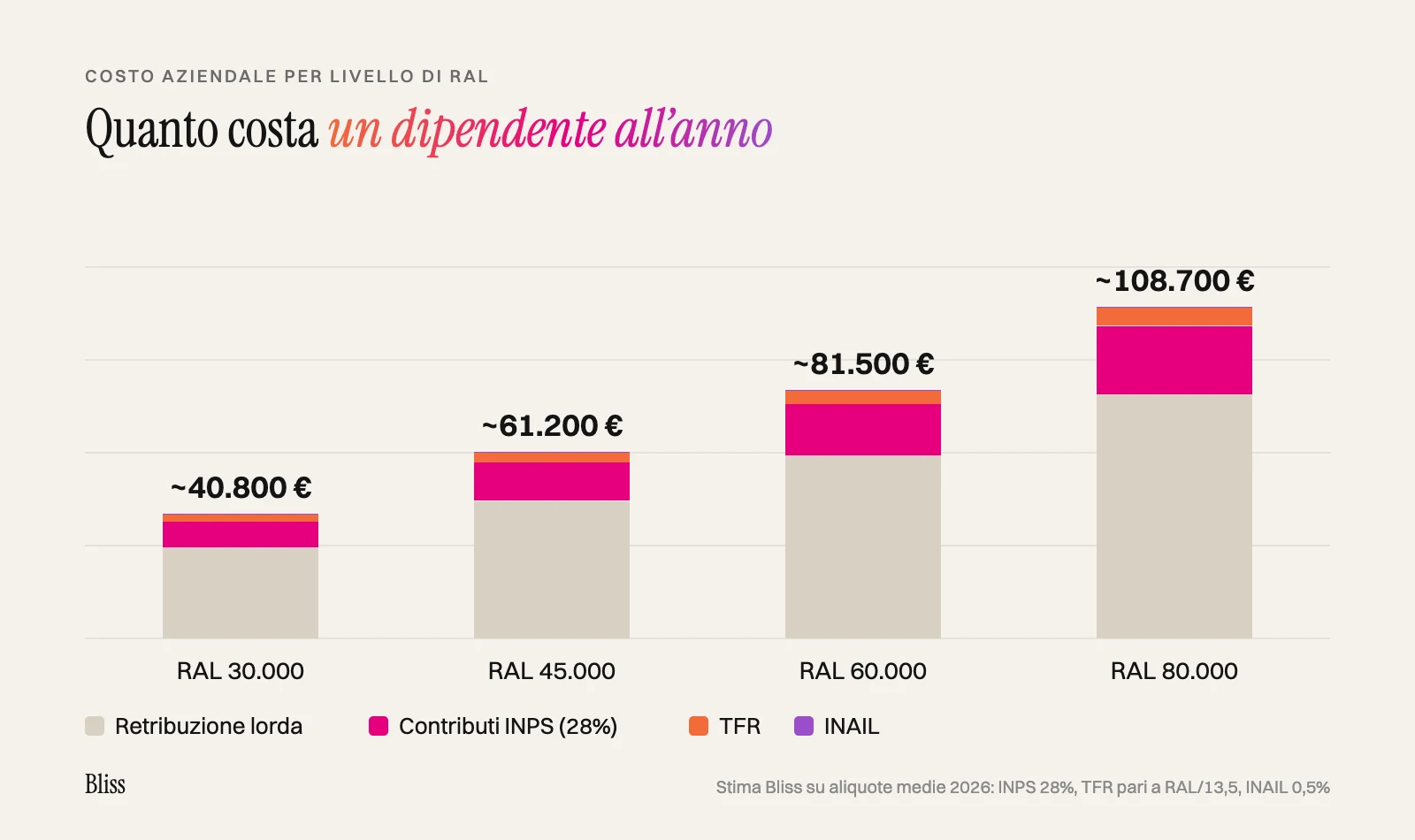
Cost rises in proportion to salary: at every gross annual salary (RAL) level, the company pays around 36% more in social security contributions, TFR severance and insurance. The calculation uses average 2026 rates and excludes indirect costs, which vary widely from one company to another.
How much does an employee on a gross annual salary of 45,000 euros cost?
Around 61,000 euros a year in direct cost. On a salary of 45,000 euros, the employer’s INPS contributions amount to between 24% and 28% depending on sector and contract, TFR to 6.91% (the salary divided by 13.5) and INAIL to a minimal share: at a 28% rate the total comes to around 61,000 euros (2026 estimates based on average rates). On top of this come indirect costs: workstation, software, training and time spent on recruitment.
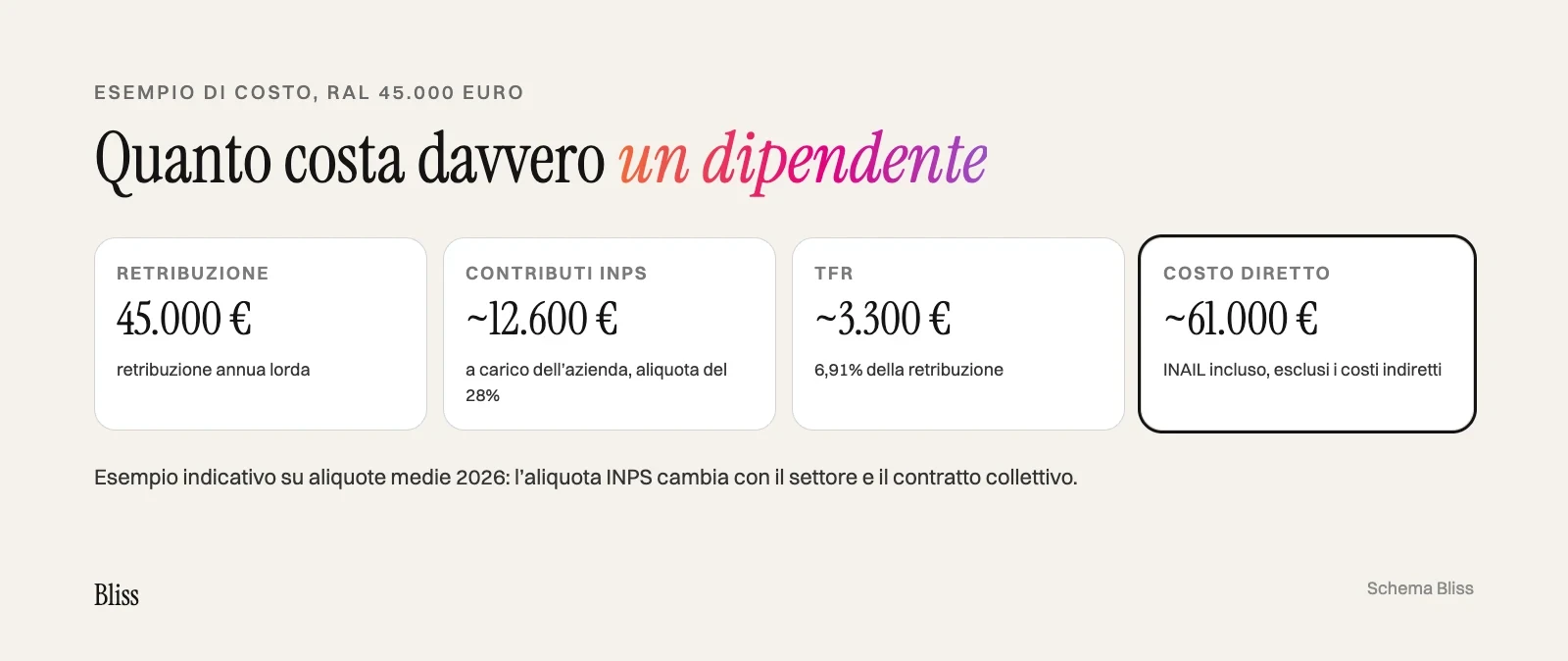
Breaking down the 45,000-euro example, more than 16,000 euros never reach the payslip but remain a cost to the business.
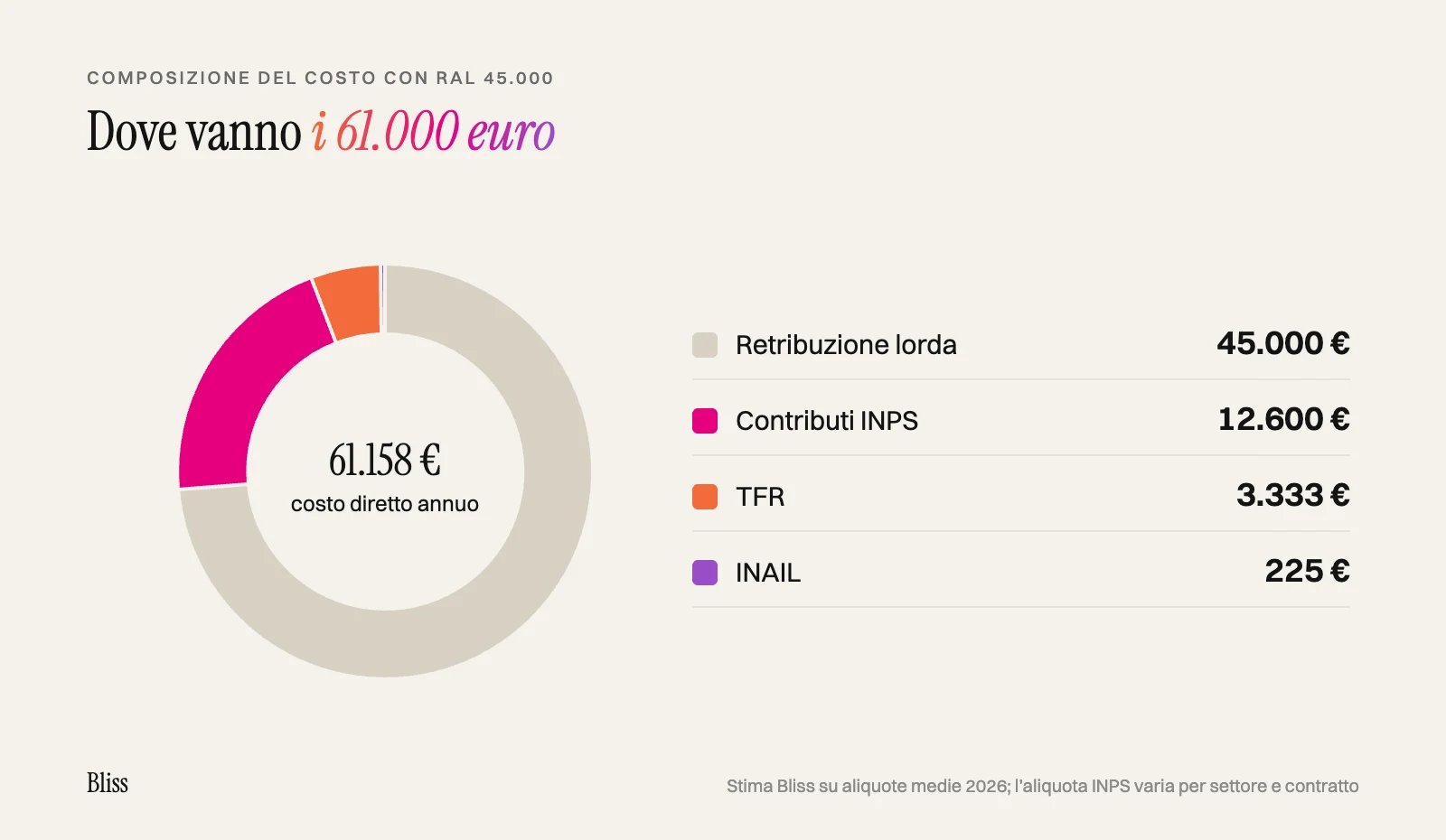
More than three quarters of this share is INPS contributions, whose rate varies with the sector and the collective agreement applied. A precise estimate requires an employment adviser; for a comparison with external consultancy, the order of magnitude is sufficient.
What is the hidden cost?
It is the time that passes before a person delivers results. Between recruitment, onboarding and training, a new hire takes months to learn the products, customers and processes, and meanwhile the cost keeps running. An external consultant also has to learn the context, but arrives with a method already applied in other cases.
Onboarding takes longer if the role is hard to fill. In 2025 Italian companies considered 47% of planned hires hard to fill, out of more than 5.8 million expected hires (Excelsior information system, Unioncamere and Ministry of Labour).
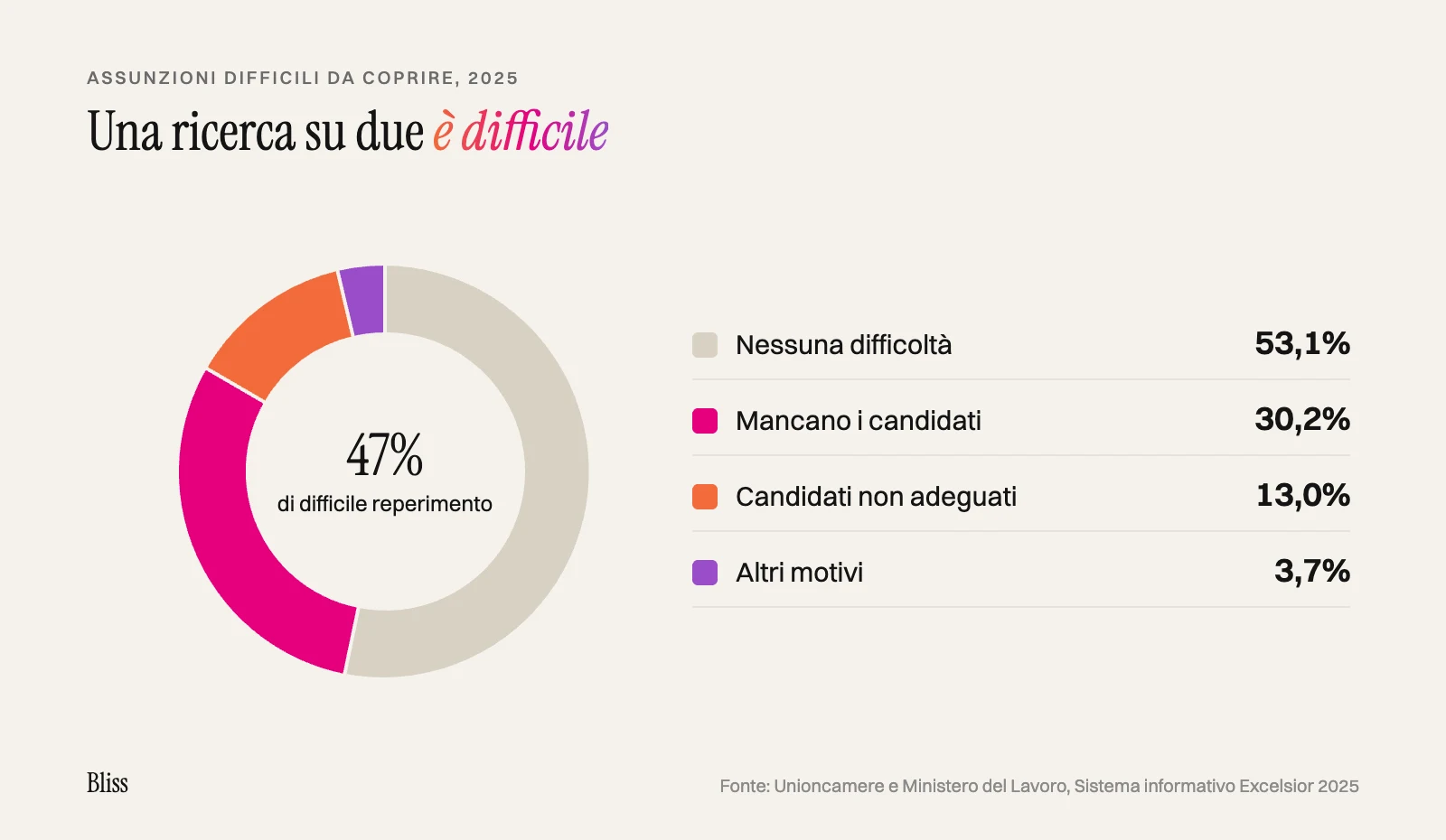
In most cases the problem is a lack of candidates, which affects 30.2% of hires; in 13% there are candidates but they lack the required skills. For a role that must deliver results within a few months, these timescales weigh as much as the salary.
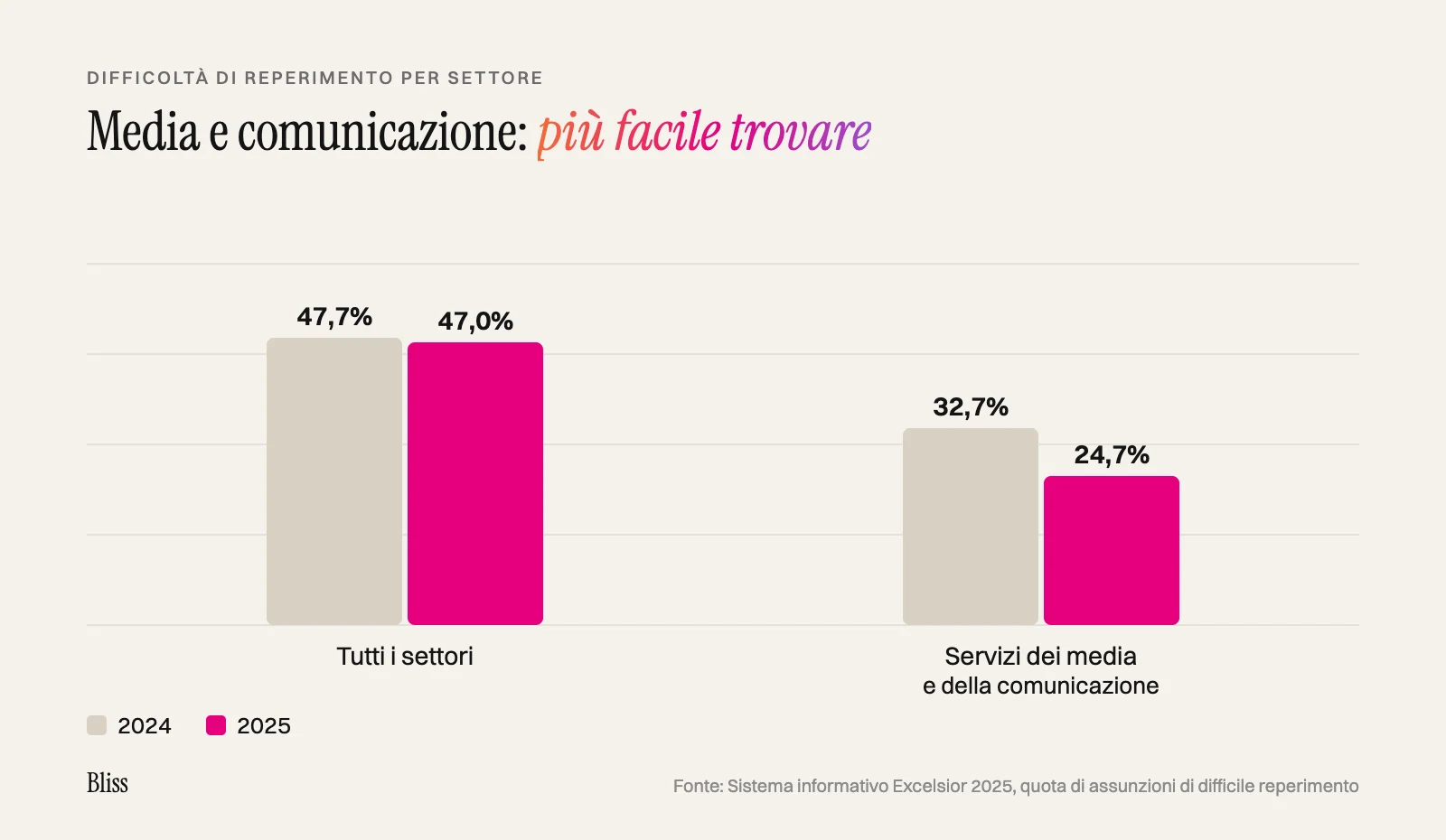
In the media and communications sector the situation is better than average: the share of hard-to-fill hires falls from 32.7% in 2024 to 24.7% in 2025 (Excelsior 2025). Finding an operational profile is therefore easier than finding one capable of defining strategy.
How much does a day of external consultancy cost?
A day of management consultancy costs on average around €880, according to the Assoconsult Observatory 2024-2025 on 2024 data, an increase of 1.4% on the previous year. The rate varies with the size of the firm: around €940 at large firms, €780 at medium-sized ones and €680 at small ones.
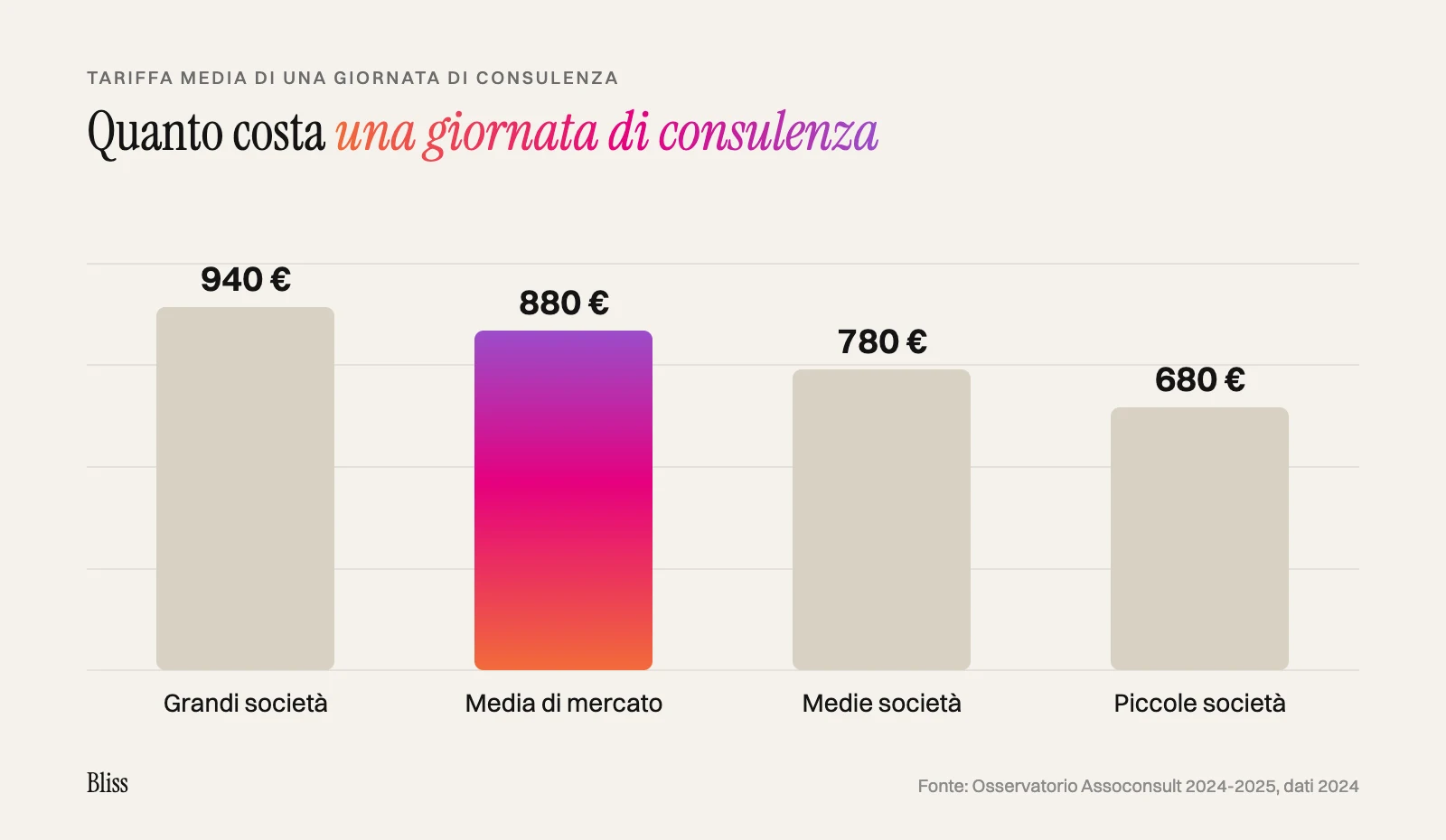
These are average rates for management consultancy in the broad sense; brand and marketing consultancy follows similar orders of magnitude, but the final price depends on how the assignment is structured: by the day, by project or with a recurring fee.
How many consultancy days is an employee equivalent to?
With a gross annual salary of €45,000, the direct cost of an employee equals roughly 69 days of consultancy at the average rate: just over one day a week for a year. We calculated this by dividing the estimated cost to the company by the average Assoconsult rates.
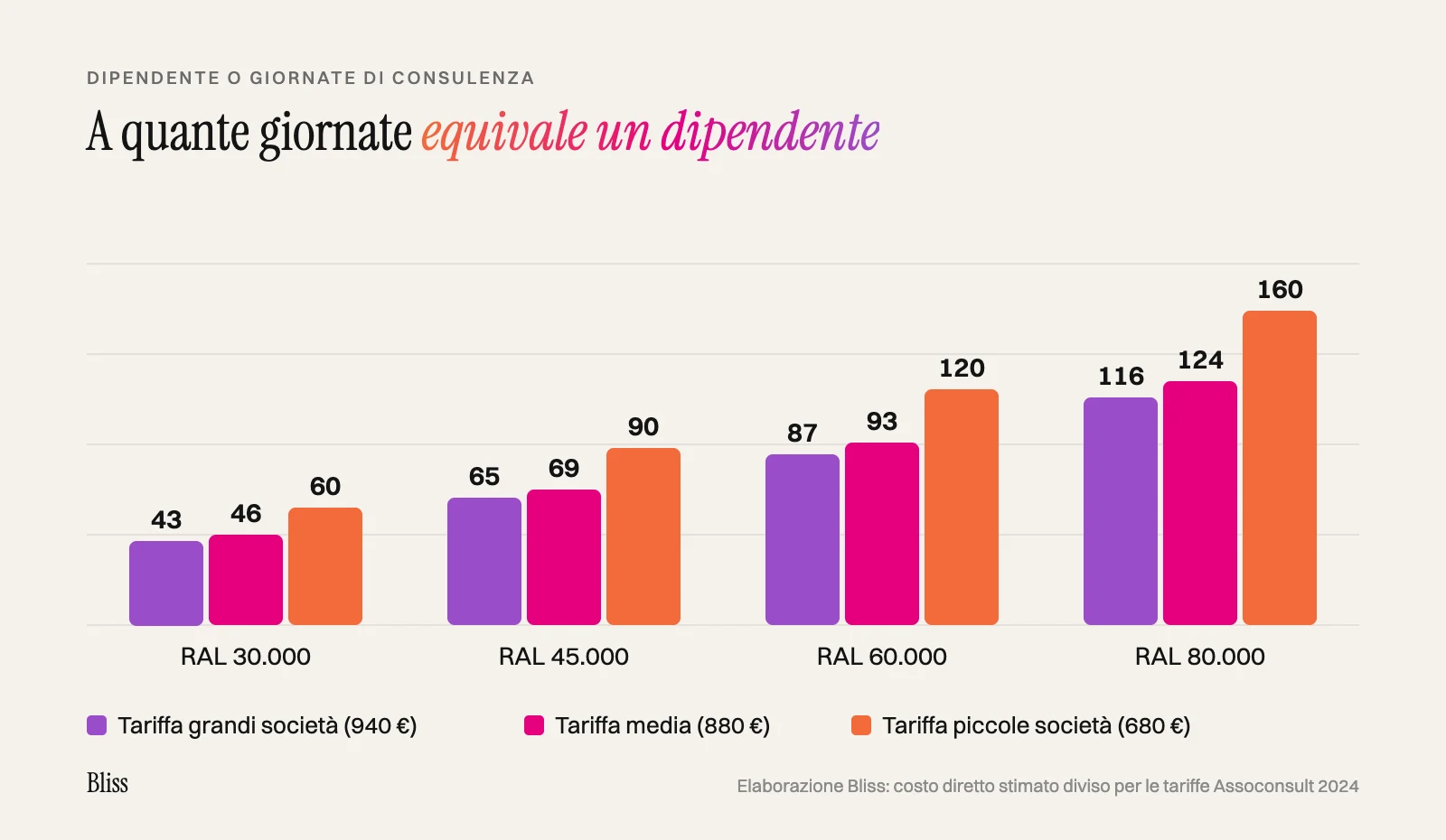
The comparison does not say that one solution costs less than the other: it says what the same sum buys. An employee guarantees daily presence on recurring activities; consulting days are for when what counts is the judgement of someone who has already seen the same problem in other companies.
How much do Italian companies spend on consultancy?
The median annual spend of companies with turnover up to 100 million is €37,500, while the average exceeds €103,000 (Assoconsult and Buono & Partners survey, June 2026). The gap between the two figures shows that most companies buy targeted interventions, while few fund broad programmes.
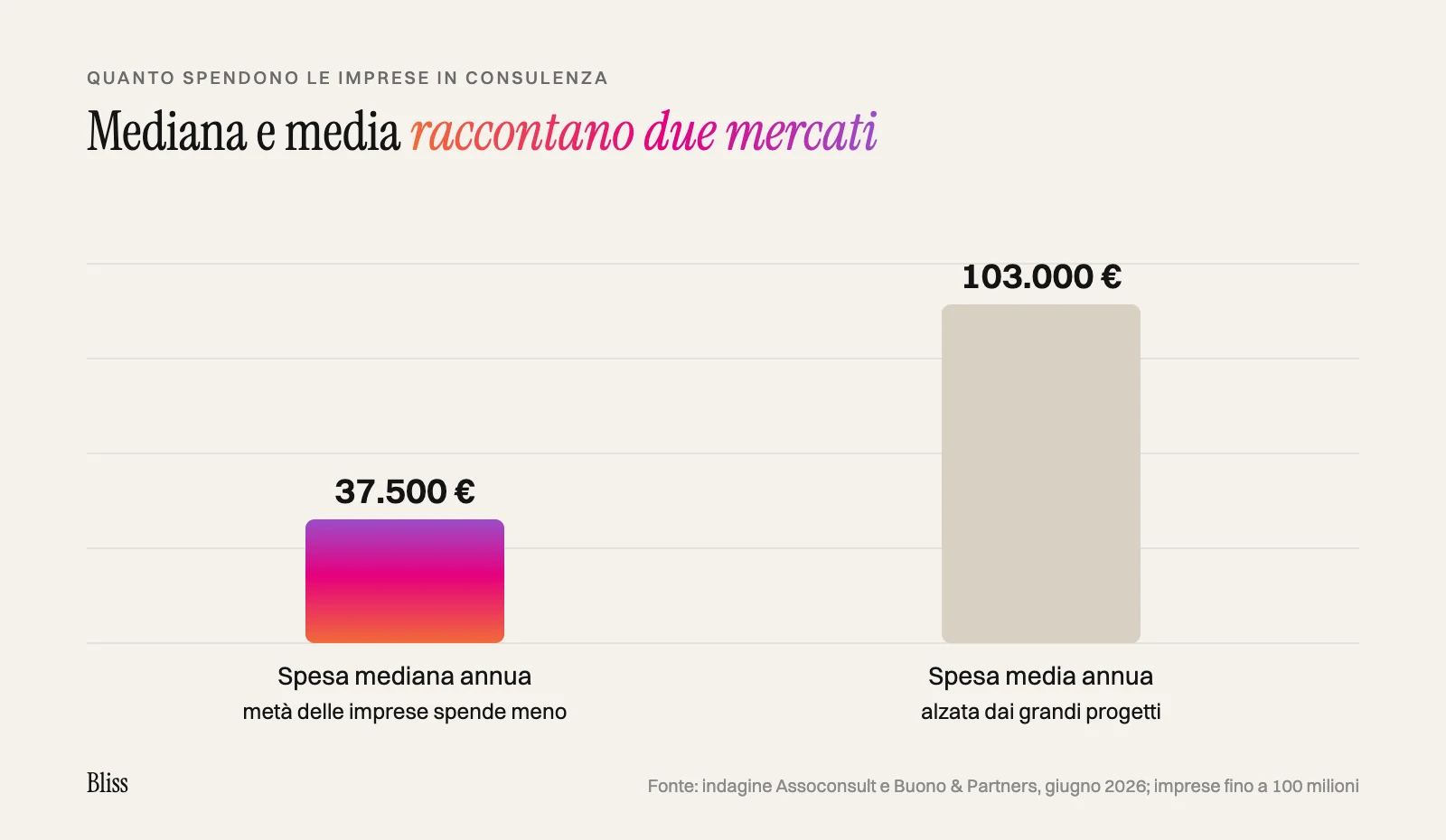
For a small or medium-sized business this is the most useful benchmark: the median spend covers around 43 days of consultancy at the average rate, less than the cost of a junior employee.
Who knows the company better, and who knows the market better?
The insider knows the company better; the outsider knows the market better. Those who work inside know who decides, which projects have already been attempted and why they failed; those who work with several companies see what happens across different sectors and bring comparisons that are hard to get from the inside. The risk, for those who stay long in the same organisation, is reading every problem through the same frameworks: we explored this in our piece on in-house and outsourced marketing.
Who has more independent judgement?
The external consultant, because they do not report to the people they have to assess. This matters above all in decisions involving the owners, senior management or generational succession, where an employee finds it hard to contradict whoever pays their salary. The external consultant has a limit too, the commercial interest in keeping the engagement: that is why an independent advisor must be able to say no, even when the answer is unwelcome.
How long does it take to see the first results?
The external consultant is usually the fastest, because they are operational from the start of the engagement. An employee requires recruitment, onboarding and training; the internal consultant is usually already in the company, but their time has to be freed up from other activities. In a project with a deadline, such as a launch or a change of positioning, this difference matters more than cost.

The supply of consultants is also growing: professionals at management consultancy firms with at least 3 staff rose from around 37,000 in 2022 to over 46,000 in 2025 (Osservatorio Assoconsult 2024-2025). For a business, this means more choice, and therefore a greater need for criteria to choose by.
When a company asks us whether to hire a marketing manager, the first question we ask is to do what. Often the role being sought would have to set the strategy, manage suppliers and execute, all at once.
Bliss’s point of view
“Companies look for one person who can do everything. Such a person rarely exists, and when they do, they cost more than a mixed model.” Francesco Acri, CEO of Bliss
That is why we start from the work to be done, and only then from the role to fill.
What happens if the person leaves?
With an employee or an internal consultant, part of the knowledge leaves with the person: contacts, decisions taken, the reasons behind them. With a structured external consultant, that is a firm rather than an individual professional, continuity is ensured by the team and by the documentation of the work. It is a risk to assess beforehand, not once the person has already resigned.
Which contractual aspects do you need to know?
The main point is not to turn a consultancy into a de facto employment relationship. If the company organises when and where the consultant works, the relationship risks being reclassified: this is the case of client-organised collaborations under Article 2 of Legislative Decree 81/2015. An external consultant decides how to carry out the work and is accountable for the agreed result.
What should an external consultancy contract contain?
- the scope of the engagement and the expected results;
- the duration and termination terms;
- the fee and payment terms;
- confidentiality obligations;
- ownership of the work produced: documents, data and materials.
Can an external consultant fill roles required by law?
Yes, in several cases the law expressly provides for it. The data protection officer, for example, can be an employee or an external party under a service contract (Art. 37(6) GDPR); the same applies to the head of the prevention and protection service for workplace health and safety.
When does each of the three make sense?
An employee makes sense when a stable function needs day-to-day oversight with consistent workloads: social media management, customer service, administration.
An external consultant makes sense when you need a decision or a change of direction backed by independent judgement, or expertise the company would only need for part of the year.
An in-house consultant makes sense in larger companies, with several functions to coordinate and projects that cut across different departments.
Is there a model that combines them?
Yes, and it is often the most effective: an external advisor governs direction and rules, the in-house team carries out the day-to-day work and an external operational structure covers projects and peaks. This way the company pays on a permanent basis only for the skills it uses every day and gets independent judgement where it is needed.
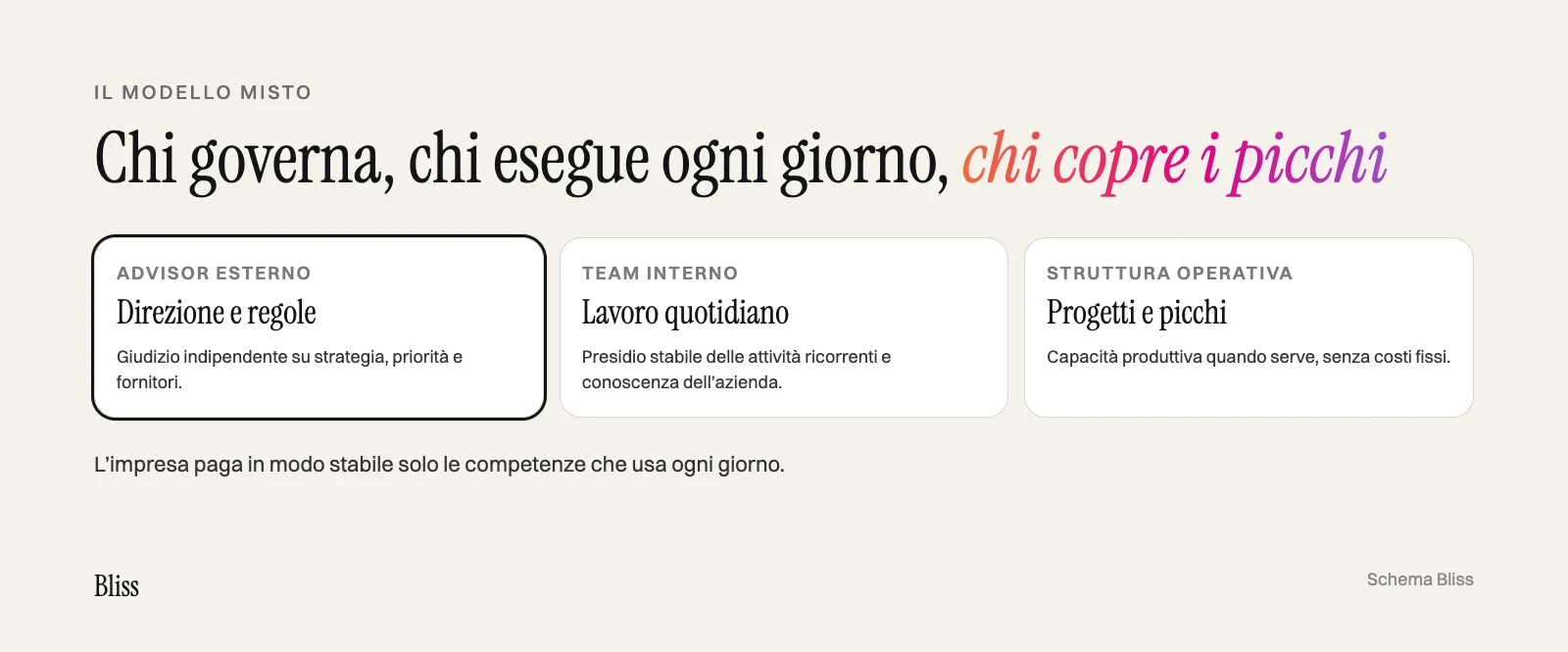
This is the model Bliss works with: Advisory and Governance steer brand decisions, while Bliss Studio delivers campaigns, content and websites alongside the client’s team. For it to work, analysis and execution must answer to the same indicators: we explain this with market figures in our analysis of agencies and consultants in Italy and where value is lost between strategy and execution.
Who works on your project
The people of Bliss across Rome and Milan





Frequently asked questions
What is the difference between an external consultant and a freelance contractor?
The external consultant works independently on a defined assignment and is accountable for the result; the collaborator often works on an ongoing basis within the company’s organisation, and if the company decides the times and places of work, the relationship may be reclassified as employment.
Can an external consultant work exclusively for one company?
Yes, exclusivity can be agreed in the contract, but working for a single client, with hours and locations set by that client, is one of the indicators of an employment relationship: it should be assessed with an employment consultant or a lawyer.
Is it better to hire a marketing manager or a marketing consultant?
An in-house marketing manager makes sense if there is day-to-day work to coordinate all year round; an external marketing consultant if what is needed is strategic direction or a review of existing marketing. Often the answer is an in-house manager supported by an external adviser.
How much does an external consultant cost for an SME?
It depends on the scope and duration of the engagement. As a benchmark, Italian companies with turnover of up to 100 million euros spend a median of 37,500 euros a year on consultancy (Assoconsult and Buono & Partners survey, 2026).
Who should you turn to for an external brand and marketing consultant?
To a firm that has analytical tools and a team capable of execution. Bliss supports companies as an external brand and marketing adviser with the Advisory, Governance, Operations model: the first step is a 30-minute conversation.
Which sources did we use?
- Italian Civil Code, Articles 2094 and 2222; Legislative Decree 81/2015, Article 2; EU Regulation 2016/679 (GDPR), Article 37.
- Labour cost: 2026 estimates based on average sector INPS rates, with TFR equal to pay divided by 13.5.
- Assoconsult and Buono & Partners survey on demand for professional services, June 2026.
- Unioncamere and Ministry of Labour, Excelsior information system: the demand for professions and training among Italian companies in 2025.
- Assoconsult Observatory 2024-2025 on management consulting in Italy: average daily rates and professionals, 2024 data and 2025 preliminary figures.
Bliss · Rome and Milan
The right profile, before you hire
A discussion of skills, costs and timescales, with a consultant who knows brand and marketing from analysis to execution.
Tell us which expertise you are missing.
Two minutes on the contact form, then we will call you back.
We get back to you
A consultant reads your request and arranges an initial call with you.
You receive a proposal
Scope, priorities and costs, starting from the diagnosis.