
When marketing fails to deliver results, an Italian business almost always has two counterparts: a consultant who says what to do and an agency that does it. Value is lost in the handover between the two, because those who analyse do not execute and those who execute lack the tools to interpret the data. What is needed is a single counterpart that carries out the diagnosis with its own tools and then executes: Bliss does this through its Advisory, Governance, Operations model.
To understand how widespread the problem is, we combined official market figures with an original analysis: we reviewed the websites of 60 suppliers that Google shows to anyone searching for an agency or a consultant. Only 2 state that they have both their own analytical tools and in-house execution.
In brief
Agencies and consultants in Italy in 4 key points:
- 1
In Italy there are 43.453 communications businesses, 88,6% of them with fewer than 4 employees.
- 2
Established consultancies number around 3,400, accounting for just over 6 billion euros.
- 3
On the websites of 60 providers, all agencies execute, but only one in four offers analysis.
- 4
Only 2 providers out of 60 state that they have proprietary analysis tools and also execute.
How many communications agencies are there in Italy?
In Italy there are 43.453 active businesses in communications, of which around 18.000 are agencies in the strict sense, according to the Rapporto Pma 2025-2026 by Strategie per Agenzie. The number has grown by 14,6% since 2017, and the wider market includes digital consultants, design studios, software houses and independent professionals: between 150.000 and 200.000 people in all, freelancers included.
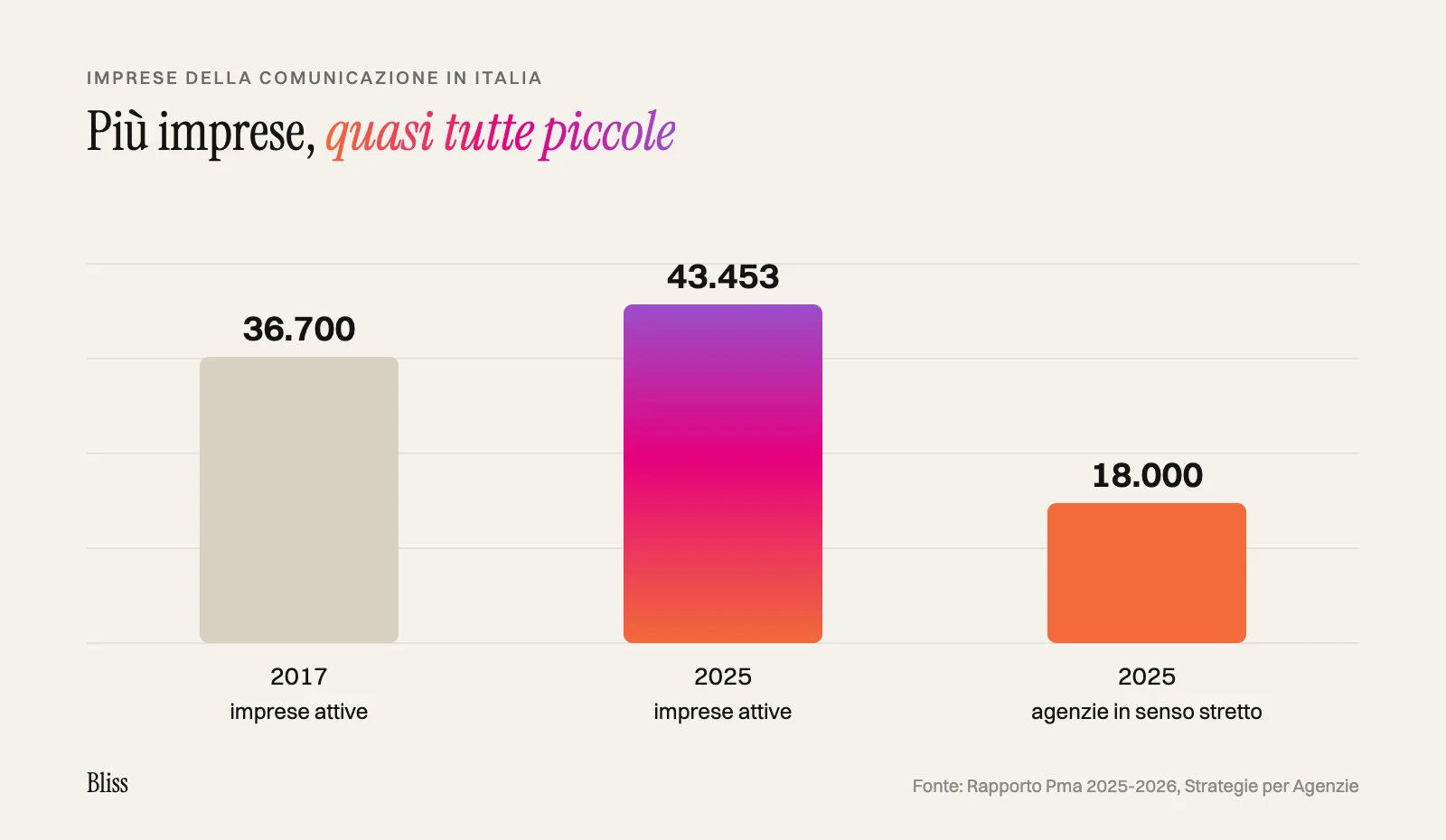
In eight years the number of communications firms has grown by almost 6,800, but fewer than half are agencies in the strict sense: the rest are digital consultants, design studios, software houses and freelancers. For anyone choosing a provider, this means plenty of choice and few criteria for comparing it.
The figure that matters most is size: 88,6% of agencies have fewer than 4 employees and only 1.874 businesses exceed one million euros in turnover. Total turnover recorded by the Chambers of Commerce is 21,3 billion euros, and Lombardy and Lazio together account for almost 60% of the market (Rapporto Pma 2025-2026). Those looking for the best-known names will find them in our ranking of communications agencies in Italy.
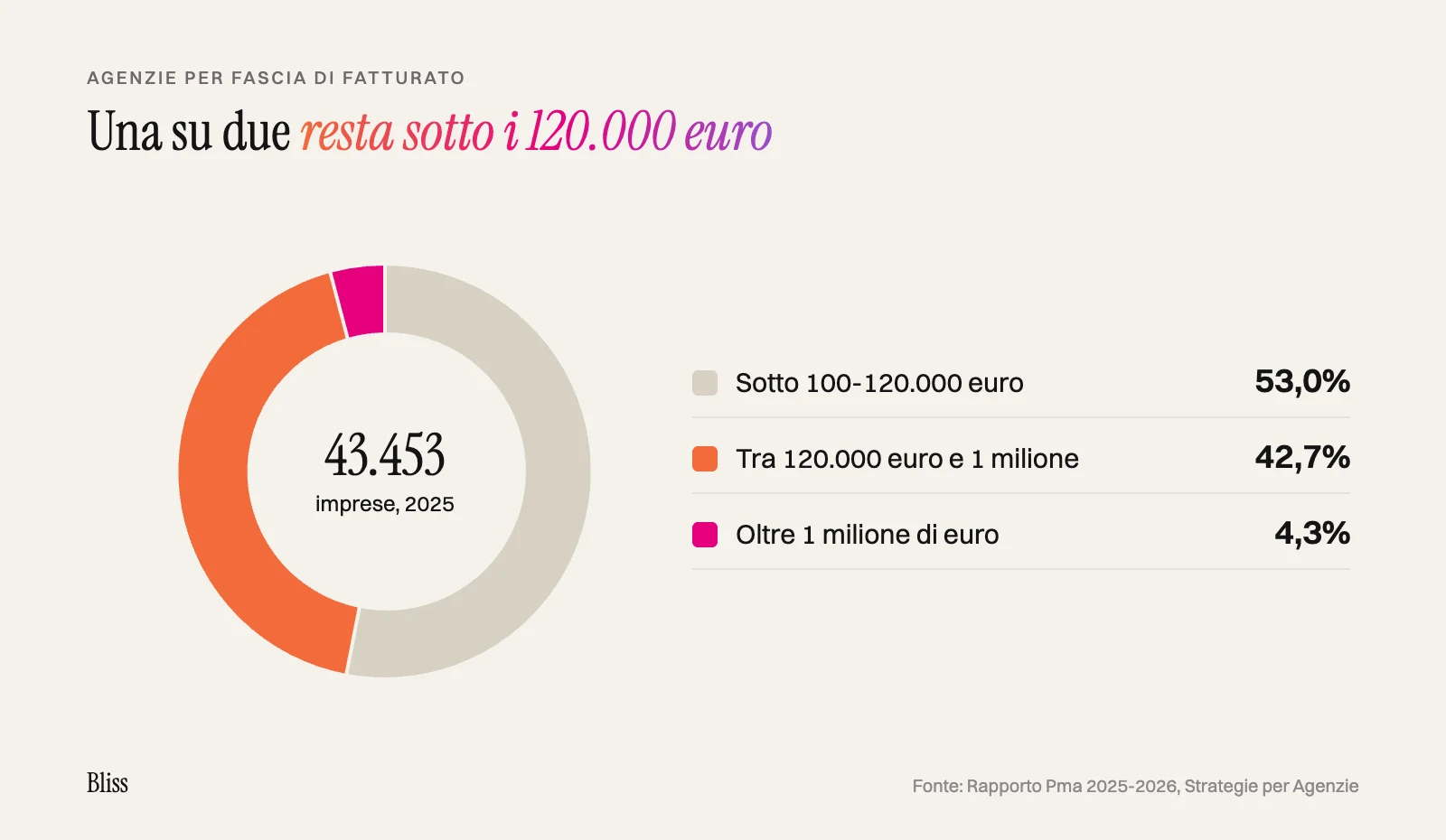
The breakdown by turnover shows a polarised market: on one side just under 1,900 firms above one million euros, on the other more than 23,000 firms below 120,000 euros (Rapporto Pma 2025-2026). The middle band, which we calculate by difference, accounts for 42.7%.
Why does agency size matter?
Because it determines how much time and how many people an agency can devote to analysis. According to the same report, micro-businesses generate between €30,000 and €35,000 in turnover per employee, compared with around €150,000 for large Milan agencies, and between 37% and 40% of new service businesses close within five years. A three-person team working on campaigns, content and websites rarely has anyone dedicated solely to measuring and interpreting.
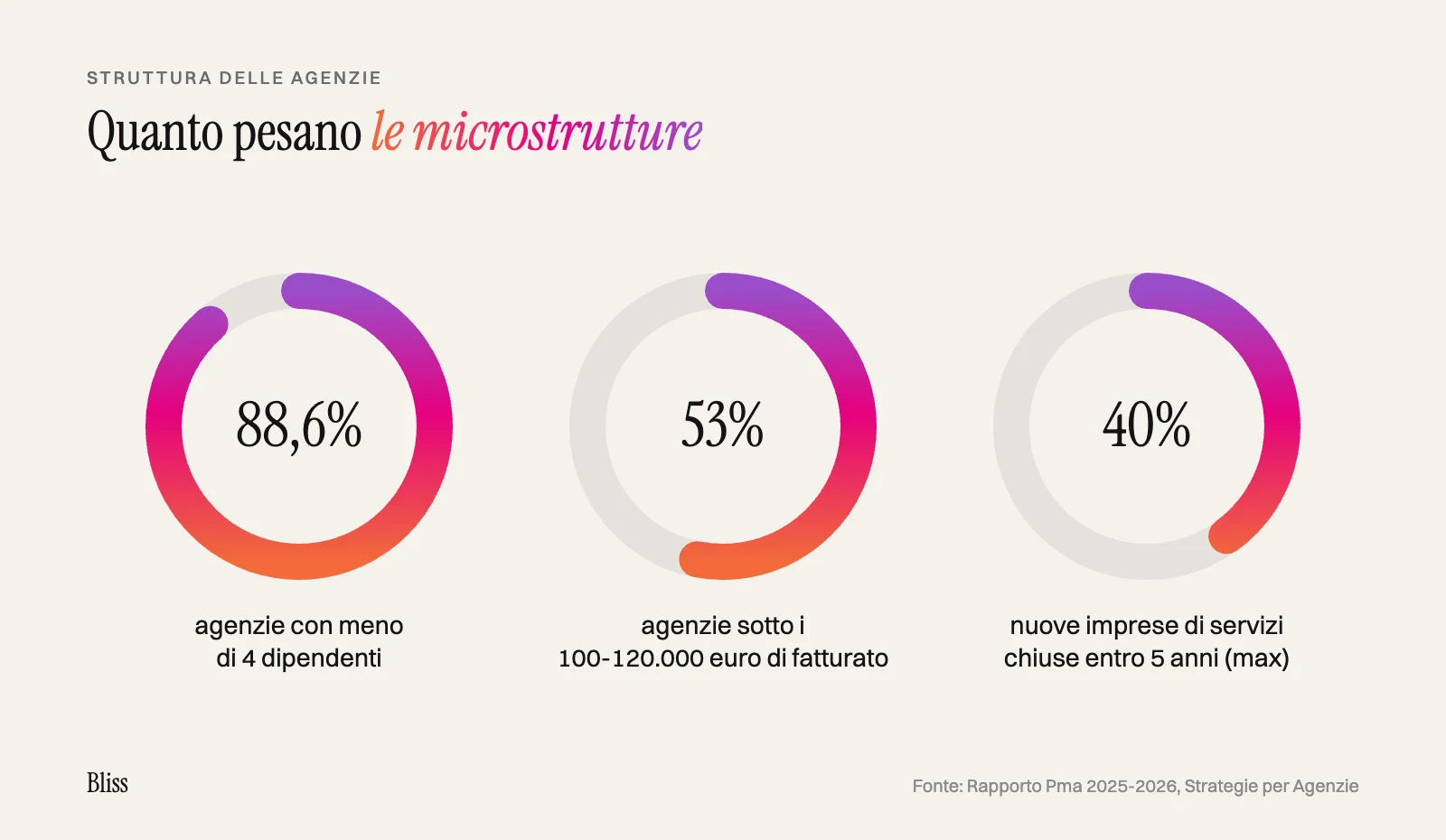
Taken together, the three indicators describe the typical provider: a firm of a few people, with revenue that does not allow stable resources to be dedicated to measurement, in a market where more than one in three new service businesses closes before its fifth year.
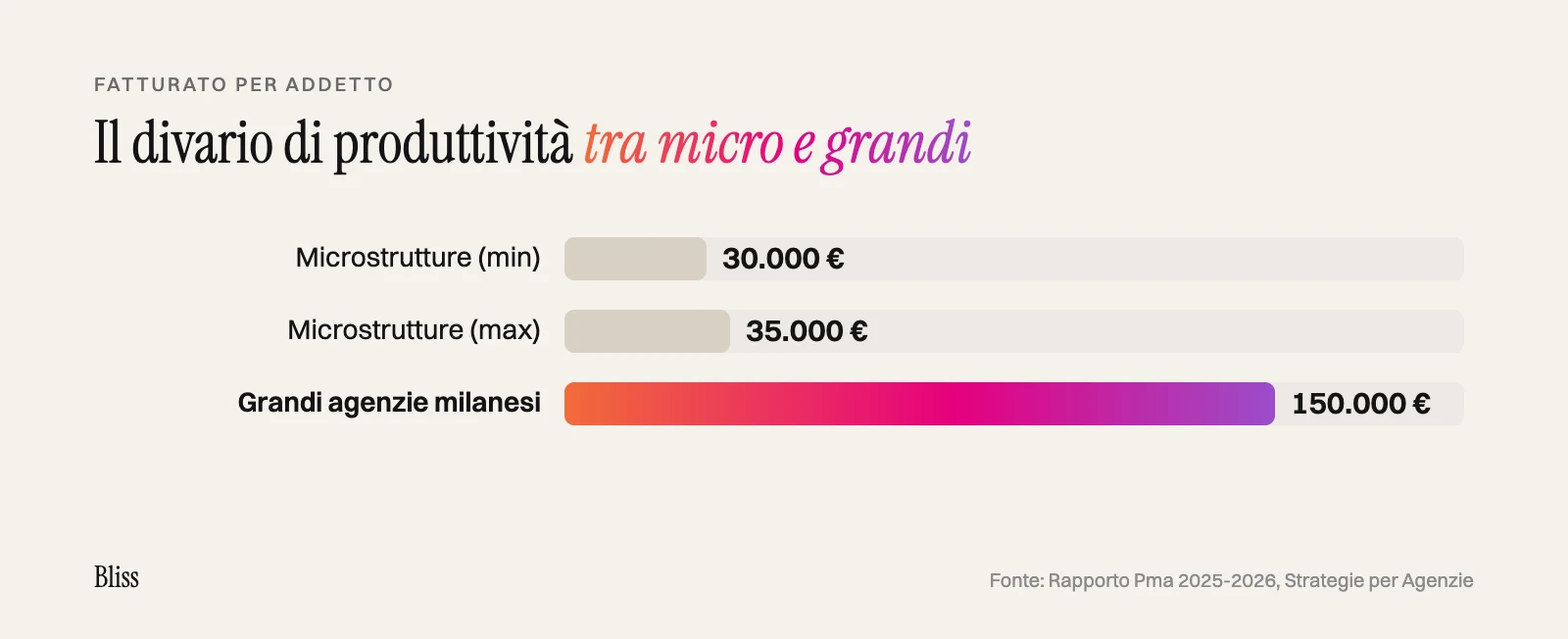
The productivity gap between micro-agencies and large agencies is roughly fivefold. It is not down to size alone: larger firms can afford people and tools dedicated to analysis, which in turn make execution more efficient as well.
How many consulting firms are there in Italy?
In 2024 there were around 3,400 management consultancies with at least 3 employees, with an output value of just over 6 billion euros and around 48,700 employees (Assoconsult Observatory 2024-2025). Including micro-firms with fewer than 3 employees, in 2023 there were around 26,600, accounting for over 6.6 billion euros (Assoconsult Observatory 2023-2024). Since 2025 the reference ATECO code for business consultancy has been 70.20.09, which replaced 70.22.09.

After two years of growth above 13%, the sector is slowing: +8,5% in 2024 and +5,7% expected for 2025 and 2026. In real terms, growth in 2025 falls to 3,6% (Osservatorio Assoconsult 2024-2025). The market is still expanding, but clients are becoming more selective about what they buy.
Who shares the consulting market?
The market is highly concentrated: the 35 firms with more than 50 staff make up 1% of businesses but generate 72,6% of production value, while the roughly 2.900 small firms, with 3 to 9 staff, share 13,1% of it (Osservatorio Assoconsult 2024-2025, 2024 data). The Marketing and Customer Experience area accounts for 7,4% of the market.
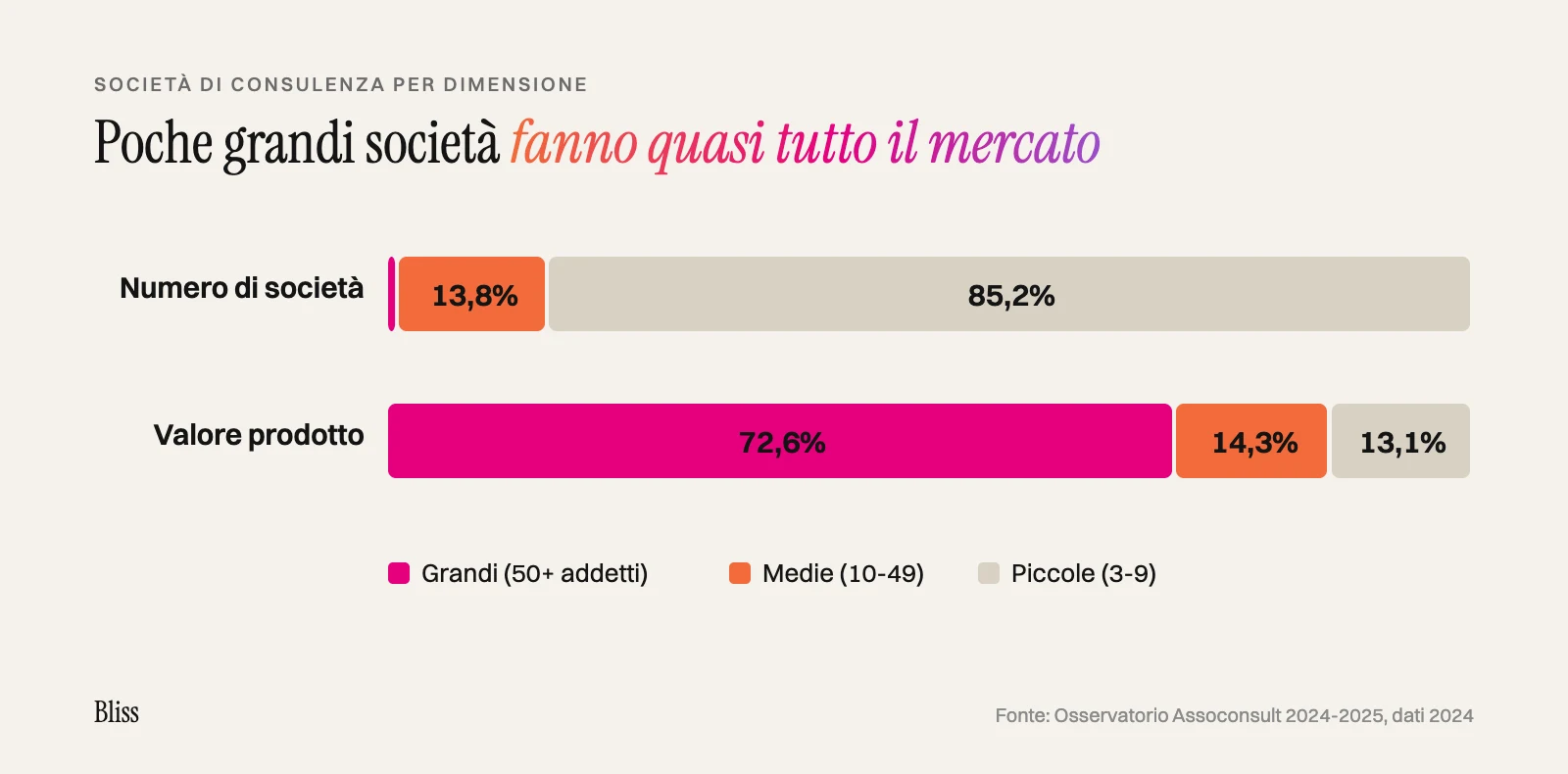
Comparing the number of firms with the value they produce makes the concentration clear: 1% of firms account for almost three quarters of the market, while 85% share little more than a tenth of it. In 2010 large firms accounted for 57.6% (Osservatorio Assoconsult 2024-2025): concentration has increased since 2010.
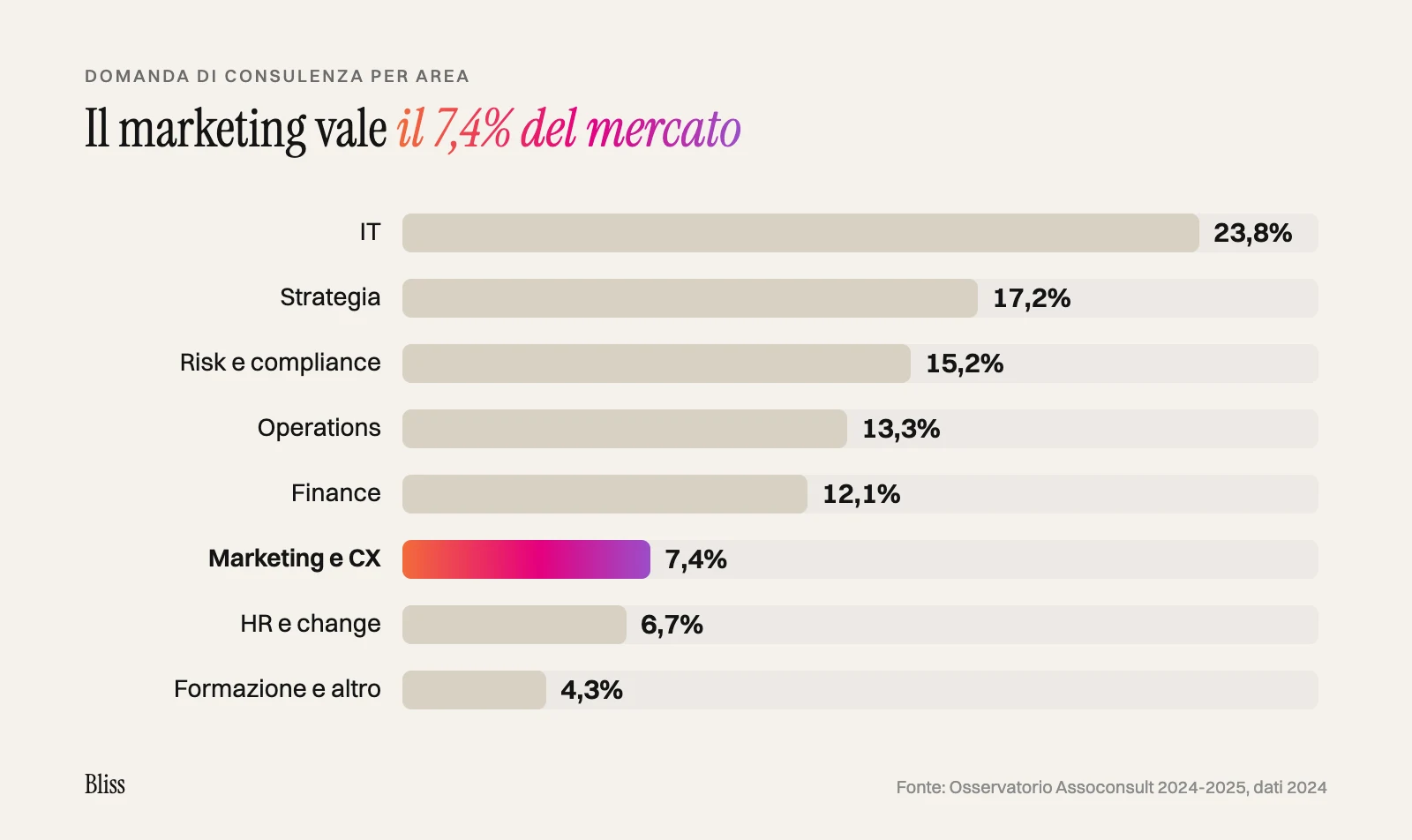
Marketing is a small share of management consulting: less than one euro in thirteen. The large firms work mainly on technology, strategy and regulatory compliance, and rarely take marketing through to execution.
How much do SMEs account for in consulting spend?
Little, and less and less: in 2024 client companies with revenue below 50 million accounted for 17% of consultancy spending, against 21% in 2019, and their demand did not grow in value. These companies buy around 60% of their services from small and medium-sized consultancies (Assoconsult Observatory 2024-2025).

Over five years spending has shifted towards larger companies: those with revenue above 500 million rose from 52% to 56% of private demand, while SMEs fell from 21% to 17%. In 2024 private spending on consultancy was around 5.3 billion euros (Assoconsult Observatory 2024-2025).

How many companies buy consulting and marketing?
Almost all of them: of more than 750 Italian companies with turnover of up to 100 million euros, 96.9% buy professional and consulting services (Assoconsult and Buono & Partners survey, presented at the Stati Generali del Management Consulting in June 2026). 29.7% buy consulting on marketing and business development and 27.2% on strategy; median spend is 37,500 euros a year and 59.1% choose their consultant on the basis of specialisation.
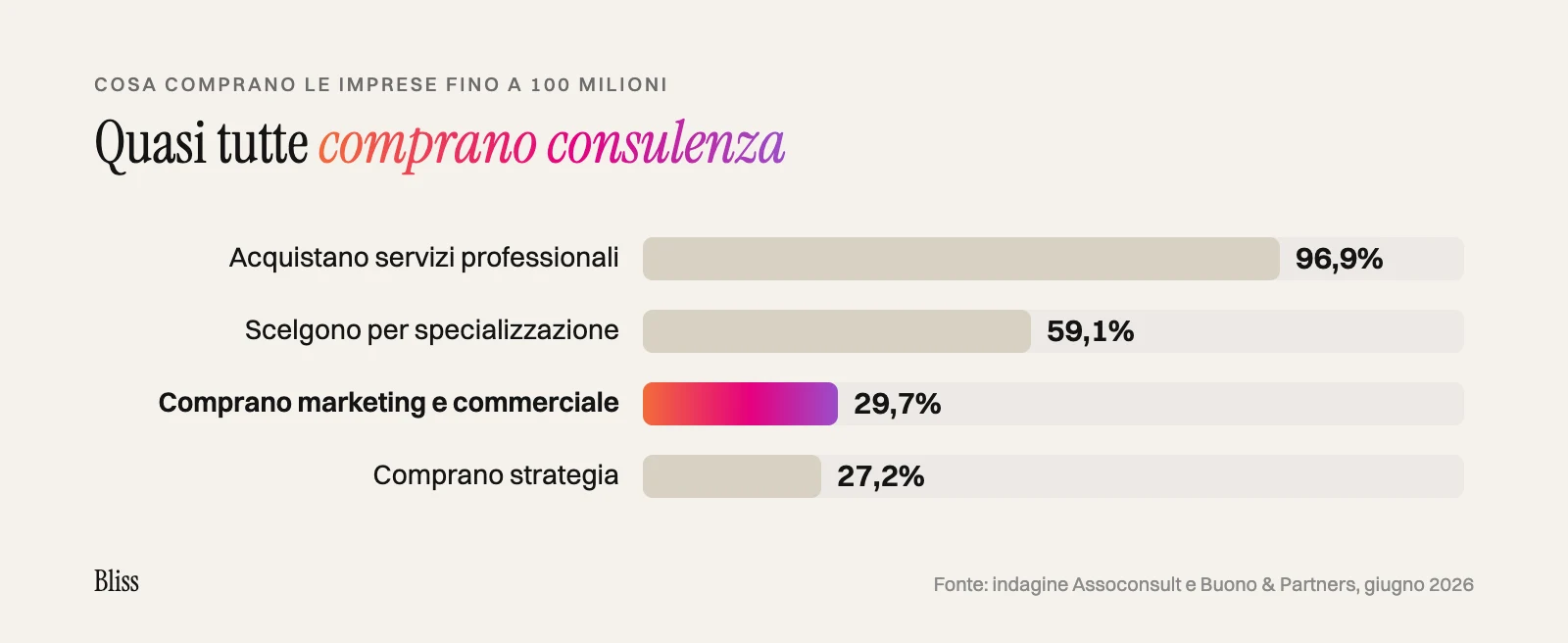
The figure that interests us most is the third: almost three companies in ten buy consulting on marketing and business development, more than buy it on strategy. The demand is there; what is often missing is a provider that follows it from analysis through to results.
These figures should be read alongside the structure of the country: there are 4.617.000 active businesses in Italy (ISTAT, Annuario statistico 2025, 2023 data), the vast majority of them small. A business of this size almost always buys strategy from one supplier and execution from another.
How much do Italian businesses invest in advertising?
In 2025 advertising investment in Italy reached 9.6 billion euros, up 0.4% on 2024, according to Nielsen data on the extended scope that includes search, social and OTT platforms. The market has been flat for three years: it is barely growing, so every euro has to work harder.

Digital is the leading medium, with €4.3 billion and 45% of the market, ahead of television with €3.8 billion (Nielsen, Confindustria Radio Televisioni analysis, 2025). In Italy the digital share remains lower than in the other major European countries: in 2024 it stood at 44.1%, against 58% in France and 81% in the United Kingdom.
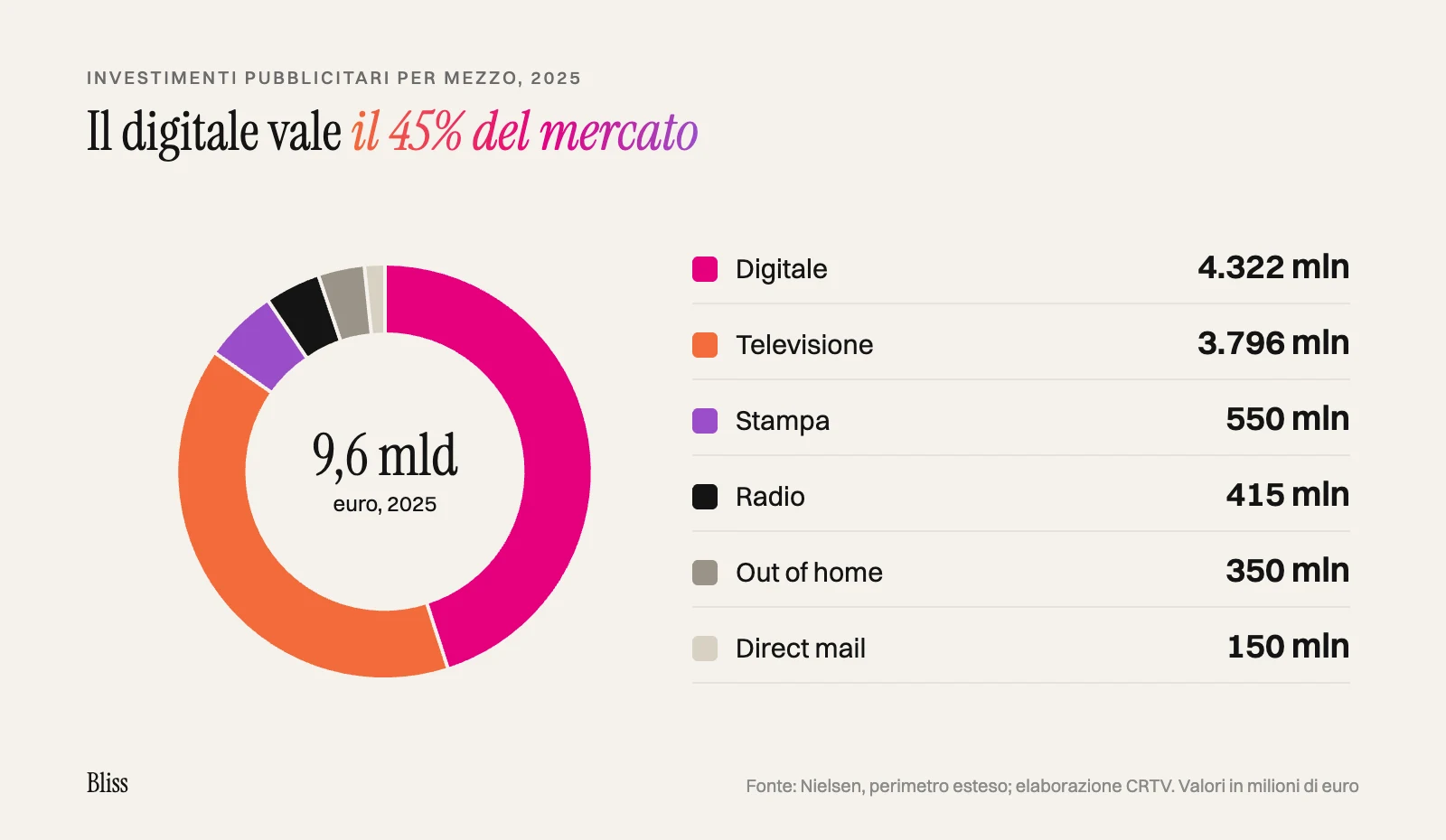
For a business, this means that most of the budget goes through measurable channels, but measurable separately: each platform reports its own numbers. Without someone reading them together, decisions are taken channel by channel.
The problem: why is value lost between consultant and agency?
Value is lost because those who analyse and those who execute are almost always two different parties, and the business has to act as the go-between. The consultant delivers a diagnosis and a plan, but has no structure to implement it. The agency produces campaigns, websites and content, but rarely has the tools to tell whether they are moving the numbers that matter.
In our first meetings with a business owner the most frequent question is not what to do, but who does it. Often there is already a plan written by a consultant on the table, alongside an agency proposal, and the two do not speak to each other.
Bliss’s point of view
‘The consultant tells you what to do, but doesn’t know how to do it. The agency executes, but doesn’t have the tools to interpret what is happening. We sit in between.’ Francesco Acri, CEO of Bliss
That is why we have built our own analysis tools and an operational structure that delivers: the diagnosis and the work answer to the same indicators.
What did we measure on the websites of 60 providers?
We read the websites of the providers that Google shows in Italy to anyone searching for an agency or a consultant: 40 agencies and 20 consulting firms, surveyed on 19 November 2026. For each one we checked three things: whether it offers an analysis or an audit as a service, whether it states that it has its own analysis tool, and whether it carries out the operational work directly.
What 60 providers state on their websites
Bliss analysis, data collected on 19 November 2026
| Criterion | Agencies (40) | Consulting firms (20) |
|---|---|---|
| Execute directly (campaigns, websites, content, operational management) | 40 (100%) | 6 (30%) |
| Offer an analysis or audit as a service | 10 (25%) | 3 (15%) |
| Claim their own analysis tool | 2 (5%) | 1 (5%) |
| Analysis or audit and execution | 10 (25%) | 1 (5%) |
| Proprietary tools and execution | 2 (5%) | 0 |
Agencies all execute, but three in four do not offer analysis as a service, and when they do it almost always covers a single channel: SEO, the website or visibility in AI engines. Consultancies analyse, but seven in ten do not execute; several claim a named method, none a tool that measures the brand. Only 2 providers out of 60 claim both their own analysis tools and execution, and in both cases the tools cover SEO and online reputation, not the brand as a whole.

We then cross-referenced the answers to understand how analysis and execution are combined within the same supplier.

Among agencies, one in four offers both an audit and execution; the others execute without a declared analysis service. Among consultancies, six in ten stop at strategy, with neither a structured audit nor execution, and only one offers both.
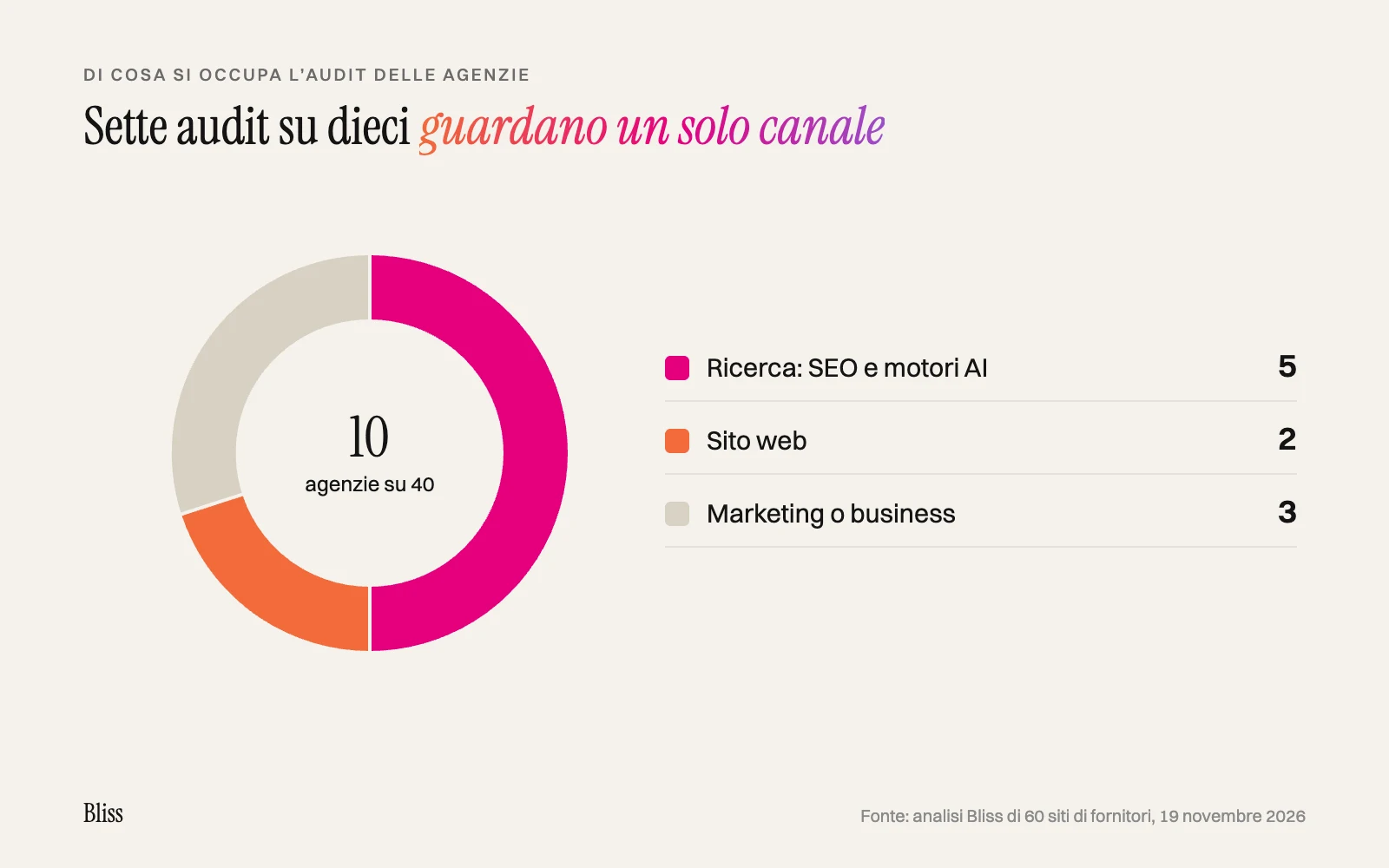
Even when there is one, an agency audit almost always covers a single channel: in five cases out of ten, search on Google and AI engines; in two, the website. Only three agencies state that their analysis starts from marketing or the business as a whole.
What does this handover cost the business?
- Two providers to coordinate, with meetings, briefs and handovers that fall to the founder or the marketing manager.
- Strategic direction that the agency cannot translate into activity, or translates in its own way.
- Execution that nobody measures against the initial diagnosis.
- A result no one is fully accountable for: the consultant delivered the plan, the agency delivered the campaigns.
The solution: what does it take to move from analysis to action?
What is needed is a single counterpart that carries out the diagnosis with its own tools, turns it into decisions and then executes them, measuring results against the initial diagnosis. In practice, four conditions are required.
- Proprietary analytical tools that measure the brand, not just a channel: awareness, consistency, positioning against competitors, presence in the answers of AI engines.
- Ability to interpret: turning data into a few decisions, in order of priority.
- An operational structure that delivers campaigns, content, websites and media without a second handover.
- A common measure: the same indicators used to make decisions are used to assess execution.
The value: what changes when analysis and execution sit together?
What changes is that decisions are made on data, and those who execute them are accountable for the same indicators used to make them. No translation is needed between a strategy document and an operational plan, and when an activity is not working it shows in the diagnosis indicators, not just in the campaign ones.
This is what happens in projects where we handle both the analysis and the operations. For Doreca, a Rome-based beverage chain, we managed the sales system across stores and digital channels: during the engagement, in 2023, conversion rose by 8% and the average receipt by 12%.

Our case study
Retail advisory across stores and online
For Doreca we managed the sales system across stores and digital channels: during the engagement, in 2023, conversion +8% and average receipt +12%.
Read the case studyThe same approach applies to launch projects, such as the Auriga fragrance for Profumum Roma, where audience analysis, identity and campaigns were handled by the same team.
Action: how does Bliss work across Advisory, Governance and Operations?
Bliss analyses and interprets with proprietary tools, defines the rules by which the brand presents itself at every touchpoint and executes through Bliss Studio, its operational unit. These are three levels of the same work, with single accountability for the result.
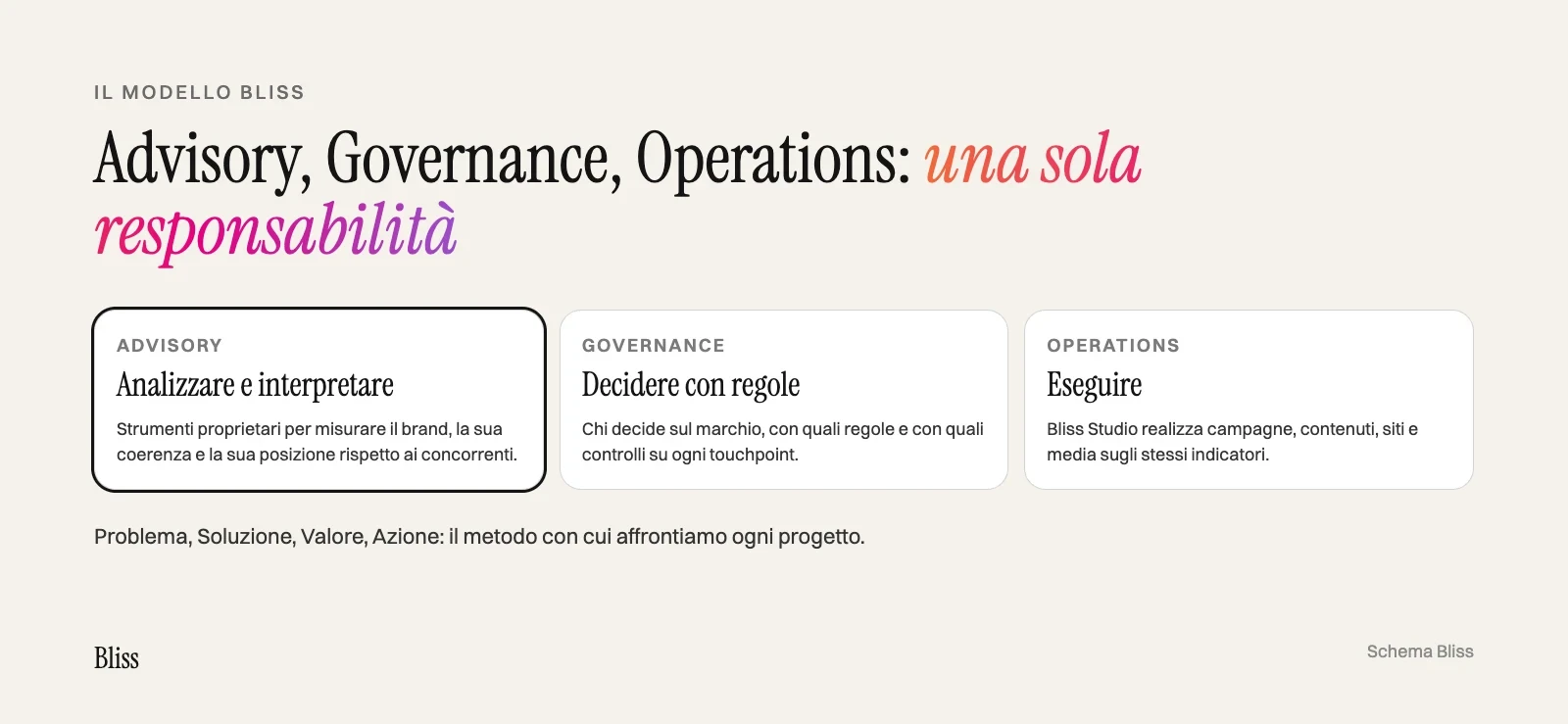
Advisory: what tools do we use to analyse the brand?
With tools developed in-house that read the brand from several perspectives:
- Brand strength: a brand equity index built on 8 indicators, read through a dashboard designed for the board of directors.
- Presence in AI engine answers: how well ChatGPT, Gemini and Claude know the brand, how they describe it and whether they suggest it when nobody names it.
- Competitive positioning: the brand and up to five competitors compared across eight dimensions, based on public data.
- Touchpoint consistency: how recognisable and consistent the brand is across the website, Google, LinkedIn, social media and external presences.
- Gap between perception and narrative: how far the externally perceived image departs from the way the brand presents itself.
- Competitors’ content cadence: how much they publish and on what, and when their cadence changes.
The starting point is almost always a brand audit, which brings these readings together into a diagnosis.
Governance: who decides on the brand, and by what rules?
Brand governance establishes who decides on the brand, under which rules and with which controls, so that the decisions taken in the diagnosis are not dispersed across suppliers, departments and offices. It is the layer that holds analysis and execution together over time.
Operations: who does the work?
Execution is entrusted to Bliss Studio, the Bliss operational unit that delivers campaigns, content, websites, social and media. It works on the same indicators defined in the advisory phase, so the result is measured against the initial diagnosis.
Who works on your project
The people of Bliss across Rome and Milan





When is a pure consultant or a pure agency the better choice?
A pure consultant is enough when there is a single decision to make, for example entering a new market, and the company already has someone to execute. A pure agency is enough when the strategy is clear, the indicators are shared and what is needed above all is production capacity. The model that combines analysis and execution is needed when the problem is unclear, when there is more than one provider or when the results cannot be explained: in these cases the cost of the handover between those who analyse and those who execute outweighs the advantage of having two specialist providers.
For those choosing between different structures, we have also examined the comparison between a large agency and an independent agency and that between in-house and outsourced marketing. On the role of people, the difference between external consultant, internal consultant and employee is the subject of a dedicated article.
How did we analyse the 60 websites?
We selected the sites Google shows in Italy for 22 typical searches by people looking for an agency, such as communications agency, marketing agency Milan or advertising agency, and for 16 searches by people looking for a consultant, such as consulting firm, strategic advisory or marketing consulting, using SEOZoom results as at 19 November 2026. We excluded directories, portals, blogs, training bodies and Bliss, and took the first 40 readable agency sites and the first 20 readable consulting firm sites, in order of presence in the searches.
For each site we read the pages listed in the sitemap and the homepage. We counted analysis as a service only where a dedicated page exists, a proprietary tool only where it has a name and is not a third-party tool, and execution only where the provider directly delivers campaigns, websites, content or operational management. The analysis measures what providers claim, not what they can do, and reflects those who rank on Google, so mainly small and medium-sized firms. We do not name the providers analysed.
Frequently asked questions
How many communications agencies are there in Italy?
There are 43,453 active firms in communications, of which around 18,000 are agencies in the strict sense (Rapporto Pma 2025-2026, Strategie per Agenzie).
How much is the consulting market worth in Italy?
In 2024 management consulting, in firms with at least 3 employees, generated just over €6 billion in production value, with growth of 5.7% forecast for 2025 and 2026 (Osservatorio Assoconsult 2024-2025).
A marketing consultant or an agency: which is better?
It depends on where the problem lies: if a decision is needed and someone is already executing, a consultant is enough; if the strategy is clear and production is needed, an agency is enough; if the problem is unclear or the results cannot be explained, you need someone who does both with the same indicators.
What does moving from strategy to execution mean?
It means that the diagnosis and the decisions become concrete activities with no handover between different providers, and that results are measured against the initial diagnosis.
Who should you turn to if you need both diagnosis and execution?
To a partner with its own analytical tools and an operational structure. That is how Bliss works, with the Advisory, Governance, Operations model and Bliss Studio as its operating unit: the first step is a 30-minute conversation.
Which sources did we use?
- Pma Report 2025-2026, Strategie per Agenzie (summary published on 9 July 2026).
- Osservatorio sul Management Consulting in Italia, Assoconsult, 16th report 2024-2025 (2024 data) and 15th report 2023-2024 (2023 data).
- Nielsen, advertising investment in Italy 2021-2025, extended scope; analysis by Confindustria Radio Televisioni (2024 and 2025).
- Assoconsult and Buono & Partners survey on demand for professional services, June 2026.
- ISTAT, Italian Statistical Yearbook 2025, chapter 14 (2023 data).
- Bliss analysis of 60 agency and consulting firm websites, survey conducted on 19 November 2026.
Bliss · Rome and Milan
From diagnosis to delivered work
Proprietary analysis tools, brand rules and execution through Bliss Studio, with a single point of contact.
Tell us where your marketing stops today.
Two minutes on the contact form, then we will call you back.
We get back to you
A consultant reads your request and arranges an initial call with you.
You receive a proposal
Scope, priorities and costs, starting from the diagnosis.