
Digital marketing consultancy is the service through which a professional or a firm analyses a company’s digital presence and defines which channels, messages, budget and metrics to use to reach measurable commercial objectives. It serves to decide what to do online before doing it.
Often, however, the problem lies upstream. Many companies seek digital marketing consultancy when the campaign figures do not add up, but the cause lies in the offer, the pricing or the positioning. A good consultancy says so before optimising the channels.
In this guide we explain what digital marketing consultancy is, what it includes, how strategic and operational consultancy differ, what it costs, how to choose a consultant and how to tell when the problem is not digital.
In brief
Digital marketing consultancy in 4 key points:
- 1
It serves to decide channels, messages, budget and metrics before executing.
- 2
It comprises five phases, each with a concrete outcome for the company.
- 3
It is chosen on verifiable criteria: sourced cases, method, people, measurement, independence.
- 4
The problem often sits upstream of digital: offer, pricing or positioning.
What is digital marketing consultancy?
Digital marketing consultancy is a service of analysis and decision-making: it establishes how a business should use online channels, from Google search to social media, from e-mail to the website, to reach its sales, lead or awareness targets. Digital marketing is the set of activities; consultancy is the work that decides which ones to carry out, in what order and with what budget.
It is aimed at companies already investing online without clear results, those that need to enter a new market and those that want to know whether their supplier is doing a good job. The broader picture of marketing consultancy, including beyond digital, is in our guide to marketing consultancy.
The economic weight of the issue has grown. According to the Osservatorio Internet Media of the Politecnico di Milano, in 2025 the internet attracted €6.2 billion of advertising investment in Italy, 53% of the total, and growth to €7 billion is forecast for 2026. The more budget moves to digital channels, the more it costs to get the direction wrong.
What is the difference between digital marketing consultancy and digital consultancy?
Digital marketing consultancy concerns online communication and sales; digital consultancy concerns the company’s technology, processes and information systems. The first decides how to be found and chosen by customers, the second how to digitalise the way the company works. They often meet, for instance in choosing an e-commerce platform, but they answer different questions.
What does a digital marketing consultancy include?
A digital marketing consultancy comprises five phases, and for each one the company should receive a concrete outcome:
- Initial analysis: sales and traffic data, active channels, competitors. You receive a written diagnosis with the weak points ranked by importance.
- Objectives and KPIs: what you want to achieve and how it is measured, linking digital indicators to business KPIs. You receive a framework of indicators with baseline values.
- Channel selection: where to invest and where not to, based on the customer’s funnel. You receive a channel map setting out the role of each one.
- Plan and budget: activities, timing and spend allocation. You receive an operational plan that an in-house team or a supplier can execute.
- Measurement: how to verify whether the plan is working. You receive a tracking system and a review schedule.
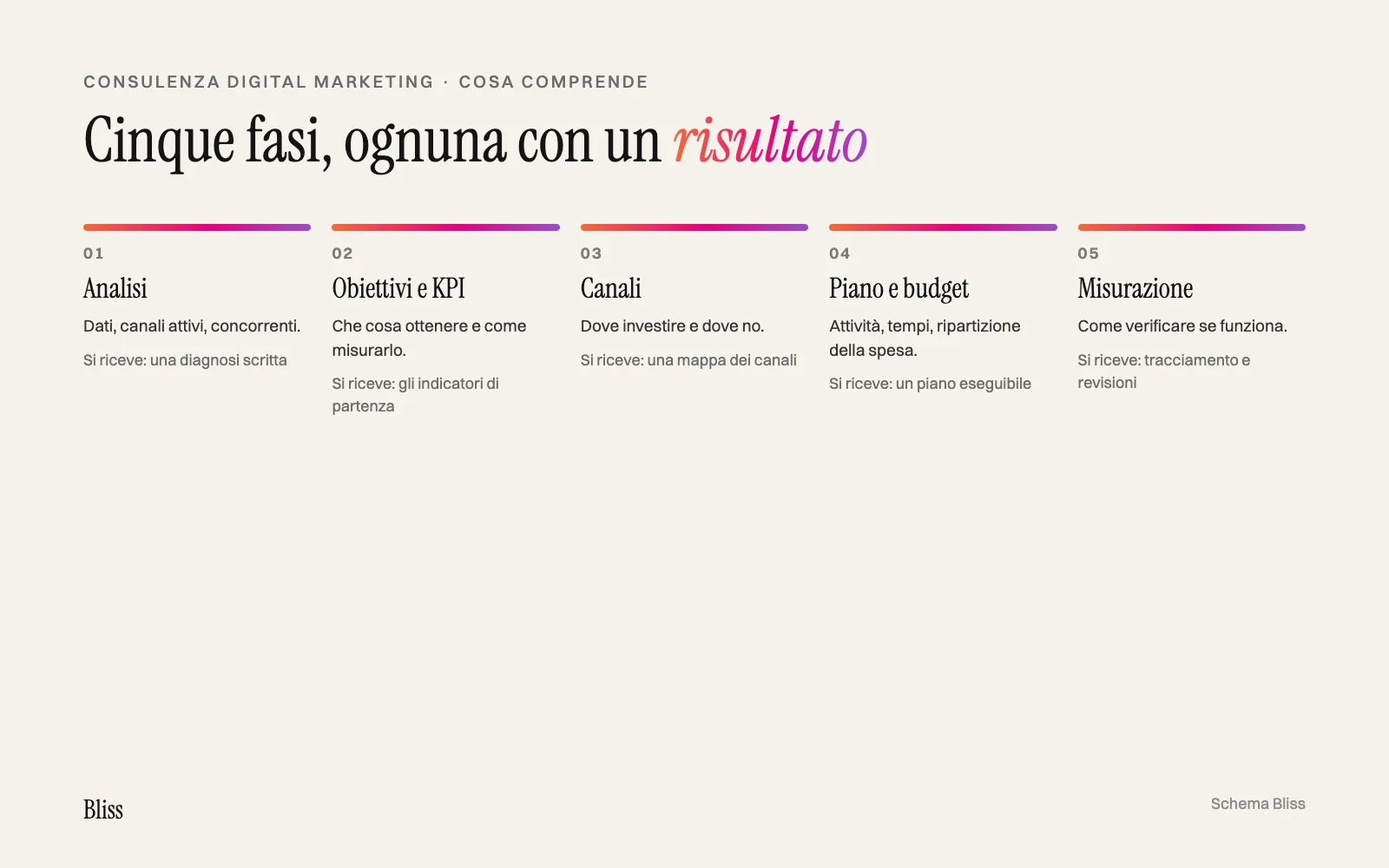
Order matters. Skipping the analysis to go straight to the plan means choosing channels on the basis of habit, not data. Skipping measurement means not knowing, six months later, whether the plan worked or whether the results would have come anyway.
In the initial analyses we carry out, the most frequent problem is dispersion: budgets spread across too many channels, each with few resources, and no measurable objective for any of them.
What is the difference between strategic advisory and operational consultancy in digital marketing?
Strategic advisory decides what to do; operational consultancy does it. The first sets objectives, channels, messages and budget; the second manages campaigns, content and day-to-day optimisation. Strategic advisory without execution remains a document; execution without strategy remains a set of disconnected activities.
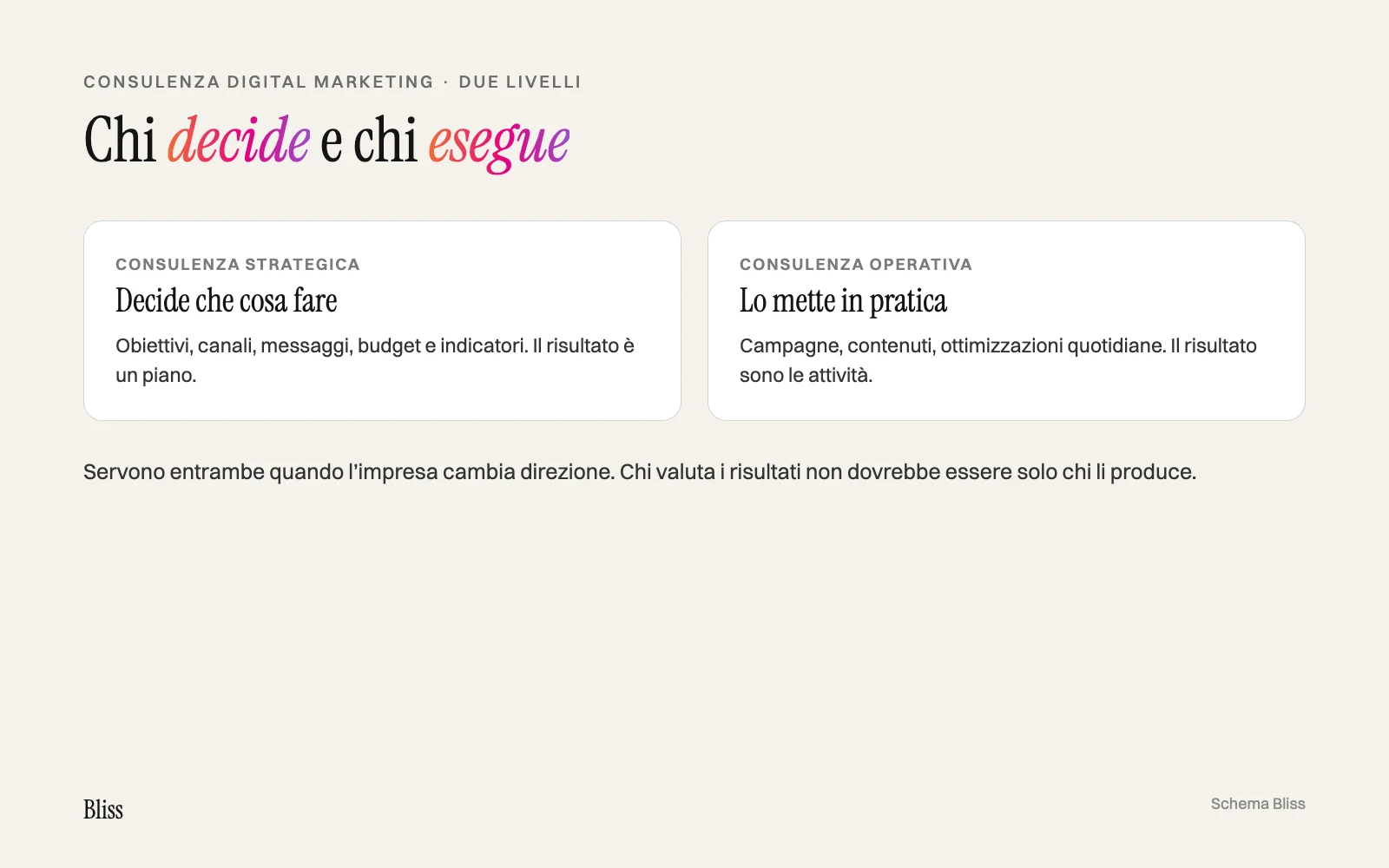
Both are needed when a company changes direction: a new market, a new product, an unexplained drop in results. When the direction is clear, a periodic strategic review alongside operational management may be enough. A good sign is the separation of roles: whoever assesses the results should not be only whoever produces them.
How much does a digital marketing consultancy cost?
The cost of a digital marketing consultancy depends on four factors: the scope, meaning how many channels and markets are analysed; the duration, from a project of a few weeks to support over several months; the depth of analysis, from a review of available data to market research; whether execution is included, since a consultancy that covers campaign management has a different cost structure.
There are three common fee models: per project, with a fixed price for defined phases and deliverables; per day, for targeted support; and a monthly retainer, when the consultancy supports execution over time. Fees calculated as a percentage of advertising spend should be assessed carefully, because they tie the consultant’s pay to the size of the budget rather than to results.
More useful than the price is its relation to the budget the consultancy will steer: a consultancy that avoids wasting part of the annual advertising spend pays for itself quickly. Always ask for a quote that lists the phases, the expected outcome of each and what is excluded.
How do you choose a digital marketing consultant?
A digital marketing consultant should be chosen on five verifiable criteria:
- Cases with data and sources: results with the period, the platform they come from and the context, not isolated percentages.
- Stated method: how they work, in which phases, and with what deliverables for each.
- Who works on the project: the people who will actually look after the company, not just those who meet it during the sales phase.
- How they measure results: which indicators they propose and how they link them to the company’s figures.
- Independence from platforms: a consultant who earns in proportion to advertising spend has an incentive to recommend more of it.
There are also some warning signs: promises of guaranteed results in a short time, no direct access to data and advertising accounts, which must remain the company’s property, and reports that show only platform metrics, such as impressions and clicks, without linking them to sales or leads.
In our work for Charles Philip Milano, a luxury footwear brand, digital results are reported with source and period: in 2024, clicks from Google Shopping rose from 80 to over 1,000, with all 677 products approved in Merchant Center, and the email click-through rate rose from 1.8% to 6.8% (Charles Philip Milano case).

When is the problem not digital?
The problem is not digital when the channels work technically but customers still do not choose the offer. There are four signs to recognise before changing supplier or platform:
- Traffic arrives but does not convert, even with well-structured campaigns: often the offer is unclear or uncompetitive.
- It only sells at a discount: the price is not backed by a promise the customer recognises.
- The messages are interchangeable with those of competitors: there is no positioning.
- Each channel tells the story of a different brand: there is no shared identity.
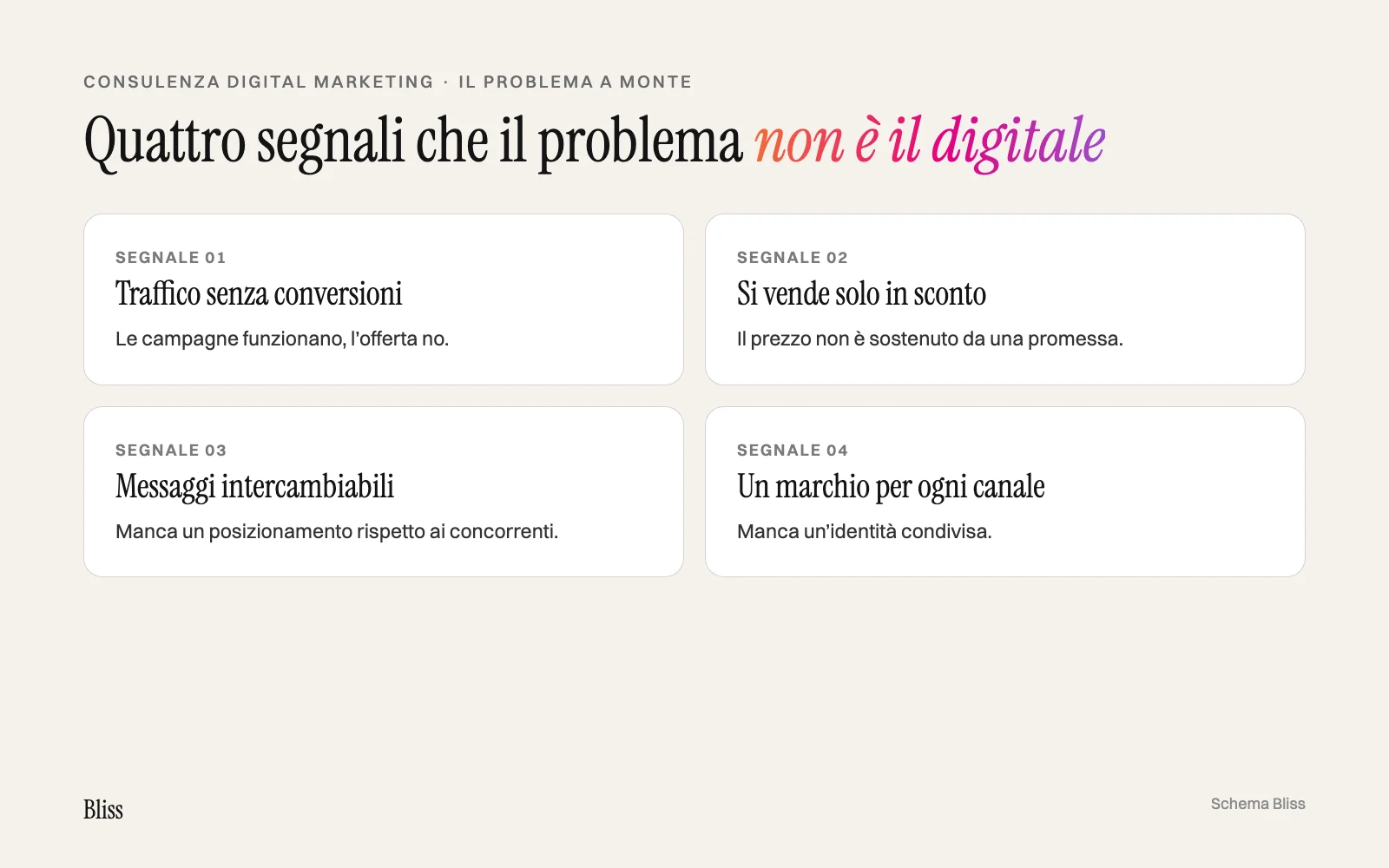
In these cases the solution lies in positioning and the value proposition before the channels. This was the case with Oro Elite, in the cash-for-gold market, where almost everyone communicates in the same way: the work started from what made the brand different, and only then moved on to content, website and campaigns.

For Doreca, digital worked because there was a clear promise to tell: between March and May 2023 the brand’s TikTok profile went from zero to 30,129 followers, and between February and November the Google Ads campaigns generated 51,599 clicks (Doreca case). When the promise is there, channels amplify it; when it is missing, they dissipate it. This is the work we do through our marketing advisory.

Our case study
Digital that sustains a heritage brand
For Profumum Roma we set up Google Ads, Meta Ads, SEO and tracking, starting from the maison’s positioning. Between January and May 2026 Google Ads recorded a ROAS of 18.05x; between April and December 2025 gross e-commerce revenue grew by 27.8% on the same period of 2024 (Google Ads and profumum.com e-commerce).
Read the case studyIn our initial analyses the question we ask is not which channel works best, but what the company is selling and to whom. When the answer is clear, channels are chosen and measured against precise criteria; when it is not, every optimisation simply shifts the problem from one channel to another.
Bliss’s point of view
“Before optimising a channel, we always ask what the company is selling and to whom. Often the answer explains the numbers better than any dashboard.” Francesco Acri, founder and CEO of Bliss
This is why every digital marketing consultancy we set up starts with the offer, pricing and positioning, and only then moves on to the channels.
Who works on your project
The people of Bliss across Rome and Milan





Frequently asked questions about digital marketing consultancy
Is digital marketing consultancy also useful for a small business?
Yes, provided it is proportionate. For a small business, an initial analysis and a plan covering a few channels, carried out in-house or by a supplier, may be enough. The greatest risk for small businesses is spreading a limited budget across too many channels.
How long does a digital marketing consultancy last?
An analysis and planning project usually takes a few weeks. Support that also covers execution and measurement lasts months, with periodic reviews of results.
Does the consultant also manage the campaigns?
It depends on the type of engagement. Strategic advisory defines what to do; campaign management is an operational service that can be entrusted to the same consultant, to an agency or to the in-house team. It is worth making this clear in the proposal.
What results should you expect after a consultancy engagement?
A clear plan, measurable indicators with baseline values and a reasoned budget allocation. Commercial results come with execution, and should be read over the period of the engagement together with the other factors that influence them.
Freelance consultant or consultancy firm: which is better?
A freelancer suits well-defined projects on one or two channels. A firm is better suited when different skills are needed, from brand strategy to data analysis, along with continuity over time. The deciding criterion remains who will actually work on the project.
What should you prepare before the first meeting with the consultant?
Sales data for the last twelve months, access to analytics tools and advertising platforms, budget spent per channel and a description of the best customers. The more data available, the more useful the initial analysis.
Sources
- Osservatorio Internet Media, Politecnico di Milano, 2025-2026 research on the Italian advertising market
- Bliss, case studies Profumum Roma, Charles Philip Milano, Doreca and Oro Elite
- Platform data as reported in the case studies: Google Ads, Meta Ads Manager, Google Merchant Center, newsletter platform
- Images: Bliss diagrams; photographs from the Charles Philip Milano, Oro Elite and Profumum Roma case studies; cover generated with Magnific
Bliss · Rome and Milan
We bring order to your digital activity
Budgets spread across too many channels, results that cannot be explained or a supplier to assess: we start from the data and from what you sell, and build a measurable plan.
Tell us your numbers
Two minutes on the contact form: channels, budget, objectives.
We get back to you
A consultant reads your request and arranges an initial call with you.
You receive a proposal
Scope, priorities and costs, starting from the diagnosis.