



An LLM, or large language model (in Italian, modello linguistico di grandi dimensioni), is an artificial intelligence model trained on vast amounts of text to predict the piece of text that follows a sequence.
To work, a language model estimates the probability that a token, or a sequence of tokens, will appear within a longer text (Google, Machine Learning Crash Course). It does not, therefore, consult an archive of facts; it simply (so to speak) produces the most plausible text. This guide explains what it is, how it works, how it is trained, where it goes wrong and what changes for those with a brand to defend.
LLM: meaning and what makes it “large”
The most important term in Large language models is undoubtedly language, as it fully describes how the model works on sequences of text. Large, by contrast, indicates that its capability depends on how much data it sees in training and how many parameters it contains. Parameters are the numerical values the model adjusts during training: GPT-3, described in 2020 by Tom Brown and colleagues, had 175 billion, ten times more than any previous non-sparse language model (Brown et al., Language Models are Few-Shot Learners).
The piece of text the model works on is called a token: it can be a word, part of a word or a single character, and most current models use parts of words (Google, Machine Learning Crash Course). In English, a token averages about four characters, or three quarters of a word.
It helps to keep apart four things that everyday language tends to conflate. The model is the engine, that is, the LLM. The application is what makes it usable by a person, such as an assistant you type a question into. This distinction also helps in understanding tools such as ChatGPT, Gemini and Claude: the application the user interacts with may use different models and change them over time.
The system is the combination of model, instructions, data and controls around which a service is built. The agent is software that interprets a request and acts to carry it out, often relying on an LLM, as we have already explained when discussing AI agents.
Model, application, system, agent
Four words that are often confused in everyday language.
| Term | What it is | Example role |
|---|---|---|
| Model (LLM) | The engine: it generates text by predicting the next token | The component that produces the answers |
| Application | What makes the model usable by a person | The assistant you type a question into |
| System | Model, instructions, data and controls combined into a service | A business service built on a model |
| Agent | Software that interprets a request and acts to carry it out, often using an LLM | Something that carries out a sequence of actions after an instruction |
Bliss summary. On agents: Bliss, What an AI agent is and why it is essential for SMEs.
How an LLM works
An LLM generates text through a repeating cycle. It takes the text it is given and splits it into tokens. For every possible token, it calculates how likely it is to come next. It picks one, adds it to the text and starts again, until the answer is complete.
- The input text, whether a question or an instruction, is broken down into tokens.
- The model assesses the context and assigns every possible token a probability of being the next one.
- A token is chosen on the basis of those probabilities.
- The chosen token is appended to the text and the cycle restarts from step 2, until the response is complete.
Point 2 is the one that changed the field. Until 2017, the most widely used translation and language models were based on recurrent or convolutional networks. That year, Ashish Vaswani and colleagues introduced the Transformer, an architecture that relies solely on the attention mechanism and dispenses with recurrence and convolutions (Vaswani et al., Attention Is All You Need). The practical advantage, which Google describes in its course, is that a model of this kind assesses the entire context at once, whereas recurrent networks process tokens one at a time and struggle with long sequences (Google, Machine Learning Crash Course). In the original paper, the Transformer achieved better results in English-to-German and English-to-French translation at a far lower training cost than earlier models.
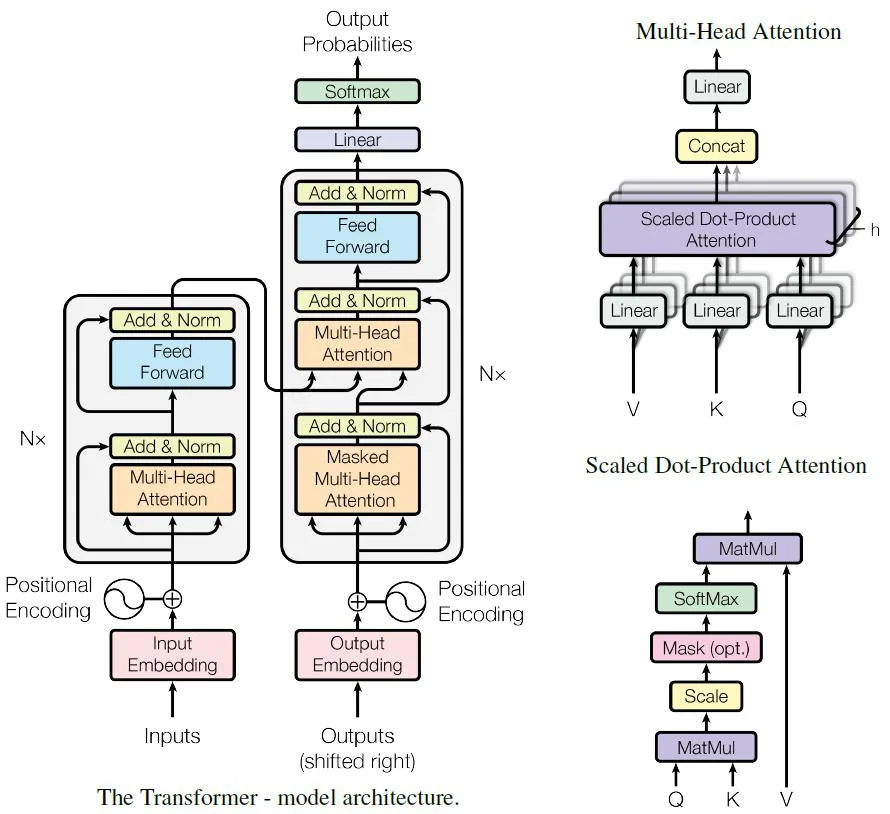
This is where the difference between understanding and calculating arises. The model has no archive of facts to draw on; it has numerical weights that encode regularities in the text it was trained on. That is why it writes fluently even when there is nothing true to say, and why its answer changes if the question is phrased differently.
How an LLM is trained
Training proceeds in stages, and each stage adds something different.
- Pre-training. The model learns to predict the next token across vast quantities of text, without anyone labelling the data: this is self-supervision at scale, the same expression the European AI regulation uses to describe general-purpose models (Regulation (EU) 2024/1689, Art. 3, point 63). From this phase the model derives language, style and an enormous share of knowledge about the world, along with its errors.
- Supervised fine-tuning. The model is further trained on demonstrations written by people, so that it learns to respond to an instruction rather than simply continue a text.
- Human feedback. People rank different responses from the model, and that judgement is used to steer it towards what users prefer, through a technique called reinforcement learning from human feedback (Ouyang et al., Training language models to follow instructions with human feedback).
Phases 2 and 3 explain a finding that surprises anyone who assumes bigger means better. In the study by Ouyang and colleagues (2022), users preferred the responses of a 1.3-billion-parameter model trained with human feedback to those of GPT-3, which has 175 billion: a hundred times more. Size matters, but it is not enough: how the model is steered matters too.
Bigger does not mean better
Size and user preferences in the InstructGPT study.
Parameters (billions)
Responses preferred by raters
The 1.3-billion-parameter model, trained with human feedback, was preferred to GPT-3, which has roughly a hundred times more parameters.
Source: Ouyang et al., Training language models to follow instructions with human feedback (2022). The bar for the smallest model is to scale.
The Bliss corner: why should an AI recommend your brand?
When a customer asks an AI assistant which company to choose, the question for those who govern the brand is this: does the answer convey the reason why that customer should prefer us? A company can be cited under the right name, in the right category, and still appear interchangeable with its competitors. This happens when the answer lists what it sells and leaves out what sets it apart.
Consider a machinery manufacturer that customers choose because it can step in quickly when a line stops. If the assistant describes it only as an “industrial machinery manufacturer”, the description is correct, but anyone looking for a supplier able to reduce downtime does not find the reason to choose it. Part of the brand’s value is lost at precisely the moment the customer compares the alternatives.
For those leading the business, the work begins by identifying the reasons for choice that truly matter and checking where they are documented. For the manufacturer, these might be published response times, the coverage of the service network or a customer case study describing how a stoppage was handled. Generative engine optimization helps verify whether this information surfaces in the answers. The test is to ask the model the same question a customer would and see whether, alongside the brand name, a concrete reason to choose it appears.
The limits of an LLM
The limitations stem from how it works, and it pays to understand them before entrusting the model with a task.
The best-known error is AI hallucination: fluent, plausible text that does not match the facts. It is a problem that has been recognised for years, with a dedicated body of literature on how to measure it and how to reduce it (Ji et al., Survey of Hallucination in Natural Language Generation). Even models aligned with human feedback continue to make simple mistakes, as the authors of the study that described them acknowledge (Ouyang et al.). The model does not distinguish between what it knows and what it invents, because to the model they are the same kind of operation.
The second limitation lies in the data. What the model produces reflects what it has seen: if a piece of information was missing, incorrect or skewed in the training text, the answer will be too. Brown and colleagues flag methodological issues for GPT-3 linked to training on large collections of web text (Brown et al.).
The third concerns oversight: as long as the model can make mistakes without realising it, a person is needed to check what it produces, as we explain in our piece on human oversight of AI.

What you can do with an LLM
An LLM is a general-purpose model: it is not built for a single task, and it can be integrated into many different applications. The European regulation says almost exactly this when it defines a general-purpose AI model as a model trained with large amounts of data that displays significant generality, is capable of competently performing a wide range of distinct tasks and can be integrated into a variety of downstream systems or applications (Regulation (EU) 2024/1689, Art. 3, point 63).
In practice, the same model can summarise a document, translate, classify messages, write a draft, answer questions about a text or steer an agent that carries out a sequence of actions. The outcome depends on three things decided outside the model: the instructions, the data it is given access to and the controls placed on its output. These are the three points where a business can intervene.
LLMs and the AI Act: what the European regulation says
The EU AI regulation does not use the term LLM as a category, but rather general-purpose AI model (Art. 3, point 63). Specific obligations follow for those who place such models on the market. A model of this kind is presumed to have high impact, with systemic risk, when the cumulative amount of compute used for training exceeds 10 to the power of 25 floating-point operations (Art. 51, paragraph 2); the Commission may amend the threshold through delegated acts (Art. 51, paragraph 3).
From technical language to the wording of the regulation
What corresponds to what in Regulation (EU) 2024/1689.
| In everyday language | In the regulation | What it requires |
|---|---|---|
| LLM | General-purpose AI model (Art. 3, point 63) | Model trained on large amounts of data, displaying significant generality, that can be integrated into downstream systems |
| Very powerful model | Model with high-impact capabilities (Art. 51) | Presumed when cumulative training compute exceeds 1025 floating-point operations |
| Threshold | Amendable by the Commission (Art. 51(3)) | Delegated acts, in light of technological developments |
Source: Regulation (EU) 2024/1689. The regulation does not use the abbreviation LLM as a category. Summary by Bliss.
Domande frequenti
What does LLM stand for?
LLM stands for large language model, in Italian modello linguistico di grandi dimensioni. It is an artificial intelligence model trained on large amounts of text to predict the next token in a sequence, and from this capability it derives the ability to write, summarise, translate and answer questions.
What is a language model?
A language model estimates the probability that a token, or a sequence of tokens, will appear within a longer text (Google, Machine Learning Crash Course). Every model of this kind, from the simplest to the largest, works on this principle. An LLM is a language model that is very large in terms of training data and parameters.
Is ChatGPT an LLM?
ChatGPT is an application that lets you converse with a language model: the model is the engine, the application is the interface through which it is used. In everyday language the two terms are used as synonyms, but it is worth distinguishing them when assessing risks, costs and responsibilities.
How does an LLM work?
It breaks the text down into tokens, calculates for each possible token the probability of being the next one, chooses one, adds it to the text and repeats the cycle until the response is complete. The calculation is based on the Transformer architecture, which assesses the entire context through the attention mechanism (Vaswani et al., 2017).
How is an LLM trained?
In several stages. First comes pre-training, in which the model learns to predict the next token across large amounts of text. Then comes fine-tuning on demonstrations written by people, together with human feedback, which steers responses towards what users prefer (Ouyang et al., 2022).
What are the parameters of an LLM?
These are the numerical values the model adjusts during training, encoding the patterns learnt from text. Their number is the most frequently cited measure of a model’s size: GPT-3 had 175 billion (Brown et al., 2020). More parameters do not, however, automatically mean better answers.
How can I build my own LLM?
Training a model from scratch requires vast amounts of data and computing power, and for the largest models the European regulation sets a compute threshold above which a systemic risk is presumed (Art. 51). In practice, one normally starts from an existing model and adapts it through tuning techniques (Google, Machine Learning Crash Course).
What is an LLM agent?
It is software that interprets a request, in text or by voice, and acts to carry it out, with an LLM as the component that understands the instruction and decides the next step. The difference from an assistant is that the agent takes actions, as well as producing answers, and therefore requires more controls.
What can you do with an LLM?
Summarising and translating documents, classifying messages, drafting text, answering questions about a text, steering an agent. It is a general-purpose model, so how it is used depends on the instructions, data and controls chosen by whoever integrates it. For every task, it pays to check the outcome before relying on the result.
What does LLM mean in law?
In law, LL.M. is the abbreviation of Legum Magister, a master’s degree in law, such as the one offered by the Faculty of Law at Heidelberg (Heidelberg University, Law – Legum Magister). It shares only the abbreviation with language models, and the context of the sentence is usually enough to tell the two meanings apart.
Fonti e riferimenti
- Ashish Vaswani et al., Attention Is All You Need, 2017
- Tom B. Brown et al., Language Models are Few-Shot Learners, 2020
- Long Ouyang et al., Training language models to follow instructions with human feedback, 2022
- Ziwei Ji et al., Survey of Hallucination in Natural Language Generation, ACM Computing Surveys, 2022
- Google, Machine Learning Crash Course, modulo Large language models
- Regolamento (UE) 2024/1689 (AI Act), art. 3, punto 63, e art. 51
- Università di Heidelberg, Law – Legum Magister
- Bliss, Cos’è un AI agent e perché è essenziale per le PMI
- Bliss, Allucinazioni AI: guida per proteggere il brand
- Bliss, GEO: cos’è la Generative Engine Optimization
- Bliss, L’AI è una scatola nera
- Bliss, AI Policy aziendale
- Bliss, Human oversight: il controllo umano dell’AI