



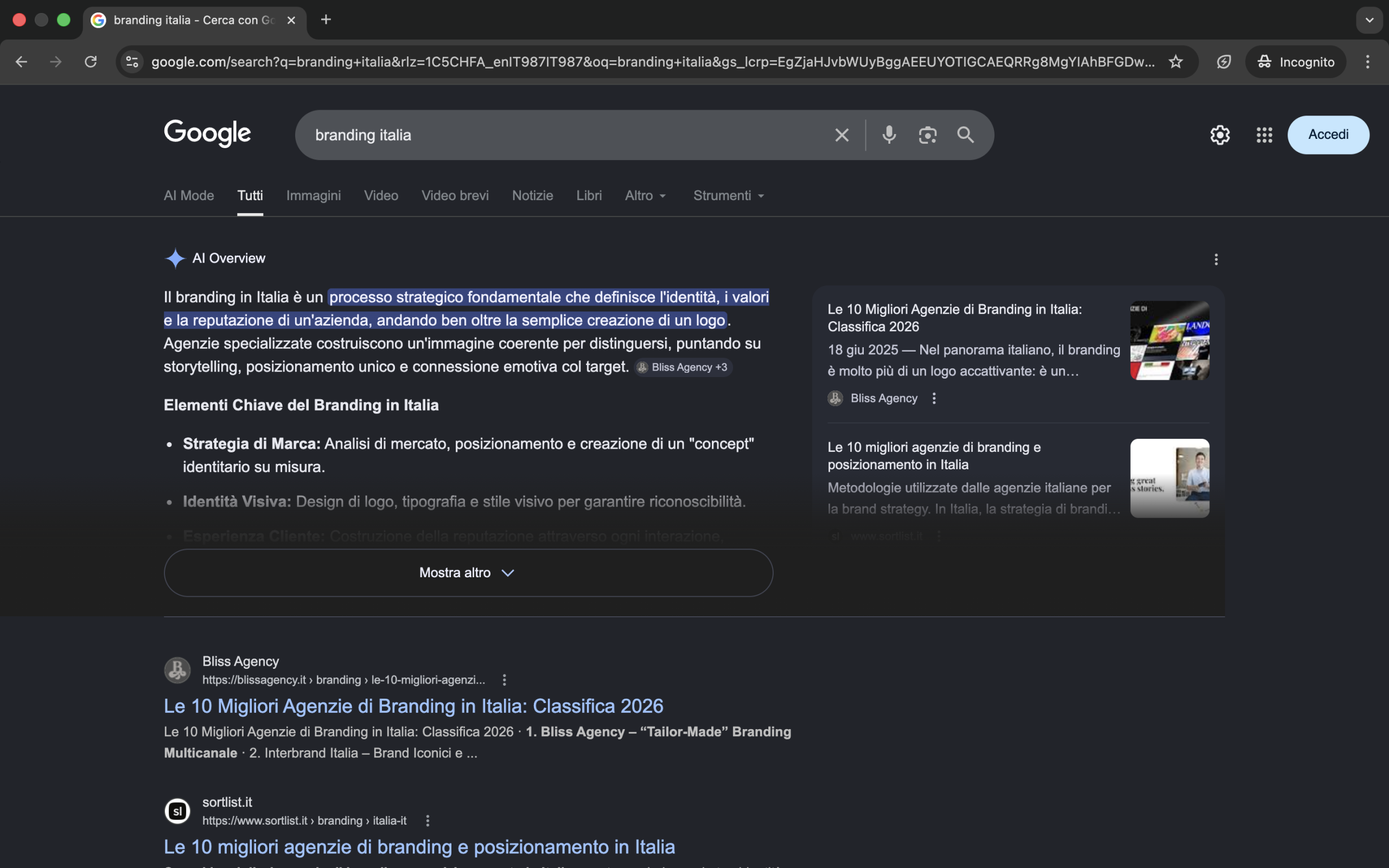
Imagine an adviser who, instead of giving you a list of sources to read, directly summarises the answer you are looking for, selectively citing the voices they consider most authoritative. Google’s AI Overviews work in exactly this way. Live in Italy since March 2025, by 2026 they are already the norm for millions of searches a day.
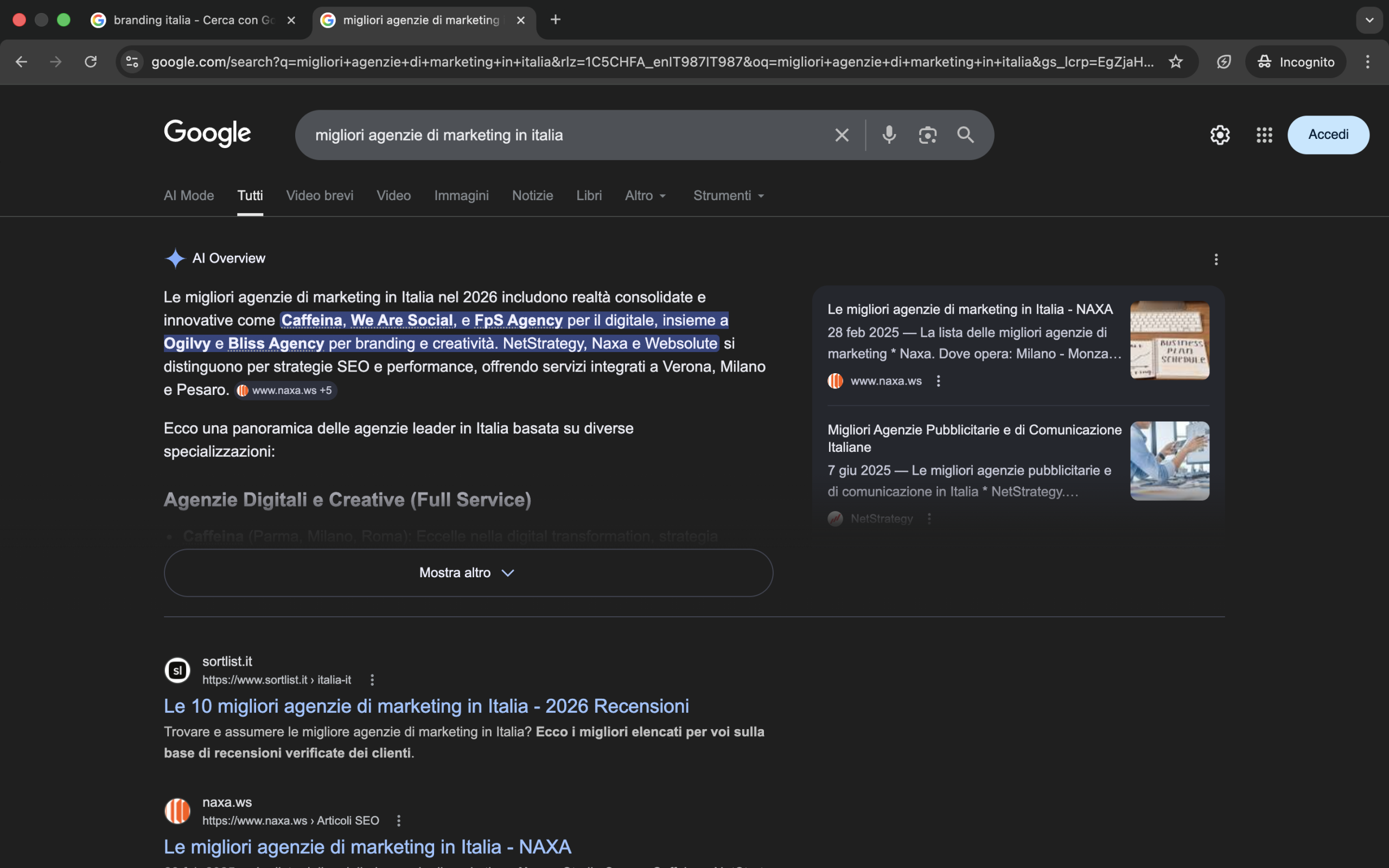
AI Overview, however, is only one of the two sides of the new Google Search. The other is AI Mode, the conversational experience that lets users develop a search through follow-up questions, reasoning and web sources. It has been available in Italy since 8 October 2025, and in May 2026 Google stated that it had already passed one billion monthly users, with query volume more than doubling every quarter since launch. Talking about generative visibility in 2026 therefore means considering AI Overview and AI Mode together, not just the summary that appears above the organic results.

They appear above the traditional organic results, answer the user’s query directly and, inevitably, erode traffic to sites that have not been selected as sources. This is not a side issue: it is the most significant transformation of online search in the past ten years.
+1,200% growth in traffic from generative AI sources Jul 2024 – Feb 2025 48% of Italian queries now include an AI Overview (May 2026) 8% of users click an organic link when an AI Overview is present (down from 15%) 60% of Google searches now end without any click to an external site
The impact on clicks is already measurable. In the update Ahrefs published in 2026, based on December 2025 data, the presence of an AI Overview correlates with a 58% lower average CTR for the page in the first organic position. The figure needs to be read correctly: it does not mean that every site loses 58% of its traffic, but that, in the sample analysed, the traditional advantage of the first position is heavily compressed when a generative answer appears above the results. The value of visibility therefore shifts partly from the click to presence within the answer itself.
This scenario does not spell the end of SEO. On the contrary, Google made clear in 2026 that optimising a site for AI Overview and AI Mode still means doing SEO: Search’s generative features rely on the same fundamentals of quality, relevance, technical accessibility and usefulness that govern Search.
What GEO (Generative Engine Optimization) is
Generative Engine Optimization (GEO) can be defined as the set of activities aimed at improving an organisation’s presence, accurate representation and citability in experiences based on artificial intelligence. The term becomes particularly useful when the scope includes not only Google but also systems such as ChatGPT Search, Perplexity and Microsoft Copilot.
The distinction therefore needs to be drawn precisely. For Google Search, GEO and AEO are not a technical alternative to SEO: Google states explicitly that optimising for generative search still means optimising for Search. In a wider ecosystem, however, GEO remains a useful term for all the activities that measure and develop the brand’s presence in answers generated by different platforms.
SEO therefore continues to build discoverability, relevance and authority. GEO broadens the view: it measures not only where a page appears in the results, but also whether a source is retrieved, cited or used to represent the brand in generative systems.
GEO vs SEO: the key differences
| Size | SEO in Google Search | GEO as a broader discipline |
|---|---|---|
| Objective | Being findable and competitive in Search, including AI Overviews and AI Mode | Being accurately represented and citable across the various generative engines and assistants |
| Measurement | Rankings, impressions, CTR, traffic and the Search Console Generative AI report | Citations, brand mentions, AI visibility share and referrals from the various systems |
| Content | Useful, original, relevant and technically accessible | The same principles, also observed outside Google and on the platforms used as sources |
| Structure | Understandable to people and engines alike, with no artificial AI-specific formats | Clarity and completeness, without universal recipes for chunks or lengths |
| Authority | Quality, first-hand experience, reputation and trustworthy signals | Entity consistency, verifiable sources and authentic presence on third-party sources too |
| Freshness | Important when the intent calls for up-to-date information | Particularly important in answers on dynamic or time-sensitive topics |
The most strategically relevant difference: with GEO, your brand enters the user’s mind even without a click. Brand awareness happens at the very moment the user consumes the AI answer. It is a fundamental shift in the perception funnel.
Why GEO is urgent in 2026
The data leave no room for optimistic readings for those who delay.
- Gartner forecasts that 79% of consumers will use AI-enhanced search by the end of 2026, and that 70% already trust generative results.
- ChatGPT handles more than 2.5 billion prompts a day and has 800 million weekly active users.
- Perplexity has reached 780 million monthly queries, with visitor conversion rates higher than ChatGPT’s, a sign of a decision-focused user base.
- 63% of websites already receive traffic from AI engines (Ahrefs, 2026).
- 58% of users have already replaced traditional search engines with AI tools for researching products and services (Capgemini, 2026).
- GEO-optimised content achieves up to 40% greater visibility in AI answers than non-optimised content, with equal traditional organic traffic (Princeton NLP Group).
The Italian figure must be read in light of the sample
AI Overviews arrived in Italy on 26 March 2025. One of the most comprehensive studies available on the Italian market is the one published by SEOZoom on 2 December 2025: analysing over 30 million Italian keywords, the platform found AI Overviews in 54.15% of the SERPs observed.
The figure should not, however, be turned into a universal percentage of Italian searches that show an AI Overview. Prevalence varies by sector, intent, device and, above all, the keyword sample observed. It is therefore more accurate always to state the methodology and date of measurement, treating 54.15% as a snapshot of the SEOZoom dataset rather than a constant valid for every search carried out in Italy.
The figure remains significant because it shows how quickly Google’s organic surface has changed. For a company, the question is no longer only the position a page holds, but also how that page can be retrieved and used within generative experiences.
How Google selects sources in generative answers
Google does not publicly document a pipeline based on “bi-encoders” and “cross-encoders” for selecting sources in AI Overviews. In 2026, however, it described the general workings of generative Search more precisely.
The first element is Retrieval-Augmented Generation, or RAG. Google uses its core Search ranking systems to retrieve relevant, up-to-date pages from its index, so that the generated answer can be grounded in information available on the web.
The second element is query fan-out. When a search triggers generative features, the model can turn the original question into several related queries and retrieve useful results for each of them. A complex question can therefore lead Google to consult parts of the web that do not exactly match the SERP for the initial query.
This also explains why organic ranking and citation no longer coincide perfectly. In March 2026 Ahrefs analysed 863,000 SERPs and around 4 million URLs appearing in AI Overviews. Only 37.1% of the cited URLs also appeared among the top ten organic links for the same query; taking all SERP blocks into account, the figure was 37.9%.
The figure does not mean that SEO has stopped mattering. Rather, it indicates that a source can surface through the secondary searches generated by query fan-out, not necessarily from the Top 10 for the original query. Findability, topical coverage and relevance therefore remain fundamental, but citability is not simply a copy of organic ranking.
Google’s official guidance of 15 May 2026: what actually changes
On 15 May 2026 Google published its first official guide to optimising for AI features in Search: “Optimizing your website for generative AI features on Google Search”. The central message is direct: “Optimizing for generative AI search is optimizing for the search experience, and thus still SEO.”
Google’s clarification applies first and foremost to its own engine. From the perspective of Google Search, AEO and GEO do not require a new optimisation system separate from SEO: the core best practices remain valid for AI Overviews and AI Mode too. Google’s stated priority is to produce useful, non-generic content that adds first-hand experience, original information, expertise and a point of view that does not simply recycle what already exists online.
Google also makes clear that no AI-specific technical shortcuts are needed:
- llms.txt: Google Search ignores it, and the file neither improves nor worsens visibility in Search.
- Special markup for AI: no specific structured data is required for AI Overviews or AI Mode.
- Artificial chunking: there is no need to split content into small blocks for Google to understand it.
- Ideal length: there is no universal measure designed for generative search.
- Artificial mentions: trying to build inauthentic brand mentions is not a recommended strategy.
Business Agent: a development distinct from the SEO guidance
Business Agent was announced by Google on 12 January 2026 as part of its new agentic commerce features. The system lets users converse directly with a brand in Search through an AI agent able to answer product questions while maintaining the company’s style and identity. The initial launch covered eligible retailers in the United States, with configuration via Merchant Center.
It is therefore an important evolution in the relationship between brands and Search, but it must be kept distinct from optimisation techniques for AI Overviews and AI Mode: Business Agent was conceived as a commercial, agentic experience, not as a GEO ranking factor.
The 7 operational GEO strategies for 2026
The strongest strategies do not start from a format written “for AI”. They start from the ability to create a source that systems can find, understand and consider useful. For Google, this foundation largely coincides with high-quality SEO; when the scope widens to ChatGPT, Perplexity and other generative systems, the brand’s presence in external sources also comes into play.
1. Create non-commodity content
Google explicitly identifies unique, useful content as one of the main levers for visibility in generative Search. A page that summarises information already available everywhere offers less value than a source that adds first-hand experience, proprietary data, real examples, original analysis or a recognisable perspective.
For a company, this means turning cases, projects, internal benchmarks and operational expertise into information that can be published and verified.
2. Write to be understood, not to create “chunks”
A clear structure remains important, but not because there is an ideal length for extractable units. Google states that there is no need to artificially break content into chunks and that its systems can identify the relevant parts of a page on their own.
Descriptive headings, readable paragraphs, precise definitions and H2/H3 hierarchies help people and engines alike. Rules such as “40-60 characters”, “maximum 200 characters” or other universal thresholds, by contrast, have no official backing.
3. Look after technical SEO and use structured data correctly
Generative features still depend on Google’s ability to find, index and understand the page. Crawlability, internal linking, canonicalisation, rendering, performance and sound information architecture therefore remain fundamental.
Structured data remains useful when it describes content accurately and supports standard Search features, but it is not a shortcut to AI Overview or AI Mode.
FAQPage, in particular, should no longer be presented as a lever for appearing in AI Mode: Google stopped showing FAQ rich results on 7 May 2026 and removed the related documentation in June. FAQs can still have strong editorial value because they answer the audience’s questions well, but the benefit does not come from any special GEO treatment of the markup.
4. Build genuine topical coverage
Query fan-out makes it even more important to cover a topic from complementary angles. A good editorial system links a central page to content that can explore problems, use cases, comparisons and specific questions in depth.
The aim is not to automatically produce a page for every query variant. Google explicitly warns against mass-producing content designed solely to capture secondary queries. The cluster must exist because each piece of content genuinely adds something.
5. Use verifiable data and sources
Statistics, primary sources, official documentation, documented examples and proprietary data strengthen a page’s editorial solidity. There is, however, no mandatory quota of “one source every 150-200 words”.
The priority lies elsewhere: every claim that requires proof should be traceable to an appropriate source. When a company has its own data, publishing the methodology, period and sample makes that information easier to understand and reuse.
6. Building an authentic presence beyond your website
Generative answers can draw on information from many surfaces across the web. This is why a company’s own website, editorial publications, professional profiles, videos, forums and other platforms can all contribute to the overall representation of a brand.
External presence must, however, be authentic. Google explicitly warns that chasing artificial mentions does not deliver the advantage often attributed to this tactic. It is better to invest in content, editorial relationships, real cases and contributions that generate spontaneous, verifiable citations.
7. Update when freshness genuinely matters
Updating remains important, especially for topics where data, regulations, products, technologies or scenarios change quickly. There is, however, no universal threshold beyond which a page is automatically outranked for being “old”.
An evergreen guide can remain valid for a long time; an article on software, pricing, regulation or technology may need frequent revision. Update frequency should follow the intent and the speed at which the information changes, not an artificial calendar.
For strategic content, it is therefore worth periodically checking data, sources, examples, links and time-dependent sections, clearly stating the date of the last review where that is useful information.
The 5 most common mistakes in GEO strategy, and how to avoid them
1. Treating GEO as a substitute for SEO on Google. AI Overviews and AI Mode still depend on the fundamentals of Search. A generative strategy that ignores indexing, architecture, relevance and quality starts from the wrong foundation.
2. Writing for a supposed extraction formula. There are no ideal lengths, mandatory capsules or chunks to be artificially built for Google. Structure should make content understandable, not fit it to an undocumented recipe.
3. Looking for technical shortcuts. llms.txt, “AI” markup and schema added without a real function do not increase visibility in Google’s generative features. Structured data should be used to describe accurately what exists on the page and to support SEO as a whole.
4. Confusing training crawlers with search crawlers. Not all AI bots perform the same function. Google-Extended is not a Search crawler either, and its directives do not determine presence in AI Overviews or AI Mode. Access policies must be defined platform by platform and according to how the content is used.
5. Measuring only clicks from AI. A growing share of generative visibility happens before the click. Impressions in Google’s AI experiences, pages shown, citations, brand presence and referrals must be observed together.
GEO & AIO
Want to govern your AI visibility?
We analyse your company’s current presence in generative engines and build a GEO strategy integrated with the SEO plan you already have.
The new metrics of GEO visibility
One of GEO’s current limitations compared with traditional SEO is measurability: there is not yet a direct equivalent of Google Search Console for AI Overviews. The metrics do exist: they must be sought in the right places and built through active monitoring.
| Metric | What it measures | How to track it |
|---|---|---|
| AI Citation Rate | Citation frequency in AI answers | Manual tests on ChatGPT, Perplexity and Gemini with target queries |
| AI Referral Traffic | Sessions from chatgpt.com, perplexity.ai, gemini.google.com | Google Analytics 4 › Acquisition › Source/Medium |
| AI Visibility Share | Share of visibility against competitors in AI answers | Semrush AI Toolkit, Ahrefs AI Overview Tracker |
| AI Brand Mentions | Brand mentions in generated answers | Manual monitoring and AI brand monitoring tools |
| Zero-Click Displacement | Drop in organic CTR on keywords with AI Overviews | Google Search Console › CTR comparison by query over time |
October 2026 update: multimodal search comes in too
Since 24 September 2026, Search Console has also measured multimodal web search, both in the standard Search reports and in the dedicated Generative AI report. The new filter covers searches made through Google Lens, Circle to Search, images uploaded directly to Search and Chrome’s feature for searching from an image.
The consequence matters above all for companies, e-commerce businesses and publishers with a strong visual component: visibility in generative Search is no longer only about text queries. Images and visual content become a measurable part of the path through which Google retrieves and presents information.
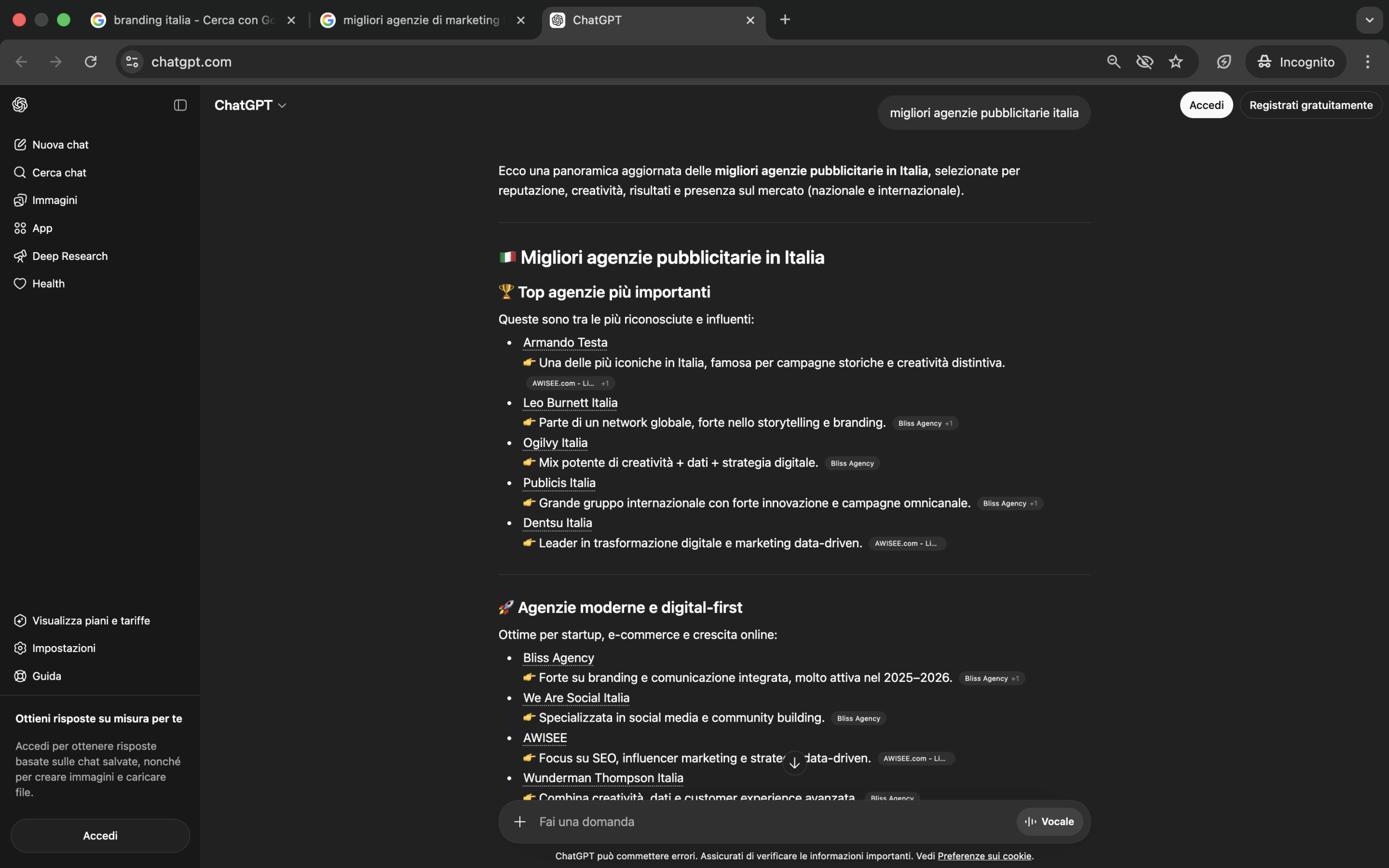
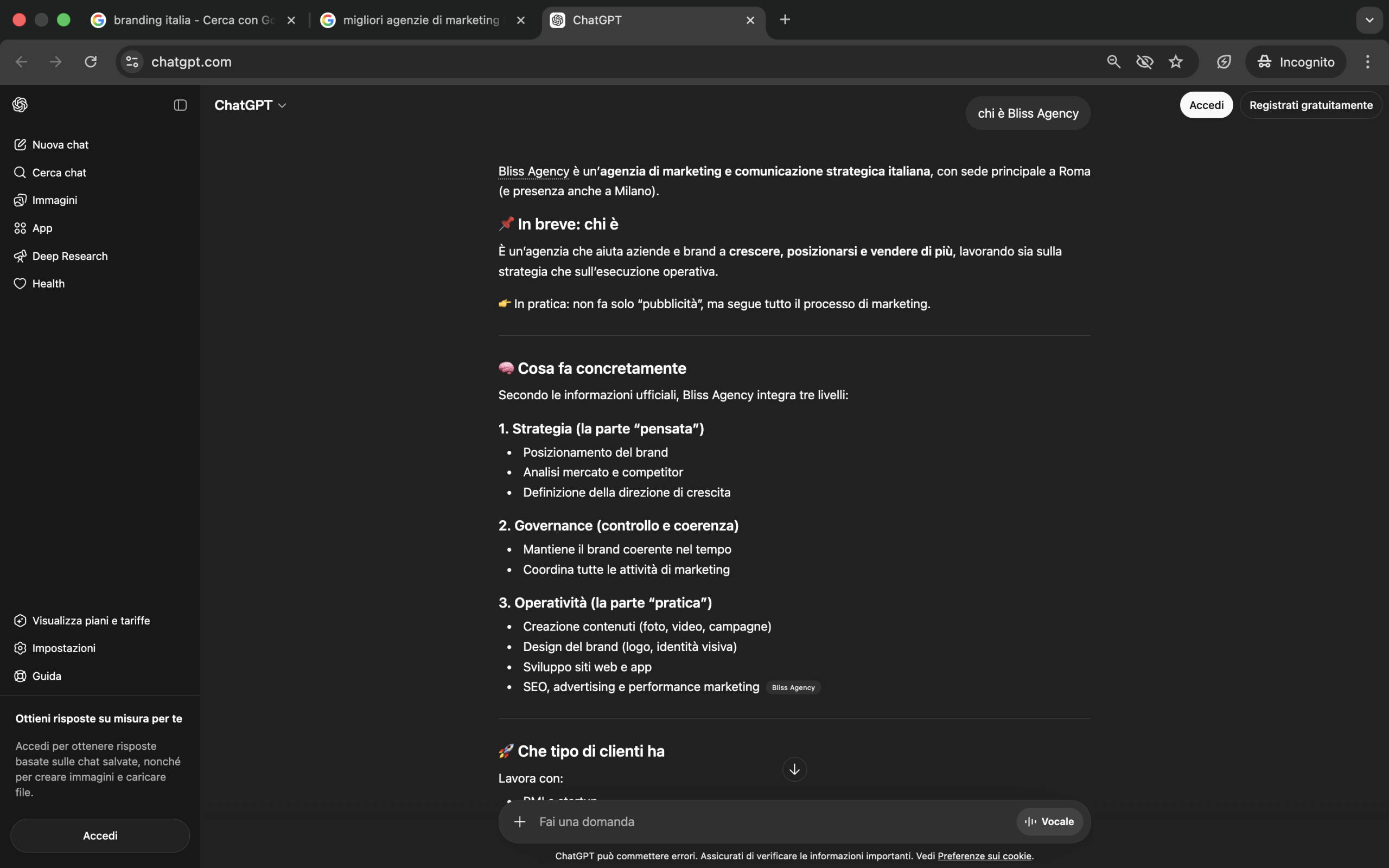
The minimum monthly protocol: manually test the 10-15 most relevant questions in your sector on ChatGPT, Perplexity and Google. Check whether your brand or your content is cited. It is a simple, systematic audit that is enormously revealing of the existing optimisation opportunities.
AI visibility tools can complement proprietary data to monitor brand presence, citations and changes relative to competitors across multiple platforms. In GA4 it is also worth creating segments dedicated to generative sources, so as to distinguish the traffic actually sent by ChatGPT, Perplexity, Gemini and Copilot. There is, however, no universal window within which a GEO strategy should produce citations or brand mentions: timing depends on the sector, how often the systems are updated, query coverage and the authority of the sources.
Google, ChatGPT and Perplexity: differentiated optimisation
Generative engines do not all work to the same logic. Just as a message must be adapted to its channel (an executive report for the board is one thing, a LinkedIn post is another), GEO requires platform-specific calibration.
| Platform | Operational base | What to watch |
|---|---|---|
| Google AI Overviews and AI Mode | SEO, original content, technical accessibility, relevance and query fan-out | Search Console Generative AI, impressions, pages shown |
| ChatGPT Search | Findability of sources and representation of the brand across the web used by the system | Citations, referrals and accuracy of the information returned |
| Perplexity | Findability and quality of the sources used in answers | Citations, referrals and presence on priority queries |
| Microsoft Copilot | Visibility in the search ecosystem used by the service | Citations, referrals and presence on strategic queries |
Perplexity deserves specific attention in a B2B context: despite lower traffic volumes than ChatGPT, visitors arriving from Perplexity convert at significantly higher rates. The typical Perplexity user is a professional in an active decision-making phase: a CMO, a founder, a head of procurement. For Italian B2B companies, it is probably the platform with the highest ROI on which to focus GEO efforts in the short term.
SEO + GEO: a single foundation, a wider scope
For Google Search, SEO and GEO are not two separate engines. The foundation is the same: making content useful, reliable, technically accessible and relevant to the people looking for it. AI Overviews and AI Mode use this infrastructure and do not require a second optimisation system built specifically for AI.
The scope changes when you look beyond Google. ChatGPT, Perplexity, Copilot and other generative systems add new surfaces on which a company can be cited, described or recommended. It is in this wider space that GEO takes on a specific function: monitoring and governing the brand’s presence across different engines, external sources and answers that can be consumed without generating a visit to the site.
The soundest strategy in 2026 therefore starts from SEO and extends it. Original content, information architecture, authority, verifiable data and accessibility remain the foundation; citation monitoring, multi-platform presence and control over how the brand is represented extend that foundation to the new ways in which people search for information.
A single point of contact, from strategy to execution
Start governing your AI visibility
A structured process to understand how your company is read, cited and recommended by generative engines, and to act where needed.
- Audit of presence in generative engines
- Editorial architecture
- Schema Markup
- Optimisation plan
Explore the GEO & AIO service →
Domande frequenti
Does GEO replace traditional SEO?
No. GEO and SEO are complementary approaches. SEO continues to generate direct organic traffic; GEO optimises presence in generative search engines. Organisations that integrate both achieve better results in terms of overall visibility and traffic protection.
How long does it take to see results from GEO?
It depends on the authority the domain has already built. For sites with strong SEO positioning, the first citations in AI Overviews typically arrive within 4-8 weeks of implementing the correct markup and structurally optimising the content. For new domains, timing aligns with the parallel building of organic authority.
Do I need to create different content for each AI platform?
Not necessarily. The core principles (clear structure, verifiable data, frequent updates, Schema Markup) work across platforms. Platform-specific adjustments (e.g. greater emphasis on freshness for Perplexity) are a second layer of optimisation, to be applied once the foundations are in place.
How do I check whether my site appears in AI Overviews?
The starting point is manual testing: search for the 10-15 most relevant questions in your sector on Google, ChatGPT and Perplexity and check whether your brand or content is cited. For systematic monitoring, Semrush and Ahrefs have introduced specific features to track visibility in AI Overviews.
What is the first concrete step to take?
Start with FAQ optimisation. Identify the 10 most frequently asked questions in your sector, write complete, structured answers, implement FAQPage markup according to Schema.org and update the content every 30 days. It is the starting point with the most favourable effort-to-impact ratio in the short term.
Fonti e riferimenti
- Google, Arriva AI Overview anche in Italia
- Pew Research Center, Google users are less likely to click on links when an AI summary appears in the results
- Ahrefs, Update: AI Overviews Reduce Clicks by 58%
- SparkToro / Similarweb, In 2026, Less than One Third of Google Searches Still Send a Click
- SEOZoom, AI Overview conquista le SERP e compare in 1 ricerca su 2
- OpenAI, OpenAI’s new economic analysis
- OpenAI, The state of enterprise AI
- Capgemini Research Institute, 71% of consumers want generative AI integrated into their shopping experiences
- Princeton University et al., GEO: Generative Engine Optimization
- Ahrefs, 38% of AI Overview Citations Pull From The Top 10
- Google Search Central, Ottimizza il tuo sito web per le funzionalità di AI generativa nella Ricerca Google
- Google Search Central, Latest Google Search Documentation Updates
- Google Search Central, Presentazione dei report sul rendimento dell’AI generativa della Ricerca in Search Console
- Google Search Central, Announcing web multimodal Search performance reporting in Search Console
- Google, AI Mode arriva anche in Italia!
- Google, Una nuova era per la Ricerca con l’AI
- Google, Nuove tecnologie e strumenti per i retailer per avere successo nell’era dello shopping agentico