



A prospective client asks an AI assistant which companies to consider for an engagement.
A candidate looks for information on the entrepreneur they might work with.
A potential partner wants to understand what capabilities a company has developed.
In each of these situations, an answer may come before the visit to the website, the reading of an interview and the first meeting.
For those leading a company, the question is which version of the CEO and the company arrives first. A CEO may be described through an activity they left years ago. A company may be associated with services that now carry marginal weight. Or the founder may be highly recognisable while the brand stays in the background.
The leader’s personal brand and the company brand also meet here: in the information a person receives before speaking directly to the company. Governing that relationship requires observing what is being said, which sources it relies on and how far it matches the company’s current direction. It is a dynamic that has a profound effect on brand reputation, since perception of the company is also shaped by information and interpretations the company does not directly control.
When the first impression comes from an AI answer
Searching an entrepreneur’s name on Google brings up websites, professional profiles, articles and interviews. A generative answer can gather part of that information and present it already organised into a description.
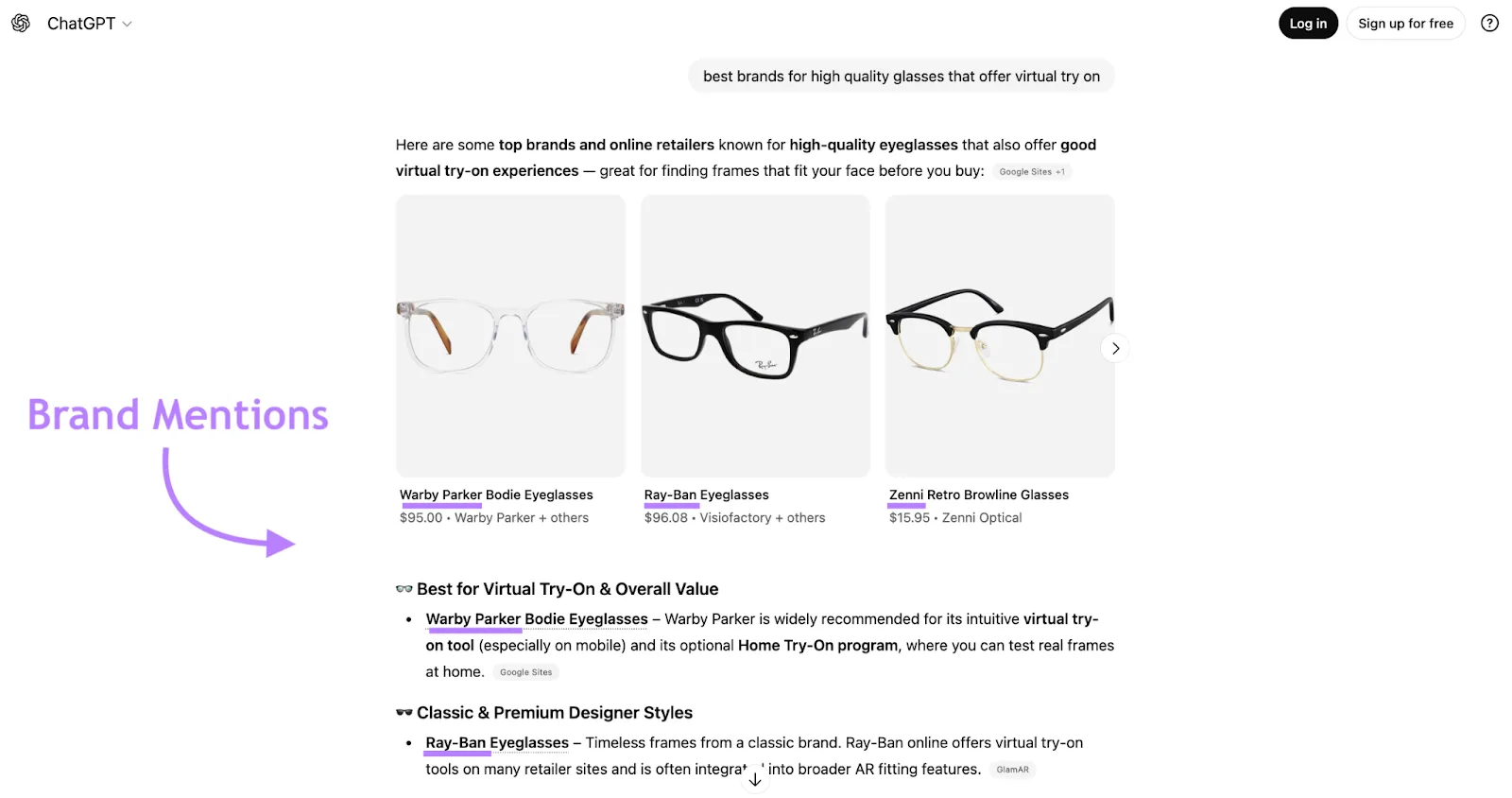
ChatGPT, for example, can search the web and support its answer with references to sources. This does not mean that every conversation triggers a new search, nor that the results are always complete or correct.
Every summary is also a selection. Some elements of the company’s history make it into the answer; others are left out. The sector of activity, a specialism, a past engagement or a particularly visible project can become the centre of the description.
Imagine a business that started as a production studio and grew into strategic advisory. The website has been updated, but interviews, industry profiles and biographies still mainly describe the early phase. An answer built on those sources could give a partial picture of the company.
The problem arises when that description meets a concrete choice. Someone looking for a strategic counterpart might not recognise in the business the capabilities they need, even though those capabilities exist.
The founder’s name and the value of the brand
In businesses built around a founder, personal reputation can open many doors. An interview, a publication or a public appearance makes experience and judgement visible. The founder’s reputation can become the gateway to the company.
This relationship does, however, deserve attention as the organisation grows. If every result is attributed to the founder, there is little room to understand the contribution of the management team, the processes developed and the expertise that remains within the company. When this dependence becomes structural, it falls within the scope of founder-independent branding: the work through which the brand’s identity, authority and capabilities are made progressively independent of the personal presence of its founder.
The question, for a CEO, is how much of their own authority can become trust in the organisation.
A case study can tell the story of the entrepreneur’s initial insight and explain how the team turned it into a result. A leadership page can clarify which responsibilities belong to which executives. An interview can give the founder a voice while keeping the company’s work visible.
These choices help the reader understand who did what and where the capability to repeat that result lies. This distinction becomes particularly important when the company is preparing to grow, change leadership or bring in new partners.
Who works on your reputation
The experts at work across Rome and Milan




Being recognised and making the shortlist
Asking ‘Who is this person?’ and asking ‘Which companies can deal with this problem?’ reveals two different aspects of public presence.
The first question is mainly about identification: role, career path, the company the person belongs to. The second is about the association between a need and the parties that could meet it.
A system may describe a CEO correctly without naming their company among the options for an engagement. It may also mention the brand, but associate it with a capability other than the one on which the business wants to be chosen. This is also a brand positioning issue: the position a company aims for only counts when it also becomes recognisable in the information through which the market interprets it.
This is why the check should consider presence, accuracy of positioning and the evidence cited in the answer together. Being mentioned says little on its own. What matters is understanding for which problem, alongside whom and on the basis of what evidence.
A single answer, however, cannot establish how authoritative or competitive a brand is. It offers one observation, to be compared with other answers and, above all, with what happens in real commercial conversations.
The risk of being described through the past
Every company leaves a public archive behind it. Old pages, executive biographies, press releases, event listings and profiles on professional platforms each tell a different moment in its history.
That archive can become hard to interpret when change is rapid. A new offering is presented on the website, while the previous one remains elsewhere. An executive changes role but keeps appearing with their old title. A company joins a group without the relationship between the different entities being clearly explained.
The past retains its value, provided it reads as the past. An interview from 2021 need not be rewritten to fit the present; a company biography that is still live, however, should describe the person’s current role.
Consistency therefore requires an intelligible chronology. Anyone consulting the sources must be able to distinguish the company’s origins from its current configuration and recognise the path that connects the two phases.
The evidence that makes positioning credible
Calling yourself an expert in a sector is easy. Making that expertise verifiable takes more work.
A useful case study clarifies the problem addressed, the decisions taken and the results observed. A publication shows how those leading the company think. A specialist contribution makes a specific capability visible. External sources can add corroborating evidence, provided they are relevant and reliable. The clarity with which people, companies, roles and capabilities are connected also helps make the entity recognisable: this is the principle behind the Knowledge Graph.
Positioning becomes credible when it leaves evidence. If the brand wants to be recognised for a particular capability, that capability should emerge from projects and content that make it understandable.
The CEO’s contribution can also become sharper when it addresses issues on which they have direct experience. Explaining a decision, the constraints encountered and the consequences observed allows the reader to assess a point of view. A string of generic statements leaves far less to verify.
The editorial goal is to build a body of evidence that makes clear which problems that company deserves attention for. Whether it is picked up in AI answers remains an outcome to be observed, with no automatic promises.
How to check the way your CEO and company are represented
A useful check can start from the questions that come before a sales meeting. First the name of the business and of the CEO, then the capabilities and problems for which the company wants to be considered. This observation can form part of a Brand Audit, alongside a review of positioning, consistency, reputation and visibility relative to competitors.
The prompts might be phrased like this:
- «Di cosa si occupa [azienda] e in quali ambiti è specializzata?»
- «Who is [nome del CEO] and what is their role at [azienda]?»
- «Quali società italiane hanno esperienza in [problema specifico]?»
- «Which projects document the experience of [azienda] in this sector?»
It is worth recording the question, date, platform, answer and sources cited, and repeating the observation over time. The test conditions should be noted: opening a new conversation does not, on its own, guarantee the absence of personalisation. OpenAI notes, for example, that memory can influence how web searches are reformulated (help.openai.com)
Reading the results should lead to specific actions. If the CEO’s role is wrong, the biographies need checking. If the offering appears outdated, the pages that still describe it must be identified. If a capability does not come through, it is necessary to assess how well it is actually documented.
Absence from an answer, on the other hand, does not by itself prove a reputation problem: it calls for further checks.
The verification kit
Four questions to ask an AI assistant
The same ones a client, a candidate or a partner would ask before meeting you.
Identifying the business
What does company do and what are its areas of specialisation?
→The role of leadership
Who is CEO’s name and what is their role at company?
→Consideration: do you make it among the alternatives?
Which Italian companies have experience in specific problem?
→Evidence cited
Which projects document company’s experience in this sector?
→What to record at each test
- Question
- Date
- Platform
- Answer
- Sources cited
The test should be repeated over time and the conditions recorded: opening a new conversation does not guarantee the absence of personalisation, and OpenAI notes that memory can affect how web searches are reformulated. Absence from an answer does not, on its own, prove a reputation problem.
Brand work continues in AI answers too
Generative visibility adds a vantage point on the company’s digital presence. Work on Artificial Intelligence Optimization concerns precisely the ability to make content, data and entities easier for generative systems to understand and use in their answers. Accessible content, up-to-date information and sources able to substantiate what is claimed remain essential. For AI features in Google Search, Google confirms that fundamental SEO practices still apply and that no special optimisation is required to appear (developers.google.com).
For the CEO, the responsibility is to give this work direction: clarifying which competences must be recognised, which results demonstrate them and how their own public presence contributes to the company’s reputation.
An answer that misrepresents the business may point to outdated information or positioning that is still hard to read. Correcting those weaknesses also pays off in sales presentations, interviews and meetings with partners.
Before direct contact, part of the work should already be done: making the value of the business, the expertise it holds and the reasons to consider it understandable. That value must remain recognisable even when the one telling the brand’s story is not its founder. Or even the brand itself.
Domande frequenti
Why should a CEO check what AI says about their company?
To identify incorrect descriptions, outdated information or expertise that is barely visible. Checking helps clarify which picture someone might encounter before visiting the website or contacting the company.
Is the founder’s personal brand the same as the company brand?
They are closely linked, but they concern different subjects. The founder’s reputation can build trust in the company; the corporate brand must also make the organisation’s expertise, people and capabilities recognisable.
Does appearing among the companies recommended by AI demonstrate authority?
A citation is a signal to be analysed alongside its context and sources. A single answer does not constitute an independent assessment of the company’s quality and does not guarantee that the result will be repeated.
Where should you start?
From the essential information: what the business does today, who leads it, what capabilities it offers and which projects document them. Comparing this with AI answers then makes it possible to identify discrepancies and prioritise actions.
Fonti e riferimenti
- OpenAI, Cercare sul web con ChatGPT
- OpenAI, Memoria in ChatGPT
- Google Search Central, Guida di Google all’ottimizzazione per le funzionalità di AI generativa nella Ricerca Google
- RepTrak, 2026 Global RepTrak 100
- RepTrak, AI as a Stakeholder
- RepTrak, AI Research is Shaping IGP Decisions
- Telescop Research, AI Search Visibility in Italia