


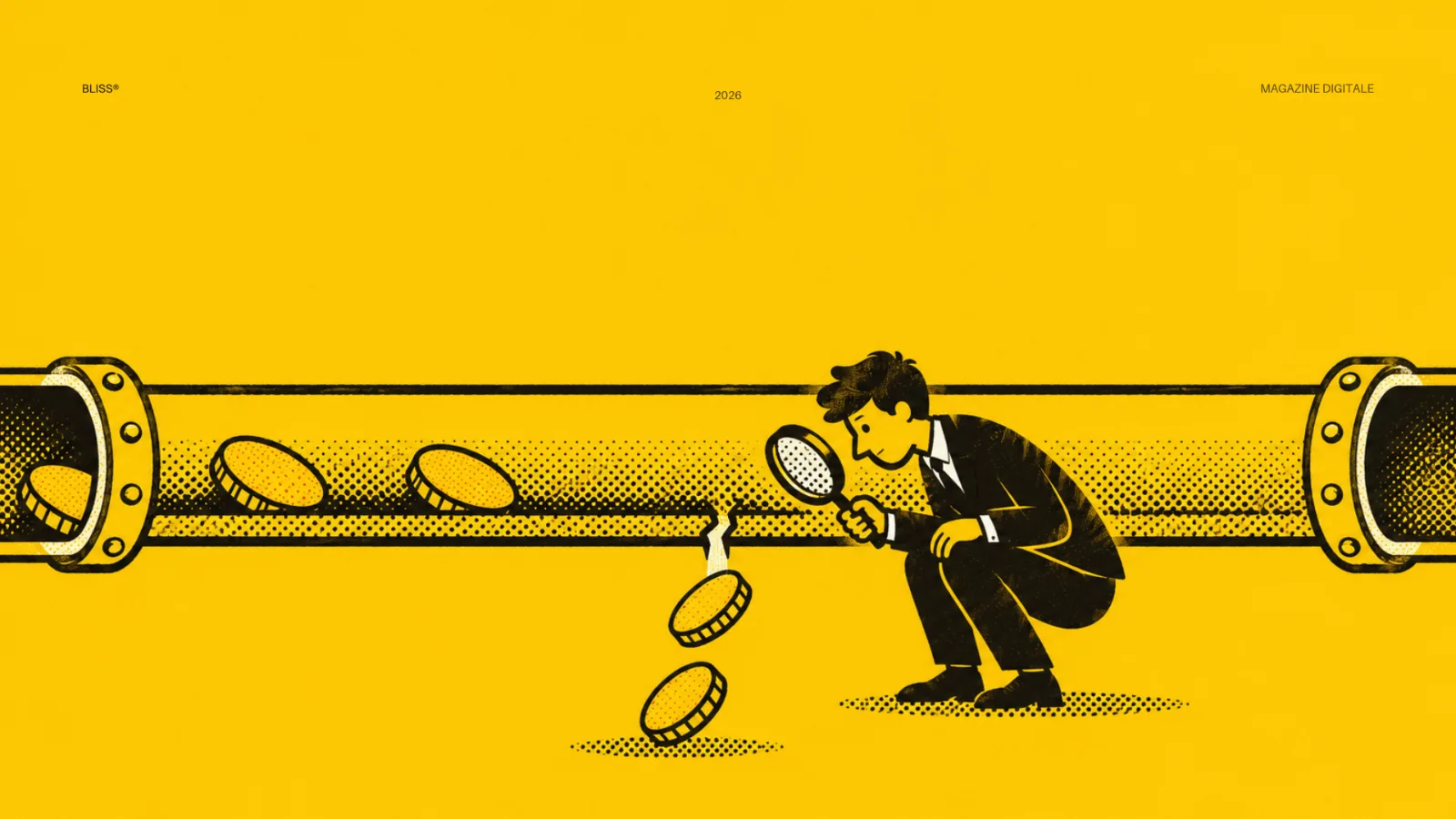
When marketing isn’t working, the problem rarely lies in execution: more often it lies upstream, in an objective that was never written down, an offer that does not stand out or a measurement timeframe that is too short. That is why the first step is not to change agency but to understand why: what is needed is a brand audit, a review of the brand, messages, channels and data before deciding where to invest. Bliss carries it out through the Brand Audit: over a period of three to eight weeks, depending on the complexity of the company, we analyse the brand’s five touchpoints with the market and deliver a diagnostic report setting out priorities.
After all, it is the phrase we hear most often in first meetings, and the answer changes how the next budget is spent.
In this article we have therefore set out, in order, the questions to ask before deciding, so as to understand why marketing is not delivering results, when the problem lies with the supplier or with something that comes before it, what to check, how much time is really needed and how it is measured.

Why is marketing not delivering results?
Marketing fails to deliver results for five recurring reasons, and only one of them concerns the supplier’s work directly.
- The objective was not written down before starting, so today nobody knows what to compare the figures against.
- The offer does not stand out: communication amplifies a message the customer has already heard from others.
- The measurement period is too short for the type of activity chosen.
- The wrong indicator was measured, for example clicks instead of contracts.
- The execution was weak: copy, campaigns or website not up to standard.
The first four causes are not solved by changing supplier. This is why the first step is not a new quote, but an honest reading of what was asked for, what was done and how it was measured.
Is the problem the agency, or does it lie upstream?
The doubt is legitimate. We can establish, with a reasonable degree of certainty, that the problem lies upstream when different pieces of work, produced by different people, have yielded the same disappointing result. If the company has already changed two or three suppliers and the picture has not changed, the fourth is unlikely to make a difference.
Clearly, the opposite case can also arise. If a supplier has not delivered what was set out in the agreement, within the agreed timescales and to the agreed quality, the problem is execution. But to know this, you need a written agreement against which to compare the work.
What is a brand audit and what does it check?
A brand audit is a review of the brand and its touchpoints with the market, to understand where results are being lost before deciding on budgets and suppliers. It checks whether the objective was measurable, whether the offer stands out from competitors’, whether messages and channels say the same thing and whether the data collected make it possible to judge the work done. It answers the question this section asks: it tells you whether the problem lies in execution or further upstream.
What should you check before changing agency?
Before changing agency, it is worth checking four things, in this order.
| What | Question | Where to find the answer |
|---|---|---|
| Objective | What measurable result had been set, and by when? | Initial brief, minutes, agreement |
| Scope | What was included in the work, and what remained the company’s responsibility? | Quote and contract |
| Team | Who actually worked on the brand, and how available were they? | Reports, meetings, points of contact |
| Measure | What data was the judgement based on, and from what source? | Reports, analytics, CRM |
The second check is the one that holds the most surprises. Two quotes at the same price can cover very different work, and before signing, whoever holds the budget should know what they are buying, what remains the company’s responsibility and which costs may be added. We cover this in the article on what you hand over to an agency with a quote.
The third check concerns people. The team that presents the proposal is not always the one that works on it after signing, and the day-to-day contact may not have the authority to change strategy or priorities. The questions to ask are collected in the article on who really works on your brand.
How long does it take to see results from marketing?
It depends on the type of activity: promotions and sales-driven campaigns produce effects within the first few weeks, while brand work needs at least six months to show its strongest effects. It is one of the most robust findings in research on advertising effectiveness.
Les Binet and Peter Field analysed 996 campaigns from 700 brands across 83 categories, drawn from the archive of the Institute of Practitioners in Advertising (IPA, The Long and the Short of It). Their conclusion is that activation produces rapid but limited effects, while brand building produces broader, slower effects that become dominant after roughly six months. This is why a campaign assessed over less than six months is judged almost solely on its short-term effects (Binet and Field, Market Leader, 2013).
Two different horizons
Activation activity and brand work are not measured over the same period.
Schematic representation of the mechanism described by Les Binet and Peter Field across 996 campaigns in the IPA archive. The chart illustrates the typical pattern of the two effects, not data from a real campaign.
In practical terms, then, if you have invested in the brand and judge it after three months using the metrics of a promotion, it will always look like a failure. If you have invested only in promotions, results will come quickly and run out when the spending stops.
Those who look at the numbers before redoing the campaigns
The experts at work across Rome and Milan





Should you pay your agency on results?
Payment by results only makes sense when the result genuinely depends on the supplier and can be measured unambiguously. In most marketing projects, sales also depend on price, offer, sales network and seasonality, which the supplier does not control.
The risk of a fee tied solely to short-term sales is that it pushes the supplier towards activities that produce quick numbers, namely promotions and discounts, at the expense of the brand. We know well the conditions to agree before signing an arrangement of this kind, and we have discussed them in paying your agency on results.

I spent money on marketing and it didn’t work: what now?
The first step is a diagnosis. If a strategic audit were to reveal that the problem lies in execution, changing supplier under a better-written agreement would be the next step. If, however, the problem lies upstream, work on the brand would be needed before spending on communication again.
The brand audit is the tool for understanding whether the brand holds a clear, recognisable position relative to its competitors – in other words, whether there is something worth amplifying.
When the answer is no, the work becomes a strategic decision to be taken with those who lead the company, and that is the territory of our Brand Advisory.
Who can carry out a brand audit?
A brand audit should be entrusted to a brand advisor independent of whoever ran the campaigns, because those who did the work cannot assess it on their own. Bliss carries it out through the Brand Audit: we start from the company’s data and materials, benchmark the brand against its competitors and close with a diagnostic report and a prioritised action plan.
Frequently asked questions about marketing that isn’t working
Who should you turn to if marketing isn’t delivering results?
To someone who can review the brand and the strategy before the campaigns, not simply to another executional agency. Bliss does this with the Brand Audit, which shows where results are being lost and where to start again.
How long does a brand audit take?
A brand audit takes three to eight weeks, depending on the complexity of the company and the number of channels to be analysed. The process covers data collection, analysis of touchpoints, benchmarking against competitors and a final report setting out priorities.
Does changing agency solve the problem?
Only if the problem lay in execution. If the cause lies upstream, in an objective that was never written down or in an offer that does not stand out, a new supplier will reach the same result with a different quote.
How can you tell whether the agency is to blame?
By comparing what was asked for with what was delivered: the written objective, the scope of work, the people involved and the measurement timeframe. If the work matches the brief and the results are still missing, the problem lies upstream.
Domande frequenti
How can I tell whether the agency is to blame?
By comparing the work delivered with what was written in the agreement: scope, timescales, quality and objectives. If the agency did not deliver what was agreed, the problem is execution. If it delivered everything and the results did not come, the cause probably lies upstream, in the objective, the offer or the way of measuring.
How long before a campaign can be judged?
It depends on the objective. Sales-driven campaigns are judged in weeks. Brand work shows its strongest effects after around six months, according to Binet and Field’s analysis of almost a thousand campaigns. Judging it earlier, with short-term metrics, always makes it look ineffective.
Is it worth changing agency after a campaign has gone badly?
Only if the diagnosis shows that the problem was execution. If the company has already changed several suppliers with the same result, the cause probably lies upstream: an offer that does not stand out, an objective never written down or the wrong measure. In that case a new supplier will repeat the same outcome.
What must a brief contain for marketing to work?
A measurable objective with a deadline, the customer being addressed, the reason they should choose the company, the budget, the internal resources available and the indicators by which the work will be judged. Without these elements, at the end of the project there is nothing to compare the results against.
Does digital marketing work for every company?
It works when there is something clear to communicate to an audience that searches, or can be reached, online. If the offer does not stand out or the customer does not know why to choose the company, digital only makes the problem more visible. The choice of positioning comes before the choice of channels.