


Between March and November 2026 we said no to 56 requests out of 300, almost one in five, worth over €2 million in potential engagements. These are not lost requests: they are engagements we chose not to take on. In this article we set out the figures for the past year: who contacted us, what problem they were starting from, what the demand was worth and why we declined. Company names never appear next to a refusal: we publish only aggregate data.
In brief
The boundaries of our no in 3 key points
- 1
In the twelve months from November 2025 to November 2026, 388 qualified companies contacted us, representing potential demand of over €15 million.
- 2
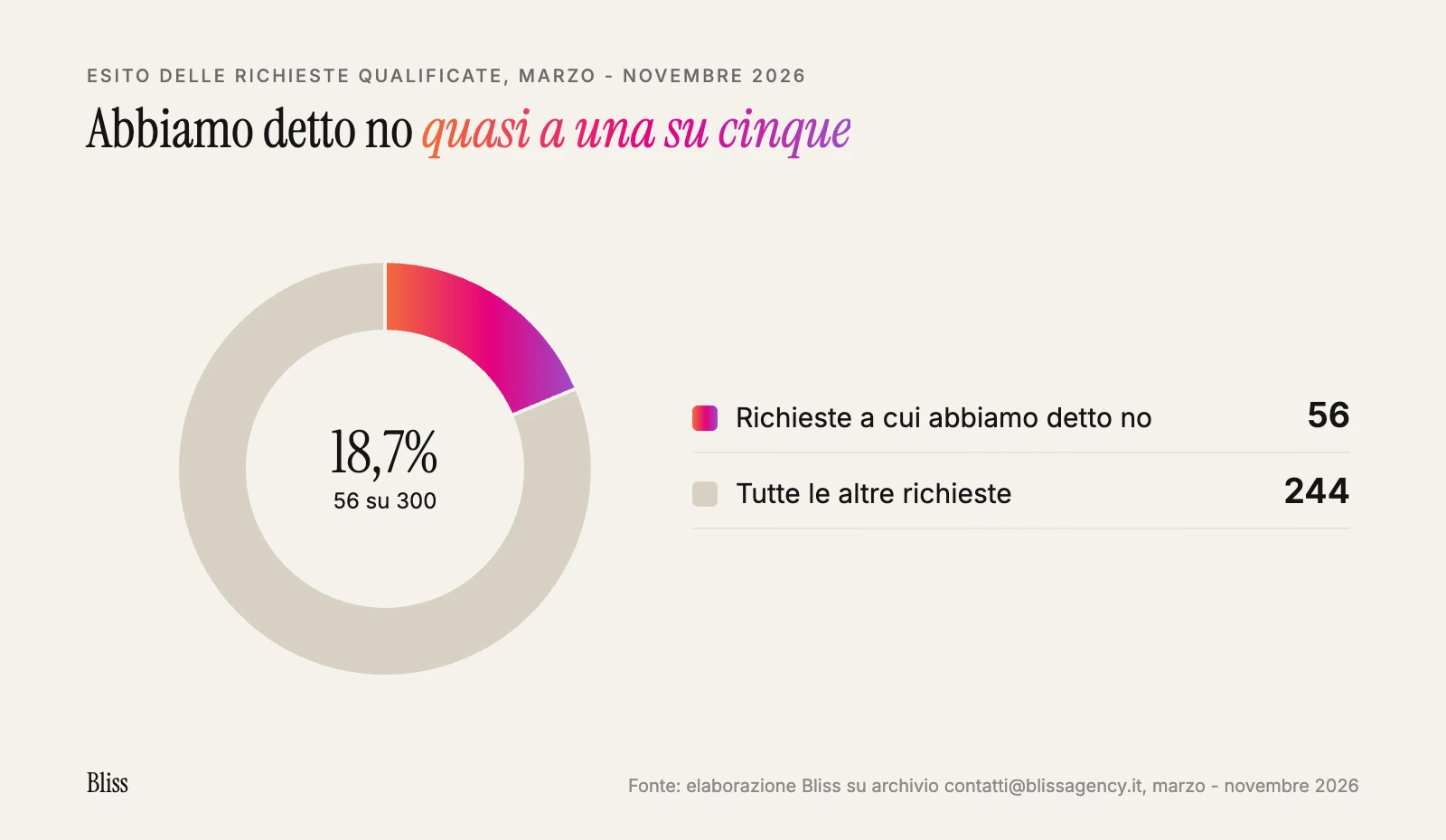
Between March and November 2026 we said no to 56 requests out of 300, around 19%, representing over 2 million euros in potential engagements.
- 3
The most frequent reasons are a budget below the threshold, the collaboration model, full capacity and the tenders we do not take part in.
What is the perimeter of no?
The perimeter of no is the set of requests a company chooses not to accept, and it says more about the company than any positioning statement. A brand becomes recognisable when its choices remain consistent over time, and consistency shows above all in what it turns down: a product it does not make, a channel it does not cover, a client it does not take on.
The same principle applies to an agency. Every engagement accepted outside its own method diverts resources, lowers the quality of work for other clients and makes it less clear to the market what the agency really does. That is why, since March 2026, we have also been logging the noes in the contatti@blissagency.it inbox, together with their reasons. We discuss the same principle applied to clients’ brands in brand strategy.
How we can help you
From advisory on fundamental choices to execution with Bliss Studio
Who contacted us in the past year?
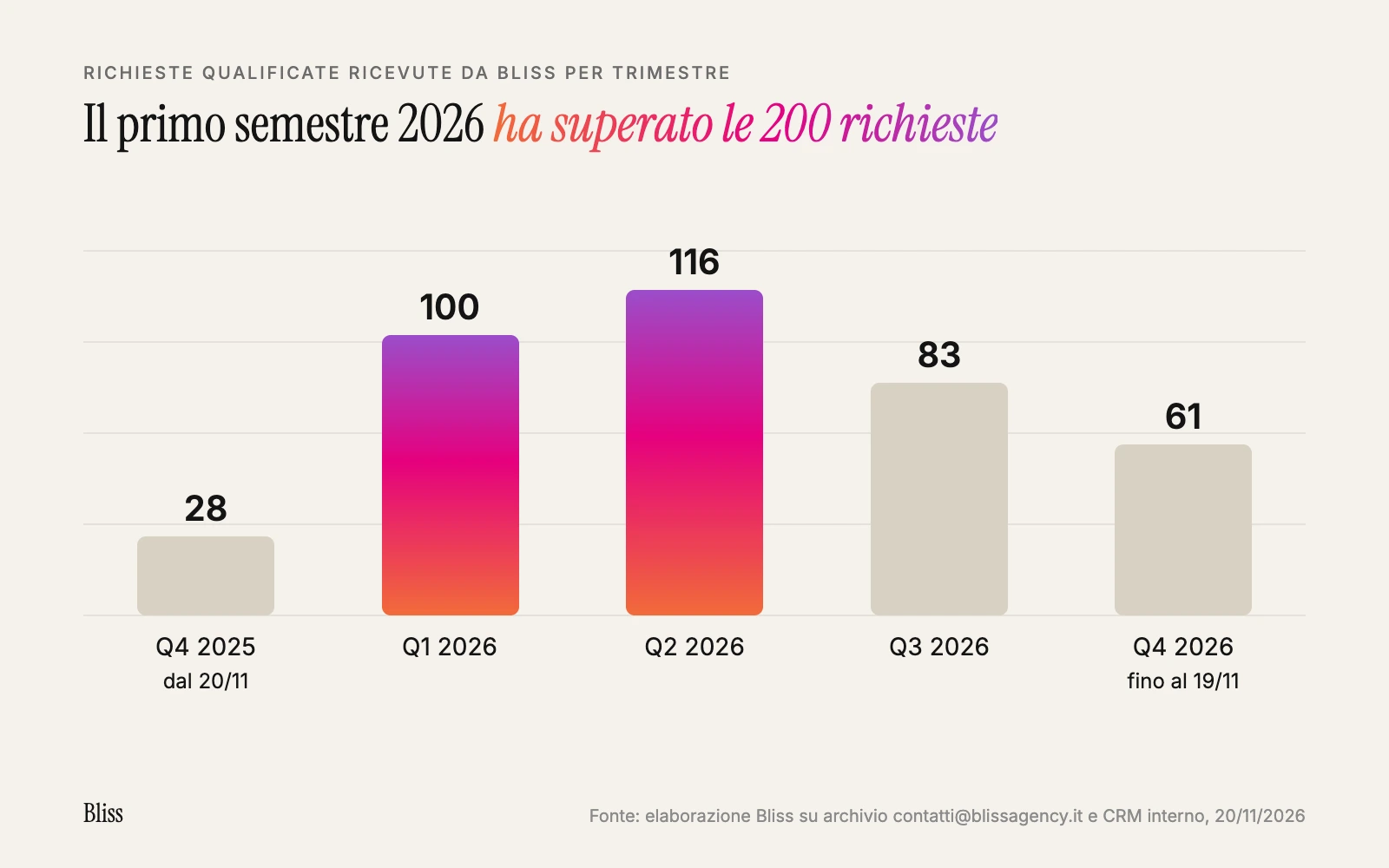
Between 20 November 2025 and 19 November 2026, 388 qualified companies wrote to us, excluding off-target requests (11). The flow grew in the first half of 2026, with 100 requests in the first quarter and 116 in the second, and remained above 80 requests in the third quarter.
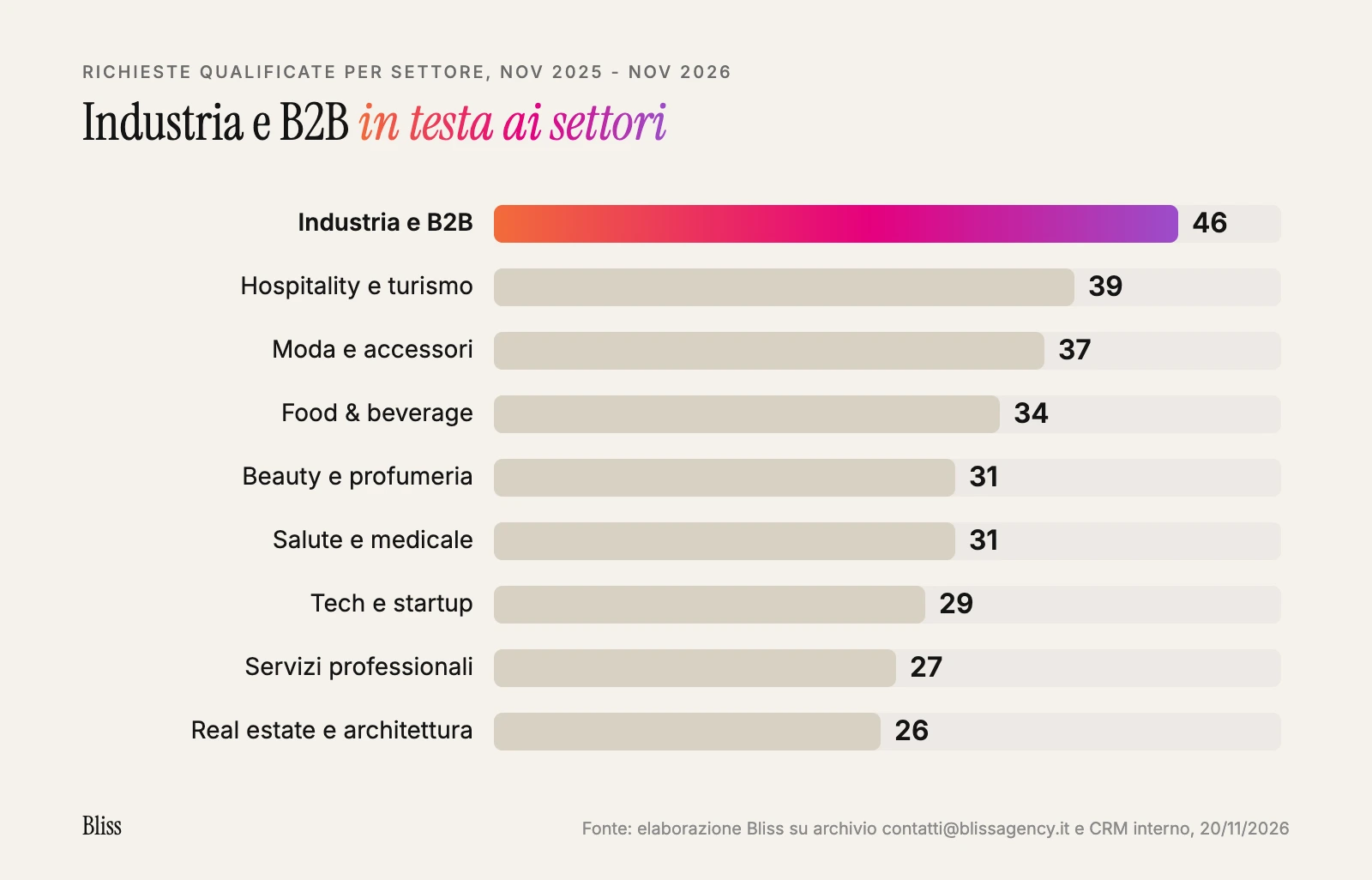
The most represented sectors are industry and B2B (46 requests), hospitality and tourism (39), fashion and accessories (37), food & beverage (34), beauty and fragrance (31) and health (31). Almost half of the requests come through the website form (178), a third by direct email (125); structured tenders number 8.
What problem do the companies that contact us start from?
Most companies do not ask us for a service; they describe a problem. The most frequent is the launch of a new brand, product or app (88 requests), followed by a website that needs rebuilding or does not bring in the right clients (77) and a brand that needs repositioning or making recognisable (59). In fourth place are companies that need clients, leads and sales (55).
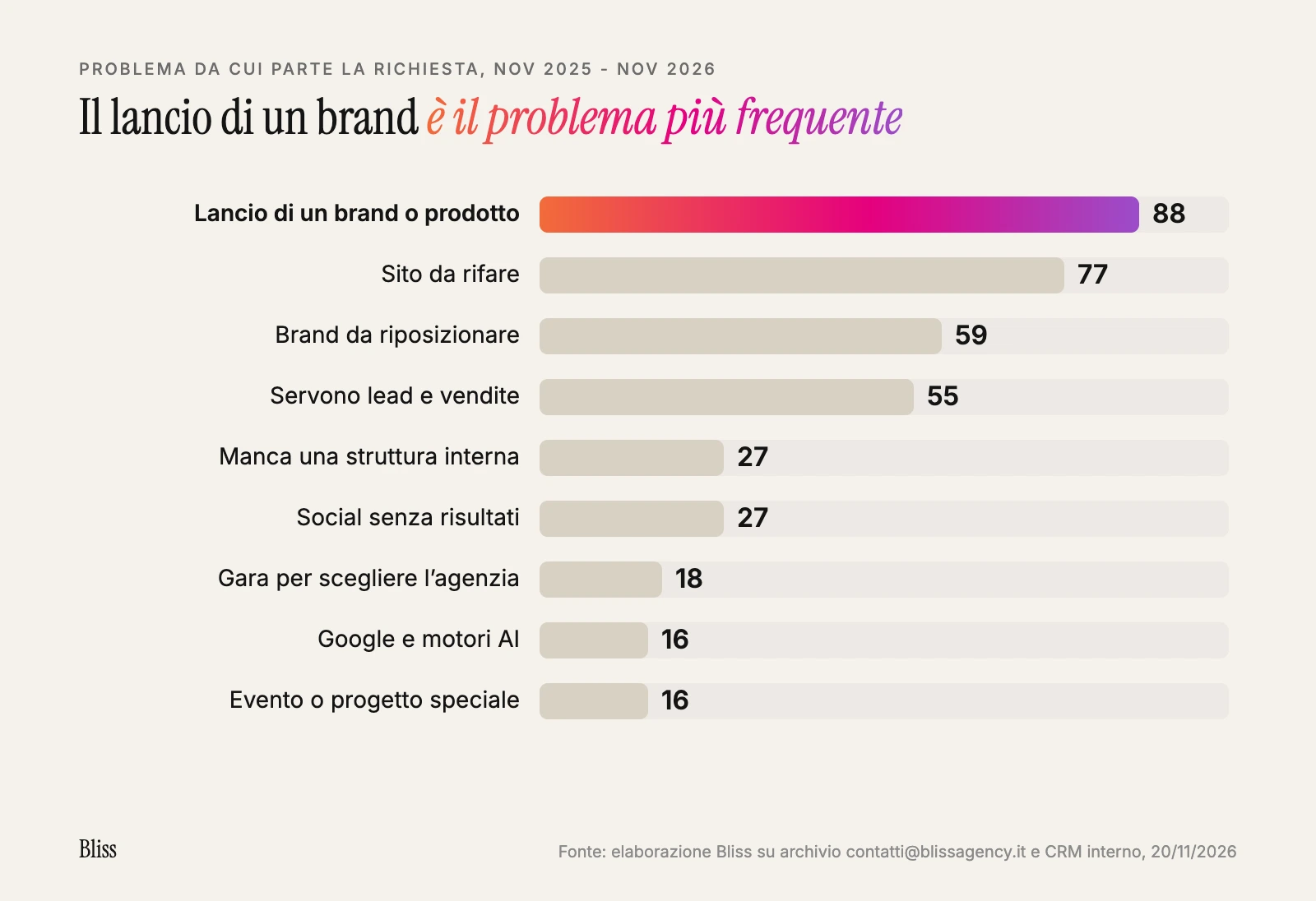
This is a figure that guides our work: the explicit request is almost always a website or a social media plan, but the problem to solve is almost always one of positioning. When the two do not match, the first step is a brand advisory diagnosis, not a quote for execution. Saying no is part of the same method: advisory defines what the company needs, governance establishes what stays out.
Who works on your project
The people of Bliss across Rome and Milan





How many requests did we say no to, and what were they worth?
Between March and November 2026 we turned down 56 of 300 qualified enquiries, roughly 19%. The potential first-year value of these engagements exceeds €2 million. We consider only this period because it is the one in which the outcome of every enquiry can be traced in the e-mails; for earlier months the figure cannot be reconstructed with the same precision.
The value is an estimate: only a few requests stated a budget, so for the others we used the values of the quotes we send for equivalent services. This is why we report it in bands rather than to the single euro.
What are our reasons for saying no?
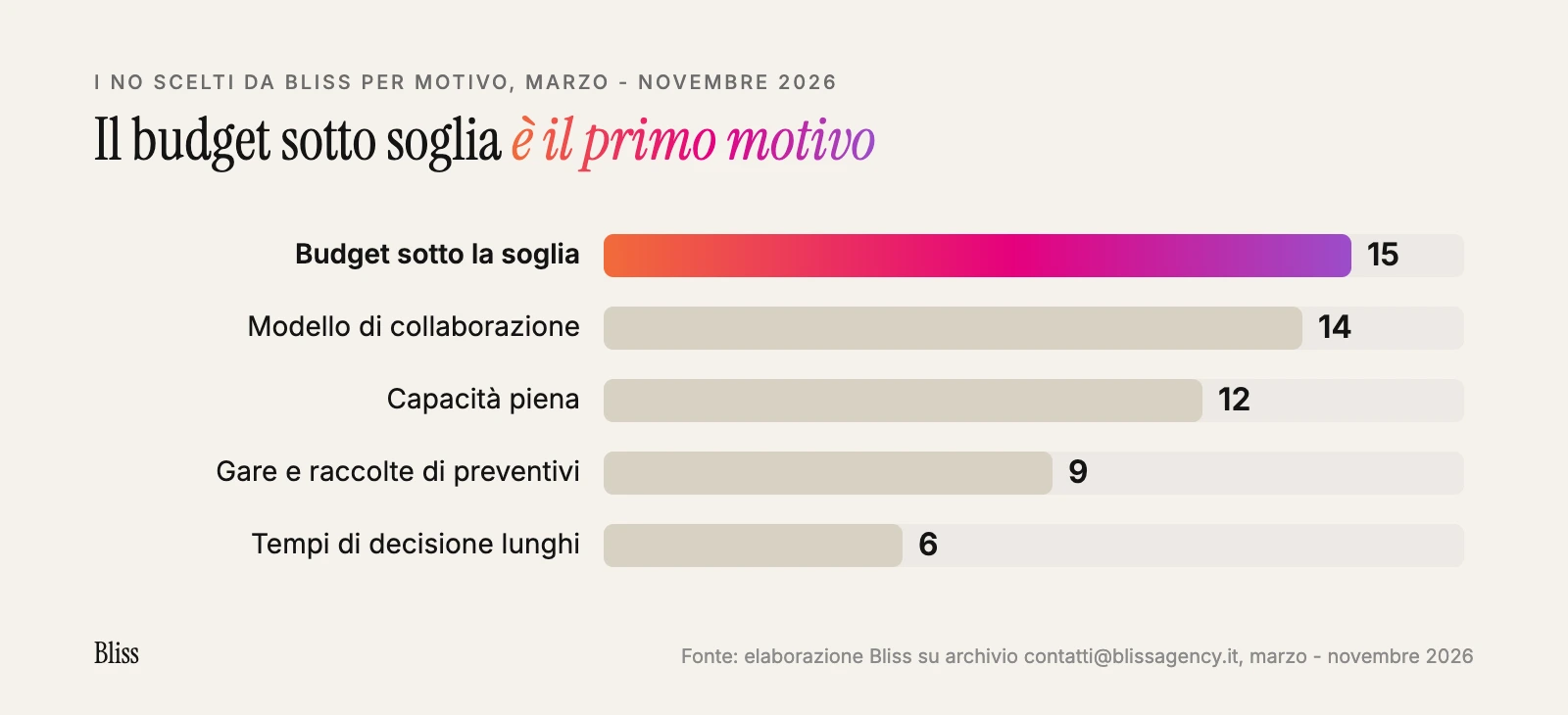
We say no for five recurring reasons, and three of them concern the way of working rather than the value of the engagement. The most frequent reason is a budget below the minimum project threshold (15 cases), followed by a collaboration model incompatible with ours (14), full capacity (12), tenders and requests for quotes (9) and overly long decision times (6).
Why do we say no when the budget is below the threshold?
We say no below a certain threshold because an undersized project produces partial work, which the client pays for regardless and which does not solve the original problem. In 15 cases the available investment allowed neither the diagnosis nor the execution to the standard we apply to our other clients. In these cases we prefer to say so straight away and, where possible, indicate which activity it makes sense to start with.
Why do we turn down performance-based fees and success fees?
We turn down fees tied solely to results because they shift attention from the project to the metric that triggers payment. A brand is built on several levers that mature over different timeframes, and a percentage-based agreement encourages choosing only those that deliver a number straight away. The same group includes requests to buy lead packages, which we do not sell, requests for purely technical website management without a strategy, collaborations without a decision-maker or a budget, and pro-forma quotes for entering a public tender.
Why do we say no even when we are fully booked?
We say no when the team has no capacity, because taking on one more engagement takes time away from existing clients. It happened 12 times, mostly between April and July. A consultancy’s capacity depends on the senior people who run the projects, and it does not grow by adding more hands.
Why don’t we take part in tenders and requests for quotes?
We do not take part in open tenders or requests for quotes because they select on price and creative proposal before any diagnosis. This applied to 9 requests, including tenders from large groups and portals that compare several agencies on the same brief. We do, however, take part in selections where there is direct dialogue with the decision-maker and room for an initial analysis. We explain how a tender works and what to ask before entering one in our guide to choosing an agency.
Why do we close negotiations that stall for too long?
We close a negotiation when the client’s decision-making timescales become incompatible with those of the project. This has happened 6 times: requests left on hold for weeks, replies that never came or decisions repeatedly postponed. A launch or a repositioning has a useful window of time, and a project that starts late is already behind schedule.
Our case studies
Websites, e-commerce and campaigns for brands we have worked with









What do companies ask before choosing us?
The questions we receive most often at the commercial stage concern costs, payment terms and the choice between agency and consultant. The most frequent are how much a brand identity costs for a new brand, whether the advertising budget is included in the agency’s fee, whether it is better to pay per project or by retainer, and whether it is possible to work on a success fee. Many companies also ask us when a strategic consultant is needed and when an operational agency is enough: we cover this in our comparison of external, in-house or employed consultants.
What is Bliss’s view on the perimeter of no?
A no delivered well is also a service to the person receiving it. Anyone who writes to us about a lowest-price tender or a percentage-based fee is looking for a different kind of supplier, and finding that out after a single email saves both sides weeks.
Our criterion
We accept an engagement when there is a problem to diagnose, a person who decides and a budget consistent with the objective. If any one of the three is missing, the project does not start well.
The perimeter of no is not a list of rejected clients. It is the most precise description of what we do.
How did we calculate these figures?
The figures come from the contatti@blissagency.it inbox archive and our internal CRM, processed by Bliss on 20 November 2026. Up to February 2026, enquiries are taken from the CRM; from March 2026 they are extracted and classified manually from the e-mails. We excluded suppliers, job applications, spam, guest post proposals and tests, and counted companies that wrote to us more than once only once. Opportunities received through intermediary platforms are excluded from the counts.
Potential value uses the stated budget where available, then the value of the quote sent and, failing both, an estimate based on our quotes for equivalent services, with recurring services counted over twelve months. It is potential demand, not revenue.
Frequently asked questions about the perimeter of no
Why should an agency turn down a client?
Because an engagement outside one’s own method lowers the quality of work for everyone else. Declining clearly protects existing clients and makes the agency’s positioning easier to read.
Can you pay an agency on a success fee?
It can be done, but we don’t do it. A fee tied solely to results pushes you to work on the levers that produce a quick number and neglect those that build brand value over time.
Do you take part in agency selection tenders?
We take part in selection processes that offer direct dialogue with the decision-makers and room for an initial analysis. We do not take part in open requests for quotes or in tenders that select on price alone.
What happens after a no?
We explain the reason and, where possible, suggest where it makes sense to start or which type of supplier is a better fit.
Sources
- Archive of the contatti@blissagency.it inbox, November 2025 – November 2026, and the ‘Quotes List’ in the Bliss CRM: Bliss analysis dated 20/11/2026.