


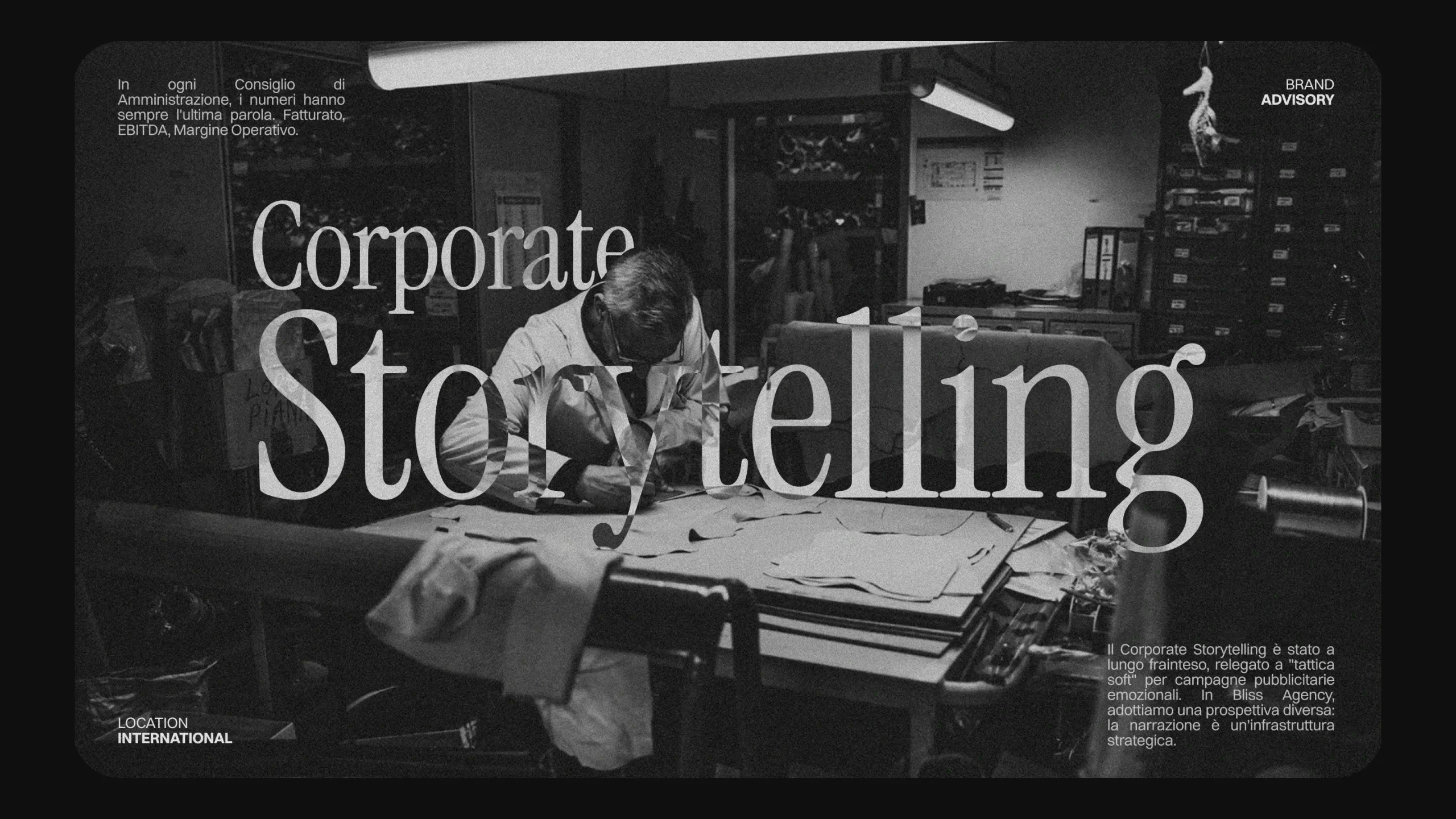
Introduction: The costly silence of numbers
Corporate Storytelling is the set of narrative techniques a company uses to communicate its values, identity and vision through structured stories, with the aim of making the brand understandable, memorable and relevant to its audience.
Unlike Brand Narrative, it operates at a tactical and communicative level, translating strategy into content, campaigns and messages.
Brand Narrative is the strategic infrastructure that governs how a company is understood, valued and remembered by all its stakeholders.
It is not marketing storytelling but a system of shared meanings that aligns strategy, leadership, internal culture and external perception, with a direct impact on trust, brand value and long-term capitalisation.
In brand advisory contexts, Narrative becomes decisive when the numbers are no longer enough: during a crisis, a merger, a restructuring, or in the competition to attract talent and capital. It is at these moments that the market does not buy a balance sheet, but the story that company represents.
The costly silence of numbers
In every Board of Directors, the numbers always have the final say: revenue, EBITDA, operating margin.
Yet there is a precise point at which numbers alone stop working.
When a company goes through a reputational crisis, faces a merger, manages a change of leadership or seeks to attract rare talent, the market no longer buys financial performance alone. It buys credibility, consistency and vision.
In those moments, the market does not buy your balance sheet.
It buys your story.
Corporate Storytelling has long been misunderstood and relegated to a “soft” tactic for emotional campaigns. At Bliss we take a different view: narrative is a strategic infrastructure, not a communications accessory.
If you do not govern your narrative, the market will write it for you.
And it will rarely be the one you want.
Bliss
Speak to a
consultant
Tell us about your project. Together, we will find the right way forward.
Contact usFrom “Campaign” to “Narrative Capital”
There is a substantial difference between tactical storytelling (marketing) and Corporate Narrative (advisory).
- Tactical Storytelling: It sells a product today. It is episodic, delegated to the creative agency and focused on the customer.
- Corporate Narrative: It builds value over time. It is enduring, governed by the CEO and focused on all stakeholders (investors, employees, institutions).
The companies that dominate global markets do not just have excellent products; they have Narrative Capital so solid that it lets them weather scandals, leadership changes and market crises with minimal damage to share value.
Table: The Financial Impact of Narrative
| Area of Impact | Without a Corporate Narrative | With Corporate Narrative |
| Talent Acquisition | Salaries 20% above market to attract talent | Attraction through alignment of values (Purpose) |
| Crisis Management | Collapse in trust and share price | “Benefit of the doubt” from stakeholders |
| M&A (Exit) | Valuation based on EBITDA multiples | Valuation based on Brand potential (Goodwill) |
| Price (Pricing) | Race to the bottom (Commodity) | Premium Price justified by Heritage |
The pillars of Narrative Governance
How do you turn an informal story into a formal asset? Through a structured Advisory process that codifies the company’s identity into management tools.
We do not “invent” stories. We extract the company’s DNA and turn it into code.
1. The Architecture of the Story (Heritage)
Many companies sitting on historical goldmines (archives, patents, visionary founders) let these assets gather dust. Brand Heritage is not nostalgia; it is tangible proof that “we know how to stand the test of time”. A crucial asset for reassuring investors about the longevity of the business.
2. The Brand Voice (Tone of Voice)
If we removed the logo from your website, would your clients recognise you?
Multinationals often suffer from communication schizophrenia: formal on LinkedIn, “young” on Instagram, bureaucratic in service emails.
Defining the Tone of Voice (ToV) is not an exercise in style but in consistency. It means setting strict rules on how the company “sounds” in every market, ensuring a single, unambiguous perception from New York to Tokyo.
3. Verbal Identity and Codes
Beyond tone, there is vocabulary. In complex sectors (Pharmaceuticals, Tech, Finance), words carry weight. A Verbal Identity Guide is the operating manual that prevents employees from using terms that dilute positioning or expose the company to legal risk.
4. Leadership Activism
In the age of transparency, the CEO can no longer hide behind a press release. Stakeholders demand to know who is steering the ship and what they think. CEO Activism is the art of positioning leadership on relevant social and economic issues, turning the face of the founder or CEO into a multiplier of trust.
When narrative becomes a shield
The real litmus test of a Corporate Narrative is not when sales are going well, but when the storm hits.
During a restructuring, a collective redundancy or a product recall, the narrative is the only thing standing between the company and reputational disaster.
Companies that have invested in a narrative of transparency and responsibility (ESG) are forgiven sooner and more fully. Those that have communicated only their products are punished severely.
Narrating to connect: the Profumum and Charles Philip Milano case studies
Storytelling is not mere entertainment but a genuine architecture of carefully calibrated messages. As illustrated in the Profumum Roma case study, the corporate narrative often intertwines with the sensory journey, creating an indissoluble bond with the client. For the Charles Philip Milano project, by contrast, the brand narrative was structured to reflect a lifestyle, positioning the product within a coherent aspirational world.
Orchestrating the Global Narrative
Within the boardroom, the narrative of a multinational group transcends pure expression to establish itself as a strategic asset for positioning and protecting equity. Advisory ensures that this vision is reflected in the long-term enhancement of intangible capital. To understand how this asset is deployed across the entire organisation, leadership can assess the structural implications of Brand Architecture, analyse reputational impact through CEO Activism & Communication and consolidate historical assets through Brand Heritage. In parallel, formal governance finds its fullest expression in the normative frameworks of the Verbal Identity Guide and the standardised protocols of Tone of Voice.
Conclusion: Who holds the pen?
The final question for the Board is not “what story do we tell?”, but “who governs our story?”.
Leaving the corporate narrative to chance, or fragmented across disconnected departments, is an operational risk that is no longer sustainable.
Corporate Storytelling is a Senior Management function. Bliss acts as Brand Advisor to structure this function, turning your story from “background noise” into a measurable competitive advantage.