



Three books for three different ways of reading organisations. One on the structure of strategy. One on positioning as a choice of field. One on the ability to observe before intervening.
In July, things slow down.
Or at least, we try.
Which is also why it is the perfect month to switch off the computer a little more often, open a good book and ask the right questions.
Which ones? At Bliss we have chosen three very different reads, linked by the same idea: to truly understand something (an event, a social dynamic, life itself) it is not enough to stop at what appears. You need to understand where it comes from, what forces drive it and in which direction it is changing.
And so, this month, ahead of the summer holidays, we have selected a book on strategy, one on positioning and one… on trees. Because sometimes the most useful lessons come from the places we would never think to look.
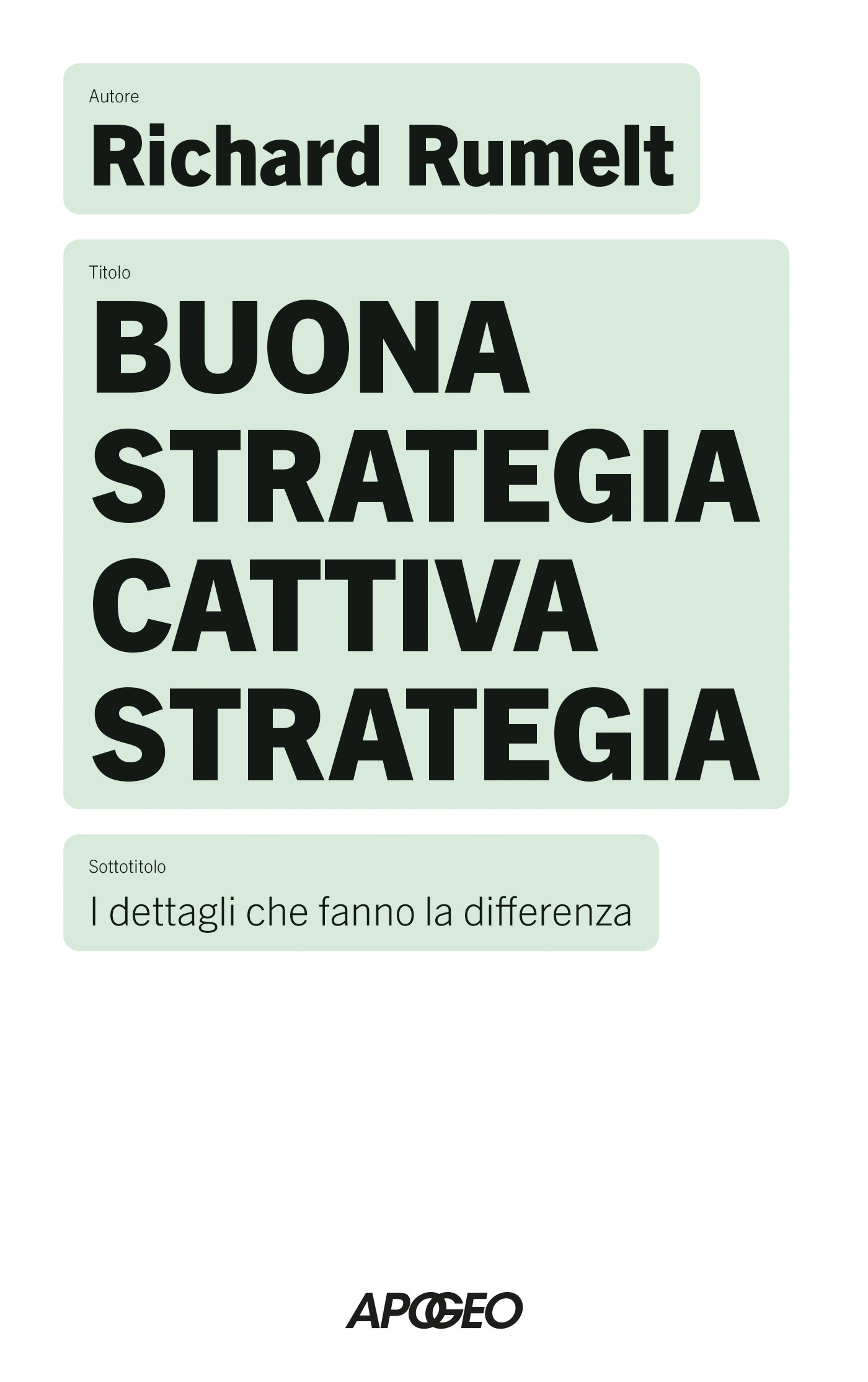

Strategy – Good Strategy Bad Strategy
Richard Rumelt · Apogeo, 2022
The book starts from a question few organisations can answer: what distinguishes a real strategy from a list of good intentions with a heading on top?
Rumelt calls the second bad strategy and describes it as (i) ambitious goals without a diagnosis, (ii) motivational slogans in place of decisions, (iii) the annual budget mistaken for a strategy. Bad strategy, Rumelt writes, is therefore actively harmful, because it occupies the space where real strategy should be.
The structure he proposes for good strategy is simple in theory and difficult in practice. First comes the diagnosis: an honest reading of the situation, the real problems and the actual advantages. Then the guiding policy: the direction chosen to tackle the problem. Finally, coherent actions: what the organisation decides to do must follow the same logic, not proceed in parallel on ten different fronts.
Lo consigliamo perché: quando entriamo in un’organizzazione e chiediamo di vedere la strategia, spesso ci viene mostrato proprio ciò che Rumelt definirebbe cattiva strategia: obiettivi, previsioni e iniziative che non discendono da una vera diagnosi del brand.
The book forces you to distinguish aspirations from decisions, and direction from a list of activities. After reading it, strategy presentations never look the same again. Not even the ones we write.
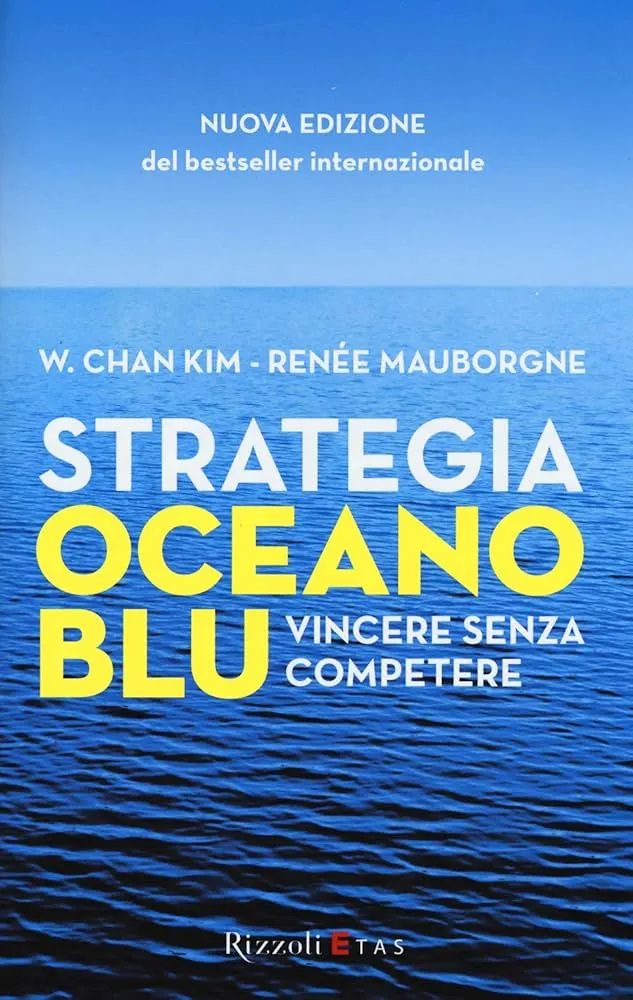
Positioning – Blue Ocean Strategy
W. Chan Kim, Renée Mauborgne · BUR Rizzoli, 2023
The book’s central thesis is that competition is often the wrong answer to the wrong question.
When an organisation builds its strategy by trying to beat competitors on their own ground, it enters what Kim and Mauborgne call a red ocean: a bounded, contested market where one player’s growth comes at another’s expense. The predictable result is margin compression, a homogenised offering and a growing dependence on variables the organisation does not control.
The alternative the authors propose is the creation of uncontested market space: the blue ocean.
The best-known case is Cirque du Soleil. The company did not try to beat traditional circuses at their own game. It built a different category, blending circus and theatre and targeting an adult audience willing to pay the price of a theatre ticket.
Since it was first published in 2005, the book has become one of the most influential texts on corporate strategy. It has remained relevant because the question it answers does not age; indeed, it has inspired us too, shaping the proprietary framework that sets us apart.
Lo consigliamo perché: il posizionamento di un brand è prima di tutto una scelta di campo. Significa decidere quale spazio occupare, quale valore rendere riconoscibile e quali confronti rifiutare.
Choosing whom not to compete with is as much a strategic decision as choosing whom to compete with. ‘Blue Ocean Strategy’ explains why this choice can be worth more than any operational optimisation.
Culture – Alberi
Aya Kōda · Mondadori, 2026
Published in Italian for the first time in 2026, ‘Trees’ is the book that accompanies Hirayama, the protagonist of Wim Wenders’ Perfect Days.
Published posthumously in Japan in 1992, the work collects the writings Aya Kōda devoted to her country’s most extraordinary trees. Cherry trees, cedars, persimmons, pines, maples and cypresses are genuine presences to be observed: each with a different form, history and way of inhabiting time. Remarkable, too, is the opening chapter on the Ezo spruces, which reflects on life and death, intertwined in the forest, yes, but also in our everyday lives.
Kōda Without looking for an a priori meaning in them, Kōda approaches trees through their particulars, letting the details create a meaning within her.
Admittedly, at first glance it may seem a book far removed from strategy and management. In part, it is. It belongs to the woods rather than to offices. And yet, deep down, its author’s approach holds everything needed for real transformation: attention before intervention, patience before judgement, and the ability to tell natural evolution from the symptom of a problem.
A company is a living system too. One that cannot be understood through isolated snapshots alone. As with the trees in a forest, everything in the market is interconnected. And what we see is ALWAYS the result of decisions, relationships and changes accumulated over time.
Lo consigliamo perché: chi governa un brand è continuamente spinto a decidere, correggere e accelerare. Kōda ricorda che osservare è già una parte della decisione.
Brand Governance begins before rules and frameworks. It begins with the ability to recognise what must be protected, what can evolve and what, almost unnoticed, has already changed.
It is July, it is hot, and not every book on governance contains charts, matrices and decision models. Some talk about cedars, pines and bark. Trees is read slowly, the way you observe something growing: without expecting to understand it all at first glance.
BLISS®
© 2026. ALL RIGHTS RESERVED