


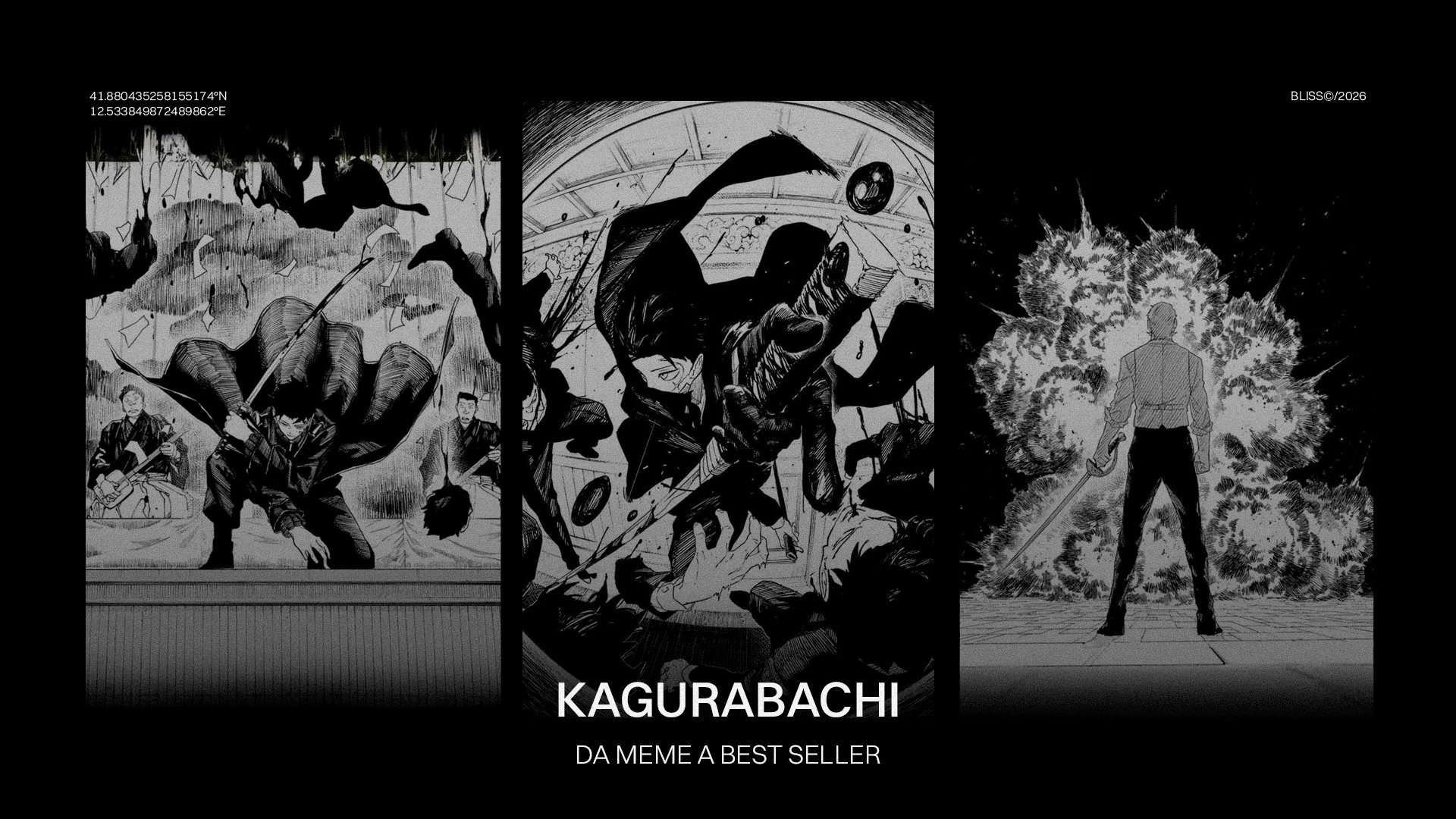
Prima ancora che uscisse il primo capitolo, internet lo aveva già bollato come pessimo prodotto, e assunto a meme.
Due anni dopo ha vinto il premio più importante del settore, e si prepara all'anime. La reputazione non si decide al lancio.
On 13 September 2023, six days before the first chapter was published, an X user posted a meme placing the face of Chihiro, protagonist of the new Shonen Jump serialisation, next to that of Boruto, protagonist of the Naruto spin-off series.
The tone, of course, was sarcastic. No one had yet read a single page of the manga. Straight away, however, the meme went viral, and in the days that followed the irony around the series exploded.

Kagurabachi was immediately labelled a run-of-the-mill shonen series with a mysterious, edgy protagonist driven by the revenge cliché. Not the most original idea of all time, people said. And so, the more the community exaggerated in calling it “the greatest manga of all time”, the more the meme worked as collective mockery.
And with My Hero Academia and JuJutsu Kaisen still being published, anyone who called it the future of the magazine did so ironically.
And yet, six months later, nobody was laughing any more.
Not because the meme had run its course, but simply because the manga worked. And its author had earned everyone’s respect.
This is the story of Kagurabachi (so far) and what it can teach every brand.
The moment the joke became genuine reading
In July 2024 Kagurabachi passed 350,000 copies in circulation. The figure rose to over 600,000 the following month, passed one million in October, and then reached 2.2 million copies sold with the release of volume 7 in May 2025.
A meme? Impossible: growth like this cannot be explained by irony. If anything, it is the answer thousands of readers gave by continuing to buy each new volume.
In August 2024, confirmation finally arrived. Kagurabachi won the Next Manga Award 2024 in the print category, with over 100,000 votes and the second-highest score in the award’s history: more than triple the runner-up.
The title the internet had mocked as “generic” was voted by the public the best of the year in its category.
The fans themselves described this shift with a phrase that captures the whole arc better than any analysis: from meme to award-winning manga.

What sets Kagurabachi apart
In itself, the irony made sense.
Kagurabachi does not have a particularly original plot. The whole story revolves around Chihiro, son of the national hero who saved Japan with six enchanted swords he forged himself. At the end of the war, Chihiro’s father is killed and the swords are stolen. It falls to the son to track the weapons down before they fall into the wrong hands.
Where the story apparently falls short, however, the artist’s remarkable eye takes over: Takeru Hokazono, now just twenty-six and on his first publication, who has shown a unique drawing style and a particular attention to action scenes.
That is partly why reading Kagurabachi is like watching a Tarantino film or one of the best action series around. It is pure adrenaline, with unexpected artistic choices and a freshness the manga industry needed. Enough to catapult the series to the top of the charts not only in Japan but worldwide, and to earn what will be the most anticipated adaptation of 2027: its anime.

An author’s resilience
The most important detail of this story is not popularity in itself, nor the fact that international artists such as Gabriele dell’Otto (as shown here) now create Kagurabachi covers around the world.
What is interesting, rather, is that the series became popular in the opposite way to what almost everyone expected.
Kagurabachi is what it is today not because of the memes that surrounded the series, but because of the substance it has demonstrated.
In this respect, despite his age, Hokazono did not react to the memes by chasing the irony or changing course to please those who found his story banal. He kept writing what he had in mind, chapter after chapter, letting the material itself answer for him.
He did not fight the narrative that had been stitched onto him. He let it run, knowing that every new chapter was an opportunity to be judged again.
This is the point most organisations fail to see when a launch goes wrong: a reputation is not a verdict delivered on day one. It is a process that builds up chapter after chapter, post after post, interaction after interaction. The first judgement carries weight, but it does not settle the game.
Life teaches us that the only ones who lose are those who stop playing.
The lesson for those who govern a brand
A launch that is mocked, misunderstood, met with coldness or irony is not a final sentence.
It is simply an unfavourable starting point.
The gap between the two is enormous, and it separates those who abandon a project after a difficult start from those who build, chapter after chapter, the conditions to be judged again.
This does not mean that any weak launch will turn into a success if you wait long enough. Kagurabachi worked because behind the meme there was an original work that, chapter after chapter, managed to deepen its plot and stir emotion.
Without all this, the meme would have burnt out within a few weeks, leaving nothing behind but memes and jokes.
In the same way, a brand’s reputation is not fixed at first impression. It is written one chapter at a time, because every chapter is a new opportunity to be read differently from the way you were read the day before.
New Connections (FAQ)
Our product had a difficult launch, with negative reviews and little attention. Is it too late to recover?
The Kagurabachi case shows that the window of judgement stays open far longer than people fear. What matters is not the initial verdict but what happens in the chapters that follow: every new touchpoint with the public, an improved product, sharper communication, a more solid experience, is an opportunity to be judged again. The condition is that there is genuinely something better to show. Recovery requires substance, not just time.
Is it worth responding to the irony or the early criticism, perhaps in a playful tone, to try to ride the wave?
Hokazono did not respond to the meme. He did not chase it, did not correct it publicly, did not change the plot to please those mocking him. He kept writing. That choice let the product, over time, answer for him. Chasing irony often prolongs its public life instead of exhausting it, because the brand ends up trapped in the very narrative it wants to move beyond.
How do you tell a case worth waiting out from one that needs correcting immediately?
The question to ask is not how much noise surrounds the launch, but whether the substance beneath that noise is actually improving. Kagurabachi kept coming out regularly, with a plot that progressed and artwork that stayed consistent: the product was doing its work, chapter after chapter, while public judgement remained suspended. If the substance does not progress, waiting achieves nothing. If it does, time is the most underrated ally a brand can have.