




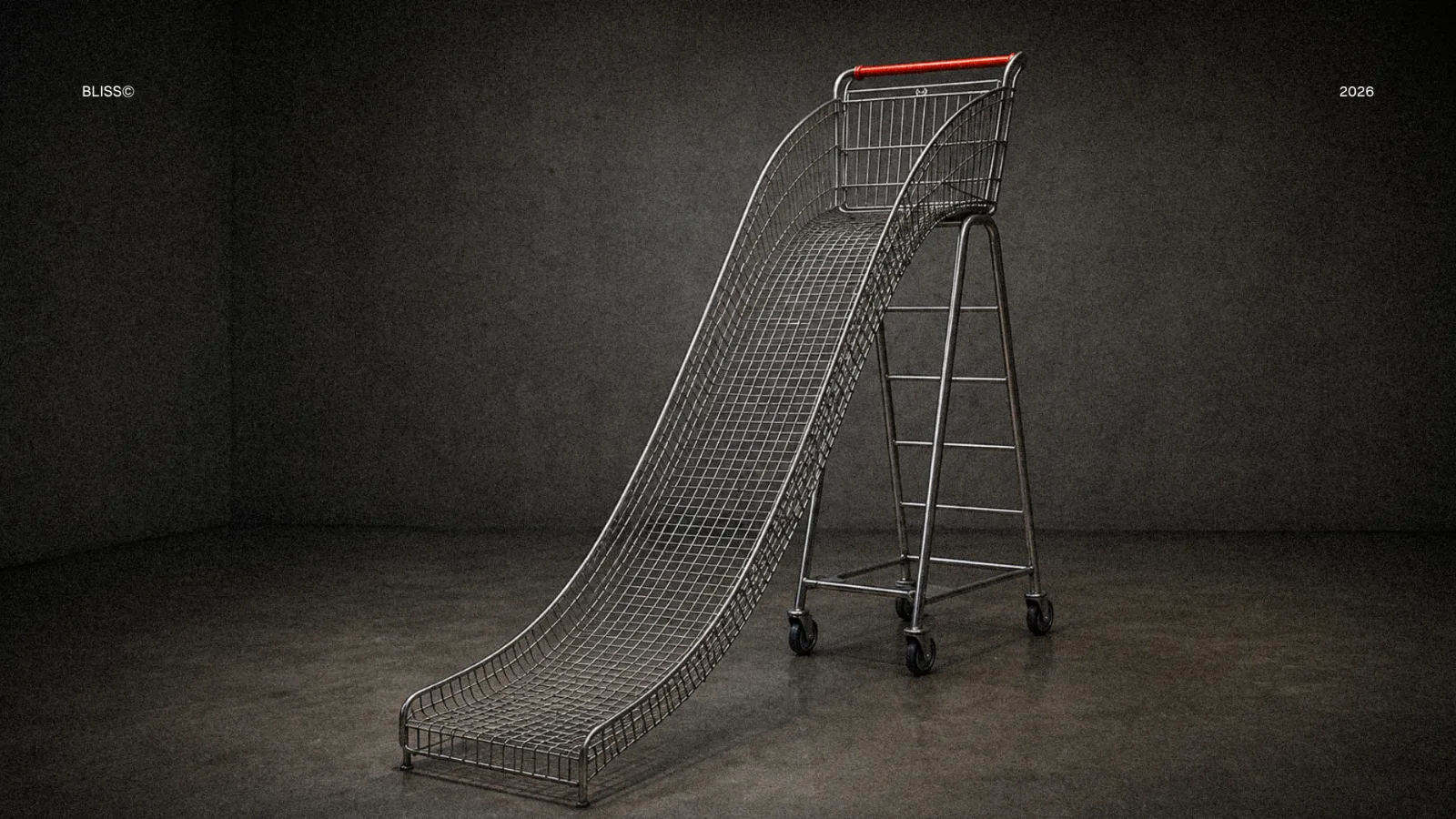
Many e-commerce businesses treat the abandoned cart as a remarketing problem. The user adds a product, leaves the site and a sequence of emails starts trying to bring them back.
Sometimes it works.
Sometimes…
If the site shows shipping costs only at the final step, requires some form of registration or builds an overly long checkout, recovery comes when the damage is already done. That is why the starting point should be the structure of the experience: an e-commerce site guides the user through to purchase by removing friction, uncertainty and unnecessary steps. The CRM and automations come in later, when there is an identifiable contact and reopening the relationship makes sense.
According to the Baymard Institute, the average cart abandonment rate is 70.22%. The figure lumps together very different behaviours. Some users are browsing, comparing, saving for later. Others stop because of concrete problems at checkout.
Those abandonments can almost always be avoided. In this article, we look at how.
What an abandoned cart is
We speak of an abandoned cart when a user adds one or more products to the cart and leaves the site before completing the purchase. The metric that measures it is the abandonment rate:
Abandonment rate = [1 − (completed orders / carts created)] × 100
With 1,000 carts created and 300 orders, the rate is 70%.
Taken on its own, the figure obviously says little. A high rate can stem from users treating the cart as a wish list, from poorly qualified campaigns, from unexpected costs, from technical errors or from a checkout that demands too much effort. Before taking action, it is therefore essential to know where and why the journey breaks off.
Ipotesi: 10.000 carrelli al mese, valore medio 100 €, a parità di traffico.
Conversione dal carrello 30%
3.000 ordini
300.000 €
Conversione dal carrello 33%
3.300 ordini
330.000 €
+30.000 €
al mese, senza generare un solo nuovo carrello. Tre punti percentuali recuperati nel checkout valgono quanto un aumento di traffico del 10%.
Why users abandon their cart
The causes carry different weights. Excluding those who say they are just browsing, Baymard’s research identifies these as the most frequent:
- extra costs too high (40%);
- delivery too slow (20%);
- low trust in the site with card details (19%);
- having to create an account (18%);
- checkout too long or complicated (17%);
- site errors or crashes (17%);
- total cost impossible to calculate upfront (12%);
- insufficient payment methods (9%).
Almost all of them share one trait: they introduce new information or new friction when the user has already decided to move towards purchase.
Let us examine these cases one by one.
Costs that appear too late
The price on the product page creates an expectation. If shipping, fees or other costs appear at checkout, that expectation breaks at the most delicate moment.
Free shipping helps; the first lever is still predictability. If shipping costs €7, the user finds out straight away. If it becomes free above a threshold, the cart shows how much is left to reach it. What loses the sale is often the surprise more than the price.
Mandatory account creation
The customer wants to buy. The site asks them to register.
Registration serves the company database and slows down anyone who wants to complete their order. Guest checkout removes this friction and allows the account to be offered after purchase. The order of priorities remains clear: conversion first, profile enrichment second. A CRM builds the relationship over time, and data collection finds its place after the first transaction.
An overly long checkout
Every field takes time. Every screen forces the user to work out where they are. Every unnecessary piece of information adds a chance of error.
For every field, it is worth checking whether it is genuinely needed before payment. When the answer is no, the field comes out of the checkout.
Trust asked for before it has been built
Entering card details is the moment when trust becomes concrete. Visual errors, unclear copy, missing returns information, few payment methods or a careless interface all increase uncertainty.
Before checkout, an e-commerce site makes the seller, security, returns, delivery times, payment methods and final cost clear. Many classify these elements as UX. They also concern the perception of risk, and perceived risk weighs directly on conversion.
Delivery times out of step with the need
The price is right, the product appeals, the checkout works. The user leaves anyway, because delivery comes too late.
The delivery date or window should be shown early. “Delivered in 3-5 working days” and “arrives Friday” say almost the same thing; the second lets users immediately compare the promise with their own need.
Insufficient payment methods
Payment habits vary by market, age, cart value and category. Card, PayPal, digital wallets and instalment payments meet different needs, and when the preferred method is missing, some users stop.
The choice starts from the data: markets served, devices, average order value, audience, payment success and decline rates. The checkout thus reflects how customers actually behave.
Errors, slowness and technical friction
A button that doesn’t respond. A discount code that empties the cart. An address field that rejects a valid format. A page that loads slowly.
In the funnel, technical quality coincides with commercial quality: errors, loading times and checkout usability affect conversion, average value and abandonment rate. A technical problem and a marketing problem produce the same result, a lost sale, and must be tackled together.
How to reduce cart abandonment
Reducing abandonment requires a precise order, and therefore an architecture designed around the experience. First the structural causes must be fixed, then the users who interrupted the purchase anyway are recovered.
It always starts with showing the real cost before checkout. Price, shipping, taxes and thresholds must be clear as early as possible; if the cost depends on the destination, an estimate is enough. Users accept a higher price far more readily than a price that changes at the final step.
In the meantime you need to reduce the fields. What remains is name, address and the information essential for delivery and payment. Data useful for marketing is collected later, through the CRM and post-sale.
To achieve this, it helps to offer guest checkout. Purchase without registration. After the order, the site can offer to save the details for future purchases.
Always make returns, delivery and security visible. This information belongs where doubt arises: product page, cart, checkout.
And, of course, save the cart. If the cart survives an interrupted session (especially when the purchase calls for reflection or comparison), the chances of conversion go up.
The last point matters even more for high-value products. In the luxury sector, where the average order value is high and recovery was already in place, the purchasing experience, the email and the return to the cart carry a very different economic weight from an impulse purchase.
Recovery emails, without turning them into spam
When the user is identified and can be contacted again in line with consent rules, CRM and email marketing reopen the journey. A simple sequence includes:
- a cart reminder;
- an answer to the main objections: delivery, returns, product details;
- genuine urgency or an incentive, only if consistent with the strategy.
The discount comes last. If every abandonment generates a promo code, the brand teaches the customer to expect it. An incentive makes sense when margin, audience behaviour and commercial strategy justify it.
Segmented recovery and retargeting
Carts have different values. One worth 30 euros and one worth 900 call for different strategies; so do a regular customer and a new visitor; someone whose payment was declined has a different problem from someone who stopped browsing. With CRM, recovery is built on the customer’s history and context, and each segment receives the right sequence.
The same applies to retargeting. Repeating the same creative for days leaves a weak checkout untouched. A campaign performs better when we know the product viewed, the cart value, the type of user, the likely obstacle and the time elapsed. Retargeting recovers intent.
How CRM recovers an abandoned cart
CRM comes in when the company holds an identity or a piece of data that can be linked to behaviour. It records the contact, the product, the cart value, the communication history and the outcome of subsequent actions, and builds workflows on this data:
- abandoned basket over 300 euros → 2-hour wait → personalised email → no purchase → second contact after 24 hours;
- existing customer → abandoned cart → purchase history check → a different message from the one sent to a new visitor.
It is the same logic that governs how a CRM works: event, information, rule, action. Cart recovery is one of the system’s use cases, within a much broader scope.
Abandoned carts and Business Intelligence
At high volumes the average rate is no longer enough. Abandonment needs to be segmented by device, channel, country, category, product, cart value, new and returning customers, payment method and checkout step.
This data feeds into a Business Intelligence system and shows where the company loses most value. An average rate of 68% may conceal, for example, 82% on mobile and 54% on desktop, or 60% in Italy and 79% in the United States. At that point the problem takes a different shape: from “we have too many abandoned carts” to “the US mobile checkout loses users at the shipping step”. That is information you can act on.
What reducing the abandonment rate is worth
The most direct way to grasp this is to turn the percentage into revenue. Take 10,000 carts a month, an average value of €100 and a cart conversion rate of 30%: that gives 3,000 orders and €300,000 in revenue.
Raising conversion to 33%, with the same traffic and value, orders rise to 3,300 and revenue to €330,000. That is €30,000 more without a single additional cart.
That is why checkout optimisation and recovery are read alongside acquisition. Driving more traffic to a journey that leaks value mainly increases the number of users lost.
What to measure beyond the abandonment rate
The overall rate is the starting point. We monitor at least these indicators:
| KPI | Cosa indica |
|---|---|
| Cart abandonment rate | Quanti carrelli non diventano ordini |
| Checkout abandonment | Quanti utenti iniziano il checkout e non lo completano |
| Conversion rate per step | Dove si interrompe il percorso |
| Payment failure rate | Problemi nella fase di pagamento |
| Recovery rate | Quanti carrelli vengono recuperati |
| Revenue recovered | Il valore economico effettivamente recuperato |
| AOV recuperato | Il valore medio dei carrelli recuperati |
| Conversion by device | Frizioni specifiche di mobile o desktop |
| Conversion by channel | Qualità del traffico in ingresso |
| Time to purchase | Quanto tempo serve al cliente per decidere |
The figure that guides decisions shows where the company can change the outcome.
Fix first, then recover
Before setting up any automated sequence, you need to understand why the customer left. An audit starts from:
- funnel analysis;
- session recordings and usability tests;
- technical errors;
- costs and shipping;
- payments;
- behaviour by device;
- customer feedback;
- automations already in place.
Only then do you decide how many emails to send and when. With New Master we worked on an ecosystem that brings together WooCommerce, advertising, retargeting, UX and analytics: the cart sits within a broader system and must be governed as part of that system.
When an abandoned cart is a lost sale
Some abandonment is the natural behaviour of people comparing alternatives, working out a cost or saving a product for later. 42% of US shoppers surveyed by Baymard say they abandoned because they were just browsing or were not ready to buy.
Zero abandonment is an impossible metric; the useful goal is more precise: eliminating the abandonment the company causes itself. If the user was not ready, they may come back. If the site hid 18 euros of shipping from them until the final step, we made the decision on their behalf.
When the abandonment rate is high and the cause remains unclear, the next step is to isolate the point of loss before increasing traffic or automations. This is the work we do in our advisory engagements, within a governance framework that connects development, data and CRM. When the platform itself needs work, the starting point is website and e-commerce development.
Domande frequenti
What is a good cart abandonment rate?
The threshold depends on context. The documented global average is around 70%, and the useful comparison is by sector, device, market, average value and type of purchase.
When should an abandoned cart email be sent?
The first message arrives early enough to catch the purchase intent while it is still there; the exact timing should be tested on your own audience. The sequence then separates reminder, reassurance and, only when it makes sense, incentive.
Is it worth offering a discount to recover the cart?
It depends on basket value, customer, margin and past behaviour. A discount can increase recovery, but it reduces margin and can teach your audience to abandon on purpose to get an incentive.
What is the difference between an abandoned cart and an abandoned checkout?
In the first case the user has added products to the cart and may not have started payment. In the second they have already begun checkout. The distinction signals a different level of intent and different friction.
Can Bliss help reduce abandoned carts?
Yes. Work of this kind involves UX and e-commerce development, analytics, CRM, email automation, performance marketing and Business Intelligence. It starts by identifying the step where value is lost; recovery and automation come afterwards, within an ongoing Brand Advisory engagement.