



Let’s get straight to the point.
Instagram no longer works as a tool for credibility.
In different terms and in various ways, this conversation now comes up every day in thousands of marketing groups, chats and meetings. And it is the truth: visibility has become inflated. Being seen no longer means being believed.
This is a phenomenon with enormous consequences for the work and strategies of millions of people around the world.
But how did we get here? And how will the world of visibility change over the next five years?
Let’s explore it together.
How we got here
For a decade, social media fostered the illusion that visibility equalled authority.
Being present, therefore, also meant being relevant. Publishing meant positioning.
For a while it was true.
Those who maintained a presence on the channels had a real advantage over those who did not, because presence signalled seriousness, being up to date, vitality.
The market rewarded those who made themselves seen. Those who put in the effort.
The problem, though, is that at some point everyone started making themselves visible.
Every organisation went on social media, every one of them started talking. And at that point the imagery became standardised: drones, time-lapses, motivational captions. And the signal they meant to send got lost in the noise. Which made the channel unpleasant.
In 2025, organic engagement on Instagram fell by 26% year on year, from a median rate of 7.3% to 5.4%.
It is the steepest decline in the platform’s history. Static images lost 17% of their engagement. Reels, presented for years as the solution, dropped to a median rate of 0.50%. Retail and Home Decor recorded declines of close to 30%.
These numbers describe a collective cognitive system that has stopped responding to a certain type of stimulus because that type of stimulus has become indistinguishable from everything else.
And this means that anyone who still uses social media today the way they did yesterday risks dissipating value rather than accumulating it.
The saturation mechanism
The neuroscience of perception speaks of sensory habituation.
The human brain does not process all stimuli with the same intensity. It processes differences. What is predictable, repeated and interchangeable is filtered out by the prefrontal cortex before it even reaches conscious awareness.
Every format that becomes common, then (the Reel with overlaid text, the “5 things you didn’t know about X” carousel, the CEO striding through an airport with a suitcase and a life lesson), loses its signalling power the moment it becomes the norm.
The brain learns not to see it. It goes blind, selectively.
The format has become so standardised that every prospective client’s brain automatically processes it as “advertising” before even taking in the message. What is being sold may well be of good quality, or useful.
It doesn’t matter. The “advertising” category instantly triggers a defence system there is no escaping.
Being seen, being believed
Credibility is a cognitive process separate from visibility, with its own mechanisms and its own timescales.
It is built through the accumulation of consistent evidence over time: each time what a party says matches what it demonstrates, the pattern grows stronger. Each time it does not, the pattern weakens.
According to the 2025 Influencer Trust Index, published by BBB National Programs and based on a sample of 3,700 consumers, only 5% of consumers fully trust influencer content.
53% say they trust a product recommendation less if the influencer is paid. 70% feel deceived when they discover an undisclosed partnership. Trust, then, is built through consistency between what is claimed and what is real, not through mere presence.
For professional services the mechanism is even stronger.
When a lawyer, a consultant, an agency or a doctor promotes their services on Instagram or TikTok in the same way an influencer promotes a supplement, the prospective client’s brain triggers the same mistrust response through pattern association.
The format, then, carries a reputation that belongs to the category.
And if this was once an advantage, it no longer is.
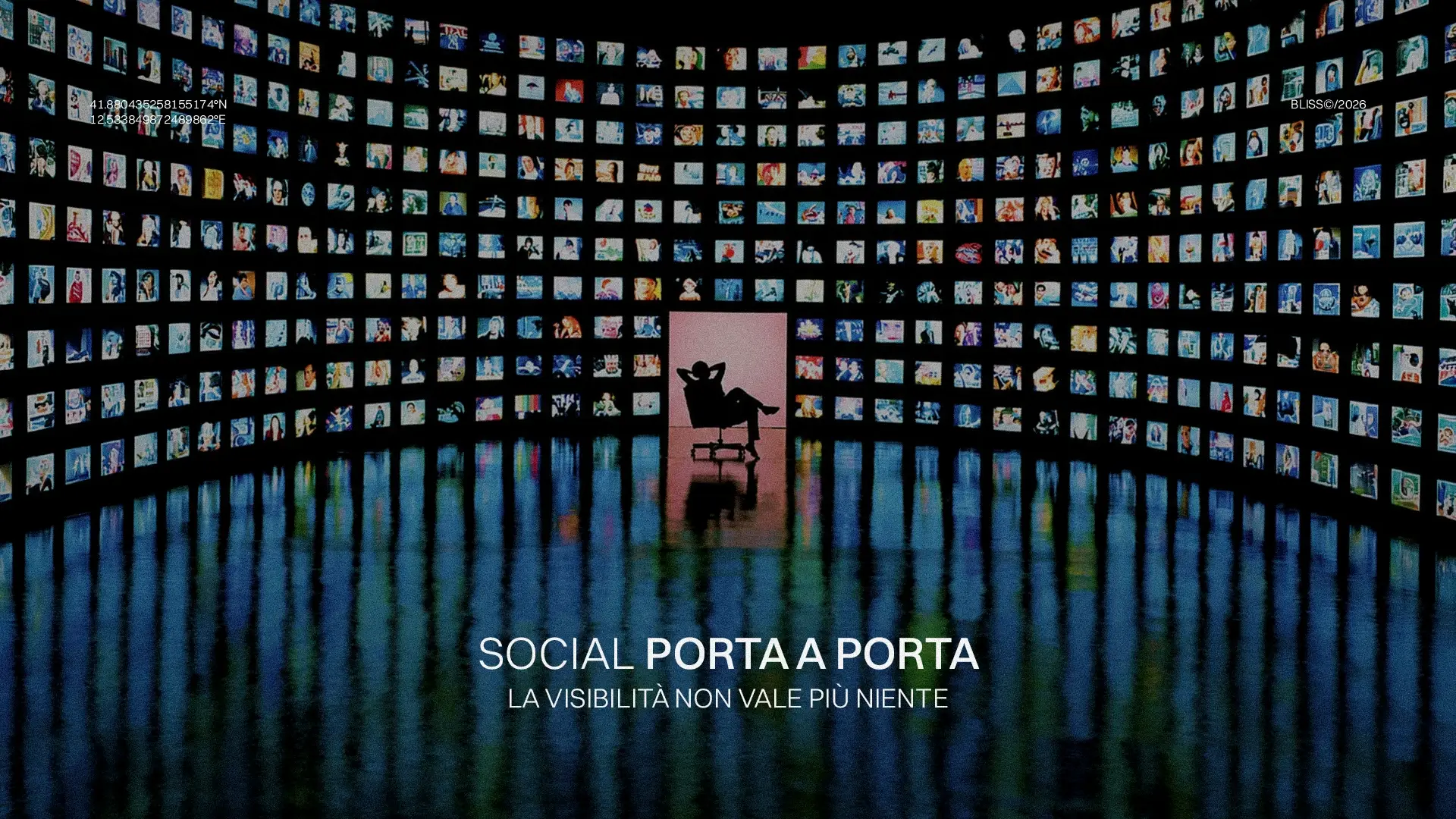
Instagram as the new door-to-door
Door-to-door selling was ineffective because the context generated mistrust. Whoever knocked at the door (a stranger interrupting daily life to sell something) automatically triggered resistance, regardless of the quality of the product or the professionalism of the approach.
On Instagram, professional services have developed the same dynamic. The profile that showcases its own results, promotes its own offering and uses the same hooks and calls to action as everyone else does exactly what the door-to-door salesman used to do: it interrupts in order to sell. And the brain responds with the same defensive reflex: “not interested”, before even assessing whether there might genuinely be interest.
By knocking insistently at the door of our attention, social media has ended up making us double-lock it.
As a result, only 22% of people today say they trust companies on social media. The channel has built a reputation that drags down those who use it.
Ironic, isn’t it?
What builds credibility today
The only possible answer is to stop confusing communication with presence.
Credibility is built through three mechanisms that today’s Instagram can no longer support in the way it once did.
The first is depth of signal. A publication that brings data, cites sources and articulates a non-obvious position is worth more than a hundred posts that claim expertise without demonstrating it. Research published in Frontiers in Communication in 2025 confirms that the perceived credibility of social media advertising depends decisively on the perceived authenticity and historical consistency of the message, not on frequency of exposure.
The second is consistency over time. A brand that communicates the same identity, with the same point of view, at every touchpoint and at every moment, even when it is not convenient to do so, accumulates trust that no communications campaign can build in the short term. That trust is the hardest asset to replicate and the most resistant to competitive pressure.
The third is verifiable reputation. Clients who speak up, documented results, case studies that a prospective client can see for themselves. Nano- and micro-influencers with small, specific communities generate significantly higher levels of trust than profiles with millions of followers, precisely because their reputation can be verified by those who follow them: it rests on real relationships, not on numbers. The same principle applies to brands: those that can be verified are more credible than those that can only be seen.
The point
In short, Instagram has become the new door-to-door. A channel that knocks, that interrupts and that makes us say “not interested” before we have even heard what it has to offer.
The solution is to understand that credibility is built through mechanisms different from those of visibility. That a signal is worth more the less noise surrounds it. And that, even if today we are no longer used to this truth, depth beats frequency. Always.
Those who govern a brand with this awareness will send a message that the next wave of noise will not be able to drown out.
And in tomorrow’s market, that will be a real competitive advantage.
New Connections (FAQ)
Our posts still get likes and interactions. So Instagram still works for us, doesn’t it?
Likes measure interaction, not credibility. A post can receive engagement from people who already know and follow you: people who do not need to be convinced. The relevant question is a different one: how many of the people who do not yet know you arrive via Instagram already inclined to trust you? Organic engagement data describe the health of the channel as an acquisition tool, not as a retention tool. For those who already follow you, Instagram may still work. As a tool for building credibility with those who do not yet know who you are, the data say otherwise.
If Instagram no longer works, where should I shift my focus?
The answer depends on where your brand can demonstrate depth, not just presence. Written content that articulates a non-obvious point of view (articles, analyses, documented cases) builds credibility because it takes real expertise to produce. Direct relationships with specific niches, through vertical communities, events or structured referrals, build trust because they can be verified. Being present on the channels where your prospective client is actively looking for solutions, not where they passively scroll a feed, captures intent rather than interrupting it. This is not about abandoning social media: it is about no longer using it as a substitute for reputation.
Large companies still invest millions in social media. Are they getting it wrong?
They are doing something different from what we describe in this article. Brands with budgets in the tens of millions use social media as a tool for reach and frequency, not for building credibility. They already know the channel does not convert on trust: they use it to stay visible while credibility is built elsewhere, through PR, partnerships, events and physical distribution. The problem is the communications theory. Anyone with 50,000 euros a year who spends all of it on social media presence to build authority is using a tool the wrong way, with resources that do not allow them to use it the right way.
In practical terms, how is the “consistency over time” discussed in the article actually built?
It means that the point of view you express today, the tone you use and the values you declare must be recognisable in six months and in three years, on every channel, in every context, even when the format changes or whoever produces the material changes. Your prospective client’s brain accumulates signals over time and builds a pattern. If that pattern is consistent, trust grows. If it is discontinuous, every new signal starts from zero. Building this consistency is not a creative problem: it is a governance problem. It requires a structure that defines in advance what the brand can say, how it says it, and what it never says, regardless of passing trends.