


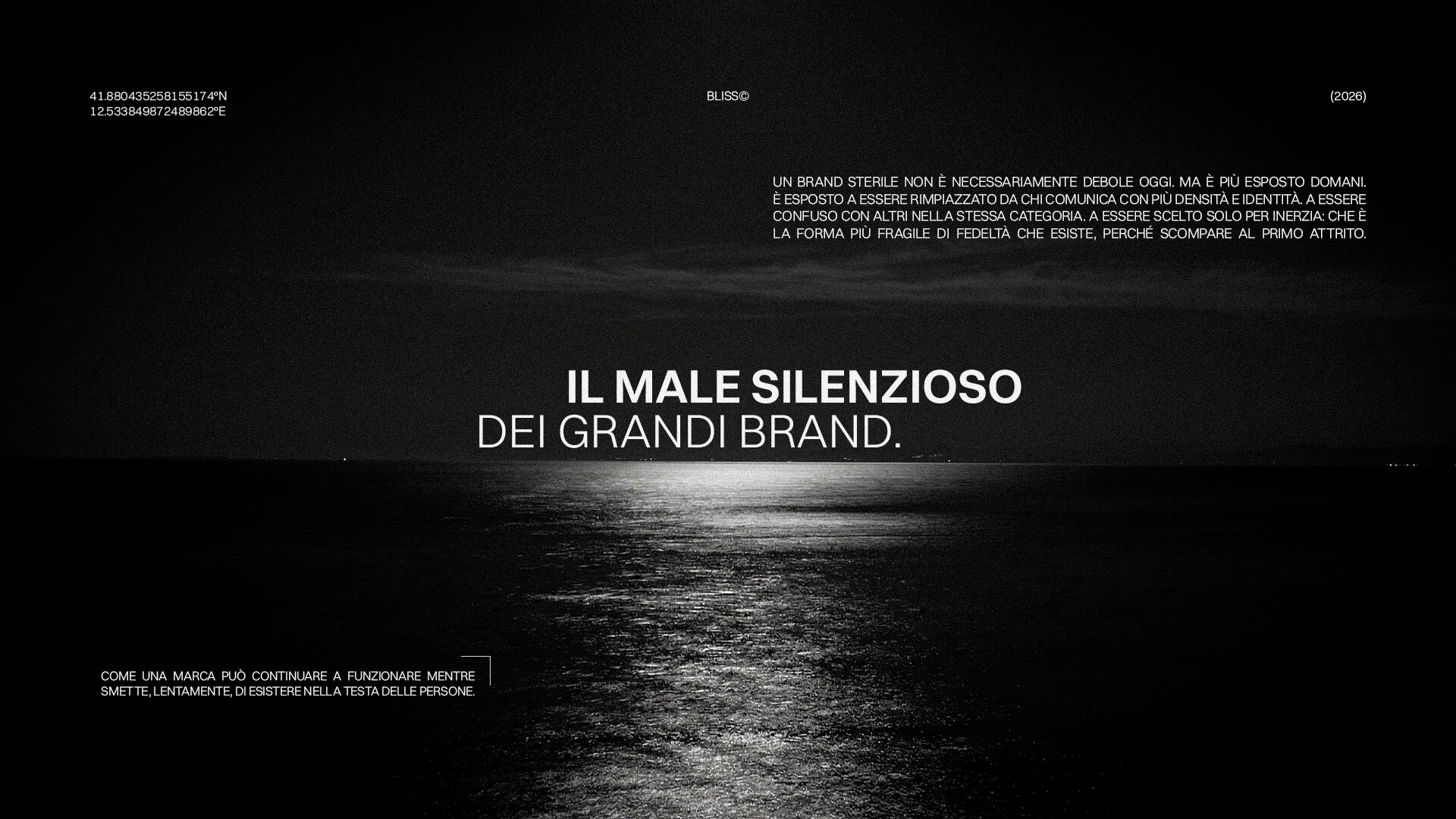
There is a kind of crisis that makes no noise.
It does not arrive with a collapse in revenue, a scandal or a misjudged campaign. It arrives quietly, over time, almost without anyone noticing: not even those whose job it is to notice.
It is the crisis of a brand that keeps publishing, holding its ground, investing, being present. But that has stopped leaving a trace.
It is not a crisis of visibility. It is a crisis of identity. And in the short term, the difference is almost invisible. In the long term, it is everything.
What really happens
As large companies grow, they optimise. It is natural, it is rational, it is necessary. They optimise processes, approvals, visual consistency, reputational control and the predictability of the message. They build systems that reduce the risk of getting things wrong.
The problem is that what makes communication safe often makes it less alive, too.
And so, without a single wrong decision being made, the organisational system begins to expel, slowly and systematically, everything that generates creative friction: fertile ambiguity, tension, expressive risk, point of view, human imperfection. What remains is communication that almost never gets it wrong. But that rarely leaves a mark.
It is sterility. It does not stem from incompetence. It stems from perfection.
What the brain registers and what it ignores
The neuroscience of memory is explicit on this point.
The brain does not retain what is merely correct. It retains what is salient, distinctive, emotionally charged, coherent but not trite. Research from MIT (Bainbridge et al., 2017) identified what neuroscientists call “memorability”: a specific neural signature that the medial temporal lobe automatically assigns to statistically distinctive stimuli, regardless of conscious attention. It is not frequency of exposure that determines what is remembered. It is perceived distinctiveness.
Sterile communication, by contrast, is legible but predictable. Elegant but interchangeable. Polished but impersonal. It enters the perceptual field but does not settle into long-term memory. It produces impressions that fade rather than mental structures that last.
The result is plenty of volume and little trace.
Noise and identity are not the same thing
There is more content today than ever.
More posts, more videos, more campaigns, more presence.
But presence is not identity. Noise is not a mental imprint.
There is a fundamental difference between occupying space and occupying minds. A brand that covers its channels without establishing a clear, living mental difference is doing the former. Only the latter builds advantage over time.
The distinction Aaker formalised decades ago (brand awareness versus brand recall) has never been more relevant. Awareness says you exist. Recall says you are chosen automatically, before the consumer even looks for alternatives. And recall is built only through stimuli that the brain has found distinctive enough to want to retain.
Why the big players seem immune, but are not
Large companies can seem immune to all this because, in the present, they also live off past gains. They live off distribution, commercial structure, historical trust, market habit and the strength of their name. These things hold up. They are real barriers.
The problem is that while they hold up economically, they can deteriorate perceptually. The brand keeps working as a commercial system while it stops working as a symbolic organism. And when the market changes, when a different generation arrives, when a competitor with a stronger identity emerges and habit is broken, that void suddenly becomes visible.
The word that matters: substitutability
A sterile brand is not necessarily weak today. But it is more exposed tomorrow.
It is exposed to being replaced by those who communicate with greater density and identity. To being confused with others in the same category. To being chosen only out of inertia: the most fragile form of loyalty there is, because it vanishes at the first friction.
Substitutability does not show up on the balance sheet. It shows when the market accelerates and the brand has not built up enough cognitive advantage to withstand the pressure. It shows in a growing dependence on media budget, because without continuous investment its presence disappears, a sign that no autonomous mental presence has been built.
What is missing (and it isn’t quality)
It is not a lack of execution, budget or presence.
What is missing is intensity of point of view: a reading of the world that is one’s own, recognisable, and that takes a stand in the highest sense of the term.
What is missing is giving back value: communicating something that enriches the person receiving it, not only the one sending it. What is missing is tension, that mental pull which ensures a message is not merely seen but felt. And what is also missing is perceptible humanity (the corporate machine shows too much, life too little), and legible difference.
Being different internally is not enough. You have to be different in a way that those outside perceive, remember and prefer.
The distinction that changes everything
There is a difference between a strong company and a living brand. They do not always coincide.
A company can be extremely strong operationally and extremely weak as a symbolic organism. It can have sound balance sheets and an increasingly irrelevant place in people’s minds. And when the brand stops truly living in the minds of those who encounter it, over time even its economic strength loses elasticity, because it depends more and more on pressure and budget and less and less on spontaneous preference.
Communication that never gets anything wrong, but never leaves a mark, is not quality communication. It is communication that has turned its function from generator of meaning into keeper of order.
And when a brand stops generating living meaning, it can carry on existing through industrial strength: sooner or later, however, it quietly begins to become replaceable.
Some brand ailments do not erupt.
They accumulate. And that is exactly why they are the most dangerous.
Frequently Asked Questions
How does a strong brand weaken without anyone noticing?
By over-optimising. If communication becomes predictable; if it never gets anything wrong but never leaves a mark either; if the brand focuses too much on what is correct, then it soon stops being distinctive and generating memorable stimuli.
What is the difference between a strong company and a living brand?
A company can be extremely solid operationally yet irrelevant as a symbolic organism. Sound balance sheets and extensive distribution hold up in the short term, but if the brand stops occupying a precise place in the consumer’s mind, the advantage dissolves as soon as the market accelerates or a competitor with a stronger identity arrives.
How do you diagnose communication sterility in a brand?
By asking whether anyone would notice the difference if the content were published by a competitor. If the answer is no, the brand has lost its distinctiveness. It is, therefore, a problem of identity. The cure is not to improve the content but to rediscover one’s own unique point of view.