


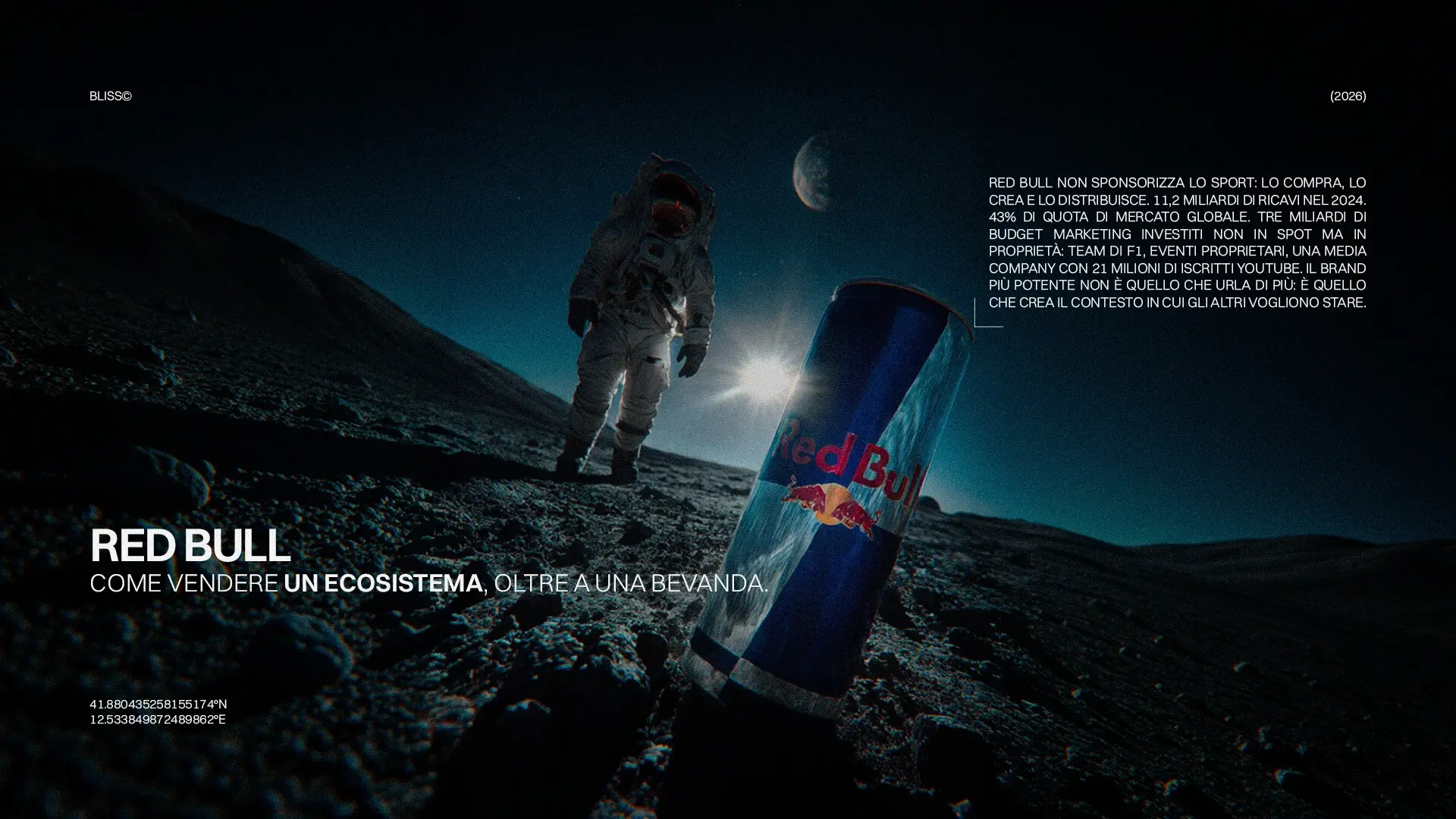
But is Red Bull a drinks company or a media company?
The question may seem obvious, yet the answer is not.
In fact, it may well be neither any longer. Not entirely, at least.
Red Bull, in fact, is now an ecosystem.
At its broadest, it includes football clubs, racing cars, global events, a media house, ventures.
Drinks too, of course. Drinks too…
Understanding how this system works, why it was built and how it can help brands and consumers better understand the market and its strategies is therefore one of the most useful exercises there is.
That is why we at Bliss analysed its entire ecosystem: the numbers, the neuroscience and the logic behind this great big world that is Red Bull.
The numbers behind the structure
In 2024, Red Bull recorded revenues of €11.2 billion, selling 12.7 billion cans in 178 countries.
Its global market share in the energy drink segment stands at 43%. The brand’s value exceeds $20 billion.
The marketing budget is around €3 billion a year, equal to 25-30% of turnover.
A percentage unmatched among the world’s leading consumer brands.
But the figure alone tells us nothing, because what really matters is how it is allocated.
Not into TV commercials. Not into traditional digital campaigns.
Into ownership.
The logic of acquisition: buying the sport
In 2004, Red Bull bought the Jaguar Formula 1 team for one dollar, plus around 400 million in operating costs taken on over the following three years.
At the time, many in the industry judged it an insane move.
A drinks company buying a loss-making Formula 1 team, in a championship whose operating budgets were (and still are) among the highest in world sport, looked almost suicidal.
Yet Red Bull’s logic was simple, and at the time nobody had grasped it.
Until then, sponsorship was the only way into a sport.
But sponsoring a team meant buying space on someone else’s bonnet; depending on the results of an outside driver.
Having no control over the narrative.
Owning a team is the exact opposite.
Every race, every technical update, every win or defeat speaks of Red Bull.
The brand does not gain indirectly: it does not benefit from someone else’s success. It receives all the credit directly. And credit after credit, its credibility grows.
Formula 1 is broadcast in 180 countries, reaching over 445 million viewers. Every race weekend, 24 weekends a year, the Red Bull brand is at the centre of that audience’s attention. As a protagonist.
Today Red Bull runs two Formula 1 teams: Red Bull Racing and Racing Bulls. The first has won six Constructors’ titles and several Drivers’ championships with Sebastian Vettel and Max Verstappen. From failure to success, validating the narrative of that famous promise: “Gives You Wings”.
And so the message that comes across is: if our energy can make a shambolic team win the F1 World Championship, what can it do for you every day?
Not a direct claim, but a subtle one: almost subliminal. And certainly a successful one.
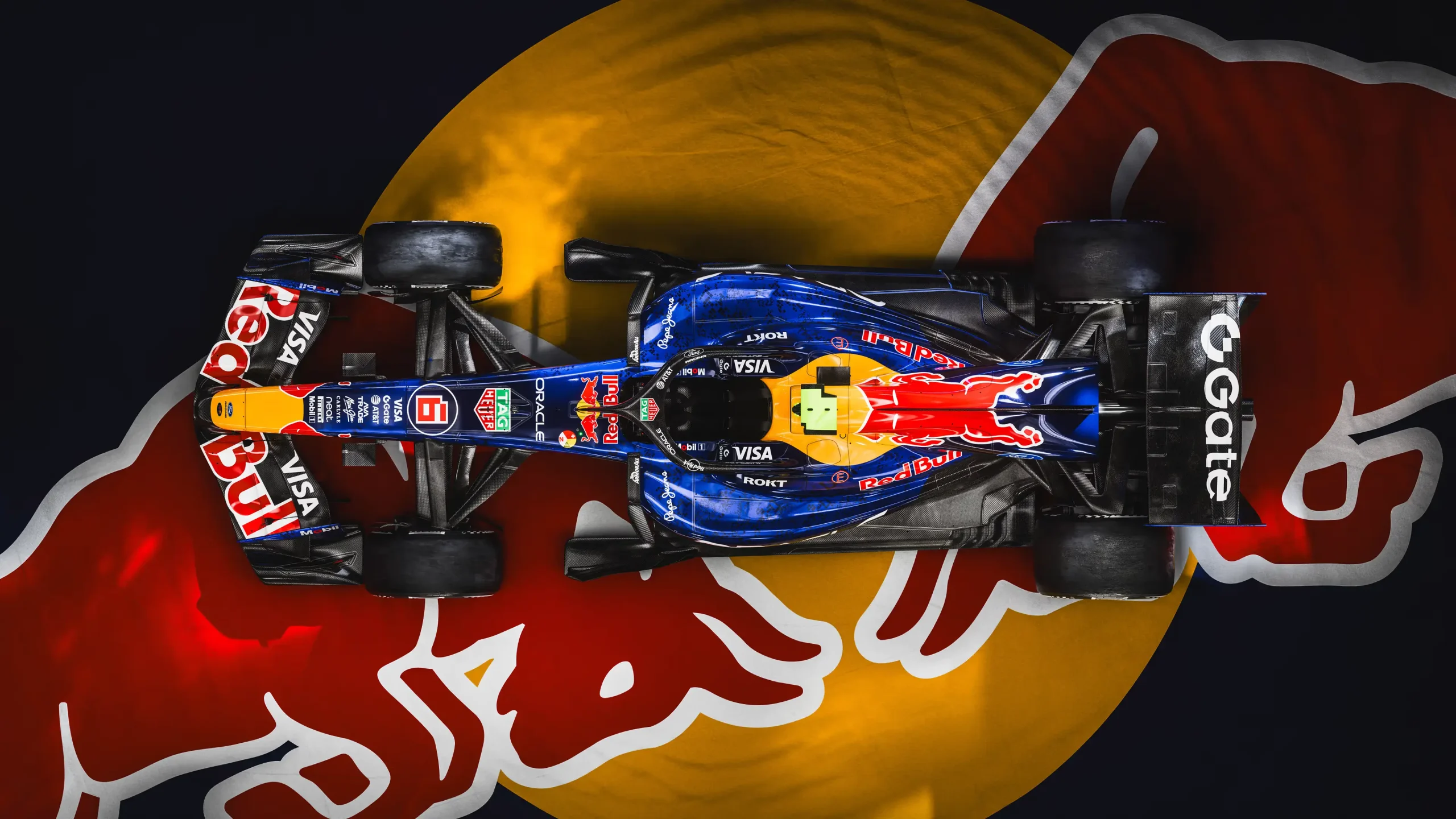
The Red Bull ecosystem: sport, media, athletes, events
From that moment on, Red Bull never stopped.
Its sporting ecosystem today includes over 750 athletes in 73 countries, football clubs on four continents (RB Leipzig, FC Red Bull Salzburg, New York Red Bulls, Red Bull Bragantino), and a circuit of proprietary extreme sports competitions and events created by the brand, such as Red Bull Cliff Diving, Red Bull Rampage, Red Bull Air Race, Red Bull Flugtag and many more.
Once again, the principle holds: when a brand sponsors an event, it is a guest.
But when a brand creates an event, it is the host. It sets the rules, the narrative and the values to be conveyed.
It is the one that owns the content.
In 2007 Red Bull formalised this logic by founding Red Bull Media House: a content production division that makes films, documentaries, live coverage and programmes. Red Bull’s YouTube channel has passed 21 million subscribers. The Red Bulletin magazine reaches 7 million readers. The content licensing system generates around 2.5 billion dollars in revenue.
Red Bull Media House is a media company generating its own profit, going far beyond the role of a communications department.
The content it produces is the purest experience the public has of the brand.
And the can benefits from it.

The Stratos case: the content is the product
On 14 October 2012 Felix Baumgartner jumped from a capsule at an altitude of 128,000 feet (almost 39 kilometres above the Earth’s surface), free-falling until he landed in the New Mexico desert.
The event, called Red Bull Stratos, achieved around one billion views.
No $100 million advertising spot has ever generated that coverage. No traditional campaign has ever produced such a volume of earned media.
Even so, the most interesting aspect of the campaign is the association. Baumgartner leaping from the stratosphere says nothing about the can: Red Bull does not even try to advertise itself. If anything, it communicates one thing only: that this brand is associated with the human capacity to go beyond one’s limits.
Physically, without metaphor.
This is an association worth billions. And one that no traditional advertising could ever deliver.

The psychology of the system: why Red Bull plays on our brains
The Red Bull model triggers a psychological mechanism that conventional advertising cannot replicate.
Whereas traditional advertising is recognisable as such, and triggers automatic cognitive defences in the consumer’s brain, Red Bull content often isn’t even recognised as advertising. On the contrary, it is sought out, shared and watched by choice.
A Red Bull Rampage video is an extreme mountain bike video that happens to have been produced by Red Bull. How could cognitive defences kick in, if there is nothing to defend against?
The result is an association between the brand and adrenaline, between excellence and extreme performance, between courage and the logo.
And this process embeds itself in the consumer’s emotional system without meeting resistance. So every time someone comes across a red and blue can, the association is reactivated at a visceral level.

What the Red Bull ecosystem teaches us
Red Bull shows how the most powerful brands are often those that know how to create a context.
Many organisations sponsor events created by others. Not Red Bull: it has built its own spaces. Agreeing, at most, to rent them out to others.
Although the can that gives you wings remains the product, the brand’s intention is to go beyond a simple commodity. By creating an ecosystem, Red Bull has made the ecosystem itself its competitive barrier.
After all, an ingredient can be copied, and so can a claim or a format. But decades of authentic content, of Formula 1 victories, of athletes who have built their careers within the Red Bull system, and of adrenaline… That, no, cannot be copied.
That is why, after almost forty years, the red and blue can is still worth more than the others.
Because in the collective imagination it will always stand for something different.
New connections (FAQ)
What does Red Bull really sell?
For Red Bull, the physical product and content serve the same purpose: building a precise mental association between the brand and a certain way of life. Rather than buying space on other people’s media, Red Bull therefore created its own: events, channels, original productions. Content is not marketing in the traditional sense: it is the product itself, sustaining the positioning. Anyone who consumes Red Bull content strengthens the association, even without buying a can.
Why has the slogan “Red Bull gives you wings” worked for thirty years without ever being changed?
Red Bull’s slogan works because it never remained merely a slogan: it became a verifiable operational mission. Every Red Bull event, every athlete, every production concretely demonstrates the promise. Consistency over time between what is said and what is done builds neural associations far more resilient than any campaign. Brands that change their message every year optimise for novelty. Red Bull has optimised for depth.
Can Red Bull’s content marketing strategy be adopted on a limited budget?
You don’t need to launch people into the stratosphere to imitate Red Bull’s recipe. It is enough to become the reference point for information and values in your own niche. A blog with genuine authority on a specific topic, an annual event that becomes a fixture: the difference between Red Bull and an SME is not strategy, merely scale.
What are the advantages of owning your own stage rather than renting it?
Platform dependency is a structural risk that most companies fail to account for until it is too late.
Building assets that generate attention without depending on (i) external platforms, (ii) algorithms or (iii) non-proprietary narratives is, instead, how Red Bull has managed to take ownership of its own story.