


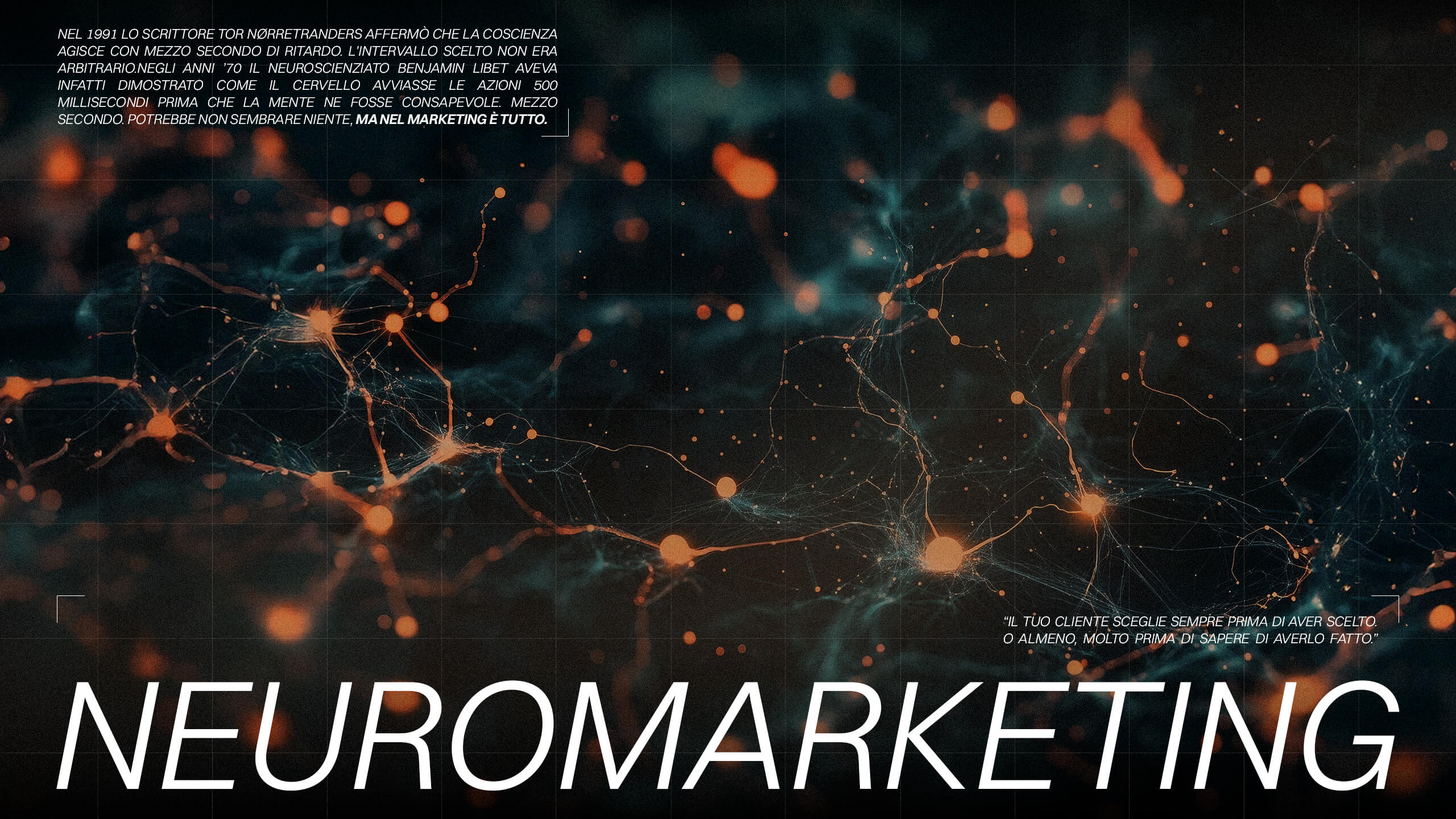
In 1991 the science writer Tor Nørretranders claimed that consciousness operates with a half-second delay.
The interval chosen was not arbitrary. In the 1970s, neuroscientist Benjamin Libet had in fact shown that the brain initiates actions 500 milliseconds before the mind becomes aware of them.
Half a second. It might seem like nothing, yet in marketing it is everything.
Over the years, these studies have shown that most decisions are made before we have even thought about them. It is in this interval — in those few hundred milliseconds that separate impulse from awareness — that effective marketing is won or lost. In that invisible gap between perception and realisation, understanding the link between neuromarketing and the decision-making processes of consumers means no longer working on intuition and starting to work on real data.
The problem is that many brands still believe choices are conscious.
Colours chosen by taste.
Messages chosen by intuition.
Campaigns built on opinions.
The sad truth is that the brain does not work that way. That is why major brands now use Neuromarketing.
In today’s article we will try to better understand what it is and what it does.
Bliss
Speak to a
consultant
Tell us about your project. Together, we will find the right way forward.
Contact usThe brain doesn’t lie (focus groups do)
Every customer always chooses before having chosen.
Or at least, long before knowing they have done so.
Neuromarketing stems from an uncomfortable truth: people do not know why they do what they do.
We have to accept it. Science has now shown that human beings are far less the masters (and authors) of their own choices than they would like to think.
When any of us reasons through a choice, we are in fact rationalising our own impulses.
We believe we make decisions. In reality, we are often just justifying something the brain has already decided.
In 2004 Samuel McClure made this truth undeniable.
Then a PhD student in neuroscience at Baylor College of Medicine, Samuel put a group of volunteers through a blind taste test between Coca-Cola and Pepsi while they lay in an fMRI scanner. The result was disorienting: participants preferred Pepsi in the blind test but said they preferred Coca-Cola when they knew the brand. The scanner explained why. Knowing they were drinking Coca-Cola activated the hippocampus and the medial prefrontal cortex, the areas linked to emotional memory and identity.
For the first time, Neuromarketing showed that a brand could steer a choice. Even when taste pointed the other way.
While traditional marketing has always relied on what is stated, what is observed called for a new perspective: decision engineering.
Neural data before opinions even form.
This is what Neuromarketing studies.
What neuromarketing is and how it influences consumer decision-making
A branch of neuroeconomics, neuromarketing developed at the intersection of psychology, marketing and neuroscience.
It is the application of neuroscientific techniques to marketing, with the aim of explaining purchasing behaviour and decisions.
We could almost call it “depth” marketing: aimed directly at the brain and its dynamics.
Using neuroimaging techniques (and therefore tools such as eye-tracking, electroencephalography and galvanic skin response), science has over the years made it possible to map decisions at the exact moment they were formed.
Today the aim is to intercept those processes in order to develop more effective marketing strategies.
That, beyond the surface, they can reach every level of our reality.
Coca-Cola, again, took this discipline so seriously that it built an in-house neuromarketing laboratory to measure volunteers’ brain responses to different adverts before launch. Since 2013 it has also systematically integrated eye-tracking and facial coding into its quantitative campaign evaluation projects.
Not, of course, to make prettier adverts. The aim is to create advertising that reaches where traditional market research cannot.
The Hierarchy of Perception: the 3 Levels of Value
A stimulus must pass through certain biological filters before it becomes an asset.
Let us call them, if we like, the three levels of depth of value.
To guide people towards choosing a brand, Neuromarketing understood that this is where it had to intervene.
They are:
- Instinct (Reptilian Brain): This is the first gatekeeper. It responds to contrast and survival. If the brand does not communicate “safety” or “immediate advantage” in under 200 milliseconds, this cognitive level shuts every window of attention. It does not ask for aesthetics, but for a reason.
A concrete example comes from the automotive industry: fMRI research on Daimler prototypes revealed that the brain processes the front of a car as a human face, because in our minds the headlights work as eyes. An aggressive or soft design triggers different responses in the amygdala. This discovery redefined the way Daimler designs the front-end styling of its vehicles, differentiating sports models from family models. - Emotion (Limbic System): This is the seat of memory and attachment. Stories are always biochemical vehicles that release oxytocin. It is at this level, then, that Brand Equity is built: an unconscious association between need and identity.
Nike is famous for working precisely at this level. Its campaigns trigger aspiration above all else. It has made emotional storytelling its main driver of long-term brand recall, delivering better results than a mere description of product features. - Reason (Neocortex): This is the final stage. Reason seeks validation, and it is the last to arrive. If the first two levels have done their job, the neocortex will always find a logical excuse to confirm what instinct already decided half a second earlier. Otherwise, it will remain uncertain and torn.
The key to Neuromarketing is to go beyond decoration, messages and stimuli. As we have shown, these are not what hit the mark.
On the contrary, once any intention to “convince” is set aside, Neuromarketing focuses on removing the mind’s obstacles.
It is a work of subtraction, designed to make value visible as effectively as possible.
At every cognitive level.
Where Neuromarketing changes marketing
Neuromarketing comes into play at the points where brands and users might encounter resistance.
In advertising, for example, neuromarketing establishes how effective an advert really is before the market passes judgement. Put simply, it acts as a probe, seeking to understand what reaction it triggers in the limbic system. It is no coincidence that Google used EEG to test a $100 million campaign before launch, measuring consumers’ brain responses to an advert showing happy people dancing around the world. The aim: to verify that it triggered the kind of emotional activation needed to build brand association over the long term.
In the consumer sector, Neuromarketing investigates how behaviour differs across product categories. The Frito-Lay case became a reference point in the industry literature when a traditional focus group rejected an advert considered “too mischievous”, although the EEG had revealed that the participants’ brains found it funny. The limbic response contradicted the verbal one. And indeed, the advert was aired anyway in the end. With results far exceeding expectations.
In services marketing, on the other hand (where the offering is by definition invisible), this discipline combines neurophysiological measurements with company data, so as to eliminate cognitive strain and strengthen trust. Only through fMRI was PayPal able to discover that consumers (while claiming to prioritise security) responded better to speed and convenience. This discovery redefined the brand’s communication: no longer “secure”, but “instant”.
Finally, in social marketing and healthcare services, neuromarketing makes it possible to overcome the brain’s defensive barriers towards complex issues, modulating emotional stimuli that trigger specific behaviours.
Classic points at which brands and users would lose each other, often without even understanding why.
Bliss
Speak to a
consultant
Tell us about your project. Together, we will find the right way forward.
Contact usEthics in Neuromarketing
Though doubts may arise, neuromarketing should not be regarded as manipulation.
Although widespread, this ethical prejudice is in fact unfounded. To manipulate means to force a weak choice. When, instead, a real need meets a solution, with no interference pushing it away, the perspective is entirely different.
Rather than manipulating, Neuromarketing enables customers to overcome their own preconceptions. All thanks to science.
And in this way, absurd as it may seem, it allows people and consumers to act more freely.
Neuromarketing at the service of your brand
Understanding neuromarketing and the decision-making processes consumers go through in those 500 milliseconds between impulse and decision has therefore become a strategic imperative for every brand.
In a noisy market, where every organisation shouts for attention, it is not whoever raises their voice the most who gets through, but whoever speaks directly to the brain of the person listening.
The brands that have grasped this (from Coca-Cola to Google, from PayPal to Frito-Lay) now use neuromarketing to produce truer campaigns, and therefore ones consistent with what the human brain really wants.
That is precisely why evidence-based marketing can no longer be considered a luxury. To ensure that every asset produced, every campaign launched and every decision taken helps build the reputation your brand deserves, you need a guarantee.
That guarantee is called Neuromarketing.
At Bliss, we support entrepreneurs and corporate groups in the decisions that shape the value of their brand over time. Through a method that integrates Brand Governance and Operations, we build or relaunch the reputation of organisations, starting from what truly matters: who you are, how you are perceived and where science says you can go.
Frequently Asked Questions
How does the purchase decision process work in the brain?
Most decisions are made before the rational mind processes them. The limbic system processes emotions and associations in milliseconds. The brand’s task is to build those associations over time, so that the choice happens automatically and in its favour.
Which cognitive biases have the greatest influence on purchasing decisions?
The most relevant are social proof, price anchoring and scarcity. Using them means designing communication so that it reduces cognitive effort and makes the choice easier.
Why does a brand that generates emotion sell more?
Because emotions are the brain’s filing system. An emotionally marked brand is remembered for longer and recalled more easily at the moment of choice.
How can neuromarketing be used in practice without costly research?
You do not need complex machines to do neuromarketing. It is enough to apply principles already validated by research: visual consistency, clear hierarchies, narrative closure. Understanding how attention works and designing every touchpoint to work with the brain is sufficient.