


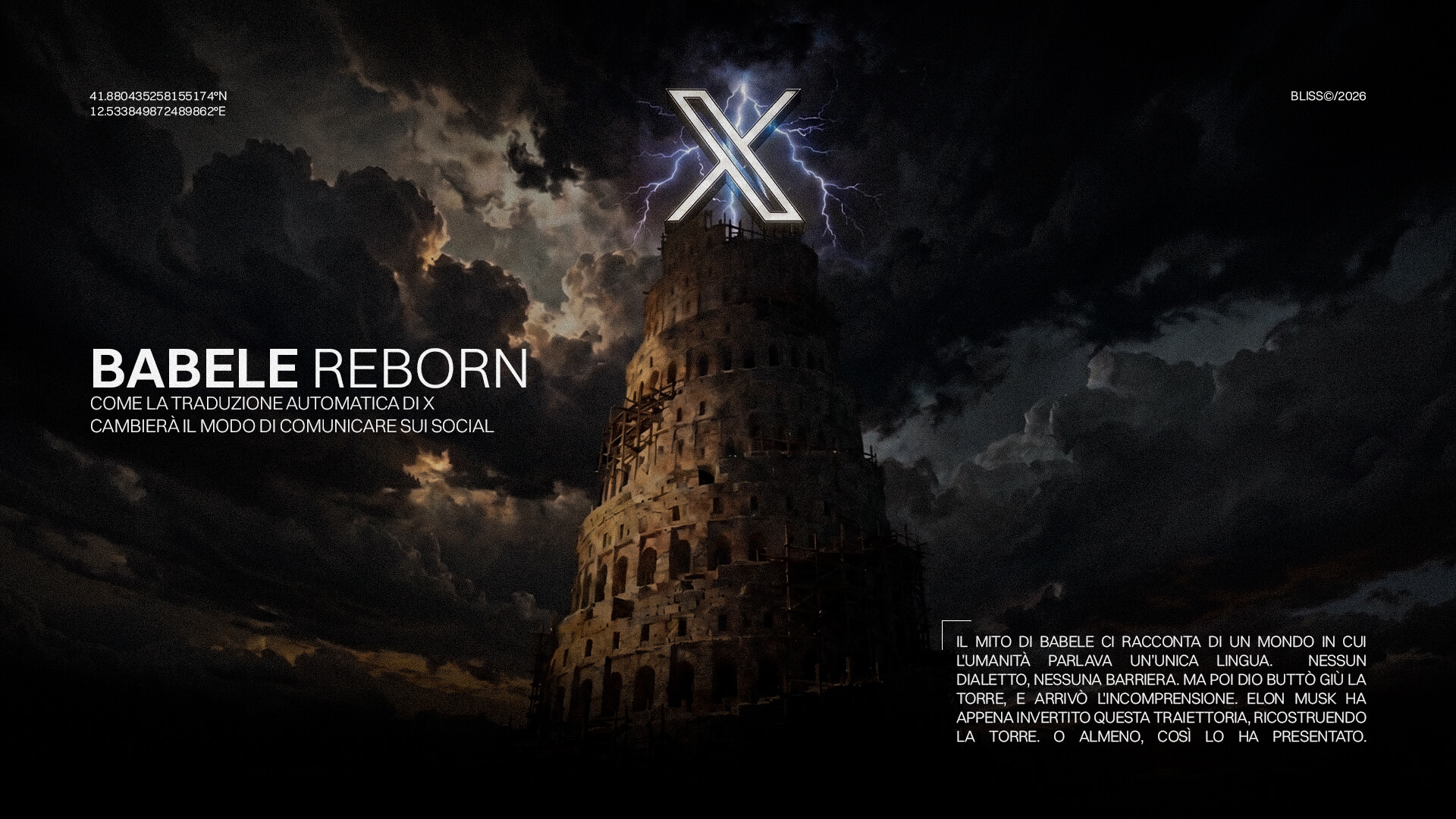
«Tutta la terra aveva una sola lingua e le stesse parole […]
Ma il Signore scese a vedere la torre che gli uomini stavano costruendo e disse: «[…] confondiamo la loro lingua, perché non comprendano più l'uno la lingua dell'altro». […] Per questo la si chiamò Babele, perché là il Signore confuse la lingua di tutta la terra e di là il Signore li disperse su tutta la terra.»
Genesi 11:1-9
The myth of Babel tells of a world in which humanity spoke a single language.
No dialects, no barriers. And so the inhabitants of the earth could engage and converse openly. And in this way, build together. Bring to life a single project, a single vision.
But then (so the Bible tells us) that dream was shattered. God brought down the tower, the symbol of a united humanity. Languages were born: misunderstanding arrived.
Human history, as we know it, began there. And the great project, inevitably, came to a halt.
Elon Musk has just reversed this trajectory, rebuilding the tower. Or at least, that is how he has presented it.
Nikita Bier, Head of Product at X, announced the global roll-out of automatic translation on 7 April 2026.
“We are rolling out automatic translation worldwide to give global reach to posts in any language on X.
Translations are powered by Grok and have improved substantially in recent months.”
In other words, from this month every piece of content published on the former Twitter platform will communicate in the same language, and will be shown automatically to users in an intelligible form. The feature is on by default, and anyone wishing to read the original text will have to switch it off manually, language by language.
“The greatest cultural exchange in history”, as Bier himself had called it the month before.
A phrase that deserves careful analysis.
Because it might be true. Or it might be exactly the opposite.

What happened, technically
X is not the first platform to offer automatic translation.
To be fair, Twitter had been doing this since 2015: first with Bing, then with Google Translate. The difference now, however, is structural. Starting in 2024 X began replacing Google Translate with Grok, xAI’s AI model (fed by the conversations users have on the platform). Then, in April this year, it took the decisive step: automatic translation for everyone, with no need to click anything.
The system supports more than twenty major languages, and every post that appears in a user’s feed is automatically translated into their preferred language.
The original text simply disappears: it remains accessible, but seeing it requires a deliberate action. In other words: languages on X are no longer distinctive experiences.
Babel is standing again.
A shifting perimeter
Let us now step outside the logic of accessibility, however, and look at what this revolution brings (or could bring) to human interaction.
Beyond the narrative with which X presents this decision, we must remember that every language is more than a communication code: it is a clearly defined perimeter.
A language implicitly establishes who is part of a conversation and who is not, what can be said and how, which nuances exist and which have no equivalent elsewhere. Every language carries with it a system of assumptions, references and ambiguities. And none of this transfers automatically.
When X has Grok translate a Japanese post, it is not only tearing down a barrier but also crossing a border. Often without asking permission.
Users around the world have reported the first problems, describing how the meaning of their posts has been completely altered by translation. Jokes that no longer land. Irony that turns into literal statements. Cultural references stripped of their context (exactly what Eco called ‘aberrant decoding’).
And these are not technical flaws that future updates will fix. They are the very essence of cultural variety.

Who wins and who loses
The restoration of Babel pays off asymmetrically.
Contrary to what one might think, those who gain most from the removal of language barriers are content producers who already work in dominant languages (English above all). Whether because translation is better optimised for them, or because the cultural context of their message sits close to that of other strong cultures.
Content producers working in minority languages, or in languages with strong cultural specificity, will instead see their message flattened. And so, over time, what we may witness is an AI-driven homogenisation of messaging: by rendering a message in a more generic and intelligible way, AI will inevitably make it less authentic.
So here is the paradox. A tool presented as democratic risks producing a standardisation of content. Not by some higher design, but as the outcome of a system that will seek to optimise itself.
The consequences for brands
This principle applies not only to people but also to brands.
For those managing corporate communications on X, the implications will be clear.
A post written in Italian by an Italian brand and read by a German user will lose the choice of words, the rhythm of the sentence, the specific tone the copywriter had crafted. The price of greater reach will, of necessity, be a loss of control over the communicative register.
If until yesterday a brand writing in Italian controlled the experience of its text, from this month it can no longer do so: not, at least, with the same degree of control.
Three consequences. The first (already mentioned) is that the brand’s voice will be filtered through a layer the brand neither controls nor chose. As a result, organisations that make linguistic exclusivity their signature may see their messages trivialised. The second is the flattening or distortion of every claim built on wordplay or cultural references. Finally, brands operating in markets with a strong linguistic identity (and Italy is one of them) will lose part of their differentiating value. Becoming less unique.
The end of misunderstanding?
This feature is on by default. Anyone who does not want it must switch it off language by language. No global toggle, no prior question to the user.
This is not the first time something similar has happened. Globalisation has followed this logic for decades. First markets were opened, then supply chains were integrated, and then culture was standardised around a handful of dominant languages. A natural outcome in systems designed to maximise flow.
Back then, those who chose to adopt the parameters of the dominant system gained reach. Those who resisted lost visibility.
X is doing the same with languages. And the point is not whether this is right or wrong (globalisation is irreversible, and its benefits are real): the point is that every time a system optimises for universal flow, something is lost in the process.
The choice to understand one another globally has been made for us. And it says a great deal about what X considers important: global engagement, content reach, volume of interactions. All legitimate goals for a platform. But all goals that look at the system as a whole, not at the individual’s experience or the creator’s voice.

Babel in reverse
The myth of Babel is a story of fragmentation.
When human beings stopped understanding one another, the collective project ground to a halt.
X promises the reverse: from now on everyone will understand one another, and the project can resume. A single conversation, finally possible.
But there is an alternative reading of the myth worth remembering.
The fall of the tower did not merely multiply languages. It was also the birth of diversity. Of local thought. Of each culture’s capacity to develop its own customs and practices. ‘To learn a new language’, it is often said, ‘is to gain a new soul’.
For what is a language, if not the way we think, and therefore see, the world?
Translating everything automatically in real time will not rebuild Babel. It will simply create something new: a single smooth surface across which everything will flow without friction. For better and for worse.
At Bliss we speak several languages: from Italian to English, from Arabic to French, by way of Urdu and Spanish. We love embracing many cultures. This is because, just as we apply an open-door policy (placing the CEO, directors and the newest arrivals on the same footing), we likewise embrace a policy of belonging and mutual respect: listening to different cultures in order to recognise their uniqueness.
Perhaps, then, the question is not whether tearing down language barriers is optimal. The question is: what will we preserve once the barriers come down?
And who has the power to make that choice?
X has just shown that the answer, for now, is Grok.
Frequently Asked Questions
What does X/Grok’s global automatic translation change for brands?
Every piece of content becomes potentially global without the brand having planned it. Everything is translated literally in real time. Those without a structured Verbal Identity lose control of their message in every market simultaneously.
Why can literal translation damage an international brand?
Because words change meaning across cultures. A claim that works in Italian can come across as neutral, ironic or offensive in another language. AI translates the text, not the context. Without cultural review, the speed of machine translation becomes a reputational risk.
How do you protect a brand’s tone of voice in the age of machine translation?
By codifying it before it is distributed. A Verbal Identity documented with glossaries, examples of correct usage and market-specific guidelines is the only tool that maintains consistency when content travels automatically. You cannot control the output without governing the input.