


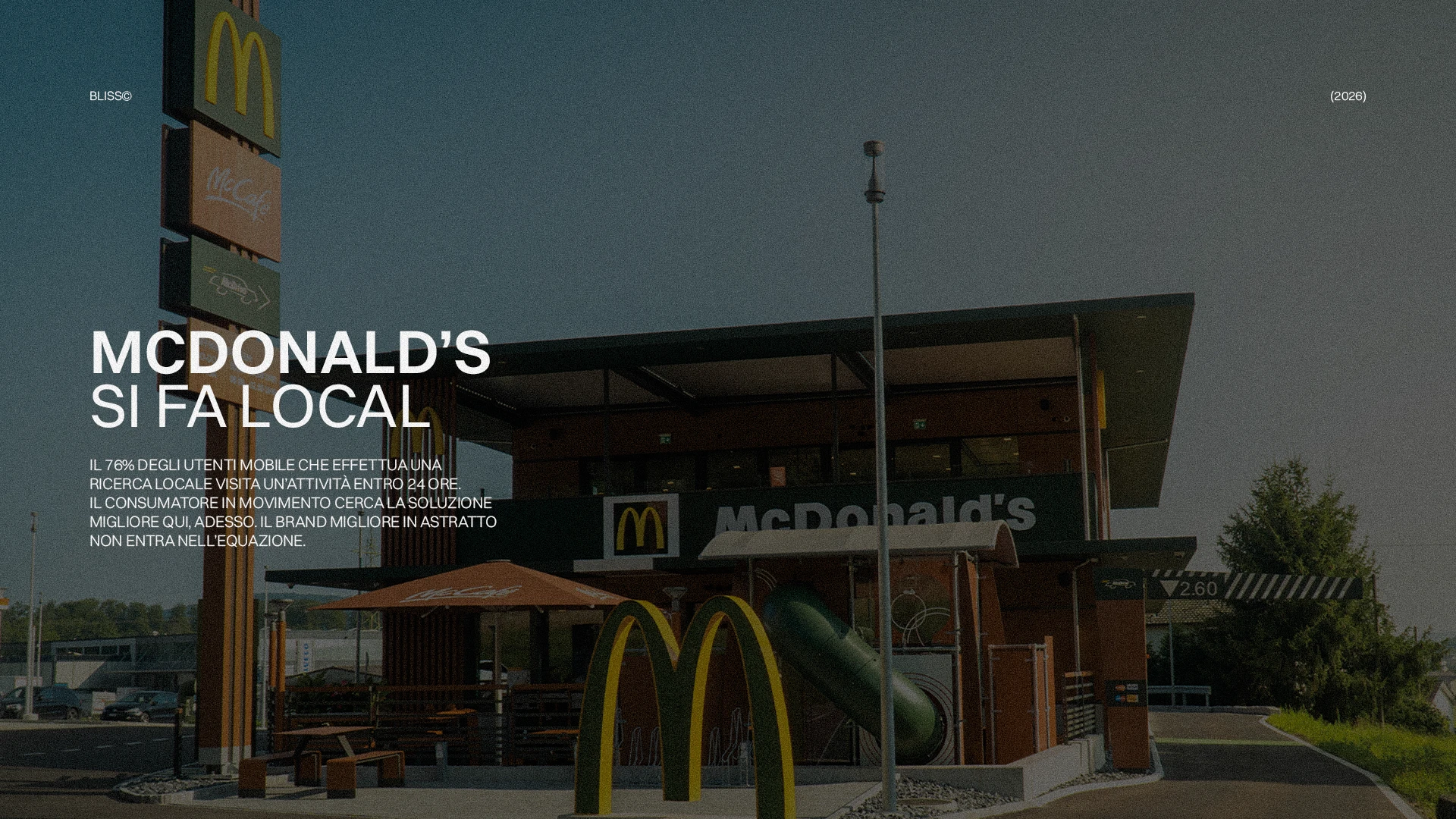
76% of mobile users who carry out a local search visit a business within 24 hours. The consumer on the move is looking for the best solution here, now. And the best brand in the abstract does not enter the equation.
McDonald’s has known this for years. And it has built its infrastructure precisely on this understanding.
Targeting is not understanding
In the geotargeting campaign carried out with GroundTruth in Germany, McDonald’s used Blueprints technology to draw digital perimeters around its restaurants and reach three types of audience. Families in their leisure time, people physically close to a McDonald’s, and consumers who had just visited a competitor.
Each of them received a different message, built on the moment.
Of the audience exposed to the message who then visited a restaurant, the large majority did so within six hours of seeing the ad. The Happy Meal promotion generated verifiable visits within the same time frame.
A case study is the best way to explain what it means to understand the consumer.
Traditional marketing works by approximation.
It defines an audience, builds a message, distributes it. The message reaches many. Few find it relevant. The rest is noise.
Today geotargeting introduces a variable that mass marketing has always overlooked. The consumer’s physical context at the moment of exposure.
“Near me” searches on Google have grown by 900% in recent years. “Open now near me” searches by 400% year on year. The consumer is looking for the best solution now, here, at this moment. And in that condition the brain processes information in a radically different way from when it is at home on the sofa.
Neuroscience describes this through the concept of situated cognition: cognition cannot be separated from the physical context in which it takes place. A message received while physically close to a restaurant activates different decision-making circuits from the same message received three kilometres away.
Proximity reduces the psychological distance between desire and action. It lowers the cognitive cost of the decision. It turns a vague intention into concrete behaviour.
76% of mobile users who carry out a local search visit a business within the following 24 hours. It is a natural response to the relevance of the moment.
The fast-food war
But McDonald’s is not the only one to stake its claim on geolocation in marketing. Its fiercest rival has also grasped its deeper strategic implications.
In 2018, with the “Whopper Detour”, Burger King staked out a 600-foot zone around every McDonald’s in the United States. Anyone approaching a McDonald’s with the Burger King app installed received an offer: a Whopper for one cent.
A campaign built on the logic of local to do something more precise: intercept the consumer at the moment of highest purchase intent. The moment when they are already close to a competitor and receptive to the message of an alternative.
The initiative generated 1.5 million app downloads in 9 days and a redemption rate 40 times higher than the previous record for a digital promotion. A campaign of conquest. Built on the moment, not on the category.

Technology in the service of brands
Geotargeting is accessible to any brand with a physical presence. Beacon technology, small Bluetooth devices placed inside or near points of sale that can detect smartphones within 50 metres and send personalised content, requires investment that is proportionate even for local businesses. It requires clarity about whom you want to reach, when and with what message.
The real barrier is simply strategic.
Most brands build strategies that start from the product and then look for an audience. Geotargeting reverses this logic: it starts from the consumer’s moment and builds the message around it. It is a difference of approach before it is a difference of tool.
Brands that use geolocation and geofencing effectively share one trait. They use technology to build radically different messages depending on the consumer’s physical context.
How to go local
McDonald’s has understood better than others when and where its consumer is ready to act.
That understanding is worth more than any communication built in the abstract. Not least because, ultimately, creativity without context is performance, while creativity with context is persuasion.
The Italian market is still largely geared towards visibility tools that do not distinguish between someone one metre from the store and someone on the other side of the city; between someone who has just eaten and someone who is hungry; someone passing through and someone with time on their hands.
That distinction is the difference between investing in visibility and investing in relevance.
And relevance, at the right moment, converts.
New Connections (FAQ)
Does geotargeting work only for big brands, or for local businesses too?
Scale is not the relevant parameter. Beacon technology and geofencing platforms are available at proportionate cost even to businesses with only a few outlets. What determines effectiveness is how precisely three questions are answered: whom you want to reach, at what physical moment, and with what message built on that moment. A single restaurant with a well-defined situational logic can outperform a chain that distributes the same message indiscriminately.
How do you measure the effectiveness of a geotargeting campaign compared with traditional communication?
Through visitation attribution: the ability to link an advertising exposure directly to a verifiable physical visit. It is the data point that turns geotargeting from a distribution tool into a system for measuring real behaviour. The McDonald’s case with GroundTruth is a clear example: what was measured was not impressions or clicks, but restaurant visits within six hours of exposure. It is the metric closest to real business value that digital marketing is capable of producing.
What is the difference between demographic personalisation and situational personalisation?
Demographic personalisation answers the question: who is this consumer? Age, income, interests, past behaviour. Situational personalisation answers the question: where is this consumer right now, and what are they looking for at this moment? The two approaches produce radically different messages. A 35-year-old consumer with an upper-middle income who is 50 metres from a restaurant at 13:00 on a Thursday is not better reached with a message built on their demographic profile. They are reached with a message built on that precise moment.