


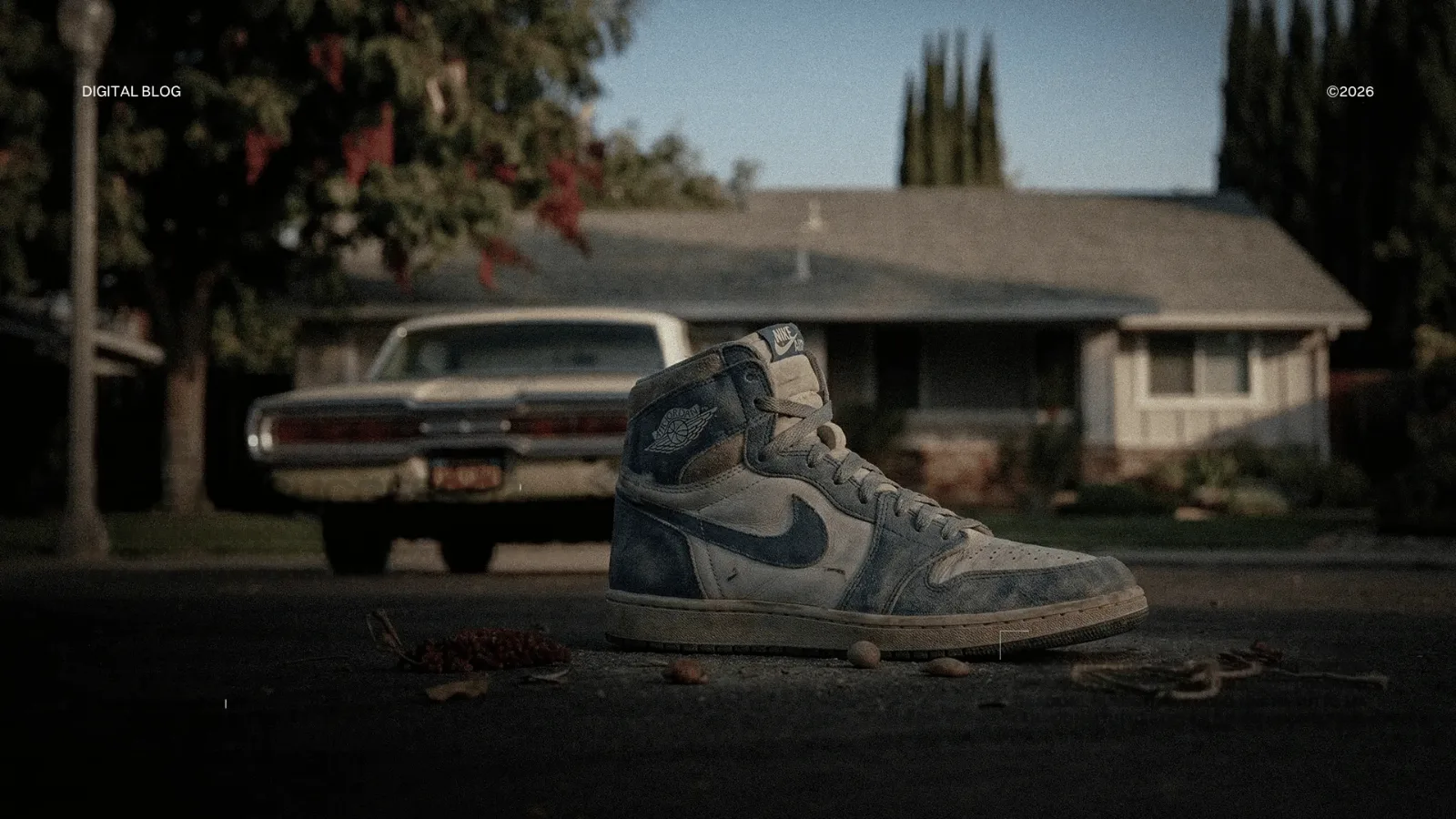
There is a company that invented basketball shoe culture.
That built the most recognisable sports brand in history.
That signed the contract that changed sports marketing forever ($500,000 a year paid to Michael Jordan in 1984: a colossal sum for the time, which everyone said was too much).
That same company, forty years later, has seen its stock fall 27% in a year, its EBIT collapse by 42%, and its Jordan Brand lose 16% of revenue while a Japanese running brand (Asics) grows 600% on the same platforms.
No, this is not the story of a changing market.
It is the story of a company that stopped remembering who it is.
The years when Nike was Nike
Between 2000 and 2010 Nike built something that few companies in human history have ever managed to build: a system in which product, athlete and culture fed one another almost automatically.
LeBron James signs with Nike in 2003, aged eighteen. Kobe Bryant takes the Swoosh into every NBA arena. And so the design evolves season after season, because someone is genuinely pushing for it to improve.
The Vaporfly in running. The Mercurial in football. The Kobe System in urban culture.
During that period, Nike was building the visual vocabulary of global sport.
Then, around 2015, something changed. Quietly, in the most dangerous way possible.

The drift no one noticed in time
Nike’s shift can be read in a data point the industry analysed only in hindsight. Nike progressively moved the centre of its narrative from athletes to macro influencers. Travis Scott. Virgil Abloh. Collaborations with the worlds of fashion and music that made complete sense in terms of visibility, but less in terms of positioning.
Clearly the problem was not Travis Scott but the logic behind his involvement: the idea that the brand’s cultural relevance could be bought through the right partners rather than built through product and athletes.
The difference, seemingly subtle, thus soon produced opposite effects.
An athlete brings technical credibility, loyalty and a narrative close to Nike’s values. What does an influencer bring instead? Immediate visibility and equally immediate decline.
A campaign logic, not a brand logic.
And if you govern a brand with a campaign mindset, this is what you get. Results that last as long as a campaign.
Numbers that cannot be ignored
In fiscal year 2025 Nike reported revenue of $46.3 billion, down 10%. Its worst result in years, excluding the COVID period. Jordan Brand (the division born from that 1984 contract) lost 16% in a year, falling to $7.3 billion. Converse, a brand in Nike’s portfolio, fared even worse, down 19%. Overall EBIT: -42%.
On the StockX resale market (where consumers vote with their wallets, uninfluenced by press releases) Nike and Jordan sales fell 21% in the first half of 2024. Over the same period, Asics grew 600%. Adidas 90%.
These latest figures show that the market is not in difficulty. If anything, it has shifted: and at that moment, Nike was not where it should have been.

Just leave it: when the athletes left Nike
When the people you helped attract start to leave, that is a significant data point.
Roger Federer left Nike for On Running, of which he is now co-owner: and he did not do it for the money. It was a question of contribution. Going where he could build something. Tiger Woods left Nike to found his own apparel brand. Simone Biles moved to Athleta. Josh Allen, quarterback of the Buffalo Bills, chose New Balance.
Nike could afford to pay every one of them: yet they were the ones who went elsewhere.
The reason is always the same, expressed in different ways: Nike was no longer the place where the best things were built. It was no longer the partner that took you forward. It had become a distribution machine with a logo on top.
Sensing this, they left straight away.
The Jordan paradox: the brand dead for twenty years that is saving the company
The most absurd fact in this whole story is something else, though.
Michael Jordan retired from basketball in 2003. In 2024, twenty-one years after his last game, the Jordan Brand was generating $7 billion in annual revenue. Jordan personally collects $300 million a year in royalties: more than any active athlete on the planet. Nike pays a man who has not played for two decades an amount equal to six hundred times his first annual contract.
For years, while Nike’s core brand struggled, Jordan was its mainstay, doubling revenue between 2020 and 2024 while the Swoosh stagnated.
Now, however, even Jordan has begun to give way, and not because it is weak. The most plausible reading is that Nike ended up leaning too heavily on the legacy of Number 23, instead of building new ones. It used Jordan as an annuity rather than as a model to replicate.
That 1984 contract was possible because someone was hungry: hungry for a young, controversial athlete, in a basketball market dominated by Adidas. Forty years later, Nike has everything. But when you have everything, it is hard to stay hungry.

The oversaturation strategy: when scarcity disappears
And then there is one specific mistake Nike made, which the market punished directly.
For years the Nike model rested on a simple principle: the best shoes were hard to find. Limited releases, exclusive collaborations, the SNKRS system with its drops. Everything built a perception of scarcity, which is the most powerful engine of desire.
Then Nike decided to scale. It ramped up production to meet demand. It opened up the catalogue. It flooded its direct-to-consumer channels. It took its shoes to places where they had previously been out of reach.
The result? Only 20% of the new Air Max DN models sold on Nike’s official website. The rest went unsold. And the problem was not the product.
When anyone can easily own a pair of Nikes, owning one no longer says anything. And when a brand loses the ability to say something through ownership, it has lost the hardest thing it could ever have to rebuild.
What the competitors understood
While Nike optimised, the market moved.
On Running, founded in Switzerland in 2010 by three people in a garage, listed on the NYSE in 2021, raising $750 million. In 2024 it was growing at double digits while Nike was losing share. Federer is not there merely as an ambassador. He is there because he believes it is building something.
Hoka entered the premium running market with shoes that looked visually impossible: an enormous sole, polarising design, a high price. It built a tribe of runners who would never go back. In 2024 the brand was posting triple-digit growth.
New Balance did the hardest thing: it held on to its identity in a market dominated by Nike, waiting for the right moment.
None of them beat Nike by copying Nike. They beat it by being exactly what Nike had stopped being: a brand with a point of view.
The new CEO and the question that remains open
In October 2024 Nike brought back Elliott Hill, the old-guard Nike executive who had taken the Jordan Brand international in the 1990s, to lead the restructuring.
The signal is clear: the company knows the problem is cultural before it is operational, and knows it needs someone who remembers what building Nike meant when Nike was truly Nike.
Whether it works depends on a single variable: whether Nike can still behave like a company with something to prove. Or whether the organisational system built over thirty years of leadership has become too heavy to allow that lightness.
The answer will come over the next three years. The markets are already placing their bets.
Why this article exists
And yet, contrary to what you might think, this is not an article about Nike.
It is an article about what happens to any brand, large or small, when it stops treating its positioning as something to be won every day.
Nike is the most visible, most documented, most striking case study of a phenomenon that is replicated on a smaller scale in thousands of companies. The moment when success becomes an annuity. When hunger turns into management. When the brand stops pushing itself and starts defending itself.
The market does not wait. Nor is it sentimental.
Domande frequenti
Why has Nike lost its appeal despite still being the largest brand in the sector worldwide?
Because it optimised distribution instead of protecting desire. When a brand is everywhere (in every supermarket, every outlet, every promotion) it stops being aspirational. The brain reads rarity as an indicator of value: the more accessible something is, the less exclusive it seems. Nike chased volume and sacrificed the perception of uniqueness that justified its premium pricing. The numbers stayed high for longer than the positioning did.
How do small brands such as On Running or Hoka compete with Nike?
By doing exactly what Nike stopped doing: holding a specific territory with a precise identity. Speaking to someone (not everyone) very clearly. Building loyal communities, low acquisition costs and protected margins. Size is not an advantage when the market rewards relevance to a specific target over generic awareness. Being irrelevant to the majority but essential to a niche can be worth more than the reverse.
Can a brand that has lost its exclusivity win it back?
It can, but doing so demands painful choices that are irreversible in the short term. Cutting distribution channels, eliminating product lines that do not communicate value, returning to investment in projects with a strong impact on identity. All of this requires structure. Declaring a return to premium is not enough: it has to be proven through choices that cost something.