


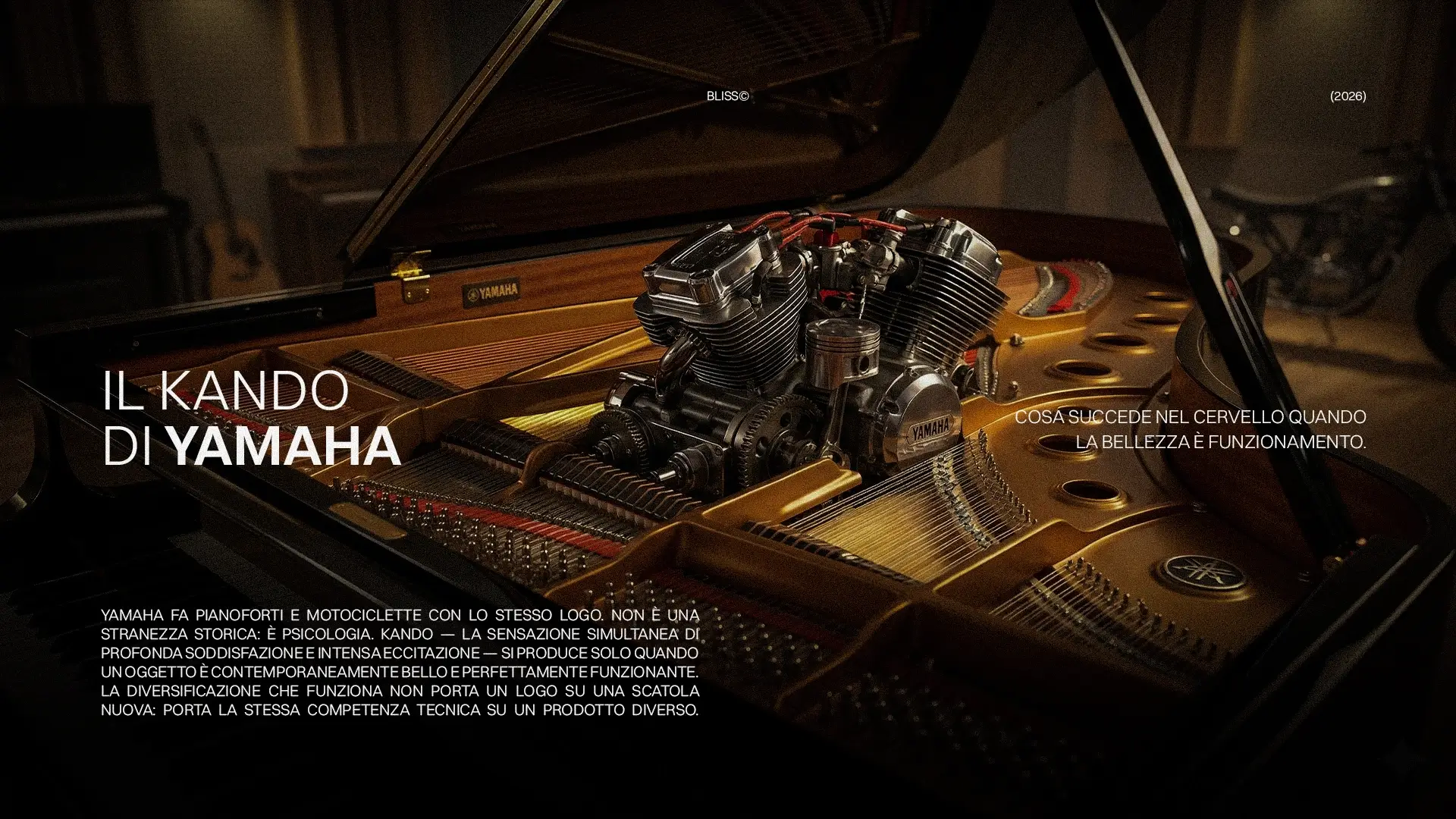
Yamaha makes pianos.
But also motorcycles.
And although it might seem so, this is not strange, because Yamaha shifted its value chain from a product to a concept. And that has made all the difference in the world.
Its logo belongs to two completely different worlds. It is engraved as much in the world’s most important concert halls as on a 200-horsepower engine on the track. Three tuning forks arranged to form a wheel: always the same three.
Always and only Yamaha.
The most obvious question is: how is this possible? How can the same brand make musical instruments and motorcycles without one damaging the other? How can a conservatoire pianist and a track rider share loyalty to the same brand?
The answer lies not in corporate history, but in psychology. Or rather, in beauty.
In this case study we will talk about beauty, and what the sight of a well-made product does to the human mind. Above all, we will understand why most brands that try to diversify fail.

Kando: the concept that unifies everything
Yamaha’s guiding philosophy is captured in a single Japanese word: Kando.
The official translation is “the simultaneous feeling of deep satisfaction and intense excitement that one experiences when encountering something of exceptional value”.
Clearly, this is not the description of a product. If anything, it is the definition of an experience.
Yamaha Motor Company was founded in 1955 as a spin-off of Yamaha Corporation, the musical instrument company established in 1887. The two entities are now independent but share the same symbol, the same manufacturing approach and the same underlying philosophy. Even the three tuning forks logo is no accident: three musical instruments forming a wheel. Music and mobility, fused into a single mark.
The physical link between the two worlds was there from the very beginning.
When Yamaha built its first motorcycle prototype, the founders applied the metal-casting techniques developed for producing piano frames. The engine had to be beautiful, not merely functional. The founder Genichi Kawakami held one conviction: Monozukuri (the Japanese approach to manufacturing that combines engineering and craftsmanship) had to produce objects with aesthetic as well as technical value.
What creates beauty in the human brain
What happens in a person’s mind when they encounter something beautiful and functional?
Neuroscience has found that the brain’s reward system activates more intensely and for longer when faced with objects that deliver satisfaction across multiple sensory and cognitive channels.
To be clear: an object that works well activates one circuit; a beautiful object activates a different one. But an object that is both functional and beautiful activates both, producing an experience that is not the sum of its parts but something qualitatively different.
Yamaha set up a scientific collaboration to study this mechanism. The Kando Research Project, developed with Dr. Mark Changizi and the Caltech Shimojo Laboratory, identified three factors required for a Kando experience to occur: physical (somatosensory) actions, intense emotion and the dynamics of emotion over time.
For Kando to take hold, an object must demand physical participation, generate emotion and make it evolve.
A Yamaha piano meets all three criteria. So does a Yamaha motorcycle. But this is no coincidence. It is simply the logic of objects created to be more than consumer goods.

Why Yamaha succeeds
The Yamaha case is interesting not only for what it did, but for how it did it.
The diversification from pianos to motorcycles did not happen because someone thought “we are a manufacturing company, we can make anything”. It happened because the metal-casting expertise developed for piano frames was directly applicable to engine production.
The diversification was technical before it was strategic. Kando was already embedded in both products before it even had a name or was discovered.
This is the point that brands which fail at diversification almost never grasp: diversifying does not mean putting a logo on a new box.
The history of branding is full of brands that looked at their own success and thought: we can take this value anywhere. And which, almost always, were wrong. Here are a few examples.
Harley-Davidson Perfume (1994)
Harley-Davidson is one of the most powerful brands in the world in terms of emotional identity. Freedom, rebellion, muscular authenticity. When the brand launched a fragrance line, however, the result was a disaster.
The product was not even poor. The consumer’s brain simply could not connect “Harley-Davidson” with anything delicate, precious and fragrant. The brand’s identity was so strong in one direction that any other association became impossible. Loyal customers felt betrayed. New customers were never won.
The product was soon withdrawn.
Colgate Kitchen Entrees (1982)
Colgate is synonymous with oral freshness and toothpaste. In 1982 it launched a line of frozen ready meals, including a beef lasagne. The cognitive association was beyond recovery: consumers’ brains had already encoded “Colgate” as “something you spit out”. Eating something branded Colgate triggered a visceral response of disgust. The product was swiftly withdrawn and remains, to this day, the case study most cited in business schools as an example of an impossible brand extension.
Swatch Car (1994)
Swatch had become a symbol of accessible, playful design. The partnership with Mercedes to produce the Smart was an attempt to carry that design into the automotive sector. The result was ambivalent: the product survived but never took off as a Swatch brand. After all, credibility in making colourful watches does not transfer into credibility in making safe vehicles. The cognitive domains were too far apart.

How to tell genuine diversification from cosmetic diversification
Over the years, Yamaha has shown that it can thrive in its ambivalence because the same technical expertise that makes product A excellent directly produces the technical expertise that makes product B excellent.
Conversely, Harley-Davidson, Colgate, Swatch and many others failed because the emotional identity of brand A could not transfer to the experience of product B.
Indeed, it blocked it.
Kando cannot be taught. If anything, it can only be built over time, one product at a time, through a craftsmanship that the consumer’s brain recognises before it even understands it.
It is the feeling you get when you press a key on a Yamaha piano and the sound responds exactly as you expected. Or when you open the throttle on a Yamaha YZF and the bike gives you what it promised.
Pure beauty. Simple, flawless perfection.
New Connections (FAQ)
What is Kando, and why does it change the way a brand is built?
Kando is proof that the most solid brands are not built around a product, but around an experience. Yamaha did not diversify from pianos to motorcycles because it had the resources to do so. It did so because both products expressed the same philosophy: objects that demand physical participation, generate intense emotion and make it evolve over time. This is why the three tuning forks logo works in the concert hall and on the track. It does not represent a product category. It represents a level of experience.
Why does brand diversification almost always fail?
Because most brands confuse emotional identity with technical competence. Harley-Davidson had an extremely powerful identity, but that very strength made any association in other directions impossible. Colgate’s positioning was so deeply rooted that it provoked visceral disgust in distant categories. Diversification works only when the competence that makes product A excellent directly generates the competence that makes product B excellent. Yamaha succeeded because the metal-casting techniques developed for piano frames were directly applicable to engine production.
What happens in the brain when a product is beautiful and functional at the same time?
Neuroscience has shown that an object that works well activates one reward circuit in the brain, and a beautiful object activates a different one. When both qualities coexist, the two circuits fire simultaneously, producing an experience that is qualitatively different from the simple sum of its parts. Yamaha’s Kando Research Project, developed with the Caltech Shimojo Laboratory, identified three conditions necessary for this to happen: physical somatosensory participation, intense emotion and the dynamics of emotion over time.
BLISS®
© 2026. ALL RIGHTS RESERVED