


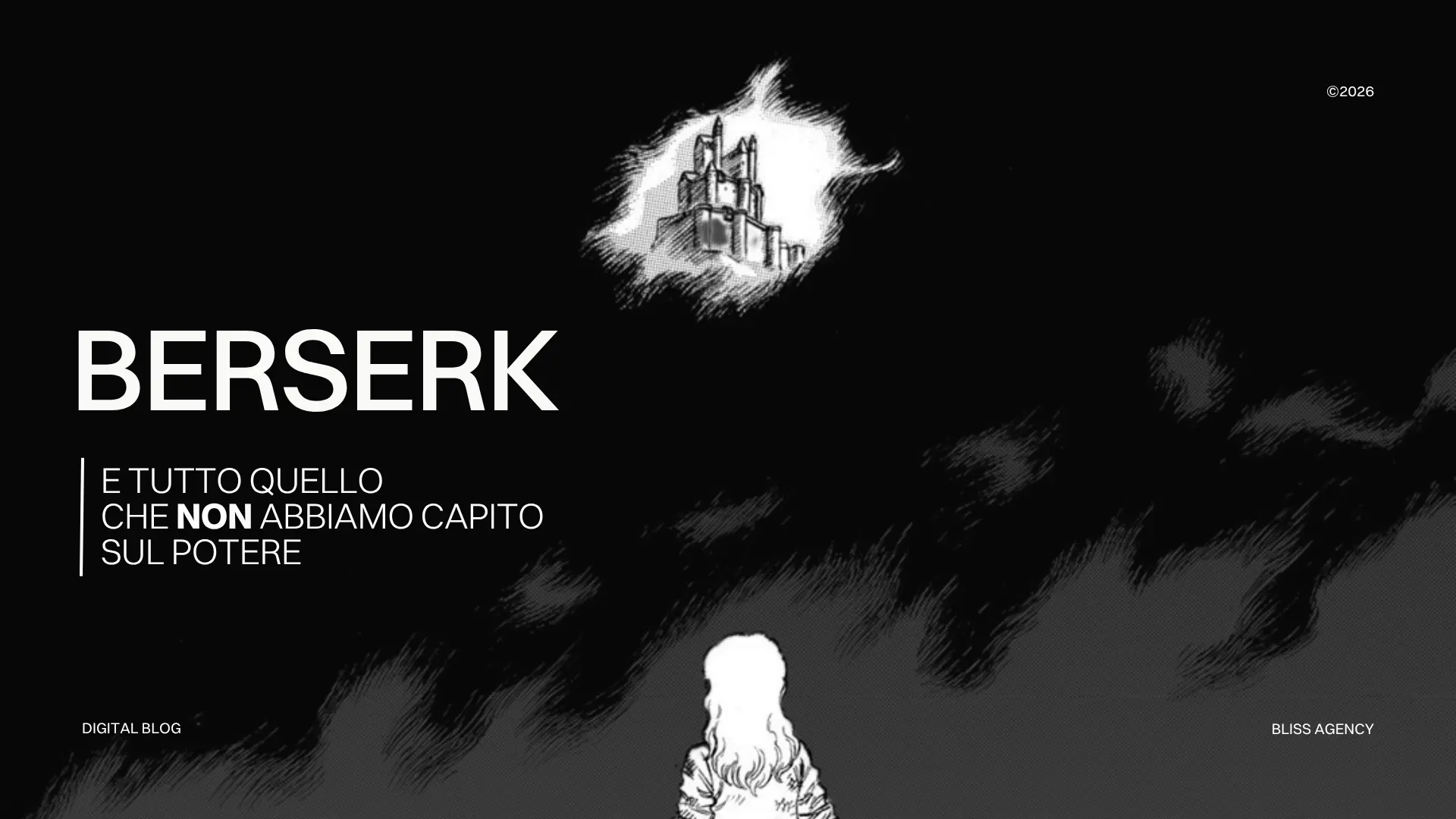
Berserk e la lezione di leadership più difficile che la letteratura giapponese abbia mai scritto.
Kentaro Miura spent thirty years building a legendary story, putting his own life on the line along the way.
In the end, the master passed away in 2021 at the age of fifty-four without ever managing to finish his masterpiece.
And so Berserk remains unfinished, despite the efforts of his friend Kōji Mori and Studio Gaga. Yet despite this (or perhaps precisely because of it), the story it tries to tell remains one of the most powerful, intense and controversial ever created in human history.
In particular, it is the eclipse (thirty years on) that still shocks readers who come to the work unaware.
Griffith is born with a dream: the ambitious (but also absurd) idea of having a kingdom all his own. And the fact is that, to reach this goal, he would have everything: charisma, intelligence, vision. After years of campaigns, even an army: mercenaries with neither trade nor standing, who recognised in Griffith a light, a direction. A hope.
Even Guts, the tragic protagonist of this story, can do nothing but admire him and follow him into battle. But just one step away from reaching that goal, everything collapses: Griffith’s blind ambition and narcissism lead him to make a mistake. Perhaps the first spontaneous, uncalculated act of his entire career. Prison follows, then torture. Forgotten by the world but not by the Band of the Hawk, Griffith is freed, but… to what end? He is no longer a warrior, and can never again aspire to any kingdom.
And so, faced with a choice (sacrifice everyone, or sacrifice his dream for good) Griffith will choose.
And that choice will be the eclipse.
Beyond the literary value of this story, we want, and need, to find in this parable (which rises from dream to triumph, then plunges into blind ambition) an extraordinary lesson for brands and for those entrepreneurs who, deluding themselves that they can reach better shores (higher earnings, a more central role, or perhaps celebrity), sacrifice in the process all the people who helped get them there.
How did Miura manage, with Berserk, to speak to people and organisations alike? Perhaps because great texts never age: they speak of human conditions that the market, management and history have never resolved. The same questions about ambition and illusion that Miura placed at the heart of his story, and that CEOs and boards today should make the effort to ask themselves, well before finding themselves with a behelit in hand.
In short, contexts change, but structures remain.
And so, in this new column dedicated to art and literature, Bliss brings the great texts into the present. Because the solutions to the problems every person and every company faces have already been found.
You only have to look for them.

The illusion of choice
In Berserk, Griffith is faced with a choice: and yet we know that time is only an illusion and that in Karma everything is already written.
In somewhat more prosaic terms (a legitimate reading to pursue, in my view), this means that the choice was in fact always illusory: the leader of the Band of the Hawk had already decided what to do long, long before. And he had done so from the very first day.
Almost as if everything had already happened the moment we chose it. The process is a mere formality.
The people around him had only ever been pawns in his plans: steps he needed to climb the peak that led to the castle of his dreams.
Likewise, history is full of such individuals. And the history of the market perhaps even more so!
So be careful about calling Griffith a monster, because many brands and many entrepreneurs are not so different, and their stories bear witness to it.
We are talking about the leader with total vision and little care for people. About the system that bears the load as long as everyone holds it up, and turns out to have no foundations the moment someone chooses to step away. About the corporate culture built around the founder’s personality rather than around a transferable architecture of values.
Business is full of eclipses: moments, that is, in which brands’ real intentions were revealed.
Heaven forbid anyone say they have changed.
Just think of when Elon Musk acquired Twitter in 2022 and laid off 75% of the staff within a few weeks: the official narrative was one of radical vision. A leaner, faster company with a new focus. Yet within eighteen months the platform lost more than half its estimated value. Advertisers pulled out. The talent that had built the product did not return. And all to put Musk at the centre and guarantee him total governance.
Today X is probably worth more than before, but it is not the platform it once was, and it never will be again.

Something similar happened with Oculus, when Palmer Luckey, a young and charismatic tech enthusiast, launched Oculus Rift on Kickstarter.
The community of gamers and independent developers rallied around him, funding the project. Yet in 2014, as soon as the brand reached its peak value thanks to the community’s momentum, Luckey sold Oculus to Mark Zuckerberg for 2 billion dollars. And for the early fans it was a true eclipse. Their dream of an open, independent virtual reality vanished. Evidently it was not really Luckey’s dream: he got his “kingdom” (the billions) by sacrificing his most ardent supporters.
Of course, it is natural to wonder: in their place, what would you have done?
Every brand that grows large enough sooner or later receives an offer that would change everything. And in economic terms, not every eclipse ends badly. X is worth more today than Twitter. Palmer Luckey is a billionaire. OnePlus still sells smartphones. Wouldn’t I want to be in their shoes?
I am not the point. The point is the brand, which is no longer what it was: and the community too, yes, which, having been taken in once, may never again support an organisation in the same way.
The lesson of Berserk
Above all, Miura teaches us one thing: to believe in ourselves, far more than in others.
Yes, there is strength in numbers (and if the work is ever finished, it will be Guts’s Band that resolves everything, I am sure of it), but you can only form a group when you are sure enough of yourself not to cling to others out of need, but only out of shared ideals. Following someone who wants a kingdom of their own only makes sense if you want that kingdom too. Otherwise, sooner or later there will be an eclipse, and the one who sacrifices the other will be the person with the greater ambition.
Not the one with the gentler ideals.
This lesson, however, concerns consumers.
And what about brands and entrepreneurs? To be honest, I am not convinced myself. Perhaps because everything I would be tempted to say is rhetorical and obvious. After all, how would I behave with a Behelit in my hand? Whom would I sacrifice to make my dreams come true?
Perhaps the greatest lesson Miura left us is not an answer but a question: or at least, the importance of asking all these questions before choosing and acting.
Because only if you have the courage to ask yourself these questions will you be able to find the answer, and understand what kind of person you are.
The kind who would sacrifice everything for a kingdom of their own.
Or the kind who, through sacrifice and empathy, would be able to build one. And to rule it.
New Connections (FAQ)
What distinguishes a leader with vision from a leader like Griffith?
The answer to the question: who does this organisation exist for? If the answer is the leader’s dream, the organisation is Griffith. If the answer includes the people within it as a value in themselves, it has a structure that holds even when the leader is gone.
How does a professional recognise that they are building their identity around an external reference point?
By asking what would remain of yourself if that company, that mentor or that role disappeared tomorrow. If the answer is very little, the most urgent work is not professional. It is about identity.
Why is Berserk literature and not just entertainment?
Because the questions it raises, about power, sacrifice, identity and direction, have no comforting answers. Miura absolves no one. He simplifies nothing. It is exactly the kind of honesty that storytelling owes to the people who read it.