


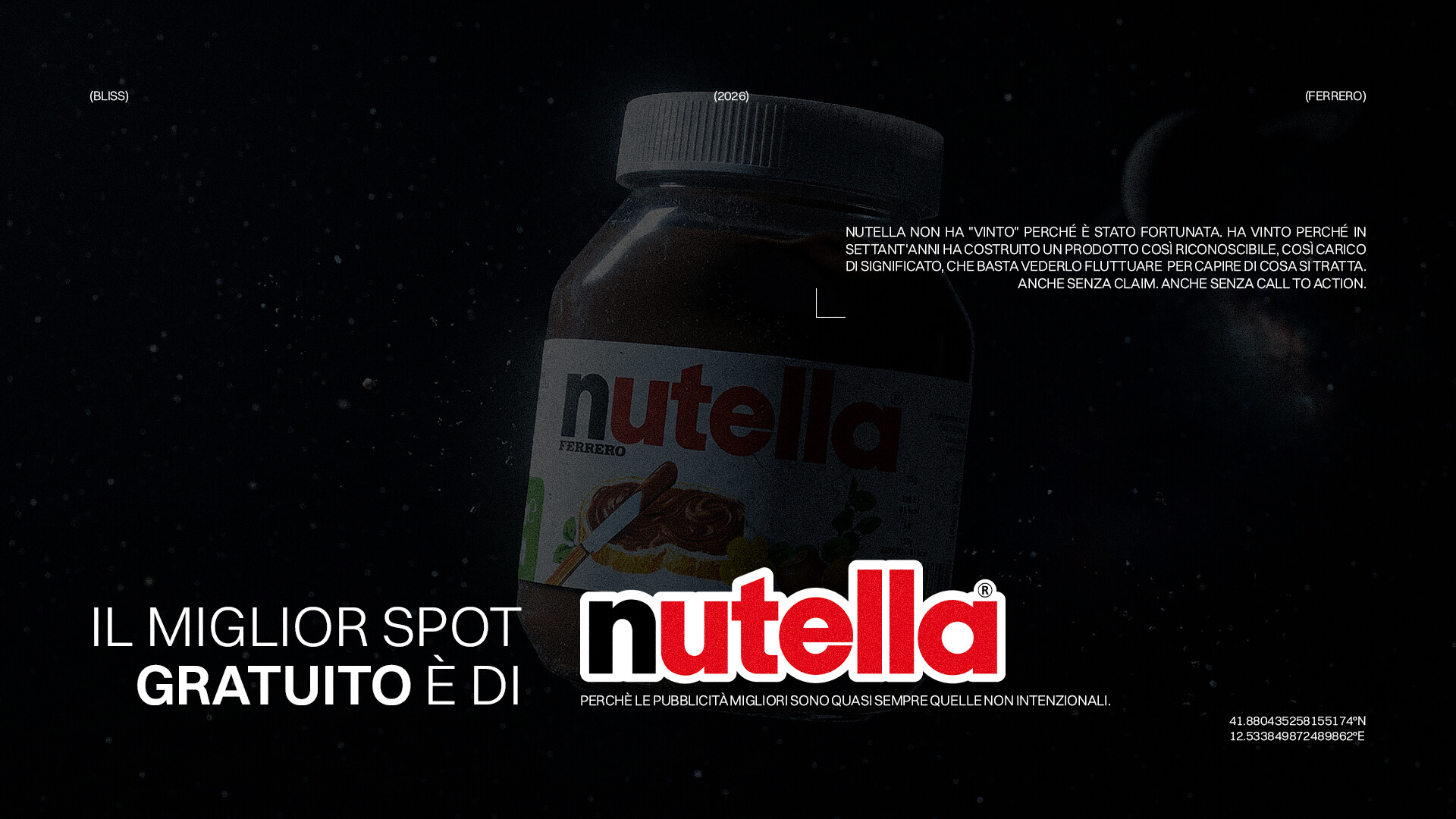
There is a video that lasts five seconds. And it has gone around the world.
During the live broadcast of the Artemis II mission (the first crewed flight around the Moon since the Apollo era, 406,000 kilometres from Earth), as the astronauts were stowing equipment in the Orion capsule, a jar of Nutella enters the frame from the right, drifts slowly across the screen from left to right, suspended in zero gravity, and disappears.
Five seconds. No commentary. No voice-over. Just a brown and white jar floating in the void of space while humanity looks on.
The doubt the brain cannot silence
“It’s fake.” “It’s AI.” “Ferrero paid NASA.” “Product placement has reached space.” The theories multiplied as fast as the video spread. And this is not a social media phenomenon. It is pure neurobiology.
The human brain is, at its very core, a pattern-seeking machine. This is not a metaphor. It is anatomy. The prefrontal cortex, the limbic system, the caudate nucleus: structures that evolved over millions of years with a single purpose: to find connections, identify causes, turn chaos into intelligible order. On the African savannah this ability could mean the difference between life and death: those who recognised the pattern “movement in the tall grass equals predator” survived. Those who put it down to the wind did not.
The problem is that in 2026 this same neurobiological machine still works exactly as it did then. When it sees something extraordinarily convenient for a brand at the most visible moment in the history of space exploration, it does not calculate probabilities. It looks for the intentional cause. It looks for the hidden director. Because a brain that has been finding patterns for millennia cannot conceive, at a visceral level, that some coincidences are simply coincidences.
Psychiatrists call this mechanism apophenia, a term coined in 1958 by Klaus Conrad to describe the tendency to perceive meaningful connections between unrelated events. Conrad studied it as a psychotic symptom, but later research showed it to be a universal feature of human thought. Not a pathology: a neurological default. The brain generates pattern interpretations automatically, before the conscious mind can even intervene. And it does so with the same sensory certainty whether the pattern is real or imagined.
What we actually know
NASA has denied any commercial agreement. The official explanation, confirmed by the agency, is as mundane and as human as it gets: astronauts may take small quantities of personal food on board, outside the standard freeze-dried menu. The jar of Nutella was a personal “treat” belonging to a member of the crew. Technicians and spaceflight experts also noted, with a certain irony, that Nutella is technically almost perfect for consumption in space: high calorie density, no crumbs, no refrigeration required, a shelf life of more than two years.
But the denial did not stop the doubt. It could not. Because the doubt does not arise from logical reasoning: it arises from a neurological system that has already processed the scene and already decided that the sequence is too perfect to be random. And once the brain has activated that interpretation, silencing the signal is cognitively costly.
A study published in Frontiers in Neuroscience showed that people who tend to recognise patterns in ambiguous stimuli (a very broad category that includes most human beings) begin to build causal narratives even when explicitly told that the events are random. Once generated, the narrative tends to resist refutation. Confirmation bias. The backfire effect. The more meaningful a pattern seems, the more the brain defends it.
And the doubt remains. Because it is there. Because it is convenient. Because it is part of how we are made. As Psychology Today explains well, apophenia is not a pathological distortion: it is how the human brain is designed.
The context that feeds every suspicion
There is, however, one element that makes the doubt less irrational than it seems. And it is worth saying clearly.
Ferrero is currently pursuing the most aggressive commercial expansion in its history in North America. The 2024/2025 financial results are explicit: global turnover of €19.3 billion, capital expenditure of €1.1 billion, 4.5% growth in the US market. A new plant in Bloomington, Illinois, producing Kinder Bueno. A $445 million expansion in Brantford, Ontario, which will take Nutella Biscuits production outside Europe for the first time. The acquisition of the WK Kellogg cereal portfolio for $3.1 billion. In five years, Ferrero’s US workforce has grown from fewer than 300 to more than 4,000 employees.
And in parallel: a marketing campaign worth over $100 million launched in autumn 2025, with a Super Bowl ad for Kinder Bueno and a massive global activation for the 2026 FIFA World Cup, the largest joint marketing operation in the group’s history, involving more than 20 brands including Nutella, Ferrero Rocher and Butterfinger. The official Nutella USA account responded to the Artemis II video within a few hours with the lines “Nutella is out of this world” and “Honored to have traveled further than any spread in history.” Reactive, fast, precise communication. Not a single misstep.
Put these elements together and you understand why the brain struggles to stay calm. Not because there is necessarily someone pulling the strings. But because the context is so favourable that the coincidence, if that is what it is, seems almost unfair in its perfection.
When chance is worth more than any campaign
But here is the point that marketing knows well, and that neuroscience explains precisely.
Perceived authenticity is the most powerful multiplier in communication. Not the quality of the message. Not the budget. Not distribution. Perceived authenticity.
A constructed image, however perfect, always triggers a subtle resistance in the consumer’s brain. A kind of automatic defence that rises in front of any packaged communication. Neuromarketing calls it the “alert response to persuasive intent”: the moment the brain recognises that someone is trying to influence it, and raises its barriers. As Psyche Ideas documents, the human brain not only seeks patterns but uses them to protect itself from external influence.
A jar of Nutella floating in the Orion capsule during the most-watched broadcast in the recent history of space exploration has none of those barriers. It cannot have them. Because, real or staged, it appears accidental. It appears unintentional. It appears human. An astronaut packing their favourite jar in their bag, as any of us would. And this elemental humanity completely disarms the cognitive defences that no $100 million advert can break down.
The American media called it “the most delicious advertising accident in history”. As Slate notes, dopamine and the reward system fire with the same intensity in response to real and imagined patterns. And perhaps that is exactly what it is. Or perhaps not. But the strength of the phenomenon does not change.
The question the brand cannot answer, and should not
Ferrero did the strategically smartest thing it could have done: it neither confirmed nor denied. It simply rode the wave with elegance, speed and wit. “Out of this world.” Four words that work in both worlds, whether the jar was there by chance or someone already knew.
And this, from a branding perspective, is the most interesting part of the whole story.
A brand strong enough to sit amid ambiguity without having to resolve it is a brand that has reached a level of recognition and trust that very few brands in the world can afford. Nutella does not need to explain how it got to the Moon. Nutella does not need to defend its presence in the Orion capsule. Nutella does not even need to confirm that it was really there. Because the brand is so deeply rooted in the collective imagination that its presence in any context, even 406,000 kilometres from Earth, seems natural. It seems obvious. It seems right.
This is the true measure of an iconic brand: not how much it spends on advertising, but how far it can exist in the world’s narrative without asking its permission.
What the doubt reveals
But let’s return to the doubt. Because doubt, that voice that keeps saying “this can’t be a coincidence”, is not a mistake. It is a signal. And the signal says something very specific.
It says that Ferrero has built a brand so recognisable, so present in people’s minds, so closely associated with moments of universal pleasure and comfort, that when it appears in the most unlikely place in the world, the first reaction is not wonder. It is suspicion. It is the conviction that someone put it there on purpose.
And this, paradoxically, is the greatest compliment a consumer can pay a brand.
Because it means the brand has become so powerful that it seems capable of anything. Capable of reaching the Moon. Capable of orchestrating a move so bold that it defies gravity, literally and figuratively. As Brain Health University explains, the human brain is so adept at recognising patterns that it ends up finding them everywhere, even where none exist.
The brain cannot believe it is chance, because the brand is too strong to leave any room for chance. And this, in the end, is the real story. Not whether the jar was there by design or by luck. But that the whole world, seeing a brown and white jar floating through space, immediately thought of Ferrero. No logo needed. No tagline needed. No voiceover needed.
Just a jar. And everything else did the work on its own.
Frequently Asked Questions
How can a brand capitalise on a viral event it did not create?
When you have an identity clear enough to know immediately what to say, you can capitalise on any unexpected event. Brands that ride unexpected moments well do so because their voice is so clearly defined that the right response is almost automatic.
Why does virality without governance fail to create lasting value?
Because a spike in attention without a clear identity leaves no mental trace. Audiences watch, share, forget. Value is built when virality reinforces an existing positioning.
What can Nutella teach brands about reputation management?
That the most powerful brand moments seem accidental but are not. They require years of consistent identity that make the brand recognisable in any context. Fortune favours prepared brands.