


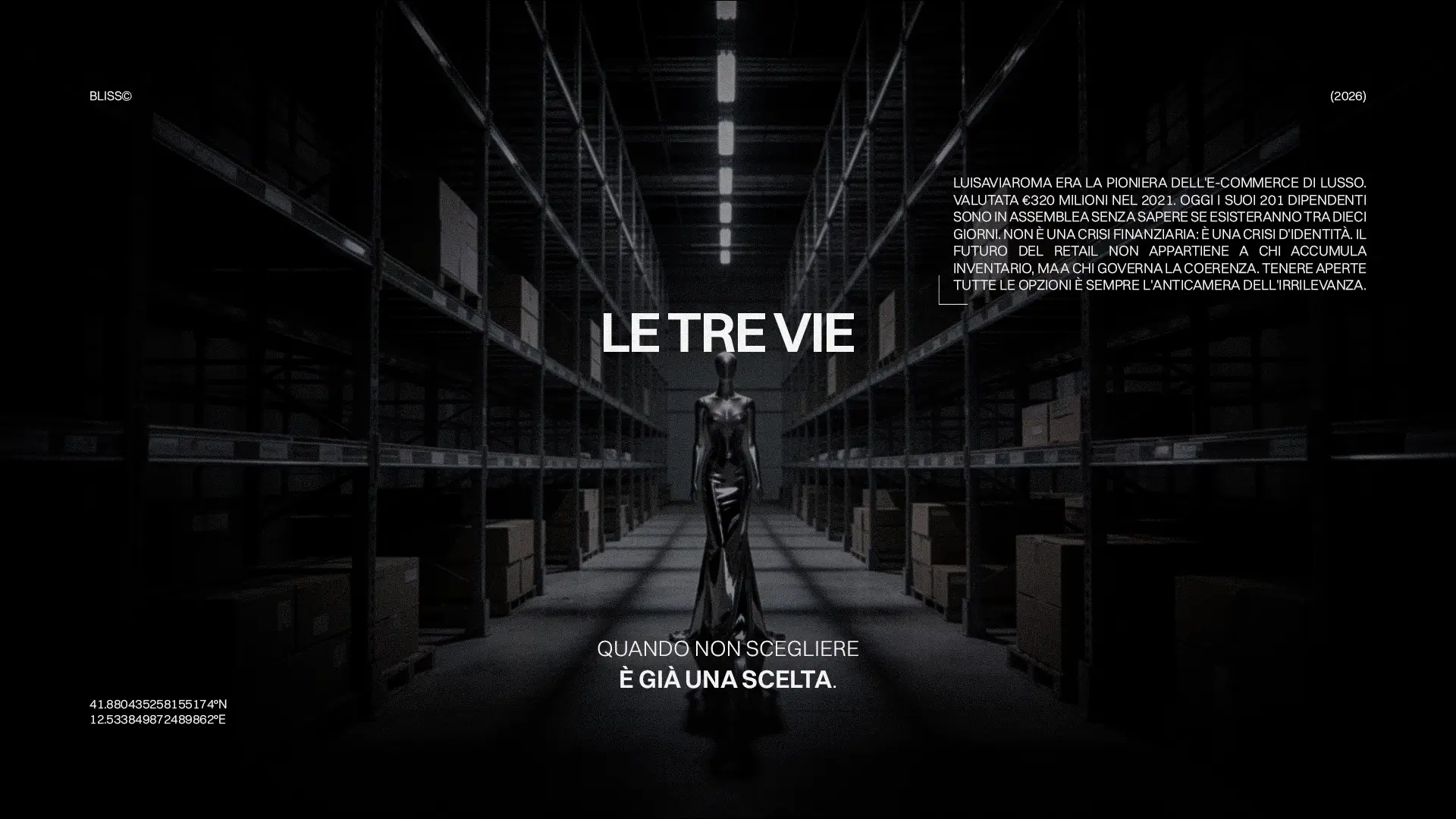
LuisaViaRoma was the first Italian company to sell luxury online.
In the 1990s, when doing so seemed madness, they did it anyway. They built a competitive advantage that seemed unbeatable.
Then, in March 2025, 201 employees gathered for a meeting in Florence. Brought together to find out what their future would be.
The story of a lost identity.
LuisaViaRoma is not just a company. It was the pioneer that, in the 1990s, taught Europe that luxury could live in the bits of e-commerce. First in Italy, among the very first in the world, to understand that selling Gucci and Balenciaga online was not madness. It was the future.
And yet that competitive advantage crumbled. €39.7 million in losses in 2023 alone. €30 million of debt. Three consecutive years of falling revenue. From €310 million in 2023 to an estimated €220 million in 2025.
And none of this comes down to a problem of scale, technology or ambition.
The real crisis was not in the numbers. It lay in a question left unanswered for too long. Why should a customer choose us, rather than a global marketplace or the brand’s own website?
A strategic error that eroded the brand’s history and prestige long before it eroded its business model.
Irreversible damage?
Or a lesson still worth learning?
In this article we analyse the LuisaViaRoma case to understand what happens when a brand loses the thread of its own identity, and how to find it again before it is too late.
The rise and decline of a brand
LuisaViaRoma was founded in 1929 as a hat boutique on Via Roma in Florence, standing out as a destination for avant-garde selection.
Specialising in high fashion, it builds its reputation on its ability to present the most interesting designers on the international scene. In 1999 it decides to go online, becoming the first company in Italy and one of the very first in Europe to open an e-commerce store.
At a time when selling Gucci and Balenciaga online seemed madness, LuisaViaRoma revolutionised the luxury e-shop market, establishing itself as a digital pioneer.
For twenty years that choice pays off. The platform becomes a global reference for more than 600 luxury brands. The LuisaViaRoma name circulates as a byword for Italian curatorship in international markets. In 2021 comes the consecration. Style Capital acquires 40% of the company for €130 million, valuing LuisaViaRoma at over €320 million. The stated goal is a Nasdaq listing, as Mytheresa had already done, listing at $2.2 billion.
The future seems written. Global scale. Physical expansion. IPO.
Yet the market changes. After opening a 1,000 sq m flagship in Manhattan and a new headquarters in Milan, the brand enters a crisis. To the point of considering the sale of its own digital infrastructure.
The heart of that competitive advantage built over twenty-six years.
The linear growth syndrome
The decline of LuisaViaRoma reveals a pattern more widespread today than ever. A recurring syndrome that strikes above all the brands that have been most successful.
When a company grows for years on the strength of a real competitive advantage, the ambition to expand often risks losing touch with that advantage. While it chases monumental physical space, the cost of acquiring digital traffic soars, eroding whatever margin remains.
Shrinking companies take on a burden designed for growing ones.
A burden too heavy to be sustainable.
Linear growth, meaning more stores, more SKUs, more markets, more channels, amounts to a very specific trap. It produces complexity. It does not produce identity.
In a market that rewards polarisation, with Mytheresa’s experiential ultra-premium on one side and Farfetch’s globalised volume on the other, whoever occupies the middle without a specific reason to exist gets crushed.
The middle is not wrong by definition. It demands an even more precise answer to the fundamental question.
Without it, every move designed for growth ends up diluting identity and weakening the brand.
The Three Ways: to choose is to live
When a brand reaches a crossroads, and every brand gets there sooner or later, there are essentially two paths open to it.
There would be a third one too, in fact. But we will come to that later.
In luxury, these choices are often mutually incompatible. Choosing one means giving up the other. And it is precisely this sacrifice that many brands cannot accept. Exclusion is frightening, and fear drives brands to keep every option open.
Keeping every option open is always the prelude to irrelevance.
So let us look at the options.
Way A, the Temple: reduce to multiply
The first path a brand like LuisaViaRoma could take rests on an uncomfortable truth.
Not every store deserves to exist.
Not because they generate losses. Because every physical presence that does not say something precise about the brand adds nothing to its value. A store that looks like all the others is not an asset. It is a cost.
The Temple principle overturns this logic. A single physical store, curated the way one curates a manifesto.
A place you leave with something you cannot find elsewhere. Exclusive through selection and narrative.
This principle extends to the website too. An editorial experience with a recognisable voice, where every product page is a declared curatorial choice. Consistent. Considered.
Only at that point, once the sanctity of the Temple has been established, is international expansion considered.
One flagship in one European capital at a time. Cultural outposts. Places that carry a precise point of view out into the world.
Paris. London. Amsterdam. Berlin.
One at a time, each one unique.
The reference model is Brunello Cucinelli. An empire built from an Umbrian village of 700 inhabitants, applying the principle that physical concentration is not a limitation. It is the source of value.
The fewer places you are in, the more each place is worth.
The rarer you are, the more you are desired.
What does this path actually require? The courage to cut. To rewrite the brand manifesto before anything else. To invest in the quality of a single presence rather than the quantity of many.
Short-term risk: high. Long-term risk: the lower of the two ways.
Way B, the Voice: exist before expanding
The second path starts from a radically different premise.
The problem is not how many stores you have, but whether you have something to say.
LuisaViaRoma had an archive of content, a history and a credibility built over twenty-six years of curatorship. Yet it never turned them into a voice.
A catalogue is very different from a point of view.
Way B reverses the order of priorities. The website comes first. First as an editorial platform, with sales following from the narrative.
An authoritative blog. Short films about the designer who never appears in the trends. The story of an origin as a founding myth.
A recognisable editorial signature even before people know what it sells.
Physical stores are reduced to one or two, but their function changes. They become sets. Places where the voice takes shape in space. Where those already won over by the digital narrative come to confirm in person what they have already chosen online.
The brand expands first through the web. The website reaches Berlin and Tokyo before a store opens there. Authority before physical scalability.
The reference models are Nude Project, which built a community before its stores, Jacquemus, which turned storytelling into its main product before having a structured distribution network, and Dover Street Market. Few stores, but an identity so strong that it has become a cultural destination.
What does it require in practice? Heavy investment in narrative in the first six months. A strong editorial figure, with a recognisable point of view and the courage to hold it over time. The stores shrink while the website grows. Physical pain and digital gain run in parallel.
Risk: medium. It requires consistent editorial execution and leadership willing to wait for results.
And then there is the third way
Leaving everything as it is is always an option.
Not the best, of course. But an option nonetheless.
Don’t expose yourself. Don’t take risks. Optimise what exists, improve communication, wait for the market to improve.
LuisaViaRoma had €400 million in revenue, a flagship in New York and a €130 million fund behind it. In March 2025, its employees gathered for a meeting because they did not know whether they would have a future in ten days’ time.
This is the mirror image of the third way.
Not choosing is always a choice. And it is often the worst one you can make.
What the LuisaViaRoma case can teach us
The LuisaViaRoma example applies to any brand that grows without answering the fundamental question about its own identity.
The future of high-end retail belongs to those who govern coherence. To those who no longer cover many markets, but manage to own their own unequivocally.
Relevance before volume.
Before expanding, investing or thinking about scalability, every brand should be able to answer three questions.
The first. Do you have an answer to the fundamental question? Not what you sell, but why buy from you. If the answer is vague or interchangeable with a competitor’s, the identity has not yet been built.
The second. Are you building on foundations or on expectations? Growth built on an expanding market is not a strategy. It is a bet. Strategy is what remains when the market stops.
The third. Do you have the courage to choose one path and rule out the others? Choosing is essential, especially when one choice excludes the other. The option of not choosing always exists. And it is the worst option. Every single time.
At Bliss we work with organisations that ask themselves these questions before circumstances force the issue. Because the difference often lies in the moment you start asking the right questions.
New Connections (FAQ)
What is linear growth syndrome, and how do you recognise it?
It is the pattern whereby a brand that has built a real competitive advantage tends to expand by accumulation, with more stores, more markets and more channels, losing touch with that advantage along the way. You recognise it when complexity grows but identity does not strengthen. When each new opening says nothing specific about the brand. When the answer to the question “why us” becomes ever vaguer.
Why is middle-ground positioning so risky in the luxury market?
Because luxury is a structurally polarised market. On one side, experiential ultra-premium; on the other, globalised volume. Those who occupy the middle without a specific reason to exist benefit from the gravitational pull of neither pole. They are crushed by both. The middle is not wrong by definition, but it demands an even more precise and defensible answer to the question of identity.
What distinguishes a brand that governs its own identity from one that is subject to it?
The answer to the fundamental question. Those who govern their own identity know exactly why a customer should choose them, and build every operational decision on that answer. Those who are at its mercy hand that answer over to the market, to competitors, to circumstances. In the short term, the difference is almost invisible. In the long term, it is everything.
BLISS®
© 2026. ALL RIGHTS RESERVED