


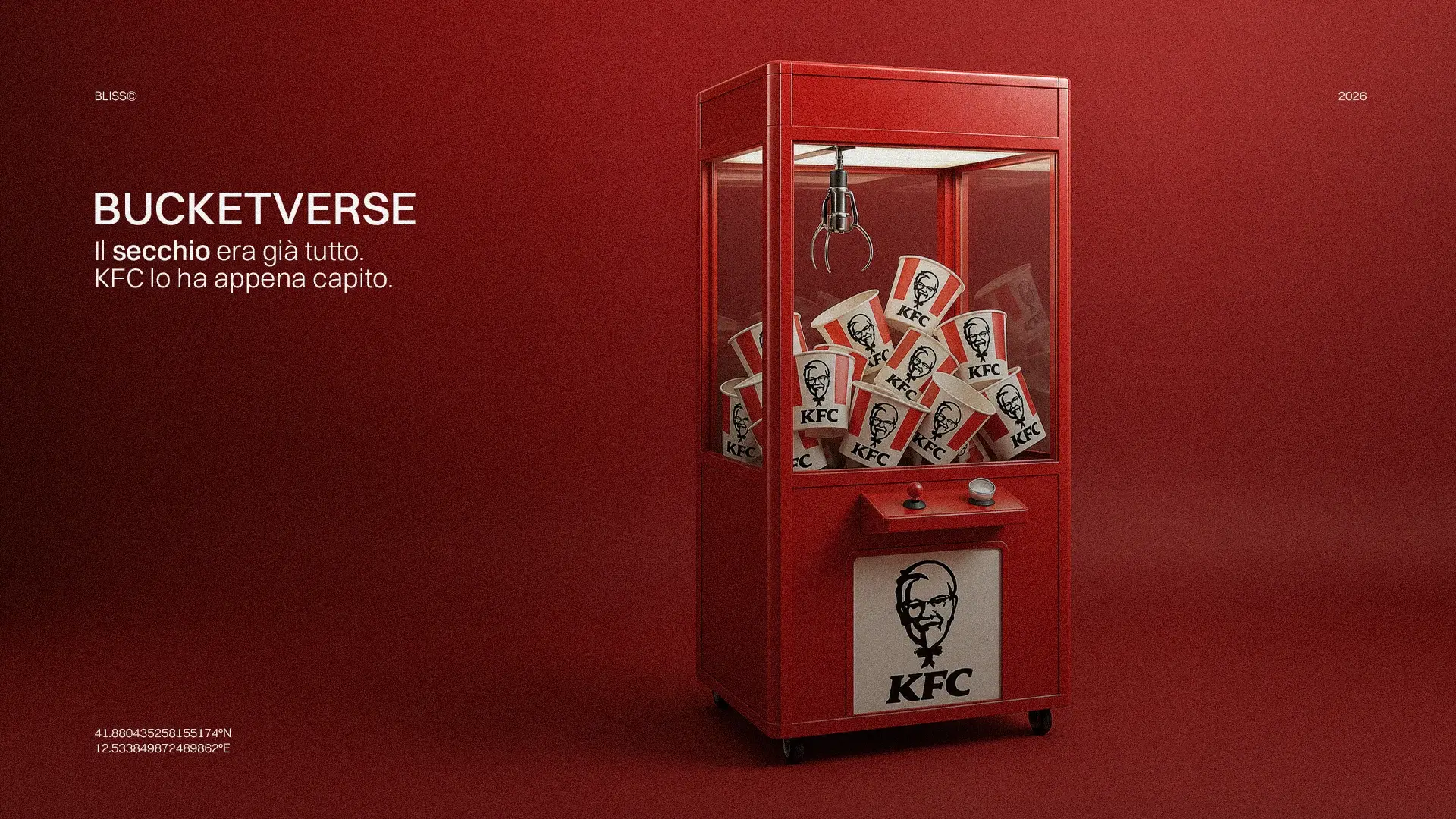
Il Bucketverse di JKR per KFC è un esempio perfetto di governance del brand: quando una realtà scopre che il proprio asset più potente era già qui, non gli resta che metterlo al centro di tutto.
Yesterday, 15 June 2026, Jones Knowles Ritchie unveiled the biggest evolution of KFC’s identity in the brand’s history.
An operation spanning logo, typography, packaging, restaurants, digital and tone of voice. All in no fewer than 150 countries.
The name chosen for this evolution is Bucketverse, and the idea is simple: build an entire world around the asset KFC has always had and never truly valued as it deserved.
Its bucket.

The bucket was always there
KFC’s bucket has existed for as long as KFC has.
It was on the counter, in customers’ hands, in the memories of three generations of people who associate it with a shared experience. In its own way, an entirely unintentional cultural icon.
The proof is that for decades the brand used it as a mere container rather than a symbol. Packaging, not a system.
But sometimes a brand has to ask itself: which asset do we own but are not making the most of?
Not every company has the courage to ask itself this question. For KFC, the answer was the bucket.
And so, JKR turned it into a three-dimensional visual structure that governs every touchpoint. The logo becomes three-dimensional. The typography (“Kentucky Fried Serif” and “Kentucky Fried Sans”) is built from the lettermark. The stripes, once merely a background texture, become an expressive asset.
Everything starts from the bucket. Everything comes back to the bucket.
Finger Lickin’ Good is no longer a slogan
One of the most interesting decisions of the entire operation is Finger Lickin’ Good, repositioned from tagline to “standard of behaviour”. In short, the principle that governs every choice the brand makes.
This distinction matters more than it seems. A tagline is a communication element: it appears in some contexts, disappears in others, and is updated every few years. A standard of behaviour, by contrast, is a governance statement: it defines the yardstick against which the brand measures every decision, every experience, every product. A difference that goes well beyond mere words.
Every brand has a phrase that could work as a standard rather than a slogan.
Most use it as a sign-off, but KFC decided to use it as a compass.

From fast food to experience: the strategic move
JKR describes this work as a category shift: from QSR (quick service restaurants) to QXR, quick experience restaurants.
It is a statement of market ambition: KFC no longer wants to compete on speed and price. It wants to compete on identity and memory.
Tosh Hall, global CCO at JKR, said:
“Every category has its leader. When you close your eyes and think about that category, you think of one, maybe two brands. When you think chicken, you should think KFC. Our job was to make sure the leader of the category was showing up like one.”
And indeed, governing category leadership is exactly this: behaving like a leader consistently, without needing to write it down anywhere.
Lessons from KFC
KFC did not invent anything astonishing.
It took a typical element of its experience and put it at the centre of its communication. Or rather, of its identity, giving it the weight it deserved. So it deepened what already existed. It took the bucket, the slogan and the experience and asked itself: is this asset working to its full potential?
The solution, and therefore the real revolution, was not to replace it but to govern it better.
An incredible lesson for everyone, because where most brands give in to the temptation to look for something new, brands that build lasting value almost always make the opposite choice. They find the asset the market already associates with them (the one already lodged in collective memory) and make it more consistent, more present.
Every brand has a bucket. Most don’t know it yet. Or they know it, but don’t govern it.

New Connections (FAQ)
But KFC is a global brand with enormous budgets. Does this logic apply to smaller brands?
The logic applies all the more to smaller brands, not less. KFC had the luxury of being able to look for new assets if its existing ones had not been strong enough. A brand with less history and fewer resources does not have that same freedom: it must find what it already owns and build a system around it. Scarce resources make governing the existing identity not a strategic option but an operational necessity. And almost always, what a brand already owns is far more valuable than it thinks.
How do you identify the asset worth putting at the centre?
With data, not internal opinions. The most common mistake is asking people inside the brand what its strongest asset is: the answer almost always reflects what the organisation is most attached to, not what the market already perceives as distinctive. The starting point is external measurement: what does the market associate with this brand when not explicitly asked? What emerges spontaneously? Often that asset is already known to everyone except those who should be governing it.
Finger Lickin’ Good as a standard of behaviour: how does it translate operationally?
It becomes the approval criterion for every brand decision. Every product, every experience, every touchpoint is assessed against that promise: does it really produce this feeling? If the answer is no, or unclear, the decision is reopened. It is a governance mechanism that needs no 200-page manual: it needs a phrase precise enough and shared enough to work as a compass. The difficulty is not finding the phrase. It is building the internal processes that ensure the phrase is actually used.