


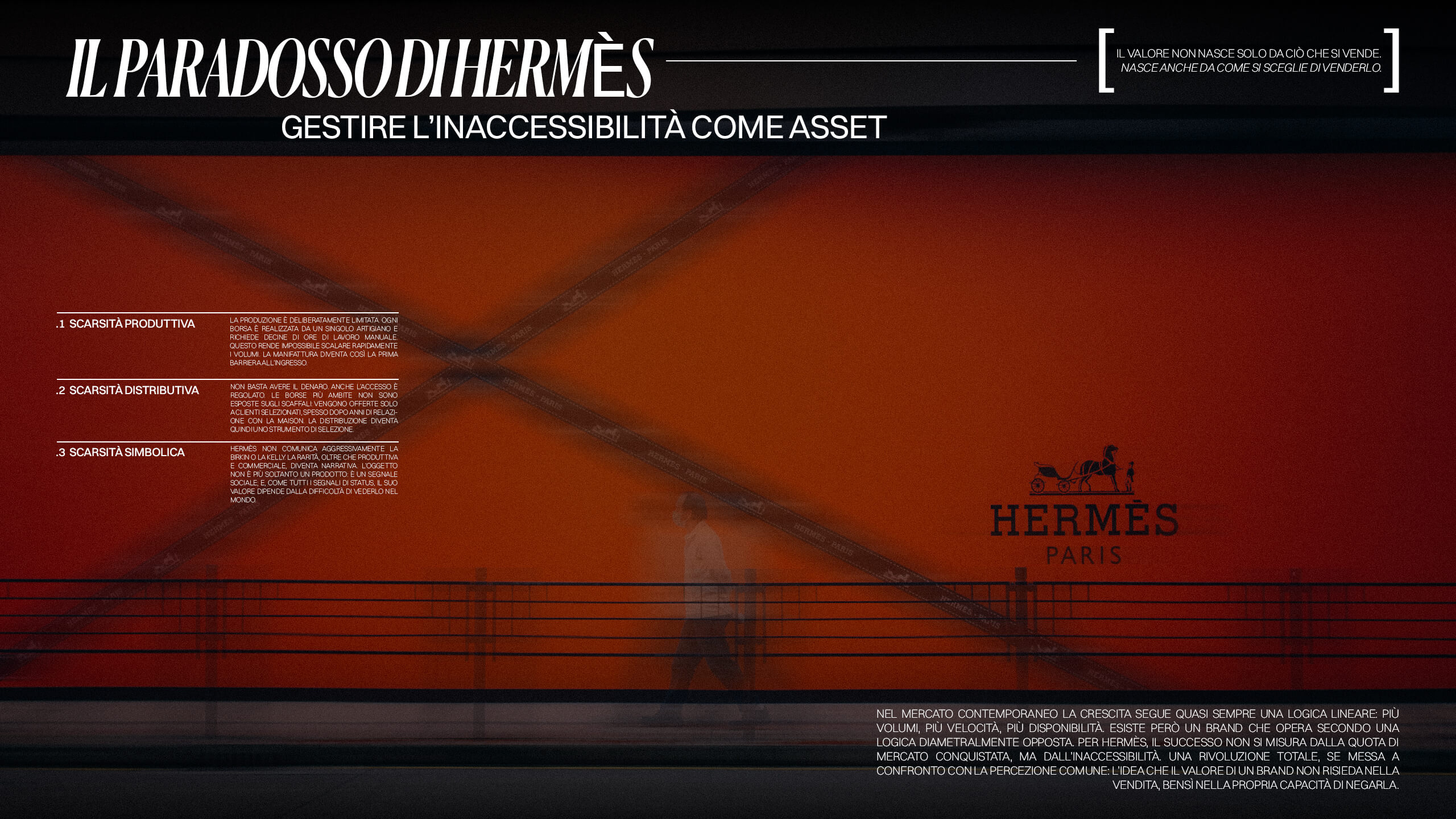
In today’s market, growth almost always follows a linear logic: more volume, more speed, more availability.
There is, however, one brand that operates by diametrically opposite logic.
For Hermès, success is measured not by market share gained, but by inaccessibility.
A total revolution, when set against common perception: the idea that a brand’s value lies not in the sale, but in its ability to refuse it.
The numbers confirm it brutally.
In 2024, Hermès reported revenue of €15.2 billion — up 15% on the previous year — and an operating margin of 40.5%. Figures most luxury brands can only imagine. And Hermès achieved them not by increasing volume, but by protecting scarcity.
Rather than relying on process efficiency and the mass-marketing of luxury, Hermès holds very different ground.
That of strategically managing scarcity.
A choice that turns the product from a mere consumer good into a genuine store of wealth.
A gamble?
Or a strategic asset?
In this article, we at Bliss set out to understand why, with a strategic analysis of Hermès’s governance across engineered scarcity, rigour of materials and market dominance.
Bliss
Speak to a
consultant
Tell us about your project. Together, we will find the right way forward.
Contact usThe engineering of friction
Many companies try to keep friction to a minimum.
Just as cars are designed in wind tunnels to be as aerodynamic as possible, websites, sales processes and shipping are now designed to make the buying experience fast, immediate and ever more impulsive.
In such an efficient landscape, Hermès has deliberately chosen to add friction.
The famous waiting list for a Birkin or a Kelly — which can exceed twelve months — is not a logistical inefficiency but a control mechanism.
Imposing time and waiting means de-commercialising the object.
The impression, then, is not of having bought a product.
You enter (in small steps, with effort) a system of validation.
Friction removes the possibility of impulse purchases.
On the contrary, it establishes a very precise power relationship:
It is not the customer who exercises the right to buy.
It is the brand that grants it.
The secondary market measures this architecture of power with precision. According to Rebag’s 2025 data, Hermès bags recorded an average appreciation of 92% on the resale market over the last decade — more than double the retail price increase over the same period. A Birkin bought ten years ago is now worth almost twice as much. Not because it has become more beautiful, but because in the meantime it has become rarer.
The governance of “no”
A traditional CEO’s job is to satisfy demand.
The job of Hermès’s leadership is to frustrate it.
Meeting every request would mean democratising the asset and, as a result, diluting its perceived value.
Limiting production and controlling distribution, by contrast, allow Hermès to protect its narrative capital.
That is, the product’s ability to hold (and often increase) its value over time.
Scarcity, in this way, is not endured.
It is designed.
This is the architecture that ensures the brand is never subject to the fluctuations of fashion, positioning it as a point of stability in a volatile market.
The data show it with almost embarrassing clarity: while LVMH and Kering recorded slowdowns and pressure on margins in 2024, Hermès closed the year with a revenue CAGR above 19% over the four years 2021–2024. Twice the growth of its direct competitors, achieved not by producing more, but by producing better — and less.
The three levels of Hermès scarcity
This strategy is not based solely on producing less.
It operates on three distinct levels of scarcity.
1. Production scarcity
Production is deliberately limited.
Each bag is made by a single artisan and requires dozens of hours of handwork. This makes it impossible to scale volumes quickly.
Craftsmanship thus becomes the first barrier to entry.
2. Distribution scarcity
Having the money is not enough.
Access is regulated too.
The most coveted bags are not displayed on shelves: they are offered only to selected clients, often after years of relationship with the maison.
Distribution thus becomes a tool for selection.
A client may buy no more than one “quota bag” a year. It is not an openly communicated policy. It is an unspoken rule that generates one of the most coveted waiting lists in the world.
3. Symbolic scarcity
The third level is the most sophisticated.
Hermès does not promote the Birkin or the Kelly aggressively.
Rarity becomes narrative as well as productive and commercial.
The object is no longer just a product: it is a social signal; and, like all status signals, its value depends on how hard it is to see in the world.
The result? It can be measured model by model: the Kelly Mini II reached 282% of its original retail price, the Sellier Birkin 183%, the Constance 137%. Eight Hermès models sold above list price in 2025 alone, while Jane Birkin’s original prototype fetched $10.1 million at auction at Sotheby’s. Once again, not only because it is beautiful, but also because it is unattainable.
The value of resistance
Hermès demonstrates a truth that many brands forget: authority comes from consistency.
The ability to stand firm while the market clamours for change is a form of leadership: one to preserve not only in the face of market fluctuations, but internally as well.
This is not about being conservative: it is about demonstrating non-negotiable principles.
When value depends on trends, you are replaceable.
But if value lies in identity, then you are the point of reference, and that cannot change.
It is worth pausing on a figure rarely cited in this context: over the last decade, the resale value of Hermès bags has historically outperformed gold. This is not marketing hyperbole: it is an actual market measurement. At a time when most luxury assets lose value the moment they leave the shop, Hermès has built a product that behaves like a financial asset.
And it has done so without ever yielding to the temptation to grow faster than its identity could afford.
What your company can learn from the Hermès paradox
Hermès is a perfect example of governance applied to a prestige brand, and it raises three strategic questions for any organisation seeking to position itself in the luxury market (and beyond).
1. Are you governing demand or are you its slave?
2. Is your product an object of desire or of availability?
3. Are you selling a product or validating a counterpart?
Giving in to every market demand is the fastest way to dilute a brand: if anyone can have you at any time, you have probably surrendered your authority.
From this perspective, then, a brand’s strength is also seen in whom it chooses not to serve.
Because ultimately, as Hermès teaches us, value comes not only from what you sell.
It also comes from how you choose to sell it.
Frequently Asked Questions
Why is the brand worth more even though Hermès never discounts?
Price is not just a number. Think of it instead as a signal. Lowering it communicates that the value was inflated. Hermès understood that defending price means defending positioning. A discount solves a sales problem today but creates a brand problem tomorrow.
What is controlled scarcity and how does it work?
Controlled scarcity is the deliberate management of availability to keep demand high. It is not about producing little out of complacency, but about producing exactly as much as is needed to avoid saturating the market. The waiting list is therefore a brand tool.
Can an SME use the Hermès strategy, or is it only for luxury?
It can, with due proportion. The principle is universal: creating barriers to entry based on expertise, selection or exclusivity qualifies the audience and strengthens positioning. You do not need to be Hermès to stop chasing others.
Why do luxury brands not communicate price?
Because price communicates accessibility. Those who need to ask what it costs are usually not the target. Keeping price out of the main communication shifts attention to value and identity: the two variables that build preference over the long term.