


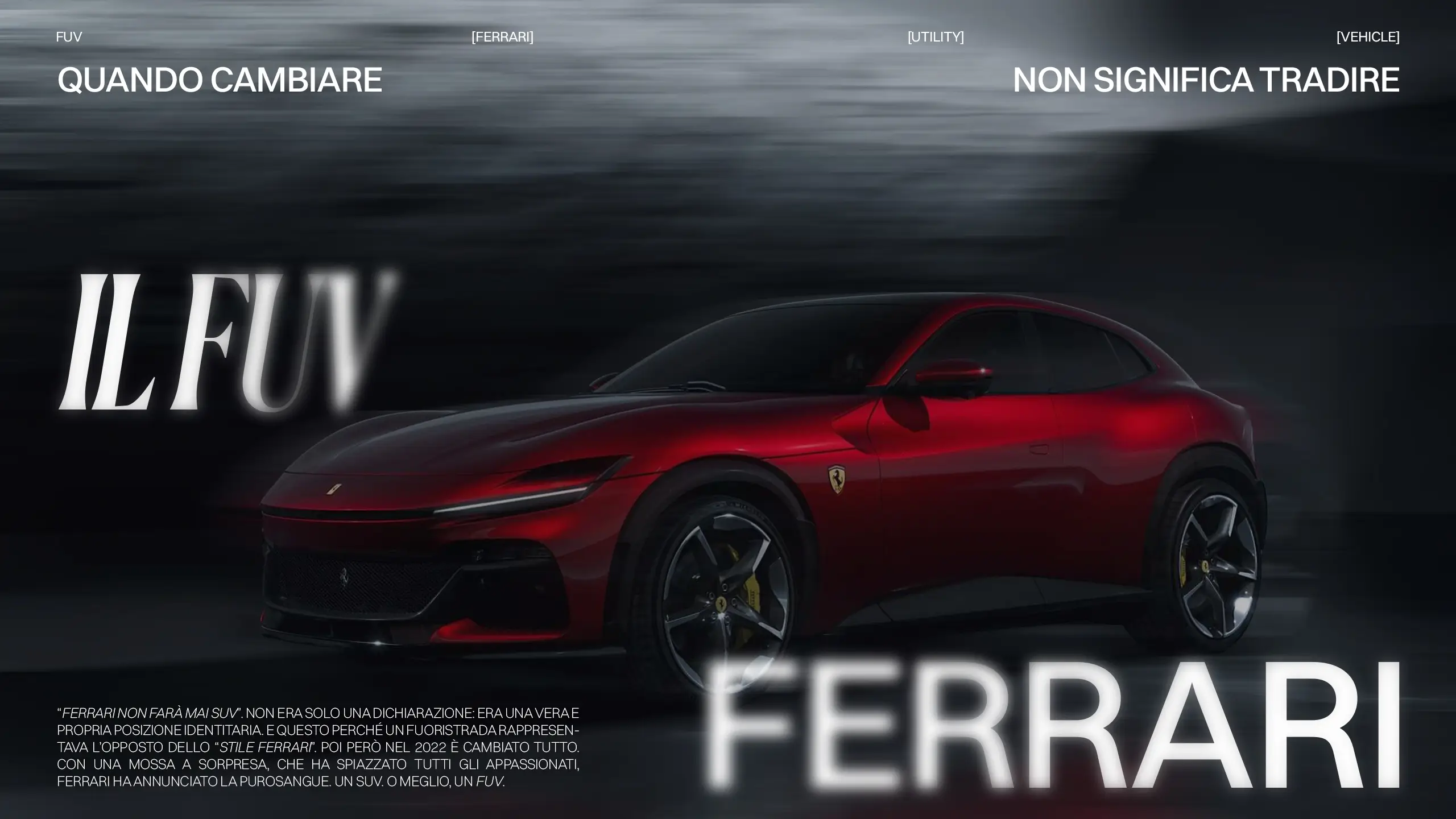
When we think of Ferrari, we all picture the same things.
Speed. Low lines. Track-ready stance.
Ferrari is, after all, the sports car par excellence.
So much so that, for decades, the Maranello company was always categorical:
“Ferrari will never make an SUV”.
It was not just a statement: it was a genuine stance on identity.
That is because an off-roader represented the very opposite of “Ferrari Style”.
Then, in 2022, everything changed.
In a surprise move that wrong-footed enthusiasts everywhere, Ferrari announced the Purosangue.
An SUV. Or rather, an FUV.
Betrayal?
Or was it, perhaps, a strategic evolution?
In this article we will try to understand it, examining the «Purosangue» case in all its complexity: principles, adaptation and prestige.
Bliss
Speak to a
consultant
Tell us about your project. Together, we will find the right way forward.
Contact usMarkets change. Principles do not.
Over the past ten years, the SUV segment has become dominant even in the luxury market.
Porsche, Lamborghini, Bentley. All of them had adapted to demand.
Not Ferrari. It had held out.
The reason was not market interest or market capitalisation.
Quite simply, a brand like Ferrari cannot afford to react by imitation.
An asset built on consistency cannot chase: it must lead the way.
And when it cannot, it must reinterpret through a proprietary language.
It is no coincidence that Maranello rejected the “SUV” label, coining the term FUV (Ferrari Utility Vehicle).
Not just marketing: the creation of an internal vocabulary that moves the product out of the mainstream market and into a category of its own.
Principles vs Format
Many brands struggle to grasp the distinction between these two things, and in doing so they lose themselves.
They defend the format, believing they are defending their identity.
They sell out their principles chasing trends.
When we talk about format, we mean the external configuration. A principle, by contrast, defines the internal identity.
In other words: format is surface, principle is identity.
Ferrari understood this well and, even at the risk of appearing hypocritical, was able to distinguish between principles and format.
How?
Recognising that the SUV is a format. Whereas sportiness is a principle.
A minimal distinction that makes all the difference in the world.
To stay consistent (with its own identity as much as with enthusiasts’ expectations), Ferrari chose not to change what it is. Only the way it presented itself.
The Purosangue was not designed as a conventional SUV. It is not a family car, nor a “comfortable” runabout.
At its core, in its principles, it remains a Ferrari.
With a different stance, granted – but a Ferrari nonetheless.
Every brand that wants to last must know where it can evolve and what must remain intact.
Without this distinction, every innovation becomes a risk to identity.
Ferrari did not follow the trend: it waited until it could enter the segment on its own terms, and only then imposed its own standard.
Ferrari Prestige, always
A prestige brand is recognised by its ability to say no even when the market is shouting “yes”.
The real strength of the Purosangue, then, also lies here: in its Governance.
Knowing full well it was stepping onto slippery ground, Ferrari imposed a strict limit.
Purosangue production could never exceed 20% of total annual deliveries.
The risk was losing its essence, but while competitors saturated the market by turning into “SUV makers”, Ferrari chose to use the new format to reinforce the brand’s rarity, not to sell it off.
As always throughout its history, with the Purosangue too Ferrari made volume control a strategic decision. Designed to protect identity, prestige and structure over the long term.
What a company can learn from the Ferrari case
Not everyone is Ferrari, but every brand faces the same dilemma: adapt, or stay true to itself?
The answer lies in understanding what must not change.
At Bliss, we help companies map these boundaries: identifying what must stay fixed so that everything else can evolve. If you have not defined your principles, every innovation becomes a risk. If you have defined them, every evolution becomes a strategic choice that generates financial value.
Before entering a new market, ask yourself these questions:
- Are you defending a principle or merely a habit?
- Is your Governance strong enough to limit immediate profit in favour of longevity?
- Would your brand still be recognisable if it changed format?
Ferrari shows that you can change configuration without losing identity.
Real strength is not promising “never”.
It is having enough structure to be able to say “now”.