


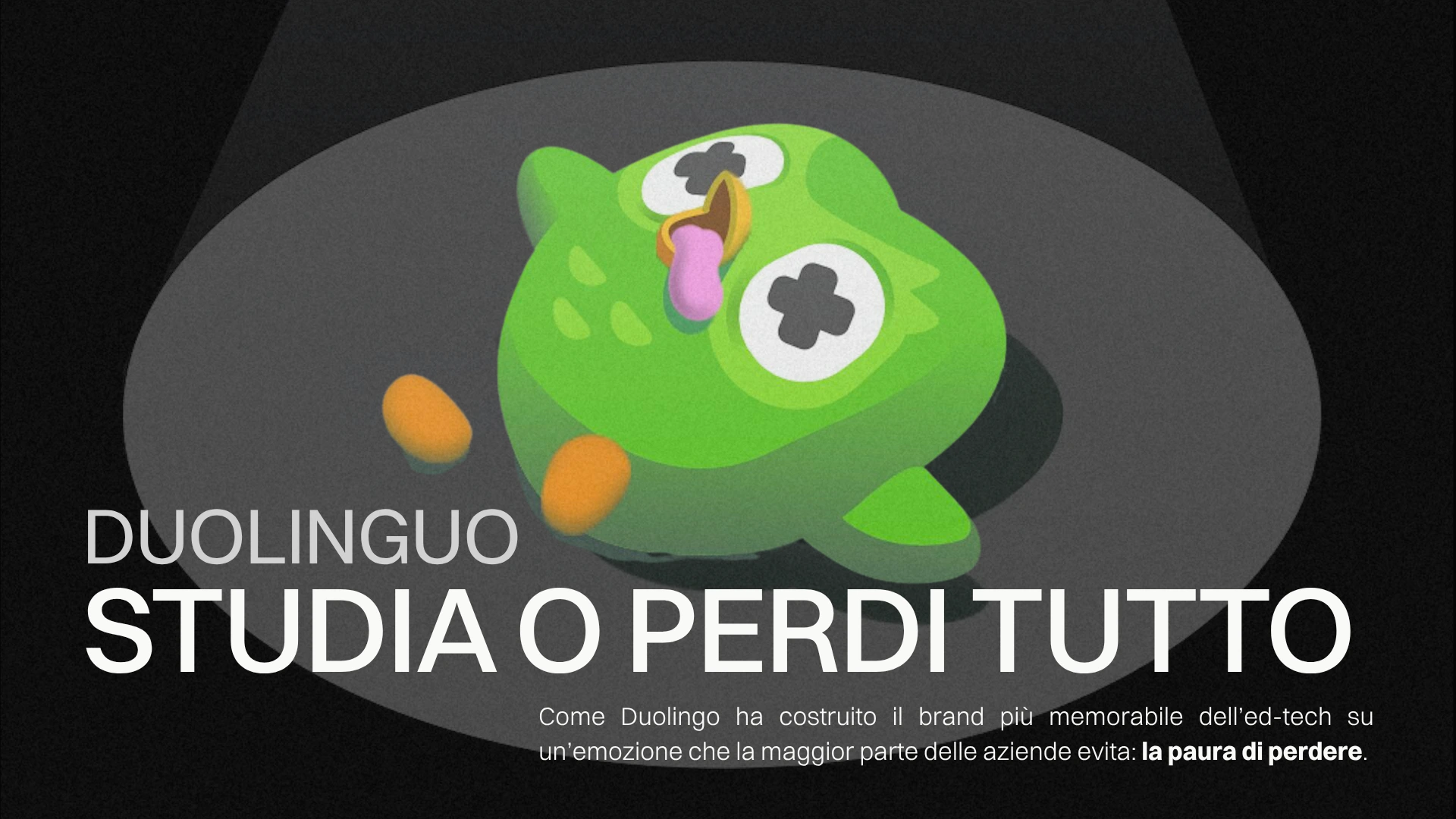
Come Duolingo ha costruito il brand più memorabile dell’ed-tech su un’emozione che la maggior parte delle aziende evita: la paura di perdere.
You reach a 599-day streak on Duolingo.
Here comes day 600. You’re certainly not going to let it slip. Come what may, you’ll open the app: to study Spanish once again?
Of course not: purely to protect those 600 days of accumulated effort. By now, learning has become secondary to preserving what you’ve already built.
Opening the Duolingo app every day appears to be a rational choice, but in reality, because of how it is structured, it follows the emotional, irrational logic of avoiding a loss. And so, Duolingo did not build the most memorable brand in ed-tech on humour. It built it on loss aversion.
Its owl is simply the face of that mechanism.

The fear of losing everything
In 1979, Daniel Kahneman and Amos Tversky documented how losses appear to weigh psychologically about twice as much as equivalent gains. Losing 100 euros produces twice as much displeasure as the satisfaction of gaining 100. The brain is asymmetric in how it assesses risk, and that asymmetry shapes a disproportionate number of everyday decisions.
Almost every consumer app is designed around gains: rewards, points, progress. They all give you something to keep you hooked. Duolingo, by contrast, has built its system around the other side of the same coin. The streak is not a reward. Rather, it is an asset you risk losing every day you don’t open the app.
The result is easy to measure. Duolingo has more than 100 million monthly active users in a market crowded with dozens of functionally identical competitors (some perhaps even better from an educational standpoint). The technical difference between Duolingo and Babbel, Rosetta Stone or any other alternative is marginal. The behavioural difference is enormous. And that behavioural difference is produced entirely by how the brand manages its relationship with the user over time.
The owl as the avatar of loss
Duo is the face of all this. His role is partly marketing (the little owl is a hit on social media and is always the face of tongue-in-cheek campaigns), but above all it is to personify the threat.
Research on humour processing has found that the brain processes controlled violations of expectations with greater attention and stores them for longer. Duo works on exactly this principle. The setup is the category: an educational app. The expectation is that category’s tone: encouragement, support, positivity. The violation is an owl writing to tell you “we’re disappointed”.
With his in-app messages, Duo threatens without frightening. He accuses without offending. He exaggerates enough to be funny, never enough to break trust. That calibration is the result of a precise governance system that defines how far the tone can go without becoming a problem.

The governance that holds it all together
What you don’t see in the Duolingo case, yet is the condition without which nothing would have worked, is the structure that governs the tone.
A brand that owns loss aversion through a menacing character is on very treacherous ground. Lean too far towards real threat and the user drops off. Lean too far towards likeability and the mechanism loses its force. The calibration must be held precisely across every channel, every notification, every post.
Duolingo’s priority was to build this system in order to stand apart from its competitors. The visible result is Duo watching you. The invisible result is all the governance work that defines how far that gaze can go before users stop laughing at it.
Without that structure, Duolingo would be the same as everyone else. With that structure, it has become a case study.
The lesson
Consciously or not, every brand owns an emotion. Most choose comfortable emotions: trust, belonging, aspiration.
Duolingo chose the most uncomfortable one: the fear of losing what you have already built.
It worked because that choice was consistent with the product, the audience and the operating rules that govern every expression of the brand. And consistency between the emotion the brand owns and the way it is managed is what turns a risky choice into an advantage.
Duo doesn’t threaten you. He simply reminds you that either you study or you lose everything. And in the consumer’s mind, losing everything is far more frightening than the thought of having to sit down and study.
New Connections (FAQ)
Why is the thought of losing something stronger than the thought of gaining?
Because the brain is asymmetric in how it assesses risk: a loss equivalent to a gain is felt as roughly twice as strong in emotional impact. Reward-based systems produce habit and then indifference: the user stops experiencing the reward as anything special. Loss-prevention systems sustain tension over time, because what is at risk of being lost is always present. Duolingo’s streak exploits exactly this: with every day that passes without opening the app, the perceived cost rises rather than falls.
Can I use Duolingo’s strategy for my brand?
Any brand can use it, but it requires the mechanism to be consistent with the product and the identity. Duolingo works because the streak is a real asset the user has built over time: the loss has a concrete object. In categories where no accumulable asset exists, building one artificially is the first step. Amazon with Prime, loyalty schemes with expiring points, subscriptions with exclusive content: all are applications of the same principle with different objects.
How do I manage the tone of my brand’s communication?
With three levels of operating rules. The first defines the boundaries of tone: how far it can go and what always remains off-limits. The second defines exceptions by context: the same tone does not work in a marketing notification, in a reply to a user in difficulty, or in an institutional communication. The third defines the approval process for borderline cases. Duolingo has all three. Most brands that attempt a similar tone without this system produce a couple of viral posts and then a reputational incident.